


Carrying gear on the trail should feel balanced and secure rather than agonizing on your shoulders. Many hikers deal with aching collarbones, rubbing hip points, and shifting gear simply because their pack does not match their body dimensions. Learning how to get fitted for a hiking backpack transforms the entire trail experience by shifting cargo weight onto your skeletal structure rather than straining your neck muscles. Whether you choose a lightweight frameless daypack or explore a supportive frame hiking backpack guide, dialing in your torso length and harness contact points remains the foundational starting step.
A correct fit relies on accurate torso sizing and understanding how each strap alters load transfer. Many outdoor enthusiasts assume user height determines pack sizing, but your spine length and pelvic crest alignment are the real measurements that dictate strap geometry. When you understand how hip belts, shoulder straps, and stabilizer components work together, dialing in a pack becomes straightforward. The following guide explains every measurement, adjustment sequence, and trail-testing step needed to achieve balanced carry comfort.

Pros
- Folds quickly into an ultra-compact pouch for easy packing inside luggage or a larger expedition backpack
- Weighs only 0.8 pounds, significantly reducing pack burden for ultralight day trips and travel-based hiking
- Dedicated wet compartment keeps damp clothes, towels, or rain shells isolated from dry interior contents
- Includes thoughtful trail safety and travel security features like an integrated sternum whistle and interlocking zipper pull clips
Cons
- Frameless design lacks internal stays or rigid structure, making it unsuited for carrying dense or heavy loads
- Shoulder straps provide minimal padding and lack load lifters or a supportive load-bearing hip belt
- IPX4 rating protects against light splashes and drizzle, but cannot withstand prolonged downpours without separate waterproof protection
The MIYCOO 35L Ultralight Packable Backpack is a collapsible daypack designed primarily for travelers who hike, casual day hikers, and campers who need a secondary day bag. Operating as a frameless, lightweight carrier, it excels when stowed inside a larger multi-day backpack or carry-on suitcase until needed at your destination. With an unpacked size of 12.5 x 8.5 x 20.9 inches and a stowed footprint of just 4.5 x 3.9 x 7.8 inches, this pack addresses the needs of outdoor recreationists who want supplemental pack capacity without the bulk and weight of traditional internal-frame daypacks.
On the trail, the pack provides 35 liters of storage volume, which accommodates bulky yet lightweight items like fleece jackets, light windbreakers, hats, lunch containers, and trail snacks. Because the backpack weighs only 0.8 pounds, it adds almost no base weight to your outing. However, buyers should remember that it is a purely frameless packable bag. Without an internal frame sheet, aluminum stays, or a padded load-bearing hip belt, the pack relies entirely on the user's packing technique for back support. Keeping soft items against the back panel is essential to avoid uncomfortable pressure points from hard gear.
In terms of construction, the pack uses water-resistant fabric rated at IPX4, meaning it is built to resist splashes and light rain during day outings or workouts. The manufacturer specifies upgraded heavy-duty zippers and reinforced stitching across major stress points, which helps the seams withstand regular loading. For security in transit or at busy trailheads, the main compartment features zipper clips that can secure two pulls together. The shoulder strap also incorporates an integrated safety whistle, giving day hikers a convenient, built-in signaling device without requiring extra hardware.
Organization is practical and user-friendly, centered around three distinct compartments. A standout feature is the dedicated wet compartment, which provides a designated space to segregate damp rain gear, sweaty apparel, or muddy accessories from clean, dry layers. Packing and unpacking the bag is straightforward, and when your excursion is finished, the entire pack folds back into its own pocket. Maintenance is equally simple: the fabric can be wiped clean with a damp cloth and hung up to air-dry before being packed away for long-term storage.
Realistic limitations must be acknowledged before taking this pack into rough backcountry terrain. The IPX4 water-resistance rating does not mean the backpack is fully waterproof or submersible, so sensitive electronics and critical insulation still require dry bags or waterproof liners during steady rain. Additionally, the thin, packable shoulder straps lack the thick padding and load-lifter support required for comfortable heavy-load carrying. Attempting to haul dense camera equipment, multiple full water bladders, or heavy survival gear will likely lead to shoulder fatigue due to the absence of a rigid suspension system.
The MIYCOO 35L Packable Backpack is a practical, value-driven choice for budget-conscious hikers, vacationers, and commuters who need an emergency summit pack or a lightweight travel daypack. If your hiking style involves carrying lightweight layers, snacks, and modest gear volumes on established paths, this foldable daypack provides useful organization, splash defense, and minimal weight in a highly portable design.
The MIYCOO Daypack provides a 35-liter capacity, measured at 12.5 x 8.5 x 20.9 inches when fully opened. This interior volume is divided into three separate compartments, allowing hikers to organize food, insulation layers, and trail accessories systematically rather than dumping everything into one open cavern.
The inclusion of an internal wet compartment is especially useful for trail outings where you encounter damp weather or river crossings. Storing a damp jacket or wet towel in this separated pocket prevents moisture from transferring into the main storage area where dry clothes are kept. For best results on the trail, pack softer items against the rear panel to form a makeshift back cushion, keeping heavier items centered and close to your body.
This backpack is constructed with water-resistant fabric carrying an official IPX4 rating. According to product specifications, this level of protection shields pack contents against splashes of water, making the daypack suitable for humid morning hikes, outdoor workouts, and light drizzle.
While the fabric resists surface moisture, the pack is not completely submersible, and prolonged downpours can eventually compromise zippers or unsealed seams. For serious rain exposure or creek crossings, hikers should wrap sensitive items, like electronics or dry layers, in dedicated waterproof dry sacks. Upgraded heavy-duty zippers and reinforced stitching at major stress points help ensure the pack maintains its structural integrity during everyday trail and travel use.

Pros
- Tensioned mesh AirSpeed backpanel keeps the pack body off your back for noticeable ventilation
- Includes a tailored raincover stowed in a dedicated base pocket for quick weather protection
- Spacious 32-liter volume easily accommodates extra clothing, food, and daily hiking essentials
- Dual zippered hipbelt pockets provide convenient storage while walking on trail
Cons
- Fixed BioStretch harness does not provide an adjustable torso-length mechanism
- Hydration reservoir is not included and must be purchased separately
- At 24.4 inches tall, it may feel long on shorter torsos or exceed strict airline personal-item limits
The Osprey Hikelite 32 is a streamlined, lightweight daypack designed for hikers, travelers, and outdoor enthusiasts who need extra volume without dragging along excessive base pack weight. At roughly 2.3 pounds, it fits squarely into the lightweight daypack category while providing enough interior capacity for long days requiring warm clothing, emergency supplies, and extra food.
Load management centers around Osprey's AirSpeed suspension system, which uses a tensioned mesh backpanel to suspend the pack body away from your back. This design encourages continuous airflow across your spine, which helps manage heat buildup on warm-weather hikes or strenuous ascents. The pack also incorporates a fixed BioStretch harness with flexible elastic binding, an adjustable sternum strap featuring a safety whistle, and a padded hipbelt to help steady the load across uneven terrain.
Organization is straightforward with a clean bucket-style main compartment, a front stretch mesh shove-it pocket for shed layers, and tall side stretch pockets tailored for secure water bottle carry. For hydration-bladder users, the pack includes an internal reservoir sleeve, dedicated hose routing port, and an Osprey Hydraclip to hold a compatible bladder upright. Two zippered hipbelt pockets provide convenient storage for small items like trail snacks or lip balm.
To counter unpredictable mountain conditions, Osprey includes a dedicated raincover crafted from bluesign APPROVED fabric with a PFAS-free DWR treatment, housed in a zippered pocket at the base of the pack. External compression straps help cinch down partial loads to keep weight close to your center of gravity, while dual trekking-pole loops allow secure attachment of hiking poles when scrambling or navigating paved approach roads.
While the M/L sizing offers a fixed BioStretch harness, it lacks micro-adjustable torso length mechanisms, meaning buyers should confirm their torso sizing aligns with Osprey's Medium/Large standard prior to purchasing. Additionally, while the pack features dedicated hydration routing and the Hydraclip, a reservoir is not bundled with the pack. The 24.4-inch height provides generous vertical space, but it may feel elongated for shorter torsos or tight on personal-item airline size boxes.
For hikers seeking a dependable, ventilated daypack that bridges the gap between minimalist daypacks and overnight packs, the Osprey Hikelite 32 offers solid utility. Its combination of an AirSpeed suspended backpanel, dedicated raincover, hipbelt pockets, and trekking pole loops makes it a well-rounded companion for demanding day hikes, shoulder-season trail outings, and gear-intensive adventures.
The Osprey Hikelite 32 utilizes the brand's AirSpeed suspension system, designed with a tensioned mesh backpanel that maintains an open space between your back and the pack body. This suspended mesh construction allows air to circulate freely, which helps dissipate heat during warm outings or steep ascents.
By lifting the bulk of the pack away from direct contact with your shirt, the AirSpeed system helps reduce moisture buildup without sacrificing stability. Combined with the fixed BioStretch harness, the suspension keeps the load balanced and secure across shifting terrain.
The Hikelite 32 comes standard with a removable raincover stored in a dedicated zippered pocket at the base of the pack. When rainfall begins, the cover pulls out quickly to wrap over the entire exterior, offering an added barrier against wet weather.
Constructed with bluesign APPROVED materials and treated with a durable water repellent (DWR) made without PFAS, the raincover provides external moisture resistance without adding bulk to the primary storage compartments.
Pros
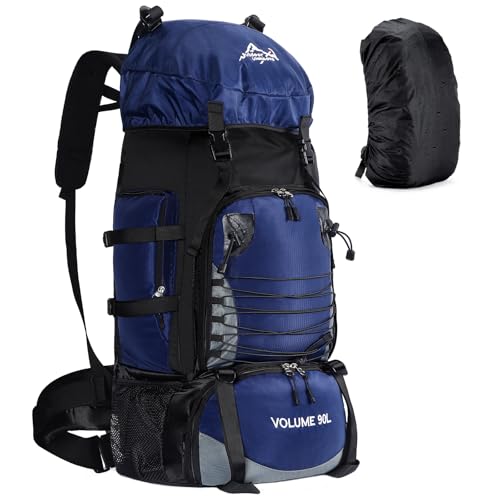
- Massive 90-liter gear volume accommodates oversized camping equipment without adding heavy base pack weight.
- Separate bottom compartment allows dirty footwear or camp shoes to be isolated from clean clothing.
- Included rain cover delivers prompt exterior weather protection during sudden trail downpours.
- Eight exterior compression and tie-down straps allow easy lashing of bulky outdoor gear.
- Three-way harness adjustment system helps stabilize high-volume loads across the torso.
Cons
- Frameless design lacks rigid internal stays to efficiently transfer heavy loads directly to the hips.
- Carrying close to the 45-pound manufacturer maximum can cause shoulder fatigue without a rigid suspension system.
- Does not include a dedicated internal hydration reservoir sleeve or designated hose routing port.
The Unineovo 90L Hiking Backpack is a high-capacity, lightweight frameless pack engineered for campers, travelers, and outdoor enthusiasts who prioritize maximum pack volume at minimal empty weight. Clocking in at around 2.4 to 2.6 pounds, it provides an enormous 90-liter interior capacity without the structural heft of traditional multi-day expedition packs. This design best suits budget-conscious backpackers, weekend campers, and road-trippers who need to transport high-bulk, moderate-weight supplies like sleeping bags, camp clothing, and group gear.
On trail and around the campsite, load management relies entirely on user packing technique due to the absence of an internal frame. While the manufacturer rates the maximum load-bearing limit at 45 pounds, carrying dense weight without internal aluminum stays means structural support comes from how gear is arranged inside the pack. Placing soft layers against the back panel and heavier items centered close to your spine yields the most stable carry. The harness system incorporates padded shoulder straps, an adjustable waist belt, and an up-and-down sliding sternum strap that helps keep the pack from swaying during active movement.
Organization is a significant strength of this pack, featuring eight functional compartments that simplify gear sorting. The primary storage consists of a top-loading drawstring main compartment, complemented by a top lid pocket for fast-grab items like headlamps and snacks. A distinct bottom compartment accommodates camp shoes or damp gear, keeping them isolated from dry clothing. In addition to standard front zip storage, the exterior includes two mesh side bottle pockets and two zippered side pouches, supported by eight adjustable tie-down straps capable of securing tents, sleeping mats, or trekking poles externally.
In terms of build and weather management, the backpack uses a rip-resistant polyester shell with reinforced stitching applied to the primary load-bearing strap interfaces. While the fabric itself offers general water resistance against brief moisture, the pack includes a fitted rain cover stored ready for deployment. Slipping the rain cover over the pack provides comprehensive defense against sustained downpours, trail splashback, and fine dust, protecting the non-sealed zippers and seam lines from water penetration.
Prospective buyers must recognize the operational limitations inherent to an ultralight 90L frameless design. Without a rigid framesheet or perimeter stays, high-density loads pushing toward the 45-pound ceiling will inevitably pull backward and place greater leverage on the shoulders rather than transferring weight smoothly down onto the hip belt. Furthermore, trail hikers who prefer built-in hydration bladders will need to rely on the external side bottle pockets, as no specific internal reservoir hanger or port is specified.
For outdoor enthusiasts seeking expansive gear capacity on a strict budget, the Unineovo 90L Backpack offers strong utility for lighter, bulkier gear loads. It works exceptionally well for car camping setups, scouting trips, basecamp transport, and travel touring where generous packing space is mandatory but heavy, technical mountain loads are not part of the itinerary.
With a volume rating of 90 liters and dimensions measuring approximately 29.5 by 13.4 by 9 inches, the Unineovo backpack provides tremendous interior space for multi-day trips and bulky camping gear. The main compartment uses a wide drawstring opening that accommodates puffy jackets, rolled sleeping bags, and camp cookware without requiring extreme compression.
Eight separate compartments streamline camp organization so you do not have to dig through 90 liters of gear to locate small essentials. A separate bottom zipper pocket allows you to keep dirty camp boots or water shoes isolated from clean camp apparel, while dual side water bottle holders and dual zippered side pockets provide fast access to hydration and smaller electronics on the move.
The Unineovo 90L Backpack utilizes a completely frameless structure, eliminating internal metal stays or hard plastic framesheets to achieve an exceptionally low base weight of around 2.6 pounds. While this keeps the pack agile when empty, users should note that the pack depends on thoughtful gear packing to maintain rigidity along the back panel.
The suspension features three key adjustment points, including contoured shoulder straps, a padded waist belt, and a vertically adjustable sternum strap designed to evenly distribute upper-body pressure. To carry comfortably near the manufacturer-rated 45-pound limit, hikers should pack denser items close to the spine and leverage the eight external compression straps to cinch the load tight against the torso.
The pack is constructed from a wear-resistant polyester fabric that provides natural resistance to abrasions and light surface moisture. However, because multi-compartment packs feature multiple exposed zipper tracks and stitched seams, relying solely on pack fabric in wet environments is not recommended.
To solve weather challenges on the trail, the backpack comes equipped with a dedicated external rain cover. Deploying the rain cover encloses the exterior pack shell, protecting your packed clothing, sleep systems, and trail gear from prolonged rainfall, blowing grit, and muddy campsite terrain.

Pros
- Includes a dedicated rain cover stored neatly in a zippered bottom compartment
- Multiple zippered exterior compartments allow quick organization for small trail essentials
- Lightweight 1.46-pound profile with compact 5.9 x 11 x 18.5-inch exterior dimensions
- Equipped with functional trail features like trekking pole fasteners, a hydration hose port, and a sternum whistle buckle
Cons
- A 20-liter capacity is strictly built for day trips and cannot accommodate bulky overnight backpacking loads
- Does not include a padded load-bearing hip belt for heavy gear stabilization
- Hydration reservoir is not included and must be purchased separately
The N NEVO RHINO 20L Hiking Backpack is an agile, low-profile daypack designed specifically for day hikers, travelers, and outdoor recreationists who want organized gear storage in a compact footprint. Sized at 5.9 x 11 x 18.5 inches with a total volume of 20 liters, this pack caters to trail users who carry core essentials such as extra layers, trail food, basic navigation gear, and water without the bulk of a multi-day internal-frame pack. Its carry-on compliant profile also makes it an appealing choice for travelers wanting a single bag that transitions from transit to the trailhead.
Carrying comfort on the trail relies on the lightweight 1.46-pound empty weight paired with ventilated mesh padding across the shoulder straps and back panel. This airflow-oriented contact surface helps minimize heat accumulation against your back during warm-weather climbs. While a 20-liter capacity does not support sleeping bags or bulky multi-day camping gear, it offers ample volume for day-long outings, summit pushes, or urban commutes where modest cargo capacity is desired.
Constructed with 210D tear-resistant and water-resistant fabrics, the exterior shell is reinforced with bar tacking at high-stress points to prevent premature tearing at strap connections. The pack features smooth zippers across its four distinct exterior zippered pockets, separating smaller personal items from the main compartment. For severe trail downpours, a dedicated rain cover is tucked away in the bottom zippered pouch, providing external weather coverage that supplements the water-resistant shell fabric.
Setting up your gear is straightforward thanks to an internal hook-and-loop hanger strap in the main compartment to suspend a hydration bladder, paired with a dedicated hose exit port on the upper seam. On the outside, elastic trekking pole attachments keep walking poles secured when navigating flat terrain or scrambles. The sternum strap secures the shoulder harness across your chest and incorporates an integrated emergency whistle for added safety, while reflective exterior markings enhance visibility in low-light conditions.
While versatile for day use, this daypack has specific structural limitations. The lack of an internal frame sheet and padded load-transfer hip belt means the carried weight rests entirely on your shoulders, making it ill-suited for dense, overly heavy loads. Additionally, a water bladder is not supplied with the pack, so hikers using hydration systems will need to provide their own compatible reservoir and ensure proper hose routing before hitting the trail.
For day hikers, casual campers, and travel enthusiasts looking for an organized, budget-conscious daypack that includes a rain cover and trekking pole holders out of the box, the N NEVO RHINO 20L offers dependable utility. Backed by a one-year replacement warranty for quality issues, it delivers practical organization and lightweight trail carry for anyone keeping their base load light.
The N NEVO RHINO 20L features a four-tier front organization system consisting of a spacious main zippered compartment, an intermediate middle pocket, and two front zippered pockets. This division allows hikers to isolate fragile items, snacks, or electronics from bulkier layers packed inside the main hold. A separate bottom zipper pocket holds the included rain cover, keeping wet protective gear completely segregated from dry personal contents.
For hydration management, the main compartment includes an internal hook-and-loop fastener to hold a water bladder securely upright. A pass-through port on the upper seam allows the drinking hose to route directly over your shoulder strap for quick sipping on the move. Keep in mind that the hydration reservoir itself is not included, requiring users to supply their own water bladder.
The pack body is manufactured from 210D tear-resistant, water-resistant fabric designed to withstand contact with brush, branches, and trail debris. High-stress anchor points along the shoulder harness and attachment seams feature reinforced bar-tack stitching to enhance longevity under tension. The zippers operate smoothly around the compartment perimeter to reduce snagging during frequent packing and unpacking.
Shoulder straps and the rear contact panel utilize breathable mesh cushioning to promote airflow across your upper body. The chest buckle features an adjustable sternum strap with a built-in survival whistle, allowing you to stabilize the shoulder harness against shifting terrain while keeping a signaling device immediately accessible.

Pros
- Extremely lightweight at just 0.9 ounces, making it great for ultralight hikers
- Convenient dual-storage layout holds a 1-liter bottle plus trail snacks or small essentials
- Dual pull tabs make one-handed drinking and re-holstering easy without pausing your hike
- Backed by the manufacturer lifetime replacement promise
Cons
- Requires compatible shoulder straps with attachment points or detachable construction
- Open mesh design provides zero weather protection for items stored in the snack pocket during heavy rain
- May sway on rough terrain if not anchored snugly against pack webbing
The Mountain Mike Water Bottle and Snack Holder is an ultralight shoulder-strap accessory crafted for day hikers, section hikers, and thru-hikers who want quick hydration access on the move. Rather than contorting your arms to reach standard backpack side pockets or taking your pack off at every water break, this holder places a primary water bottle right on your chest. It is especially suited for hikers seeking an efficient front-carry setup without adding noticeable bulk to their trail kit.
Regarding storage capacity, the main sleeve measures 4 inches by 9.5 inches and is specifically sized to accommodate popular 1-liter slim bottles such as Smartwater. Integrated onto the front is a secondary 4-inch by 5-inch stretch pocket secured with an elastic strap, providing quick-grab space for energy bars, electrolyte gels, trail trash, or car keys. Carrying hydration upfront also shifts a portion of liquid weight to your chest, which many backpackers find helps balance the load across their shoulder harness.
Construction centers on 100 percent high-strength nylon mesh paired with reinforced stitching along all primary stress points and seams. Weighing in at a minimal 0.9 ounces, it offers exceptional weight-to-utility efficiency for weight-conscious backpackers. The upper and lower pull tabs are thoughtfully placed to support one-handed bottle extraction and replacement while walking, preventing awkward fumbling during continuous ascents or descents.
Mounting the holder relies on a built-in snap hook system designed to anchor securely to backpack shoulder straps. The attachment mechanism works best on backpacks equipped with compatible daisy chains, webbing loops, or detachable shoulder strap configurations. Once secured in place, the sleeve sits flat against the harness to minimize unwanted swinging or bouncing during normal trail strides.
Potential buyers should keep a few practical limitations in mind before heading out. Because the pouch is built entirely from open nylon mesh, it offers zero weather protection, meaning paper wrappers, electronics, or moisture-sensitive snacks stored in the front pocket will get wet in steady rain. Additionally, attachment success depends on your pack's shoulder strap architecture; packs without modular webbing or attachment loops may require creative lashing or third-party clips to stay secure.
For hikers looking for an affordable, ultralight way to keep a full liter of water and essential snacks immediately accessible, the Mountain Mike holder delivers practical trailside utility. Its featherlight 0.9-ounce footprint, sturdy nylon mesh build, and manufacturer lifetime replacement promise make it a dependable upgrade for any compatible hiking daypack or multi-day backpacking rig.
The main sleeve of this holder measures 4 inches by 9.5 inches, offering a dedicated fit for tall 1-liter water bottles such as Smartwater bottles commonly favored on long-distance trails.
A built-in 4-inch by 5-inch front accessory pocket features an elastic retaining strap to keep smaller items like snack bars, energy chews, lip balm, or keys firmly held in place while walking.
Top and bottom loop pull tabs allow hikers to pull the bottle out or slide it back in smoothly using one hand, eliminating the need to stop and take off the backpack for routine hydration breaks.
This accessory mounts to backpack shoulder straps using an integrated snap hook attachment designed to clip directly onto strap hardware, loops, or webbing.
The manufacturer specifies compatibility with most backpacks that feature detachable shoulder straps or dedicated front attachment points.
Properly securing both top and bottom contact points helps reduce pack-strap bounce, keeping your water bottle steady across varied hiking terrain.
Constructed entirely from 100 percent high-strength nylon mesh, this bottle holder resists trail abrasions while keeping overall accessory weight down to an ultralight 0.9 ounces.
Reinforced stitching along the structural seams enhances overall load-bearing durability when carrying a full 1-liter bottle of water.
The product is supported by the manufacturer Forever Promise, which offers a lifetime replacement if the accessory fails during normal ownership.

Pros
- Weighs only about 0.83 pounds, significantly reducing fatigue on short-distance and summit trails
- Tri-Fit harness includes both a sternum strap with emergency whistle and a waist belt for load stabilization
- Dual-purpose side pocket drawstrings securely hold water bottles or lash trekking poles
- Multi-use internal sleeve supports active trail hydration bladders or daily work devices
Cons
- Compact 16L volume cannot accommodate bulky cold-weather insulation or overnight camping gear
- Water-resistant 400D nylon withstands light mist but is not fully waterproof and does not include a rain cover
- Drawstring and snap closure leaves a small gap at the collar compared to a fully sealed perimeter zipper
The N NEVO RHINO 16L Hiking Backpack is a dedicated ultralight daypack designed specifically for day hikers, peak baggers, casual trail commuters, and minimalist travelers who want compact, low-profile storage. With an empty weight of approximately 0.83 pounds and overall dimensions of 9.06 by 5.91 by 17.72 inches, this pack targets outings where carrying heavy gear or bulky loads is unnecessary. Its streamlined profile keeps bulk close to the body, making it agile on narrow switchbacks, rocky scrambles, or crowded transit routes.
For trail load management, the pack employs what the manufacturer terms a Tri-Fit adjustment setup. The harness relies on ergonomic S-curve shoulder straps that follow natural upper-body contours, paired with an adjustable sternum strap to keep the shoulder straps centered across your chest. A built-in emergency whistle on the sternum buckle provides quick access for trail safety signaling. Unlike many frameless packs under 20 liters that omit lower stabilization entirely, this daypack includes a waist belt to keep the bottom of the bag secure against your hips while walking over uneven terrain.
Back-panel ventilation is addressed through high-density perforated foam. A hollow gap between the upper pack body and your back allows airflow to circulate, aiding sweat dissipation during warm ascents. Construction consists of 400D nylon fabric, which provides inherent tear strength and water-resistant protection against light brush and brief drizzle. The main compartment is secured with an internal drawstring cord lock and topped off with an exterior snap closure, allowing quick packing and rapid access at trail breaks.
Organization balances trail readiness with daily utility. Inside, a dedicated separator sleeve supports a 2-liter or 3-liter hydration bladder (available separately) with routing space for quick fluid intake, or it can hold a 14-inch laptop for urban commutes. On the exterior, a zippered top pocket isolates small valuables such as keys, snacks, or a smartphone from the main compartment. Two side pockets stretch to fit standard water bottles, and their drawstring cinch cords double as trekking-pole attachment loops to lash poles flat against the pack sides when not in use.
Hikers should keep realistic capacity and weather limitations in mind. At 16 liters, this pack is strictly sized for day trips, warm-weather day hikes, or gym visits, and will not fit sleeping pads, tents, or bulky winter clothing layers. Additionally, while the 400D nylon fabric is water-resistant, the drawstring collar and non-sealed seams are not waterproof, and no separate rain cover is included. Hikers heading into heavy or persistent downpours should protect sensitive gear inside waterproof dry sacks or pack liners.
Based on its specifications and layout, the N NEVO RHINO 16L is a solid choice for hikers who value minimal base weight, active breathability, and reliable stability on fast-and-light day adventures. It delivers practical functionality, dual hydration and laptop versatility, and thoughtful exterior attachments at a very accessible price point.
The 16-liter capacity of the N NEVO RHINO daypack is optimized for minimalism on half-day hikes and everyday trail walks. Its 9.06 by 5.91 by 17.72-inch profile holds trail essentials such as a rain shell, packed lunch, first-aid kit, and an extra mid-layer without bulging awkwardly.
Access is managed through a drawstring top opening secured by an outer buckle snap, eliminating zipper jams when stuffing bulky jackets inside. A dedicated zippered pocket at the very top of the pack houses smaller items such as your phone, trail wallet, headlamp, and keys so they remain reachable in seconds.
For fluid management, the interior includes a separate hydration compartment that holds up to a 3-liter water bladder or doubles as a padded slot for a 14-inch laptop. Side pockets accommodate standard trail bottles and utilize dual-function drawstrings that also serve as trekking pole attachment loops.
The N NEVO RHINO 16L relies on a Tri-Fit harness configuration designed to prevent shifting on moving hikers. Ergonomic S-curve shoulder straps distribute pack contact across the chest and shoulders without digging into the neck.
An adjustable sternum strap connects the shoulder straps to minimize lateral sway on technical climbs, featuring an integrated safety whistle for trail emergencies. A lightweight waist belt transfers partial load stability to the hips and prevents the pack from bouncing against your lower back.
The back panel incorporates perforated foam combined with a recessed hollow gap near the upper spine. This open-channel foam architecture allows passive airflow between your body and the pack, promoting moisture evaporation during strenuous summer hikes.
This daypack is constructed from 400D nylon, a tightly woven fabric chosen for its tear resistance and lightweight characteristics. It offers water-resistant performance against light trail splatter and morning mist, though it is not completely submersible or waterproof in driving downpours.
To maintain fabric integrity, avoid washing the pack in standard household washing machines. Clean dirty spots using a damp sponge, cool water, and a mild, fragrance-free soap, paying special attention to sweat marks on the foam back panel and shoulder harness.
Always air-dry the daypack completely in a shaded, well-ventilated space before storing. Never use a heated dryer or place the pack near open campfires, as excessive heat can degrade the nylon fibers and foam padding.
The Complete Guide to Fitting a Hiking Backpack
A hiking backpack fits properly when the pack transfers the majority of its carried weight directly onto your hips while the shoulder straps wrap comfortably around your chest without pulling backward. Proper pack fitting prevents neck fatigue, sore collarbones, and painful bruising on long trail days. When a harness aligns with your skeletal structure, the load moves with your torso rather than fighting against your stride. Learning the exact steps to evaluate torso length, hip-belt position, and strap tension will ensure your pack provides balanced support across varying terrain.
Achieving this balance requires understanding that human height does not dictate backpack size. Two hikers of identical height can have radically different spine lengths, meaning a standard frame could feel cramped for one and oversized for the other. By taking careful anatomical measurements before purchasing and following a disciplined adjustment sequence on trail day, you can achieve a stable, fatigue-free carry.
Measuring Your Torso Length Accurately
Torso measurement serves as the single most critical dimension when fitting any internal-frame backpack or structured daypack. To measure your torso, tilt your chin toward your chest and reach behind your neck to find the prominent bony bump at the base of your neck. This landmark is your C7 vertebra, which marks the upper starting point of your measurement. Keeping your head level once the spot is located ensures your spine stays in a natural posture.
Next, place your hands on your hips with your thumbs pointing backward toward your spine and your index fingers resting along the top edges of your hip bones. The imaginary horizontal line connecting your thumbs across your lower back represents your iliac crest baseline. You then need a partner to run a flexible tape measure along the contours of your spine from the C7 vertebra down to that horizontal baseline. This specific length in inches represents your true torso measurement.
Most outdoor manufacturers categorize their packs into small, medium, or large based on these specific torso measurements rather than overall height. If your measurement falls directly between two manufacturer sizes, testing both options with trail weight is recommended. Smaller packs often provide better control on narrow trails, while larger frames ensure the hip belt does not ride up above your pelvic bones.
Sizing and Positioning Your Hip Belt
The hip belt carries the primary load on any structured backpack, typically supporting between seventy and eighty percent of the total gear weight. When positioned correctly, the padded sections of the hip belt wrap symmetrically around the upper curves of your pelvic bones. The center line of the padded belt should rest squarely over the top edge of your iliac crest. If the belt rests too high, it pinches your stomach and restricts breathing; if it sits too low, it hinders leg motion.
A proper hip-belt fit requires sufficient padded coverage without the two buckle ends colliding when pulled tight. Ideally, you should have between three and six inches of clearance between the padded ends when the buckle is secured. If the padded sections overlap or touch, the belt is too large and cannot tighten down firmly enough to hold weight. Conversely, if the padding fails to wrap past your hip points, the bare webbing straps can chafe against your sides during steep ascents.
Many smaller daypacks, such as twenty-liter models, utilize simple webbing belts designed primarily for lateral stability rather than full load transfer. Even with minimal webbing, placing the strap across your pelvic area stabilizes the pack against sudden side-to-side swings. For budget-conscious hikers researching lightweight gear setups, our budget hiking daypack guide offers useful context on how different harness designs balance weight and trail support.
The Sequential Strap Adjustment Method
Dialing in the fit of a loaded backpack requires following a strict bottom-up adjustment sequence every single time you put it on. Before slipping into the harness, loosen all straps, including the hip belt, shoulder straps, load lifters, and sternum buckle. Loosening the system allows the pack to settle naturally against your back so each component can be tightened in its proper anatomical order. Skipping this step often causes hikers to overtighten their shoulder straps, trapping excessive weight on their upper back.
Begin by fastening the hip belt over your iliac crest and pulling the forward webbing straps until the padding hugs your hips securely. Next, pull the lower shoulder strap adjustment tails downward and slightly backward until the padded harness contours against your shoulders and chest. These shoulder straps should wrap smoothly over your collarbones without bearing the pack weight; their job is to hold the pack close to your upper body. If you feel pressure digging into your trapezius muscles, loosen the shoulder straps slightly and snug the hip belt.
Once the shoulder harness is seated, adjust the load lifter straps located near your collarbones on framed backpacks. These straps connect the upper portion of the pack frame to the top of your shoulder harness, pulling the cargo forward over your hips. When tensioned correctly, load lifter straps typically form a forty-five-degree angle from the pack body down to your shoulder straps. Overtightening them will lift the shoulder pads completely off your chest, creating painful gaps and uneven pressure points.
Finally, connect and adjust the sternum strap across your mid-chest area. The sternum strap should rest approximately one to two inches below your collarbones, sitting well clear of your throat. Fasten the buckle and tighten it just enough to pull the shoulder straps inward so your arms can swing naturally while hiking. Overtightening the chest strap can restrict breathing and distort the ergonomic curve of the shoulder harness.
Diagnosing and Fixing Common Fit Problems
Even with careful adjustments, subtle fit discrepancies can emerge once you hit the trail with real gear. One frequent issue is a distinct gap between the top of your shoulders and the padded harness, signaling that the pack torso length is too long. When a pack frame is too long, tightening the shoulder straps simply pulls the hip belt upward off your pelvic bones. In this scenario, shortening the adjustable harness or switching to a smaller frame size restores proper contact.
Another common issue occurs when the shoulder straps wrap down around your shoulder blades before reaching the pack frame, which indicates a torso length that is too short. A short pack forces excessive downward pressure directly onto your spine and collarbones, preventing the hip belt from carrying its intended load. In addition, an improperly sized hip belt may continuously slide down over your buttocks, especially when sweating on warm hikes. Tightening the belt when standing upright and maintaining the pad alignment on the pelvic rim prevents this slippage.
Side-to-side sway is another common symptom that indicates loose stabilizer straps or poorly managed pack compression. If a backpack shifts laterally with every step, tighten the side compression straps to pull the interior cargo closer to your spine. Many modern designs, like the Tri-Fit adjustment systems found on select daypacks, feature ergonomic S-curve shoulder straps that naturally track around the chest to limit movement. Ensuring those straps are snug against your ribcage eliminates shifting on uneven switchbacks.
How Suspension and Frame Types Alter Fit
The internal structure and back-panel design of your pack significantly influence how adjustments feel during movement. Traditional foam back panels keep the load resting flat against your spinal column, providing a close center of gravity that aids technical balance on scrambles. Select models, like the N NEVO RHINO 16L daypack, incorporate perforated foam back panels to boost breathability while preserving this direct, stable contact with your torso. The closer the weight stays to your back, the less leverage the pack has to pull you off balance.
Suspended mesh back panels, such as the tensioned AirSpeed suspension featured on the Osprey Hikelite 32L, position the pack body slightly away from your back to maximize ventilation. Because a curved trampoline mesh panel pushes the cargo backward by an inch or two, proper harness tension becomes even more vital to prevent backward sag. Hikers using ventilated suspension packs must ensure their load lifters and shoulder straps hold the curved frame snugly against their lumbar region.
Frameless packs represent an entirely different fitting dynamic because they lack rigid internal stays or aluminum frames to transfer load downward. A massive frameless design, like the Unineovo 90L camping backpack, relies entirely on careful gear packing and external compression straps to create structural rigidity. Without an internal frame to bridge the distance from your shoulders to your hips, heavy loads will naturally compress the fabric body and sag downward. When fitting frameless packs, keeping total weight under manufacturer thresholds ensures the harness maintains its intended geometry.
For travelers and weekend day hikers who need flexible luggage options, our compact travel hiking daypack options examine how packable designs handle mobility on and off the trail. Packable models generally feature unpadded webbing and minimal structure, meaning fitting them focuses almost entirely on chest strap tension and even weight distribution. Understanding the mechanical limits of your pack frame allows you to set realistic expectations for carry comfort over long mileage.
Balancing Gear Weight and Harness Accessories
Even a meticulously fitted harness will feel uncomfortable if gear is packed erratically inside the main compartment. To maintain the intended fit, place your heaviest items, such as water bladders, cooking kits, and dense food bags, close to your spine at mid-back height. Packing heavy equipment too low pulls down on your lumbar region, while placing dense gear at the top makes the pack feel top-heavy and tippy. Light items like sleeping bags or spare clothing should occupy the bottom compartment to act as a stable foundation.
Hydration storage also interacts directly with harness alignment and on-trail balance. Built-in internal reservoir sleeves, like those found in the N NEVO RHINO 20L pack, secure fluid weight upright against your back rather than letting water slosh across side pockets. If you prefer carrying accessible bottles on your harness, using a dedicated pouch like the Mountain Mike snap hook bottle holder balances small amounts of weight across your front chest. Distributing minor weights evenly between your front straps and pack interior prevents front-to-back strain on your neck.
When using ultralight packable packs, such as the MIYCOO Ultralight 35L backpack, minimizing total carried mass is essential because thin straps lack thick cushioning. Because packable daypacks fold down into compact storage pouches, their shoulder straps are engineered for convenience rather than heavy load-bearing endurance. Loading them within reasonable limits keeps the thin webbing from cutting into your shoulders, preserving comfort throughout casual day hikes.
Practical Trail Testing Before Your Trip
Never take a newly fitted hiking backpack directly onto a strenuous multi-day trip without conducting a thorough indoor or local practice carry. Load the pack with fifteen to twenty pounds of gear or weighted bags to simulate your actual trail kit. Walk around your home, climb stairs, and bend at the knees to observe how the harness shifts as your body moves. Practicing under simulated weight reveals minor rubbing points or strap slippage that would never show up when testing an empty pack.
During this test walk, pay close attention to your posture and breathing mechanics. You should be able to stand completely upright without leaning forward at the waist to counterbalance the weight. If you find yourself consistently hunching forward, the pack may be sitting too low or the heaviest contents may be positioned too far from your back. Making small micro-adjustments to the hip-belt height and shoulder strap tension during this trial period will save you from painful trailside adjustments later.
Remember that backpack fit changes subtly throughout a hiking day as you consume food and water, reducing the total carried load. Periodically loosening and re-snugging your hip belt and shoulder straps keeps the contact points fresh and prevents localized friction. Checking your strap buckles and harness stitching before every major trek ensures your pack remains safe, stable, and ready for whatever terrain lies ahead.


Write Your Review
No reviews yet. Be the first to share your experience!