


Air travel requires balancing packing capacity with strict gate restrictions, and navigating overhead bin dimensions often creates pre-flight friction. Many travelers wonder, can i bring a 50l backpack as a carry on when preparing for extended trips without paying checked baggage fees. The straightforward reality depends heavily on the physical dimensions of the pack rather than the volume number printed on the marketing label. Standard domestic overhead bins typically cap carry-on luggage at 22 x 14 x 9 inches, meaning an unstructured or properly proportioned pack might pass while a tall trail rucksack fails. Travelers who often compare gear, including budget-friendly hiking backpacks, quickly realize that exterior frame length dictates compliance far more than internal volume.
A travel-oriented fifty-liter bag engineered with a compact silhouette can slide into domestic overhead compartments when kept within allowable depth thresholds. Conversely, an elongated outdoor expedition pack featuring an internal metal stay will almost certainly exceed height limits at the gate. Soft-sided travel bags offer an advantage because compression straps can pull excess fabric inward to fit airport sizer boxes. Paying close attention to airline measurement formulas, packing geometry, and device storage options helps ensure your gear remains in the cabin rather than being forced under the plane.
Navigating Airline Carry-On Rules with a 50L Backpack
Carrying a high-capacity bag onto a commercial flight provides freedom from baggage claim delays and eliminates the risk of lost luggage. The direct answer to whether a fifty-liter pack works as a carry-on is yes, but with critical caveats regarding exterior dimensions and airline policies. Flight crews do not evaluate backpacks by liter capacity; they measure exterior length, width, and depth against physical bin envelopes. Understanding how bag geometry, compression, and carrier enforcement intersect is essential for a stress-free boarding experience.
Stated Liters Versus Exterior Linear Dimensions
Airlines calculate carry-on allowances using linear dimensions rather than internal cubic capacity. When gate agents assess a bag, they check whether it fits inside a rigid metal sizer box or clears the overhead bin doorway. Stated liter ratings represent volumetric space, which manufacturers calculate differently across the outdoor and travel industries. A bag advertised at fifty liters can feature a short, wide rectangular build or a narrow, towering profile that extends past thirty inches.
Linear inches are determined by adding the total height, width, and depth of the exterior shell. Most major domestic carriers set their maximum carry-on limit at forty-five linear inches. A pack measuring 22 inches tall, 14 inches wide, and 9 inches deep equals exactly forty-five linear inches. If a fifty-liter pack exceeds any single measurement or the combined total, airline staff may require you to check the item at the gate.
Travelers must recognize that volume distribution directly controls gate compliance. A boxy pack maximizes internal volume within legal boundaries by utilizing squared corners and uniform depth. In contrast, outdoor packs taper inward or arch outward, which wastes usable dimensional space while increasing overall length. Evaluating physical tape measurements is therefore far more reliable than relying on the manufacturer liter rating.
Standard Airline Carry-On Dimensional Thresholds
Dimensional allowances vary considerably between domestic legacy airlines, international carriers, and regional budget operators. Major United States airlines, including Delta, American, and United, generally permit carry-on items measuring up to 22 x 14 x 9 inches. Southwest Airlines provides slightly more leeway, allowing overhead baggage up to 24 x 16 x 10 inches. Knowing the exact limits of your specific carrier before arriving at the terminal prevents unexpected gate-check fees.
International carriers often enforce tighter dimensional limits and strict cabin weight thresholds. European airlines frequently restrict overhead bags to 21.5 x 15.5 x 9 inches or 55 x 40 x 20 centimeters. Many overseas airlines also enforce hard weight caps between seven and ten kilograms, which translates to fifteen to twenty-two pounds. A fully loaded fifty-liter backpack can easily exceed those weight restrictions even if the physical frame fits inside the sizer.
Budget carriers such as Frontier, Spirit, or Ryanair scrutinize carry-on sizes aggressively at the boarding gate. These airlines often mandate that passengers insert questionable bags into strict metal sizers before boarding. If any portion of the backpack protrudes from the frame, including handles or water bottle pockets, gate agents will issue steep penalty fees. Checking carrier luggage allowances before packing remains the most dependable way to avoid boarding issues.
Travel Packs Versus Outdoor Hiking Rucksacks
The structural silhouette of a backpack plays a decisive role in whether it complies with commercial cabin rules. Outdoor expedition rucksacks are built for trail ergonomics and wilderness balance rather than airline overhead bins. These hiking models frequently incorporate tall aluminum stays or rigid internal sheet frames that cannot flex. Many travelers who utilize internal frame packs discover that non-removable stays push the total height beyond twenty-six inches, making cabin stowage impossible.
Travel-specific backpacks adopt a completely different design philosophy focused on maximizing overhead luggage bins. They feature rectangular silhouettes, flat bases, and suitcase-style clamshell openings that fold flat like traditional luggage. These bags omit tall top-loading storm collars and rigid curved lumbar frames, keeping total height under twenty-two inches. They also provide dedicated compartments for laptops, documents, and chargers that stay accessible during security screenings.
Rigid frames also create complications when boarding smaller regional aircraft with shallow bins. A flexible, soft-sided travel bag can squeeze into compact spaces where an unyielding frame would become stuck. If an outdoor trail pack lacks a removable frame sheet, it almost always requires checking beneath the aircraft. Choosing a bag tailored specifically for transit ensures compliance across a wider variety of aircraft types.
Sizing and Construction of the AREYTECO Large Travel Laptop Backpack
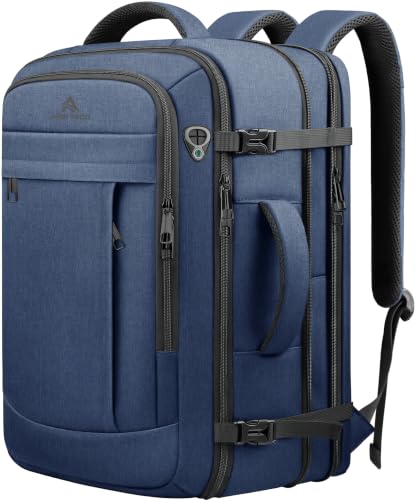
Examining the AREYTECO Large Travel Laptop Backpack for Men illustrates how a fifty-liter design can meet carry-on standards. The manufacturer specifies standard dimensions of 19.6 x 12.9 x 5.9 inches in its unexpanded state. When the perimeter expansion zipper is opened, the depth expands to 9 inches, creating an overall footprint of 19.6 x 12.9 x 9 inches. Both dimensions sit comfortably within the standard domestic airline limit of 22 x 14 x 9 inches.
The 19.6-inch height leaves more than two inches of clearance below the 22-inch overhead ceiling, while the 12.9-inch width easily clears standard 14-inch sizers. This compact profile allows the pack to provide expansive storage capacity without exceeding overhead compartment tolerances. By utilizing an expandable gusset, users can travel in a slim configuration during daily transit and expand the bag when maximum packing volume is required. The absence of a rigid internal stay allows the exterior fabric to yield when sliding beneath overhead bin doors.
The pack also features water-resistant exterior fabric designed to protect gear from light rain and tarmac moisture during outdoor boardings. Reinforced sponge handles on both the top and side provide sturdy grip points for lifting the bag into high storage areas. The exterior luggage strap slides smoothly over rolling suitcase handles, simplifying long walks across sprawling airport terminals. These functional design choices demonstrate how modern travel packs solve capacity challenges without violating airline boundaries.
Preventing the Depth Bulge and Packing Geometry
Soft-sided backpacks offer great flexibility, but they also present a common risk known as the mid-pack bulge. When users cram soft goods into an expandable bag, the center fabric bows outward into a barrel shape. A backpack with an official 9-inch depth rating can easily swell to eleven or twelve inches if packed carelessly. That excess bulk prevents the bag from sliding into metal gate sizers and stops overhead bin latches from closing.
Employing structured packing cubes is an effective method for regulating pack depth and maintaining a flat exterior profile. Cubes compress garments into brick-like modules that stack neatly inside the clamshell cavity. Placing heavier, denser items close to the back panel stabilizes the center of gravity while keeping outer pockets slim. This packing technique prevents loose clothing from shifting downward and ballooning the lower half of the pack.
External compression straps provide an additional safeguard against dimensional expansion. Once the main zipper is secured, cinching the side compression straps pulls excess volume tight toward the back panel. This flattens the pack into a compact rectangular block that passes visual scrutiny at the gate. Leaving outer stash pockets relatively empty until after boarding ensures the bag remains within legal dimensional parameters.
Harness Ergonomics and Torso Weight Distribution
Carrying a fifty-liter load through massive international airports places meaningful physical stress on your neck, shoulders, and lower back. When fully packed with apparel, footwear, and heavy electronics, a high-capacity bag can weigh twenty-five pounds or more. Carrying that mass without proper harness support can cause shoulder fatigue and poor posture during long gate connections. Quality harness components transform an unwieldy travel load into a comfortable, manageable carry.
The AREYTECO pack integrates padded shoulder straps, an adjustable sternum strap, and an air-mesh ventilated back panel to mitigate pressure points. An adjustable chest strap pulls the shoulder straps inward, preventing them from slipping outward and straining the trapezius muscles. The ventilated air-mesh back panel facilitates airflow between the user and the bag, reducing heat accumulation during brisk walks. These ergonomic features help distribute heavy gear across the upper torso rather than concentrating pressure on collarbones.
Balancing internal weight correctly is just as critical as harness adjustment for long-term carrying comfort. Heavy electronics, shoes, and toiletries should sit directly against the back panel rather than against the outer face of the pack. Positioning heavy items close to your spine prevents the bag from pulling backward and straining your lumbar region. Properly fitted straps combined with thoughtful weight distribution make navigating crowded terminals significantly less tiring.
Checkpoint Efficiency and Device Compartments
Navigating airport security lines with a bulky backpack can create bottlenecks if the interior layout is disorganized. Travel-focused backpacks often incorporate flat-lay openings that open from 90 to 180 degrees like a book. This feature allows airport security officers to scan laptop screens clearly without requiring travelers to dig through piles of clothing. A streamlined security experience keeps lines moving and reduces the stress of disassembling your entire bag.
The dedicated rear tech compartment on the AREYTECO travel pack accommodates laptops up to 17.3 inches in screen size. Isolating your computer in an independent padded sleeve protects delicate screens and corners from impact with heavier packed items. An integrated exterior USB port connects to an internal power bank compartment, enabling convenient device charging while walking. Quick access to electronics and charging cords ensures you remain connected without unpacking your main wardrobe.
Travelers who utilize specialized secondary gear, such as thermal backpack coolers on road trips, understand that specialized pockets must not compromise main cavity storage. In travel bags, dedicated admin panels organize passports, boarding passes, pens, and battery chargers in shallow slots. Keeping tech gear segregated from clothing also prevents charging cables from tangling inside garments. A well-organized tech layout protects expensive electronics while keeping travel paperwork within arm’s reach.
Personal Item Rules Versus Overhead Bin Realities
A common point of confusion among new air travelers is distinguishing between a carry-on bag and a personal item. A carry-on bag is designed to occupy the overhead storage bin above the passenger seating area. In contrast, a personal item must fit entirely beneath the seat directly in front of you. Personal item limits are strictly enforced and typically cap bag dimensions around 18 x 14 x 8 inches or smaller.
A fifty-liter backpack cannot realistically serve as an under-seat personal item on any commercial airline. At nineteen to twenty-two inches tall, a pack of this capacity will protrude into the passenger legroom, violating federal aviation safety rules. Attempting to pass a fifty-liter bag as a free personal item on budget carriers will result in immediate gate-check fees. You must purchase a ticket that includes dedicated overhead carry-on privileges when traveling with a bag of this size.
Passengers should also prepare for regional aircraft where overhead bins are smaller than standard mainline jets. On smaller commuter aircraft, flight crews frequently mandate gate-checking for all roll-aboard suitcases and large backpacks. Because the AREYTECO pack features soft sides, it can sometimes squeeze into shallow regional bins where rigid rolling bags fail. However, keeping critical items and fragile electronics in an easily removable pouch ensures you can surrender the main pack without worry if required.
Pre-Flight Packing Checklist for Maximum Compliance
Conducting a dimensional test at home before leaving for the airport eliminates gate-side surprises and costly baggage fees. Pack your fifty-liter bag with every item planned for your journey, including shoes, toiletries, and tech accessories. Once zipped, set the bag on a flat floor and measure the exterior height, width, and depth with a rigid tape measure. Be sure to measure from the base of the bag to the highest point of the top carry handle.
Check the depth profile across the center of the bag to verify that it does not exceed the carrier’s nine-inch limit. If the center bulges past nine inches, engage the exterior compression straps or remove bulky non-essential garments. Place the packed bag on a bathroom scale or digital luggage scale to verify total cabin weight against airline guidelines. Ensuring the bag meets both dimensional and weight restrictions gives you complete confidence when walking through the boarding gate.
Lastly, organize the exterior pockets so they lie as flat as possible during airport transit. Bulky water bottles or jackets stuffed into outside mesh sleeves can push a compliant bag beyond sizer thresholds. Stow your water bottle inside the main compartment until you pass through the boarding gate and enter the jet bridge. Taking these simple preparatory steps ensures your high-capacity travel backpack glides into the overhead compartment without friction.
Final Carry-On Verification and Transit Takeaway
Bringing a fifty-liter backpack as a carry-on is entirely practical when using a purpose-built travel pack rather than an elongated outdoor trail rucksack. Models like the AREYTECO travel backpack provide ample packing capacity while maintaining exterior dimensions of 19.6 x 12.9 x 9 inches that align with major airline standards. By taking advantage of clamshell packing convenience, compression straps, and ergonomic harness support, you can travel efficiently without checking bags. Always verify your specific airline dimensional and weight rules before flying to ensure a smooth, hassle-free boarding experience.






Write Your Review
No reviews yet. Be the first to share your experience!