


Planning a multi-day trip requires balancing gear storage against physical carrying fatigue, which makes pack volume one of the most critical specifications to understand before setting out. Many travelers and hikers wonder exactly how big is a 55 liter backpack when shifting from compact commuter daypacks to substantial backcountry luggage. In terms of physical capacity, a fifty-five-liter bag provides roughly 3,350 cubic inches of interior volume, which generally accommodates several days of wilderness camping gear or a week of minimalist travel apparel. When paired with sturdy harness systems such as an iron frame hiking backpack options setup, this size tier bridges the gap between mid-sized weekend bags and oversized expedition packs.
Selecting the proper pack volume prevents the frustration of cramming bulky sleeping gear into undersized compartments or carrying loose, unbalanced loads down steep switchbacks. A well-designed 55L internal frame backpack distributes dense gear weight directly to the hips, keeping your center of gravity stable across uneven terrain. Understanding how these dimensional envelopes translate into real-world gear capacity helps adventurers avoid packing blunders while staying comfortable on long routes. Exploring alternatives like affordable hiking backpack models shows that volume efficiency and functional ergonomics can align across various budget ranges.

Pros
- Integrated rain cover provides fast weather protection without needing to purchase an aftermarket cover.
- Adjustable torso harness accommodates medium and tall adult hikers across different body types.
- Dedicated lower sleeping bag compartment simplifies overnight gear organization and packing.
- Internal frame system and multi-directional compression straps help stabilize shifting trail loads.
- Feature-rich internal frame design offered at an accessible price point for budget-minded campers.
Cons
- At roughly 4.1 pounds empty, it is noticeably heavier than dedicated ultralight frameless packs.
- Hydration reservoir is not included and must be purchased separately.
- Torso adjustability is geared toward medium and tall adventurers, which may not fit shorter hikers.
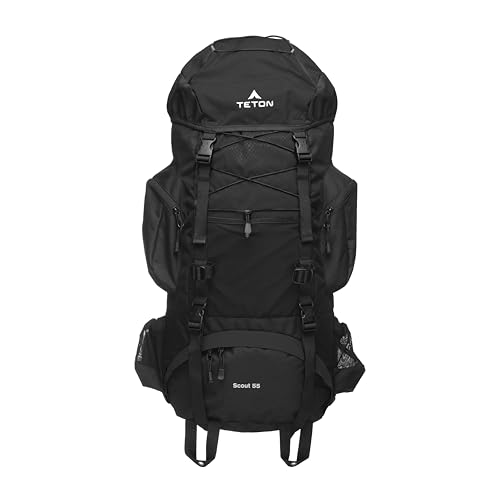
The TETON Sports Scout 55L Internal Frame Backpack is a high-capacity, budget-friendly trail pack engineered for weekend backpackers, car campers transitioning to trail camping, and outdoor travelers. Designed to balance gear organization and load management, this pack offers a 55-liter storage volume that suits overnight to multi-day hiking itineraries. It is especially suited for first-time backpackers or cost-conscious hikers who want essential trail features without the steep investment typical of premium outdoor gear.
Equipped with an internal frame and measuring 16 x 30 x 10 inches, the pack weighs approximately 4.1 pounds empty. This internal frame structure works in tandem with a multi-position torso adjustment system designed to accommodate medium and tall adventurers. The suspension design centers around a durable open-cell foam lumbar pad and molded back-panel channels that encourage airflow across your back, helping reduce heat buildup during warm-weather ascents and extended trail miles.
Storage and gear management are central to the Scout 55L layout. The pack includes a dedicated lower sleeping bag compartment, which keeps your sleep setup separated from heavy mid-pack items like food bags and camp stoves. Multi-directional compression straps run along the body to pull the load closer to your spine, preventing gear from shifting over uneven terrain. External attachment points and spacious compartments provide distinct places for essentials, while an internal hydration pocket supports hands-free water storage.
Fitting and packing the pack is straightforward for beginner and experienced hikers alike. Users can adjust the shoulder harness position to align with their torso length before tensioning the hip belt and load-bearing straps. Packing is simplified by the dual-compartment layout, allowing direct access to the sleeping bag compartment without emptying the upper ruck. An integrated rain cover is included in the package, deploying quickly during unexpected storms to shield the pack fabric from wet conditions.
While the Scout 55L offers dependable utility, hikers should recognize its specific trade-offs. Weighing just over four pounds, it is heavier than specialized ultralight packs, making base weight management a key consideration. The torso harness is tailored specifically for medium to tall body frames, so shorter or petite hikers may struggle to achieve an ideal load-transfer alignment. Additionally, while the pack features a pocket for a hydration reservoir, the bladder and drinking tube itself must be acquired separately.
Overall, the TETON Sports Scout 55L stands as a practical, reliable option for weekend trekkers seeking a structured internal-frame pack with included weather protection. The combination of multi-position torso adjustability, an integrated rain cover, dedicated sleeping bag storage, and airflow-oriented lumbar padding delivers exceptional functional value for trail adventures across the United States.
The TETON Sports Scout 55L features an adjustable suspension harness with a multi-position torso adjustment mechanism. This adjustment range is designed to fit medium and tall adult hikers, offering balanced shoulder strap and hip-belt positioning across different back lengths.
Hikers with shorter torso lengths should confirm fit before packing, as the adjustment range is optimized for medium and taller adventurers. Properly aligning the harness ensures that the open-cell foam lumbar pad sits securely against the lower back to assist with load distribution.
With a 55-liter capacity and dimensions of 16 x 30 x 10 inches, this pack accommodates standard weekend gear, including shelter, sleep systems, clothing layers, and trail nutrition. The dedicated bottom sleeping bag compartment helps segregate bulkier gear from the main top compartment.
For wet weather management, the backpack includes a fitted rain cover that stores compactly when not in use. While the rain cover shields pack fabric from external showers, sensitive gear such as electronics, dry clothing, and down sleeping bags should still be packed in waterproof dry sacks or pack liners for comprehensive protection.

Pros
- Multi-position torso adjustment offers fit customization for medium and tall hikers without complex tools.
- Comes standard with a dedicated rain cover and separate sleeping bag compartment, eliminating the need for separate add-ons.
- Open-cell foam lumbar pad and molded back channels promote air movement along the spine on strenuous ascents.
- Multi-directional compression straps stabilize partial loads and provide secure external tie-down points for gear.
Cons
- Manufacturer specifications do not provide numeric torso length or hip-belt circumference ranges, making precise sizing verification harder before purchase.
- Includes an internal hydration pocket, but a compatible water reservoir and drink tube must be purchased separately.
- At 16 x 30 x 10 inches, the tall profile may feel bulky for shorter users or tightly overgrown backcountry paths.
The TETON Sports Scout 55L is an internal-frame backpacking pack engineered for multi-day hiking trips, weekend camping, and outdoor travel. Designed for both men and women, this pack caters directly to entry-level backpackers, scout troops, and value-minded adventurers who need a full-featured load-hauler without a premium price tag. Its structured design provides the essential balance and stability required when transitioning from casual day hikes to overnight wilderness expeditions.
With a 55-liter storage volume, a total weight of approximately 3.85 pounds, and dimensions measuring 16 by 30 by 10 inches, the Scout 55L offers ample room for bulkier three-season gear. The internal frame provides the structural backbone necessary to keep heavier items balanced close to your center of gravity. To assist with temperature regulation during steep switchbacks and warm afternoons, the back panel pairs an open-cell foam lumbar pad with molded airflow channels designed to encourage ventilation between the pack and your body.
Organization is a central strength of the Scout 55L layout. The pack includes a dedicated lower sleeping bag compartment, allowing backpackers to isolate camp bedding from food bags and cooking gear. Spacious exterior compartments and multiple pockets keep navigation tools, headlamps, and trail snacks readily accessible. Additionally, multi-directional compression straps run along the body to cinch down excess volume when the pack is not fully filled, preventing gear from shifting uncomfortably on the move.
Fitting the backpack to your body is managed through a multi-position torso adjustment system tailored specifically for medium to tall hikers. This adjustable harness makes it simple to dial in shoulder-strap positioning relative to the lumbar pad before hitting the trail. For hydration planning, the interior features a dedicated hydration pocket to hold a bladder, though users must supply their own reservoir. When unexpected mountain storms roll in, the pack includes an integrated rain cover that stretches over the Burnt Orange exterior to protect gear from trail spray and soaking rains.
Prospective buyers should evaluate a few realistic limitations before purchasing. While the multi-position harness accommodates medium and tall frames, the manufacturer does not supply exact torso length ranges in inches, meaning those with especially short torsos may struggle to achieve an optimal balance. Furthermore, while the included rain cover shields the pack exterior from rain, a rain cover alone does not make the pack fully submersible, and critical electronics should always be kept in waterproof bags.
For hikers, campers, and travelers seeking a capable, structured 55-liter internal-frame pack, the TETON Sports Scout 55L delivers practical utility. The inclusion of a rain cover, dedicated sleeping bag storage, and an adjustable torso harness make it a strong, practical choice for multi-day adventures on a budget.
The TETON Sports Scout 55L incorporates a multi-position torso adjustment system built to fit medium and tall adventurers. Backpackers can adjust the shoulder strap yoke up or down along the frame to match their torso length, which helps seat the open-cell foam lumbar pad properly on the lower back.
Because the manufacturer does not list exact numeric inch measurements for torso length or hip-belt circumference, buyers with shorter torsos should double-check their body proportions before relying on this pack for heavy wilderness loads. Ensuring the harness sits correctly on your shoulders and the lumbar pad rests on the iliac crest is essential for balanced load transfer.
A 55-liter total volume makes the Scout 55L well suited for overnight camping outings and multi-day trail routes where gear volume is moderate. The main compartment offers vertical loading space, while the dedicated sleeping bag compartment at the base eliminates the need to unpack daytime layers to reach your sleep system at camp.
Multiple exterior pockets and multi-directional compression straps provide dedicated spaces for trail essentials. The compression straps can be pulled taut to steady uneven loads or slackened to lash lightweight gear horizontally across the pack exterior.
The Scout 55L features an internal pocket designed specifically to house a hydration reservoir for easy trail drinking. The water reservoir and delivery hose are sold separately, allowing hikers to pair the pack with their preferred bladder size and hose system.
Weather protection is handled by an included rain cover that deploys directly over the pack exterior during sudden downpours. While the rain cover blocks direct rainfall and trail grit, hikers carrying sensitive electronics or down sleeping bags should still pack sensitive items in sealed dry bags for complete security in severe weather.
Pros
- Spacious 55L capacity organized with a separate sleeping bag compartment and multiple pockets
- Adjustable torso system allows medium and tall hikers to adjust harness positioning easily
- Includes an integrated rain cover, saving the expense and effort of sourcing a separate cover
- Internal frame and foam lumbar pad help distribute load weight effectively across the back
- Multi-directional exterior compression straps keep uneven gear loads secure and compact
Cons
- At 4.14 pounds empty weight, this pack is heavier than minimalist or ultralight trail options
- Torso adjustment is oriented toward medium and tall adventurers, which may not suit hikers with shorter torsos
- Hydration reservoir is not included and must be purchased separately to utilize the hydration pocket
The TETON Sports Scout 55L Internal Frame Backpack is an entry to intermediate backpacking pack built for hikers, campers, and travelers who require dependable load support and structured organization without premium gear costs. Equipped with a 55-liter capacity, this model suits overnight weekend trips, car-camping excursions, and gear-intensive day outings. It is engineered with a multi-position torso adjustment system designed for men and women with medium to tall builds who want a balanced, custom fit on the trail.
In terms of load management, the backpack relies on an internal frame structure that channels pack weight toward the hips and lower body. The back panel integrates an open-cell foam lumbar pad alongside molded channels designed to provide cushioning while promoting continuous airflow across the back. Measuring 16 x 30 x 10 inches and weighing 4.14 pounds empty, the Scout 55L balances durable structural components with manageable pack weight, giving recreational backpackers sufficient rigidity without the extreme heft of older external-frame models.
Organization is a distinct asset of this design, highlighted by a dedicated sleeping bag compartment at the base that allows easy access to camp sleep systems without unpacking the main hold. The pack also features spacious exterior compartments, multiple pockets for trail items, and multi-directional compression straps that pull cargo inward to keep weight centered. A designated internal hydration pocket supports hands-free hydration bladders, while an included protective rain cover stows neatly until wet conditions demand fast deployment.
Setting up the pack is straightforward thanks to the multi-position torso mechanism, which lets hikers adjust the shoulder harness height before heading out. Users should take the time to align the lumbar pad comfortably against the lower back and tighten the compression straps once packed to prevent gear shift. For ongoing maintenance, spot cleaning with mild soap, air drying thoroughly out of direct sunlight, and checking buckle points prior to departure will keep the hardware and fabric in good trail-ready condition.
A few practical limitations should be kept in mind before purchasing. The 4.14-pound empty weight puts this pack outside the ultralight category, which may deter long-distance thru-hikers focused strictly on base weight reduction. Additionally, because the multi-position torso system is built for medium and tall users, individuals with shorter torso measurements may struggle to find an optimal harness fit. Hikers should also note that while a hydration pocket is built in, a compatible reservoir and drinking tube must be purchased separately.
For weekend backpackers, trail newcomers, and outdoor enthusiasts seeking a dependable internal frame carrier, the TETON Sports Scout 55L delivers reliable utility and thoughtful compartment layout. The inclusion of a fitted rain cover, multi-directional load compression, and a dedicated sleeping bag section make it a practical, trail-ready choice for budget-conscious hikers.
The TETON Sports Scout 55L features a multi-position torso adjustment system engineered to fit medium and tall adventurers. Proper backpack fit requires setting the harness height so the lumbar pad rests securely on the lower back while the shoulder straps wrap comfortably around the chest without pinching or leaving large gaps.
Hikers should establish their harness setting at home with moderate weight loaded inside before hitting the trail. Shorter hikers should carefully evaluate their torso dimensions, as the harness geometry is tailored for medium to taller body frames and may not shorten sufficiently for smaller statures.
With a 55-liter total volume, the Scout 55L provides distinct compartments that simplify overnight trail packing. The lower sleeping bag compartment keeps bulky sleep systems isolated from damp clothing, trail snacks, and upper cargo, preventing unnecessary repacking during camp setup.
Multi-directional compression straps run across the pack body to pull heavy gear closer to the user spine, reducing sway on uneven terrain. Exterior compartments and side pockets offer organized storage for essential accessories, tools, and maps that need to be reached without opening the main internal body.

Pros
- Ships complete with an internal steel frame, 3L hydration reservoir, and dedicated rain cover
- Very light baseline weight of just 3 pounds for a fully featured 55-liter multi-day rucksack
- Side-entry zipper provides fast, direct access to the main compartment contents on the trail
- Adjustable S/M/L shoulder strap anchor positions help dial in upper-body fit
- Dual zippered hip-belt pockets keep compact trail essentials within immediate reach
Cons
- Polyester and nylon fabric is water-resistant, making use of the rain cover necessary during continuous downpours
- Torso adjustment uses three preset positions (S/M/L) rather than a continuous micro-adjust slider
- Full 31-inch height may exceed standard overhead carry-on dimensions for certain commercial airlines
The IX INOXTO 55L Internal Frame Backpack is an accessible multi-day rucksack equipped with an internal steel frame, an included 3-liter water reservoir, and a fitted rain cover. At an advertised weight of only 3 pounds, this pack is designed for weekend backpackers, campers, and gear-conscious hikers who want an all-inclusive setup without having to purchase separate hydration systems or external weather protection.
On the trail, the 55-liter capacity provides ample room for shelter, a sleeping bag, layered apparel, and several days of trail provisions within its 31 x 14.5 x 8.6-inch footprint. A built-in elastic steel frame supports the pack structure, working with a suspended three-dimensional breathable back system to transfer pack weight toward the hips while maintaining an open channel for back ventilation. External extension compression straps and lash points allow hikers to secure bulky items like tents, trekking poles, climbing ropes, or ice axes directly to the pack exterior.
The pack is constructed from tear-resistant and wear-resistant polyester and nylon fabrics designed to withstand regular outdoor abrasion. Critical stress points and shoulder strap anchors feature lap-knot reinforced stitching to improve structural durability under heavy loads. While the shell material provides basic water resistance, the backpack includes a dedicated waterproof rain cover stored in a bottom pouch, protecting sensitive gear when inclement weather rolls in.
Harness setup is handled through an adjustable system that offers S, M, and L preset positions for the padded S-curve shoulder straps, helping accommodate both men and women across different torso heights. For trail organization, the pack features a top lid pocket, a front stash pocket, dual side bottle pockets, and two zippered waist pockets on the hip belt for small electronics or snacks. A side-zippered entry into the main compartment makes it easy to grab gear positioned in the middle or bottom of the pack without disturbing the top load.
A realistic limitation of this design is the three-position ladder adjustment, which offers preset sizing rather than continuous micro-adjustment, meaning some users may find themselves between ideal torso settings. Additionally, while the pack fabric repels light moisture, it lacks taped seams, making deployment of the included rain cover necessary in persistent downpours. Travelers should also note that its 31-inch vertical height may exceed strict airline carry-on size limits when packed full.
For hikers, travelers, and campers searching for a versatile 55L internal-frame pack that bundles essential accessories like a 3L hydration bladder and rain cover, the IX INOXTO rucksack delivers solid functional value. Setting the shoulder harness to match your torso length and utilizing the compression straps to stabilize your gear will help ensure a balanced, reliable carry on multi-day outdoor trips.
The IX INOXTO 55L pack comes supplied with a dedicated 3-liter hydration bladder, giving you substantial fluid capacity for long stretches between water sources. The bladder is built with an extra-wide opening that facilitates rapid filling, allows the addition of ice cubes, and simplifies interior cleaning and drying between outings.
The drinking system includes a 47-inch flexible hose with a 0.4-inch diameter to promote consistent water flow. A switch valve combined with a protective dust cover cap creates a double leak-proof barrier, preventing unwanted dripping while hiking or transporting your pack. The reservoir material is rated to handle water temperatures ranging from -20 to +50 degrees Celsius, making it versatile across varying seasonal conditions.
Load management in the IX INOXTO 55L rucksack centers around a built-in elastic steel frame that stabilizes the pack and prevents the back panel from barreling into the user when fully packed. This steel structure evenly distributes carrying weight to relieve pressure across the shoulders and upper spine.
The suspension system incorporates a suspended three-dimensional back design covered in breathable mesh, creating a separation zone between the pack body and your back to promote passive airflow. The S-shaped shoulder straps can be adjusted between S, M, and L anchor points, allowing hikers to adapt the torso fit to their specific body size.
Organization on the trail is supported by a multi-compartment layout consisting of one main storage cavity, one top zippered pocket, a front quick-access pocket, two side pockets, and dual zippered waist belt pockets. The hip-belt pockets provide convenient storage for small trail necessities like lip balm, compasses, or compact pocket tools.
In addition to traditional top-loading access, a side-entry zipper opens directly into the main compartment. This secondary access point allows hikers to slide out extra layers, cooking kits, or rain gear stored deep inside the pack without having to unpack items from the top down.
Understanding 55-Liter Backpack Dimensions and Carrying Capacity
Evaluating the true capacity of a 55-liter pack starts with understanding both its three-dimensional volume and its external footprint. A pack in this volume class is engineered primarily for three to five days on backcountry trails, international travel involving diverse climates, or winter overnight treks requiring bulky insulating layers. Rather than functioning as a compact commuter bag, a fifty-five-liter model serves as a mid-to-large capacity hauler built to carry shelter, sleeping systems, food rations, and multiple changes of apparel comfortably. It offers substantial space without forcing you into the cumbersome bulk of heavy expedition packs.
Physical Dimensions and Cubic Volume Equivalents
In mathematical terms, 55 liters converts to approximately 3,356 cubic inches or roughly 0.055 cubic meters. Standard external dimensions for a pack in this bracket typically hover around 30 to 32 inches in height, 13 to 15 inches in width, and 8 to 10 inches in depth when fully packed. For example, published specifications for the IX INOXTO 55L internal frame backpack list measurements of 31 by 14.5 by 8.6 inches, which illustrates the tall and narrow profile standard across outdoor load haulers. Variations in pocket geometry and frame curvature can alter these exterior boundaries slightly between different manufacturers.
This vertical orientation is deliberate because keeping dense gear aligned along the spinal column reduces lateral momentum during motion. An unstructured duffel bag with identical liter volume might feel much broader and sag under weight, but an internal frame pack maintains structural rigidity. Compression straps along the perimeter pull the outer fabric inward, allowing you to stabilize the total volume when traveling with less than a complete load. That mechanical compression keeps the load from shifting awkwardly when navigating steep ascents or descending loose scree fields.
What Fits Inside a 55-Liter Backpack for Multi-Day Trips
A fifty-five-liter pack provides generous volume without straying into the unmanageable bulk of expedition rucksacks. Under typical packing protocols, this volume accommodates a compact two-person tent, a three-season sleeping bag, an insulated sleeping pad, a compact camp stove system, and three to five days of dehydrated meals. In addition to core shelter and cooking setups, adventurers can easily pack a hard-shell rain jacket, extra thermal layers, a water filtration kit, and personal hygiene supplies. This makes the capacity ideal for weekend backpacking trips as well as week-long trail sections.
For extended travel rather than wilderness camping, this storage bracket easily swallows a week of clothing rolled into compression cubes, a pair of spare shoes, a toiletry kit, and travel electronics. Because technical packs often feature dedicated bottom compartments, separating damp shoes or dirty laundry from clean garments remains straightforward throughout transit. Specialized gear such as trekking poles, sleeping mats, and ice axes can also be anchored to exterior lash loops, preserving internal volume for delicate cargo. This versatile layout helps globetrotters navigate long itineraries without relying on multiple separate luggage bags.
Comparing a 55-Liter Bag to Other Backpack Size Brackets
Positioning a 55L pack against other gear categories clarifies where it excels and where it feels oversized. Everyday carry bags and campus packs generally measure between 18 and 28 liters, providing just enough space for laptops, notebooks, daily charging cables, and an extra sweater. Weekend daypacks typically span 30 to 40 liters, accommodating supplies for dawn-to-dusk hikes or streamlined overnight stays in mild weather. Stepping beyond 40 liters fundamentally changes how a bag is constructed and carried.
At 55 liters, the pack transitions into full self-supported wilderness territory and extended travel capability. While massive 70-liter or 85-liter expedition bags cater to winter mountaineering or multi-week off-grid expeditions, they frequently encourage overpacking that strains the hiker. A fifty-five-liter capacity strikes a sweet spot that enforces disciplined packing habits while supplying ample space for essential safety gear and comfort items. It delivers the carrying power needed for serious trails without encouraging hikers to haul unnecessary weight.
Airline Carry-On Rules and Overhead Bin Sizing Realities
Prospective travelers frequently ask whether a 55-liter backpack complies with commercial airline carry-on regulations. Most domestic and international commercial airlines enforce maximum carry-on overhead dimensions around 22 by 14 by 9 inches, creating a combined linear total of approximately 45 inches. Given that a typical 55L internal frame model measures roughly 30 to 31 inches in length, these packs exceed standard carry-on dimensional thresholds on almost all major airlines. Attempting to pass a fully loaded pack of this size through airline gate checkpoints often leads to mandatory gate checks.
The rigid internal stays or steel frames prevent the bag from collapsing vertically to fit inside airport gate sizing boxes. Attempting to force an internal frame pack into regional aircraft overhead bins or underneath cabin seats risks luggage gate-checks and potential damage to frame components. If you plan to fly with a pack of this volume, checking the bag as standard luggage or using a protective flight cover to guard buckles and straps is generally the safest approach. Dedicated flight covers prevent loose straps from catching on automated airport baggage conveyer belts.
Internal Frame Architecture and Weight Distribution
Carrying 30 to 40 pounds of gear requires specialized load-bearing architecture that compact daypacks lack entirely. Models like the Teton 55L Scout internal frame backpack and the IX INOXTO 55L utilize internal metal stays or elastic steel frames that channel gravitational weight downward onto the lumbar region. This structural backbone prevents the pack body from bowing outward or pulling backward away from the shoulders during steep climbs. Without that internal framework, heavy gear would cause the backpack to sag severely against your lower spine.
A dense, open-cell foam lumbar pad cushions the base of the spine while thick, padded hip belt wings wrap securely around the pelvic girdle. When adjusted properly, the hip belt carries roughly seventy to eighty percent of total pack mass, sparing sensitive neck muscles and shoulder joints from excessive fatigue. Molded airflow channels and suspended three-dimensional mesh back panels help dissipate perspiration by keeping moving air circulating between the pack fabric and the user’s back. This constant ventilation minimizes back moisture accumulation during strenuous warm-weather trekking.
Torso Sizing and Harness Adjustment for Balanced Loads
A pack with fifty-five liters of volume must fit your specific torso length rather than your overall standing height. Measuring your torso requires locating the prominent C7 vertebra at the base of your neck and tracing down your spine to the top edge of your iliac crest along your hips. Backpacks such as the Teton 55L Scout offer multi-position torso adjustments designed to match medium and tall body profiles by shifting the shoulder harness anchor up or down. Choosing a pack that matches your exact torso length ensures the hip belt rests comfortably over your pelvis.
Dialing in the harness starts by loosening all webbing straps, seating the hip belt directly over the iliac crest bones, and cinching the waist buckle securely. Next, pull the contoured shoulder straps snug without letting them lift the hip belt off the pelvis or press painfully into collarbones. Finally, fasten the sternum strap across the mid-chest to stabilize the harness width, and gently cinch the upper load-lifter straps to pull the top of the pack closer to your center of gravity. Properly adjusted load lifters should form roughly a 45-degree angle from the pack body to the shoulder harness.
Compartment Layout and Exterior Storage Organization
Efficient volume utilization depends on how the fifty-five liters are divided between the main cavity and auxiliary pockets. A classic top-loading design features a cavernous central compartment secured by a cinch cord and a protective top lid with zippered stash compartments for small essentials. Complementing the main hold, separate bottom zippered entries allow hikers to remove sleeping bags or camp footwear without unpacking everything stacked above. Many models also feature side zipper entries that let you reach mid-pack items without rummaging from the top down.
External storage fixtures significantly boost the functional versatility of a large backpack. Elastic side pockets hold water bottles or fuel canisters, while zippered hip belt pockets provide fast access to trail snacks, compact navigation tools, or pocketknives. Many models also integrate hydration bladder sleeves with routing ports for drinking tubes, such as the three-liter bladder system included with the IX INOXTO 55L hiking backpack, keeping hydration constant without stopping on the trail. Front stretch pockets or daisy chain webbing also create quick storage spots for wet rain shells.
Fabric Durability and Weather Protection Considerations
Backpacks designed to hold fifty-five liters endure substantial abrasive friction from trailside branches, rough granite boulders, and airline transit handling. Manufacturers construct these packs using durable polyester and tear-resistant nylon fabrics reinforced with heavy bar-tack stitching at high-stress shoulder and compression attachment points. While water-resistant polyurethane fabric coatings provide baseline protection against light mist, extended rainfall requires dedicated moisture defense. Long trail exposure to heavy storms will eventually penetrate unprotected exterior seams.
Quality outdoor haulers typically feature integrated, waterproof rain covers stowed in dedicated bottom pockets that deploy quickly over the entire loaded pack exterior. When traversing damp routes or riverbanks, keeping sleeping gear and electronics inside silicone dry bags adds a crucial secondary moisture barrier. Those carrying specialty insulated cargo might also consider combining their main gear setup with trail backpack cooler designs to keep fresh food chilled on wilderness routes. Taking extra precautions against moisture keeps your insulating layers dry when outdoor conditions deteriorate.
Practical Packing Strategies to Maximize Usable Interior Volume
Mastering the internal packing hierarchy ensures that a 55-liter pack carries comfortably across long trail miles. Place lightweight, bulky gear like your sleeping bag and camp sleep clothes at the very bottom of the pack to form a soft structural foundation. Directly above that foundation, pack heavy dense items like your camp stove, fuel, water filtration gear, and food supply tight against the back panel close to your spine. Positioning heavy cargo against the back panel stabilizes your center of gravity and prevents backward pull.
Lighter items, such as insulating fleece jackets, extra clothing layers, and a tent body, can then fill the perimeter and outer spaces around the heavy core. Medium-weight essentials, first aid kits, and rain shells belong near the top opening or under the top lid where they remain accessible during abrupt weather shifts. Utilizing all external compression straps pulls the entire package inward, eliminating internal empty voids that cause shifting loads and spinal imbalance. A well-compressed pack moves naturally with your body rather than swaying from side to side.
Managing Unladen Tare Weight and Total Trail Mass
Unladen pack weight plays a decisive role in overall energy expenditure when carrying a loaded fifty-five-liter pack. Because these bags feature structured internal stays, heavy-gauge zippers, and dense lumbar padding, the empty pack itself generally weighs between three and four and a half pounds. For instance, the IX INOXTO 55L model lists an unladen weight of approximately three pounds, offering an exceptionally light baseline for an internal frame hauler. A lighter starting pack tare weight leaves more room for essential rations and gear.
Keeping the total loaded weight below thirty to thirty-five pounds ensures that the internal frame transfers stress effectively without overwhelming the hiker’s joints. Packing unnecessary duplicate gear or excessively heavy camping items quickly pushes a 55L bag past comfortable carrying limits, negating the ergonomic advantages of its suspension harness. Monitoring every item loaded into the pack preserves stamina across long ascents and minimizes wear on shoulder seams and hip belt webbing. Setting a strict weight target helps keep your pack agile across rugged trail terrain.
Maintenance and Cleaning for Technical Backpack Fabrics
Preserving the structural integrity and weather resistance of a 55-liter pack requires proper cleaning and storage practices after every excursion. Trail dust, perspiration salts, and body oils can gradually degrade synthetic fabric weaves, foam cushioning, and polyurethane waterproof backings if left unattended. Washing a technical backpack in a domestic washing machine is strictly discouraged because violent agitator motions can snap internal frame stays and peel delicate interior coatings. Harsh detergents can also break down surface water repellency on coated exterior materials.
Instead, spot clean stained fabric surfaces using a soft-bristle nylon brush, lukewarm water, and a mild non-detergent technical soap formulated for outdoor gear. Pay particular attention to cleaning accumulated debris out of zipper coils, as trail grit causes slider friction that can lead to split zipper tracks under tension. Always hang the pack to air dry completely in a shaded, well-ventilated space away from direct heating elements or scorching sun before packing it away in dry storage. Storing the pack loosely in a cool closet prevents foam padding from taking a permanent compression set.
Understanding the real-world scale and carrying capacity of a 55-liter backpack enables travelers and hikers to make informed gear decisions before heading outdoors. With over 3,300 cubic inches of structured volume supported by adjustable internal framing, this pack class delivers the perfect balance of gear capacity, trail stability, and ergonomic load carriage. By matching your body’s torso length to the harness and loading your gear with mindful weight distribution, a 55-liter pack can comfortably support your most ambitious multi-day journeys. Taking the time to dial in your gear volume guarantees a safer and far more enjoyable backcountry adventure.







Write Your Review
No reviews yet. Be the first to share your experience!