


Airport boarding gates create plenty of stress when gate agents begin scanning luggage sizes, making pack volume a top priority for travelers. Many flyers wonder how many liters for a carry on backpack is ideal for maximizing packing room without exceeding airline restrictions. Standard domestic overhead bins typically fit packs measuring between 35 and 45 liters, whereas compact under-seat personal items usually demand 30 liters or less. Selecting the right volume depends on your travel routine, trip duration, and packing habits.
Picking the correct liter capacity keeps your transit smooth and prevents unexpected gate-check fees at the terminal. Travelers searching for cost-effective gear often explore budget backpack options to balance practical volume with lightweight materials. A well-organized 35-liter travel bag holds several outfits, essential tech, and personal toiletries while staying light enough for comfortable airport walking. Translating airline dimensional restrictions into functional liters ensures your bag slides easily into overhead bins or beneath cabin seats.
Pros
- Low 1.74-pound empty weight reduces carrying strain during travel and casual day hikes
- Thoughtful organization with nine functional pockets, a separate shoe bag, and an internal wet pocket
- 180-degree lay-flat opening simplifies packing and airport security checks
- Water-resistant construction provides basic protection against light moisture
Cons
- Lacks a supportive hip belt, frame sheet, or sternum strap for stabilizing heavy loads on steep trails
- Water-resistant exterior is not seam-sealed and does not include a rain cover for heavy downpours
- No dedicated hydration reservoir port or hose routing for technical hydration bladders
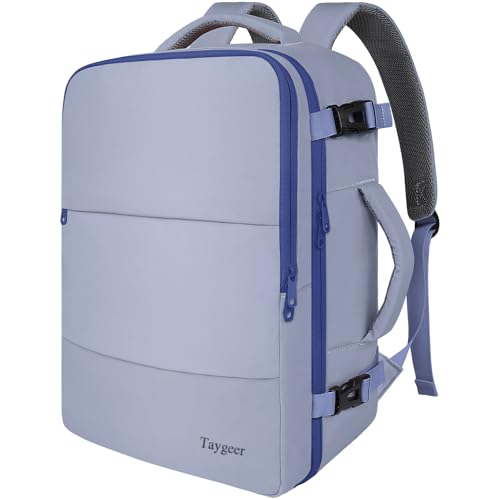
The Taygeer 35L Travel Backpack is an adaptable carry-on pack designed for travelers, road-trippers, and weekend outdoor enthusiasts who need clean gear organization in a manageable size. Measuring 16.8 by 11 by 7 inches with an empty weight of 1.74 pounds (0.79 kg), this pack bridges the gap between an airline personal item and a versatile daypack for scenic nature walks and casual cabin outings.
With 35 liters of total capacity spread across three large compartments and nine pockets, the bag easily accommodates mixed apparel, electronics, and daily essentials. Hikers taking day excursions from a campsite or hotel can utilize the side storage pocket for a water bottle while packing extra clothing and trail food into the roomy main section. The integrated wet pocket is especially convenient for damp swimwear, rain jackets, or damp towels, while the separate shoe bag keeps trail grime away from clean clothing.
The backpack is made with water-resistant fabric that helps protect belongings from light moisture, morning mist, or brief drizzles. Carrying comfort is provided by adjustable padded shoulder straps, while dual padded grab handles on the top and side make lifting the pack into overhead bins or vehicle trunks effortless. An integrated rear luggage strap also allows the bag to slide securely over rolling suitcase handles during transit.
Packing the Taygeer 35L is efficient due to its 180-degree lay-flat opening, which also facilitates quick airport security checks for the padded 15.6-inch laptop and 12.9-inch tablet sleeves. Daily handling is simple, and the smooth exterior fabric can be wiped clean with a damp cloth and air-dried between outings to maintain the condition of the material and zippers.
A realistic limitation of this backpack is its lack of technical hiking suspension. Because it has no internal frame, sternum strap, load lifters, or padded hip belt, all pack weight is carried directly on the shoulders. Users carrying dense, heavy gear over long or rocky trails may experience shoulder fatigue. Furthermore, while the fabric resists light water exposure, it is not fully waterproof and does not replace a dedicated rain cover during sustained rainfall.
For budget-conscious buyers seeking an organized, lightweight multi-use pack that transitions smoothly from airport terminals to casual nature paths, the Taygeer 35L offers practical value and versatility. Backpackers planning rugged backcountry expeditions or requiring hands-free hydration bladder systems will want to opt for a dedicated technical trekking pack instead.
The Taygeer 35L backpack emphasizes structured organization through three spacious compartments and nine functional pockets. This layout allows hikers and travelers to separate quick-access items like snacks, maps, and sunglasses from bulkier clothing layers. The dedicated wet pocket provides a reliable moisture barrier to prevent damp garments or toiletries from transferring humidity to clean gear.
In addition to interior organization, the included shoe bag isolates dirty trail shoes or secondary footwear from the rest of the contents. Padded tech compartments fit laptops up to 15.6 inches and tablets up to 12.9 inches, ensuring electronics remain secured and buffered during transit to and from trailheads.
With dimensions of 16.8 by 11 by 7 inches, this backpack meets carry-on criteria for major airlines such as Spirit and JetBlue, fitting comfortably in overhead compartments or under airline seats. When transitioning from travel to light day hikes, the side pocket holds a standard water bottle, though users should note that the bag does not include a hydration reservoir hanger or hose port.
The adjustable padded shoulder straps support light to moderate loads during casual trail outings, city walking tours, and daily commuting. However, because the design is frameless and lacks a weight-bearing hip belt, it is best utilized for lighter gear loads where technical trail stabilization is not essential.
Carry-On Backpack Liter Capacity and Airline Dimensions
A standard carry-on backpack designed for commercial air travel generally falls between 35 and 45 liters for overhead bins, or between 18 and 30 liters for under-seat personal items. Overhead luggage space allows larger dimensions, but domestic and international airlines enforce distinct dimensional sizer boxes that determine allowable exterior volume. Knowing the exact volume you need prevents awkward gate-check baggage fees and keeps your belongings accessible throughout your trip. The following detailed breakdown explains how backpack volume translates to real-world airline compatibility and packing efficiency.
Airlines measure luggage compliance by external length, width, and depth rather than interior liter capacity. Because bag manufacturers measure interior capacity in liters, travelers must calculate how external dimensions correlate with internal packing volume. Soft-sided bags expand easily, meaning an overfilled 40-liter pack can quickly exceed dimensional sizer cages at airport gates. Understanding how different liter brackets behave under real travel conditions helps you select the right pack for your flight profile.
The 35L to 45L Overhead Carry-On Benchmark
The 35-liter to 45-liter bracket represents the classic overhead carry-on size for one-bag air travel. Most major domestic carriers allow overhead bags measuring up to 22 by 14 by 9 inches, which calculates to roughly 45 liters of theoretical volume. A 35-liter backpack fits comfortably within these boundaries, leaving adequate clearance even when pockets are packed full. Packs in this range provide enough space to hold clothing, footwear, toiletries, and mobile tech for trips lasting from three days to several weeks.
International airlines often impose stricter carry-on limits than domestic American carriers, frequently restricting overhead luggage to 35 or 40 liters. European budget carriers such as EasyJet and Ryanair regularly check dimensions using rigid metal sizing frames at boarding gates. Choosing a 35-liter backpack offers an optimal balance because it satisfies most international dimensional standards while providing generous packing depth. Travelers flying on smaller regional jets also find 35-liter bags much easier to stow in compact overhead lockers than rigid 45-liter alternatives.
Weight distribution becomes especially critical when carrying a loaded 40-liter to 45-liter backpack through expansive airport terminals. Fully loaded packs in this volume tier often weigh between 15 and 25 pounds, which can strain shoulder muscles if carried incorrectly. Look for contoured shoulder straps with dense foam padding to soften pressure against collarbones. Dual top and side grab handles make lifting a 35-liter to 40-liter pack into high overhead bins smooth and controlled.
The 18L to 30L Under-Seat Personal Item Tier
Travelers who prefer to avoid overhead bin competition often rely on personal item backpacks ranging from 18 to 30 liters. Personal item allowances require bags to fit completely beneath the passenger seat directly ahead of you during taxi, takeoff, and landing. Standard personal item limits across major airlines average around 18 by 14 by 8 inches, though specific carrier requirements vary. A pack around 25 to 30 liters fits neatly within these spaces while offering ample space for daily commuting gear or short weekend trips.
Ultra-low-cost airlines such as Spirit, Frontier, and regional carriers enforce particularly strict rules regarding personal item dimensions. Bags that bulge beyond the designated sizing limits may incur hefty gate-check penalty fees before boarding. A streamlined 25-liter to 30-liter bag with controlled exterior depth ensures compliance without forcing you to sacrifice critical electronics or travel documents. Keeping high-density items centralized in the main compartment prevents the bag from ballooning outward at the sides.
Carrying a personal item backpack under the seat provides immediate access to headphones, tablets, chargers, and snacks during flights. Stowing a bag under the seat does reduce available foot room on long-haul flights, making slim exterior depth a valuable design trait. Compact 20-liter to 28-liter packs slide flat against the floor, preserving passenger leg comfort throughout the journey. Travelers who pack minimally can easily manage two-day or three-day weekend getaways using only an under-seat personal item.
Translating Dimensions in Inches to Real Usable Liters
Calculating the true capacity of a travel backpack requires understanding how linear inch measurements translate into metric liters. The standard mathematical formula multiplies external length, width, and depth in inches, then divides the resulting cubic inches by roughly 61. For example, a travel pack measuring 16.8 by 11 by 7 inches yields approximately 1,293 cubic inches, which converts mathematically to roughly 21 to 22 liters of exterior volume. However, manufacturers often account for expandable pocket gussets, fabric stretch, and specialized compartments when publishing total liter capacity ratings.
Internal usable space rarely equals the raw external mathematical volume because internal padding, lining fabrics, and pocket dividers absorb physical room. Laptop sleeves with protective foam buffers, separate shoe compartments, and zippered divider walls consume cubic inches that would otherwise hold bulk clothing. A bag listed with a 35-liter capacity may feel closer to 30 liters of open packing volume once organizational dividers are filled. Packing efficiency depends heavily on whether the pack uses open cavity volume or divides space into numerous small organizational pockets.
Soft fabric constructions allow flexible backpacks to conform to tight luggage bins, but overstuffing poses genuine dimensional risks. When you stuff extra garments into exterior stash pockets, the depth of the backpack can easily balloon from 7 inches to 10 inches or more. Airline gate agents frequently flag backpacks that bulge outward, as rigid sizer boxes have zero tolerance for expanded seams. Using internal compression straps helps compress soft goods flat, keeping external bag depth within legal limits.
Clamshell Openings Versus Top-Loading Packing Architecture
Luggage-style clamshell openings transform how travelers organize and access their clothing in carry-on backpacks. A full 180-degree clamshell opening lays flat like a traditional suitcase, allowing you to pack folded shirts and pants without disturbing the entire load. In contrast, top-loading backpacks force users to dig down through layers of packed gear from a single top opening. For air travel and hotel living, clamshell designs streamline morning routines and prevent wrinkled apparel during multi-city trips.
Dedicated compartments for footwear and damp items provide significant utility in modern travel backpacks. Including a separate shoe bag keeps dirty street soles isolated from clean clothing, preventing dirt and odors from spreading through the interior. A built-in water-resistant wet pocket provides a secure spot for damp swimsuits, gym clothes, or liquid toiletries that might leak under cabin pressure changes. These dedicated zones keep packing clean and predictable, especially when traveling without access to laundry facilities.
Compression cubes serve as an essential companion for maximizing space inside any 30-liter to 40-liter carry-on backpack. Packing cubes compress bulky fabrics like sweaters, jeans, and socks into compact rectangular modules that slide neatly into clamshell cavities. Organizing your gear into separate cubes also speeds up airport security screenings if border agents request a manual bag inspection. Clean modular packing preserves internal space while keeping clean garments completely separated from footwear and tech accessories.
Tech Sleeve Clearance and Airport Checkpoint Efficiency
Modern travel requires dedicated electronics storage that balances drop protection with quick airport checkpoint access. A padded laptop compartment designed to accommodate 15.6-inch laptops and 12.9-inch tablets shields fragile screens from transit impacts. Positioning the laptop sleeve directly against the back panel keeps heavy electronic components centered close to your spine for better walking stability. Placing dense devices along the rear wall also prevents the bag from tipping forward when set down on flat floors.
TSA-friendly designs that unzip 180 degrees allow the laptop compartment to lay completely flat on airport security conveyor belts. This flat-lay feature lets X-ray screening machines scan the laptop without forcing you to remove the computer from the protective sleeve. While international airports may still require removing laptops, domestic checkpoints equipped with automated screening lanes often permit flat-open bags. Streamlining the security checkpoint experience removes significant friction when moving through crowded transit hubs.
Protective padding around the laptop sleeve must cushion devices against sudden vertical drops when setting the backpack onto hard tile or tarmac. Look for sleeves that maintain adequate padding along the bottom perimeter to prevent metal laptop chassis from hitting the floor directly. Ensuring your tablet and power cables fit into dedicated secondary slots prevents metal charging plugs from scratching laptop casings. Keeping your tech organized in one secure zone safeguards expensive work tools throughout extended travel.
Tare Weight, Carrying Comfort, and Harness Systems
A backpack unladen tare weight significantly influences overall carrying fatigue during long airport layovers. A lightweight travel pack weighing under two pounds, such as approximately 1.74 pounds, reserves nearly all your weight allowance for clothing and gear. Heavy technical packs constructed with thick exterior shells can weigh four to five pounds before packing a single item. Keeping the empty pack weight low is especially vital on international airlines that enforce strict seven-kilogram or ten-kilogram total carry-on limits.
Shoulder strap ergonomics determine how comfortably a 35-liter load sits across your upper body during long walks between gates. Contoured shoulder straps filled with breathable foam distribute pressure evenly across the trapezius muscles without pinching delicate nerves. Unlike outdoor hiking gear such as internal frame backpacks that utilize rigid stays and heavy hip belts, travel packs rely on compact padded harnesses and soft structures. Adjustable sternum straps help stabilize the shoulder straps, preventing outward slippage when walking briskly through airport corridors.
Dual carry options add immense flexibility when transitioning between walking, boarding planes, and navigating crowded bus or train aisles. Padded grab handles mounted on both the top and side of the bag let you carry the pack like a briefcase when maneuvering down narrow airplane aisles. A rear luggage trolley strap slides directly over the telescoping handle of rolling suitcases, allowing hands-free transport through terminals. Having multiple carrying options reduces physical strain and adapts effortlessly to different transit situations.
Water-Resistant Materials and Hardware Durability
Travel gear frequently encounters sudden rain showers, damp terminal pavement, and humid climates, making exterior fabric selection critical. Water-resistant synthetic fabrics repel unexpected splashes and light drizzle, keeping sensitive paper documents and electronic devices dry inside. While water-resistant materials provide dependable protection against standard weather, they differ from fully submersible waterproof dry bags with welded seams. Packing sensitive cords and paper passports inside interior water-resistant pockets adds a dependable secondary moisture barrier.
Zipper hardware endures constant lateral tension when travel backpacks are packed to maximum capacity. High-grade zipper tracks with reinforced stitching resist teeth separation when expanding around packed clothing and shoe bags. Smooth zipper pulls allow quick access to external passport pockets, side water bottle holders, and tech compartments without frustrating snags. Checking zipper seams periodically for loose threads prevents unexpected blowouts during transit.
Maintaining the water-resistant coating on synthetic travel backpacks requires gentle cleaning methods rather than harsh machine laundering. Machine washing with aggressive spin cycles and hot water can degrade internal polyurethane weather coatings and fray seam bindings. Spot-cleaning soiled exterior fabric with a damp microfiber cloth, lukewarm water, and mild hand soap safely removes airport grime without damaging materials. Allowing the backpack to air-dry completely away from direct heat sources preserves fabric coatings and foam cushioning for future trips.
Matching Liter Capacity to Your Travel Duration
Matching your backpack capacity to the expected length and climate of your journey eliminates unnecessary bulk. A compact 20-liter to 28-liter backpack provides plenty of storage for overnight stays, weekend road trips, or professional overnight business meetings. In contrast, four-day to seven-day getaways generally require a 30-liter to 35-liter pack to accommodate multiple clothing changes, workout apparel, and extra footwear. Long-term travelers who practice regular sink washing can easily travel indefinitely out of a well-organized 35-liter to 40-liter bag.
Winter travel and cooler destinations require additional volume due to heavy fleece layers, thermal underwear, and bulkier knit socks. If your trip involves cold climates, choosing a 35-liter to 40-liter carry-on ensures you have sufficient depth without over-compressing heavy knitwear. Warm-weather tropical vacations, on the other hand, feature lightweight linen, shorts, and swimwear that fit easily into a 25-liter to 30-liter bag. Evaluating your destination climate before selecting a pack prevents packing surprises before boarding.
A thoughtfully selected carry-on backpack bridges the gap between airline compliance, personal carrying comfort, and packing convenience. Choosing a 35-liter backpack offers the most adaptable solution for travelers seeking overhead bin compliance across diverse airlines while retaining ample packing space. Ensuring the bag features padded tech protection, convenient luggage trolley integration, and water-resistant materials keeps your gear secure and transit hassle-free. Reviewing your planned airline dimensions before packing guarantees a seamless travel experience from check-in to arrival.







Write Your Review
No reviews yet. Be the first to share your experience!