


Selecting the proper gear volume determines whether a multi-day trek feels like an effortless wilderness retreat or a grueling physical struggle. When hikers assess how many l backpack for backpacking, the decision hinges on balancing shelter bulk, culinary supplies, apparel insulation, and adequate food rations. Carrying excessive capacity invites needless weight that stresses the spine, while squeezing gear into an undersized chassis risks tearing compression seams and crushing vital insulating layers. Comparing modern internal frame architectures, such as the systems detailed in our guide to internal frame trail pack options, helps clarify how different frame styles stabilize shifting trail loads.
Understanding the practical relationship between liter capacity and trail duration prevents both painful trail fatigue and mid-hike gear blowouts. Traditional gear kits featuring synthetic sleeping bags and bulky freestanding tents require substantially more interior volume than modern ultralight shelters. Modern packs ranging from streamlined 35-liter weekend haulers to cavernous 75-liter expedition bags feature specialized load transfer systems, adjustable suspension ladders, and dedicated lower compartments to isolate heavy gear. By evaluating base pack weight alongside planned nights in the backcountry, hikers can pinpoint the exact internal volume required for safe, comfortable trail travel.

Pros
- Adjustable AirSpeed backpanel accommodates multiple torso lengths with ventilated mesh spacing
- LightWire frame effectively shifts gear weight onto the hipbelt for stable carrying
- Included removable raincover eliminates the need to purchase external weather protection separately
- Dedicated zippered sleeping bag compartment with floating divider simplifies base loading
- Daylite pack compatibility offers practical expansion options for day hikes away from camp
Cons
- 50L volume requires disciplined packing and may feel tight for cold-weather trips or bulky bear canisters
- Streamlined exterior omits front stretch mesh stash pockets found on some technical packs
- Harness adjustment system offers torso length shifting but does not feature swappable hipbelts or shoulder straps
The Osprey Rook 50L is a dedicated men's internal-frame backpacking pack engineered for overnight trips, weekend trail outings, and streamlined multi-day treks. Built around an uncluttered design ethos, this pack caters to hikers who want dependable load support and active back ventilation without unnecessary weight or overly complex strapping systems. Its 50-liter capacity offers sufficient internal volume for a standard three-season tent, sleeping gear, food storage, and spare layers, making it an appealing option for beginners assembling their first backpacking kit as well as seasoned hikers refining a minimalist base weight.
Load distribution relies on an adjustable AirSpeed suspension system anchored by a perimeter LightWire frame. The tensioned mesh backpanel creates open physical separation between the wearer's back and the pack body to promote airflow across warm hiking days. Mechanically, the LightWire frame structure directs the carried weight off the shoulder straps and channels it downward toward the hipbelt, aiding stability on uneven terrain. The suspension also allows the harness position to adjust across a variety of torso lengths, helping hikers fine-tune pack balance to fit their specific spine dimensions before stepping onto the trail.
In terms of construction and physical dimensions, the Rook 50 measures 29.5 inches high, 14.6 inches wide, and 13.8 inches deep with an overall empty weight of 3.6 pounds. Gear organization is kept intuitive through a top-loading main body paired with a dedicated lower zippered sleeping bag compartment. A floating divider separates the lower compartment from the upper pack cavity, allowing hikers to segregate wet gear or sleep systems from clothing, or loosen the divider to combine the interior into one continuous packing space. For additional versatility, the exterior is built to be Daylite compatible, allowing an optional Osprey Daylite pack to attach securely for short summit bids or day hikes away from camp.
Inclement weather protection is integrated directly into the design through an included, removable raincover stored within its own dedicated external pocket. When sudden squalls or steady rain hit, the cover deploys quickly around the main pack body to shield gear from surface moisture, and it can be detached completely to air out and dry after reaching camp. Adjusting the pack for fit requires only simple sliding adjustments along the backpanel harness points and cinch straps at the waist and shoulders. Routine maintenance involves spot cleaning with mild soap and lukewarm water, followed by hanging the pack in a shaded, well-ventilated space to preserve the tension of the mesh backpanel.
While the streamlined layout keeps overall pack weight low, the Rook 50 carries a few practical trail limitations. The 50-liter volume requires disciplined packing and compact gear choices, which may prove challenging for cold-weather adventures requiring bulky winter sleeping bags or multi-day excursions requiring full-sized hard-sided bear canisters. Furthermore, this pack focuses on essential storage rather than extensive external organization, omitting large front stretch mesh pockets or dual side-access panel zippers commonly found on heavier expedition-style packs. Hikers must pack deliberately since most mid-trail access requires going through the top collar or bottom compartment.
Overall, the Osprey Rook 50 delivers a well-balanced combination of ventilated carrying comfort, proven frame support, and essential weather protection at a very competitive baseline weight. Hikers who prefer a straightforward, durable pack with an adjustable harness and built-in rain cover will find it a capable companion across a wide variety of weekend backpacking routes and lightweight multi-day trips.
The adjustable AirSpeed suspension pairs a tensioned mesh backpanel with a LightWire perimeter frame to optimize both cooling and load distribution. The mesh panel maintains physical separation between the hiker and the pack body, which encourages continuous air circulation across the back during strenuous trail ascents. Meanwhile, the LightWire frame channels the pack's carried weight directly onto the padded hipbelt to relieve localized strain on the shoulders and upper back. Because the harness platform can be adjusted across a range of torso lengths, hikers can accurately match the pack's backpanel geometry to their personal torso measurements for better on-trail balance.
A 50-liter total capacity and an organized dual-compartment layout make the Rook 50 well suited for disciplined overnight and weekend trail packing. The lower zippered sleeping bag compartment features a floating divider, enabling hikers to isolate their sleep system or dirty laundry while keeping the upper compartment reserved for shelter, food, and clothing layers. If continuous packing space is required for taller equipment, the divider can be adjusted or pushed aside. Furthermore, built-in Daylite compatibility gives backpackers the flexibility to piggyback an optional secondary Daylite daypack to the exterior, expanding total gear capacity or providing a lightweight pack for side scrambles.

Pros
- High-capacity 65L layout features a dedicated sleeping bag compartment for organized packing
- Includes an integrated rain cover so you do not need to buy weather protection separately
- Adjustable multi-position harness caters effectively to medium and tall torso lengths
- Open-cell foam lumbar pad with molded channels aids ventilation along the spine
- Sturdy multi-directional compression webbing helps balance bulky loads
Cons
- Carries a 5-pound empty pack weight, which may feel heavy for ultralight hikers
- Hydration reservoir must be purchased separately to utilize the hydration pocket
- Harness sizing is tailored for medium to tall frames and may not fit petite hikers properly
The TETON Sports Explorer 65L is an internal frame hiking backpack engineered primarily for multi-day backcountry trips, extended weekend treks, and gear-intensive camping excursions. Built to accommodate both men and women, this model suits beginner backpackers stepping into overnight adventures as well as experienced hikers seeking a dependable, high-capacity hauler. Its 65-liter interior capacity ensures there is substantial room to organize shelter components, clothing layers, and food stores for days on the trail.
In terms of load management and support, the backpack combines an internal frame with a multi-position torso adjustment system tailored specifically for medium and tall adventurers. The back panel incorporates a durable open-cell foam lumbar pad alongside molded airflow channels designed to encourage air circulation during demanding climbs. Measuring 18 by 32 by 12 inches and weighing 5 pounds empty, the Explorer offers a stable, structured chassis that helps balance substantial loads across the hips and shoulders.
Organization is centered around practical compartment separation, anchored by a large sleeping bag compartment that allows quick setup at camp without disturbing the contents of the main pack body. Multi-directional compression straps wrap the exterior, helping you cinch down gear, minimize internal shifting, and maintain a centered balance point. The pack also features a dedicated internal hydration pocket for route-ready water storage, along with an included rain cover that deploys over the exterior during sudden downpours.
Setting up the backpack before heading out is straightforward thanks to the movable harness mechanism, allowing you to fine-tune the shoulder strap positioning to match your specific torso length. Packing bulky equipment is simplified by the spacious main cavern and external compression anchor points. For maintenance, spot-cleaning the fabric with mild soap and allowing the backpack to air-dry completely before storage will help protect the open-cell foam padding and hardware across repeated seasons.
Despite its versatile feature set, the Explorer 65L presents certain practical tradeoffs. At a base weight of 5 pounds, this backpack is considerably heavier than dedicated ultralight alternatives. Additionally, while the multi-position harness serves medium and taller frames well, shorter or petite hikers may find it challenging to achieve an ideal fit. Users should also note that while the pack includes a hydration pocket, the actual water reservoir is sold separately.
For campers, weekend backpackers, and introductory trail explorers seeking an internal frame pack that includes a rain cover and customizable torso settings right out of the box, the TETON Sports Explorer 65L stands out as a practical investment. Its combination of structured lumbar support, spacious gear compartments, and compression stability makes it a dependable companion for classic outdoor treks.
The TETON Sports Explorer 65L utilizes a multi-position torso adjustment system designed to fit adult hikers with medium and tall profiles. This adjustable harness setup allows the shoulder strap yoke to move vertically, helping you align the suspension with your spine length for proper weight transfer to the hips.
Lower back support relies on an open-cell foam lumbar pad that rests against the lower spine, complemented by molded air channels to assist with airflow. While the multi-position system offers solid flexibility across standard adult sizing, hikers with short or petite torsos should carefully evaluate their measurements, as the harness may not drop low enough for an optimal fit.
Boasting a 65-liter volume with dimensions of 18 by 32 by 12 inches, the Explorer 65L provides generous capacity for overnight and multi-day gear lists. A dedicated lower sleeping bag compartment keeps bulky sleep systems isolated from damp clothing or trail food, streamlining campsite setup when arriving after dusk.
To manage variable pack volumes, multi-directional compression straps pull the load inward toward the frame to prevent gear from swaying. The pack also features a dedicated pocket for a hydration bladder to facilitate trail drinking, alongside an integrated rain cover that packs away neatly when skies are clear.

Pros
- Generous 75-liter volume accommodates high-bulk equipment, cold-weather layers, and multi-day camping gear
- Multi-position torso adjustment fits medium and tall hikers for a more balanced center of gravity
- Dedicated sleeping bag compartment and multiple pockets streamline gear organization and campsite setup
- Comes equipped with an integrated rain cover to shield the pack exterior during wet trail conditions
Cons
- At approximately 5.45 pounds empty weight, it is noticeably heavier than ultralight pack alternatives
- Designed specifically for medium and tall adventurers, making it less suitable for shorter or petite torso lengths
- Includes an internal hydration pocket, but the compatible water bladder must be purchased separately
The TETON Sports Explorer 75L is a full-size internal frame backpack designed for campers, weekend backpackers, and extended-trip hikers who need significant packing volume without spending high-end specialty prices. Built as a balanced, unisex pack for both men and women, this model prioritizes straightforward gear organization and structural load support. Hikers moving beyond entry-level daypacks will find that its generous volume easily accommodates three-season sleep systems, extra clothing layers, and camping essentials.
On the trail, load management relies on an integrated internal frame paired with a multi-position torso adjustment mechanism. Rather than a fixed back length, the harness can be adjusted to fit medium and tall adventurers, helping position the pack properly against the shoulders and lumbar area. Comfort features include a durable open-cell foam lumbar pad and molded channels that promote continuous airflow between the pack and your back. While the pack has a listed empty weight of approximately 5.45 pounds and outer dimensions of 18 x 34 x 12 inches, the internal frame and multi-directional compression straps help pull carried weight inward to maintain balance across uneven terrain.
Organization is a standout feature on the Explorer 75L, starting with a large dedicated sleeping bag compartment at the base. This lower compartment allows quick access to your sleep setup without unpacking the entire main chamber. The pack body includes spacious secondary compartments and exterior pockets to keep trail necessities separated and accessible. Compression straps run in multiple directions, allowing you to cinch down excess volume when the pack is not fully loaded. Additionally, an internal pocket is tailored for a hydration reservoir, keeping water centered against the back, though the reservoir itself is not included.
Setting up the pack requires adjusting the multi-position torso harness before your hike to ensure the open-cell lumbar pad rests naturally against your lower back. Once fitted, packing is intuitive: heavy dense gear can be positioned near the frame, bulky sleeping gear fits in the bottom compartment, and high-frequency items slide into the outer pockets. Routine maintenance is simple, requiring spot cleaning with mild soap, air drying away from direct heat, and verifying that compression webbing and quick-release buckles remain free of grit after dusty trail outings.
Buyers should consider a few realistic limitations before purchasing. With an empty weight of roughly 5.45 pounds, this backpack is built for durability and volume rather than ultralight minimalism. Its multi-position torso system is specifically targeted toward medium and tall frames, which means hikers with shorter torsos may struggle to achieve an optimal fit. Furthermore, while an integrated rain cover is included to handle foul weather, it protects against exterior rainfall rather than total water immersion, meaning critical electronics and down gear still benefit from dedicated dry sacks.
Overall, the TETON Sports Explorer 75L represents a dependable, high-value choice for multi-day backpackers, scout campers, and wilderness hikers who prioritize substantial capacity and structured load support. It offers the storage space, torso adjustability, and pocket layout required for gear-heavy trips while remaining accessible to budget-conscious outdoor enthusiasts.
The TETON Sports Explorer 75L features a multi-position torso adjustment system designed to accommodate medium and tall adventurers. Backpackers can reposition the harness along the back panel to match their torso length, ensuring the shoulder straps and lumbar cushioning align properly with their anatomy.
Proper adjustment ensures that the open-cell foam lumbar pad sits securely against the lower back to support load transfer. Because the sizing targets medium and tall individuals, backpackers with shorter or petite torso lengths may find the frame and shoulder harness too long for balanced carrying.
With 75 liters of internal volume and dimensions measuring 18 x 34 x 12 inches, this pack is designed to carry substantial gear loads for extended camping and backpacking trips. The internal space easily swallows bulky sleeping pads, camp cookware, and extra clothing layers.
Gear organization is supported by a large separate sleeping bag compartment at the base, along with multiple spacious compartments and exterior pockets. Multi-directional compression straps allow users to compress the load, preventing items from shifting when the 75L interior is not packed to maximum capacity.
The Explorer 75L includes an internal pocket specifically designed for a hydration reservoir, allowing hikers to maintain hands-free fluid access while hiking. The reservoir and drinking hose are sold separately, so users will need to supply their own hydration bladder.
For wet-weather hiking, the backpack comes with an included rain cover that deploys quickly over the exterior. While the cover shields pack fabric and exterior zippers from driving rain, sensitive equipment such as sleeping bags, down jackets, and electronics should still be protected inside waterproof pack liners or dry sacks.

Pros
- Built-in elastic steel frame delivers structured load stability uncommon in lightweight budget daypacks.
- Suspended trampoline-style mesh back panel keeps pack fabric off your spine for cooler warm-weather hiking.
- Comes standard with a dedicated rain cover stored in its own quick-access bottom pocket.
- Separate bottom compartment prevents soiled trail footwear from contacting clean clothing and gear.
Cons
- Specific torso length and waist belt ranges are not stated numerically, requiring buyers to verify measurements against the product sizing chart.
- Total 35-liter volume requires disciplined packing and compact gear for overnight trips.
- Exterior 210D nylon fabric relies on the included rain cover to keep gear dry during sustained heavy rain.
The MIVENTO 30+5L Hiking Backpack is an internal-frame daypack and overnight trail pack designed for day hikers, outdoor travelers, and minimalist campers. By combining a rigid perimeter frame with an overall empty weight of just 2.43 pounds, this pack bridges the gap between unstructured daypacks and heavier multi-day expedition packs. Its 35-liter total volume suits hikers carrying extra layers, food, emergency essentials, and compact camping equipment.
Load management relies on a built-in elastic steel frame combined with a suspended mesh back panel. The steel frame maintains the pack's shape under load, helping transfer pack weight downward toward the hips rather than letting it sag against the shoulders. The suspended mesh panel holds the main compartment away from the wearer's back, creating a continuous air gap that reduces heat and sweat buildup during strenuous climbs and warm-weather hikes.
Construction features 210D ripstop nylon fabric reinforced with high-density threading and fortified stitching across high-stress zones, including the shoulder-strap anchors, carry handles, and pack base. For trail organization, the pack includes a main gear hold, a protective top flap cover to shield openings from dust and wind, and a segregated lower shoe compartment. Side elastic attachments and fasteners provide stable exterior mounting for trekking poles without consuming interior volume.
Adjustable shoulder straps and an integrated back support system allow hikers to tailor the harness position to their body type. Because torso length ranges are not explicitly listed in inches, consulting the manufacturer's sizing diagram before purchase is recommended to ensure proper alignment. Top-loading access paired with independent bottom-compartment entry makes packing and unpacking straightforward, whether retrieving muddy trail shoes at the trailhead or unpacking layers at camp.
While versatile for day use and short weekend outings, the 35L capacity requires disciplined packing and ultralight gear choices if used for self-supported overnight camping. The pack exterior is made of water-resistant 210D ripstop nylon, meaning hikers must utilize the included bottom-pouch rain cover to protect sensitive electronics and clothing during prolonged downpours.
The MIVENTO 35L backpack is a practical, value-focused recommendation for day hikers, weekend trail walkers, and budget-minded campers who want a ventilated, steel-framed pack with built-in footwear storage and included weather protection.
A built-in elastic steel frame gives the MIVENTO 35L backpack a supportive internal structure uncommon in packs weighing under 2.5 pounds. The frame prevents the pack from barreling when stuffed full, distributing the load evenly and helping shift over 30 percent of the weight off the shoulders and onto the hips.
Paired with the steel frame is a suspended breathable mesh back panel. By suspending tensioned mesh between the frame stays, the pack remains separated from the hiker's spine. This tensioned gap promotes steady airflow across your back, helping manage sweat and heat during warm ascents.
The 30+5L volume provides dedicated organizational zones for hiking gear, clothing, and food. A standout feature is the separate bottom shoe compartment, which isolates muddy trail runners, wet sandals, or soiled clothes from the main storage compartment to keep food and spare layers clean.
External gear management includes side elastic fasteners designed to secure trekking poles securely to the exterior pack body. A protective top flap cover adds another layer of defense against trail dust, wind-driven moisture, and accidental zipper openings on rough terrain, while reflective markings enhance visibility in low light.
The exterior of the MIVENTO backpack is constructed from 210D ripstop nylon, which provides baseline resistance against light mist and trail splatter. Because ripstop fabrics and standard seams are not fully submersible, the pack includes an extra waterproof rain cover stored in an integrated bottom pouch.
During sudden storms, the rain cover can be pulled out and stretched over the entire loaded pack in seconds. This prevents driving rain and trail dust from penetrating the zippers or soaking into the main compartment, offering dependable weather protection without taking up internal pack space.
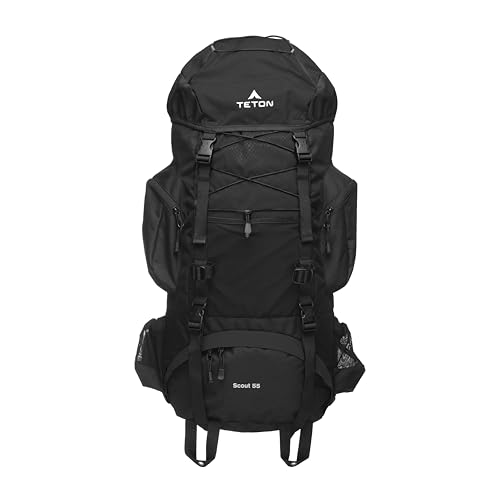
Pros
- Spacious 55L capacity organized with a separate sleeping bag compartment and multiple pockets
- Adjustable torso system allows medium and tall hikers to adjust harness positioning easily
- Includes an integrated rain cover, saving the expense and effort of sourcing a separate cover
- Internal frame and foam lumbar pad help distribute load weight effectively across the back
- Multi-directional exterior compression straps keep uneven gear loads secure and compact
Cons
- At 4.14 pounds empty weight, this pack is heavier than minimalist or ultralight trail options
- Torso adjustment is oriented toward medium and tall adventurers, which may not suit hikers with shorter torsos
- Hydration reservoir is not included and must be purchased separately to utilize the hydration pocket
The TETON Sports Scout 55L Internal Frame Backpack is an entry to intermediate backpacking pack built for hikers, campers, and travelers who require dependable load support and structured organization without premium gear costs. Equipped with a 55-liter capacity, this model suits overnight weekend trips, car-camping excursions, and gear-intensive day outings. It is engineered with a multi-position torso adjustment system designed for men and women with medium to tall builds who want a balanced, custom fit on the trail.
In terms of load management, the backpack relies on an internal frame structure that channels pack weight toward the hips and lower body. The back panel integrates an open-cell foam lumbar pad alongside molded channels designed to provide cushioning while promoting continuous airflow across the back. Measuring 16 x 30 x 10 inches and weighing 4.14 pounds empty, the Scout 55L balances durable structural components with manageable pack weight, giving recreational backpackers sufficient rigidity without the extreme heft of older external-frame models.
Organization is a distinct asset of this design, highlighted by a dedicated sleeping bag compartment at the base that allows easy access to camp sleep systems without unpacking the main hold. The pack also features spacious exterior compartments, multiple pockets for trail items, and multi-directional compression straps that pull cargo inward to keep weight centered. A designated internal hydration pocket supports hands-free hydration bladders, while an included protective rain cover stows neatly until wet conditions demand fast deployment.
Setting up the pack is straightforward thanks to the multi-position torso mechanism, which lets hikers adjust the shoulder harness height before heading out. Users should take the time to align the lumbar pad comfortably against the lower back and tighten the compression straps once packed to prevent gear shift. For ongoing maintenance, spot cleaning with mild soap, air drying thoroughly out of direct sunlight, and checking buckle points prior to departure will keep the hardware and fabric in good trail-ready condition.
A few practical limitations should be kept in mind before purchasing. The 4.14-pound empty weight puts this pack outside the ultralight category, which may deter long-distance thru-hikers focused strictly on base weight reduction. Additionally, because the multi-position torso system is built for medium and tall users, individuals with shorter torso measurements may struggle to find an optimal harness fit. Hikers should also note that while a hydration pocket is built in, a compatible reservoir and drinking tube must be purchased separately.
For weekend backpackers, trail newcomers, and outdoor enthusiasts seeking a dependable internal frame carrier, the TETON Sports Scout 55L delivers reliable utility and thoughtful compartment layout. The inclusion of a fitted rain cover, multi-directional load compression, and a dedicated sleeping bag section make it a practical, trail-ready choice for budget-conscious hikers.
The TETON Sports Scout 55L features a multi-position torso adjustment system engineered to fit medium and tall adventurers. Proper backpack fit requires setting the harness height so the lumbar pad rests securely on the lower back while the shoulder straps wrap comfortably around the chest without pinching or leaving large gaps.
Hikers should establish their harness setting at home with moderate weight loaded inside before hitting the trail. Shorter hikers should carefully evaluate their torso dimensions, as the harness geometry is tailored for medium to taller body frames and may not shorten sufficiently for smaller statures.
With a 55-liter total volume, the Scout 55L provides distinct compartments that simplify overnight trail packing. The lower sleeping bag compartment keeps bulky sleep systems isolated from damp clothing, trail snacks, and upper cargo, preventing unnecessary repacking during camp setup.
Multi-directional compression straps run across the pack body to pull heavy gear closer to the user spine, reducing sway on uneven terrain. Exterior compartments and side pockets offer organized storage for essential accessories, tools, and maps that need to be reached without opening the main internal body.

Pros
- Generous 65L gear capacity with a designated sleeping bag compartment
- Adjustable torso system accommodates medium and tall body profiles
- Includes an integrated rain cover for prompt wet-weather protection
- Open-cell foam lumbar support with molded airflow channels
- Multi-directional compression straps help stabilize loose loads
Cons
- Total pack weight of 4.5 pounds is heavier than ultralight alternatives
- Designed primarily for medium and tall frames, which may not fit shorter or petite hikers
- Hydration reservoir is not included and must be purchased separately
The TETON Sports Scout 65L is an internal-frame backpack built for hikers, campers, and travelers who require substantial gear-carrying volume without the high price tag of specialized technical rigs. Designed to serve both beginners and seasoned backpackers, this pack provides a structured internal frame that handles the bulk of overnight camp kits, clothing layers, and food provisions. Its balance of adjustable features and generous capacity makes it especially appealing for weekend backpacking trips and scout outings.
Trail utility centers on its 65-liter capacity and multi-position torso suspension. The harness adjusts across several positions to suit medium and tall adventurers, allowing users to position the shoulder straps and lumbar pad properly relative to their back length. Measuring 17 x 30 x 10 inches and weighing 4.5 pounds, the pack carries moderate base weight while using multi-directional compression straps to pull gear inward, minimizing pack sway and stabilizing the internal load across uneven surfaces.
The build emphasizes practical trail organization and solid back support. A thick open-cell foam lumbar pad cushions the lower back, complemented by molded channels designed to encourage airflow while on the move. Gear organization is straightforward thanks to a dedicated lower sleeping bag compartment, side compartments, and spacious main storage. For hydration, the pack features a dedicated internal hydration pocket, though a compatible reservoir must be supplied separately. An included rain cover adds valuable weather defense, deploying quickly over the pack when storms roll in.
Setting up the pack involves adjusting the rear harness ladder to your torso length, loosening the compression straps, and loading heavy items close to the spine. The separate sleeping bag compartment simplifies pitching camp, as your shelter and sleep system can be accessed without unpacking upper layers. Maintenance is simple: brush off dry trail dirt, hand-wash soiled spots with mild detergent, and ensure the pack and rain cover are thoroughly air-dried before storage to prevent mildew.
Potential buyers should note a few realistic limitations before purchasing. At 4.5 pounds empty, this pack sits well above ultralight territory, which may deter weight-conscious long-distance thru-hikers. Additionally, because the torso adjustment is specifically tailored for medium and tall frames, shorter hikers or those with petite torso measurements may struggle to find an optimal fit. The pack also relies on the included rain cover for foul weather, as standard pack materials and seams are not fully submersible or waterproof on their own.
Overall, the TETON Sports Scout 65L represents a practical, feature-dense option for hikers needing dependable gear capacity and solid adjustability. If you need a capable internal-frame pack for weekend backpacking, summer camping, or extended travel, its roomy layout, integrated rain protection, and customizable torso support provide outstanding real-world utility.
The TETON Sports Scout 65 utilizes a multi-position torso adjustment system engineered to fit medium and tall adventurers. This adjustable harness allows users to raise or lower the shoulder strap assembly to match their specific spine length, ensuring proper positioning over the shoulders and hips.
Hikers with shorter torso measurements should evaluate their back length before purchasing, as this pack is optimized for medium to taller builds. Aligning the lumbar pad squarely against the lower back while keeping the shoulder straps contouring smoothly over the collarbones is essential for balanced weight distribution on the trail.
With 65 liters of usable space, the Scout 65 offers a smart compartmentalized layout suited for multi-day itineraries. A separate lower compartment allows a sleeping bag to be stored independently from the main body, making camp setup and teardown much more efficient.
Multiple exterior pockets and multi-directional compression straps give users flexible options for securing gear. The compression webbing cinches excess volume when the pack is not fully loaded, while the internal hydration pocket keeps your water supply positioned close to the back panel for improved balance.
The TETON Sports Scout 65 includes a fitted rain cover designed to protect the pack exterior when inclement weather strikes on the trail. Having an integrated cover eliminates the need to source an aftermarket cover sized to fit a 65-liter frame.
While the rain cover shields gear from steady rainfall and splashing mud, hikers carrying moisture-sensitive electronics, sleeping bags, or down garments should still consider using internal dry sacks or pack liners during severe downpours for complete protection.
Matching Liter Capacity to Backcountry Trail Demands
Backcountry pack sizing depends directly on trip duration, seasonal weather conditions, and personal gear volume. For most hikers, a 30 to 50-liter pack covers fast weekend outings, a 50 to 65-liter pack serves as the standard multi-day benchmark, and a 65 to 75-liter chassis handles extended backcountry expeditions or winter treks. Determining the right volume requires looking at the actual space your core gear consumes rather than simply guessing based on trail mileage. Matching capacity to your kit ensures dense items ride close to your center of gravity without overloading your spine.
Standard Capacity Tiers by Trip Duration
Weekend trips spanning one or two nights typically require between 30 and 50 liters of total volume. Compact designs like the MIVENTO 30+5L pack or streamlined options like the Osprey Rook 50L fit neatly into this category. Hikers packing compact down sleeping bags, lightweight tents, and basic cooksets can comfortably manage two days of rations within this footprint. This capacity keeps total trail weight low and promotes agility over technical terrain, provided gear bulk remains disciplined.
Multi-day excursions lasting between three and five nights represent the most common backpacking scenario and usually demand 50 to 65 liters of storage. Packs such as the Teton 55L Scout, Teton 65L Scout, and Teton 65L Explorer operate directly within this popular sweet spot. This volume tier offers sufficient space for extra clothing layers, three to four days of food rations, a full-sized water filtration system, and emergency medical kits. The additional volume accommodates slightly bulkier three-season sleeping systems without requiring awkward external gear attachments.
Extended backcountry trips exceeding five nights or colder shoulder-season treks necessitate 65 to 75 liters or more. High-capacity frames like the Teton 75L Explorer provide the substantial cavern required for bulky synthetic insulation, mountaineering hardware, and extensive food stores. Packing for a week off the grid means carrying several pounds of dehydrated meals, supplemental stove fuel, and potentially an approved wildlife bear canister. Without adequate liter volume, packing these rigid, bulky supplies forces gear to bulge against internal frames and compromises trail comfort.
Gear Bulk and Base Kit Considerations
The single largest consumer of internal pack space is your backcountry sleep system. A compact down sleeping bag compresses down to roughly six to eight liters, whereas a budget synthetic bag can easily consume twelve to sixteen liters of main compartment space. Packs equipped with dedicated lower sleeping bag compartments, such as the Osprey Rook 50L with its floating divider, help corral this bulky gear at the base of the pack. Choosing a pack volume without measuring the packed size of your specific sleeping bag often leads to severe space shortages on trail morning.
Shelter dimensions also dictate whether a 50-liter or 65-liter pack is suitable for your trek. Freestanding double-wall tents packed with rigid aluminum poles consume considerable internal depth, often requiring dedicated vertical placement inside the main bag. Ultralight trekking pole shelters or minimalist tarps fold down into compact bundles that leave ample room for camp comfort items. External compression straps and bottom attachment loops provide auxiliary lash points, but keeping fragile tent fabrics inside the pack body protects them from brush snags.
Food and water supplies expand and contract throughout a backpacking trip, creating shifting internal space requirements. A standard hard-sided bear canister occupies approximately ten to twelve liters of non-compressible internal volume, which instantly fills smaller weekend packs. Hikers venturing into designated wilderness areas requiring approved food storage containers often need a minimum 60-liter pack to house the canister alongside sleeping gear. Planning internal volume around your largest non-compressible container prevents frustrating packing routines at dawn.
Seasonal Climate and Layering Demands
Summer backpacking in warm, predictable climates allows hikers to operate comfortably with smaller 35 to 45-liter packs. Warmer overnight temperatures eliminate the need for heavy fleece mid-layers, thermal leggings, or thick insulated parkas. A compact rain jacket and a lightweight summer quilt leave significant room for hydration bladders and trail snacks. Conversely, early spring and late autumn outings demand heavier garments that rapidly overwhelm compact packs.
Backcountry weather shifts rapidly, making integrated weather protection an essential factor in usable capacity. When unexpected precipitation strikes, packs featuring integrated, stowable rain covers, such as those included on Teton Explorer and Scout models or the Osprey Rook 50L, keep gear dry without robbing interior storage space. Durable 210D ripstop nylon fabrics provide baseline abrasion resistance, but water-resistant rain covers prevent soaked down insulation from gaining dangerous water weight. Maintaining dry insulating layers inside the pack remains vital for preventing hypothermia on exposed mountain passes.
Sub-freezing winter treks represent the most demanding scenario for internal pack volume. Cold-weather camping requires four-season tents with heavier snow stakes, zero-degree sleeping bags, insulated sleeping pads, and extra liquid fuel for melting snow. Bulky down mittens, hard-shell mountaineering jackets, and avalanche safety gear easily push equipment volume past 70 liters. Attempting to force winter survival gear into a medium three-season pack risks blown zipper seams and exposed down gear that compromises backcountry safety.
Internal Frame Dynamics and Suspension Engineering
A backpack internal frame serves as the structural bridge that transfers heavy gear weight from delicate shoulder muscles down to the hips. Quality internal frames utilize lightweight steel stays, contoured aluminum bars, or peripheral wire frames to stiffen the pack body. When properly fitted, roughly eighty percent of the pack weight rests comfortably over the pelvic iliac crest, leaving the shoulders unburdened. Exploring alternatives like budget trail daypacks illustrates how simpler, frameless packs struggle once trail loads exceed twenty pounds.
Back panel airflow becomes critical when hauling heavy multi-day loads across strenuous elevation gains. Advanced suspension systems like Osprey tensioned AirSpeed back panel elevate the pack body off the hiker back to promote constant convective cooling. Molded foam channels and open-cell foam lumbar pads, like those engineered into Teton Sports packs, provide cushioning while allowing moisture vapor to escape. Reducing sweat accumulation against the lower back minimizes skin chafing and maintains steady hiking comfort over eight-hour trail days.
The lumbar pad anchors the lower pack frame directly against the sacrum to eliminate side-to-side sway. A dense, contoured foam pad prevents the hard edges of internal frame stays from pressing painfully against sensitive spinal nerves. If a pack lacks adequate lumbar support, heavy gear pulls the chassis backward, forcing the hiker to lean forward and causing severe lower back fatigue. A balanced suspension system keeps the center of gravity aligned directly over the feet for surefooted mountain travel.
Torso Sizing and Harness Customization
Pack volume in liters means very little if the chassis does not match your anatomical torso length. Torso measurement runs along the spine from the protruding C7 vertebra at the base of the neck down to the imaginary horizontal line connecting the iliac crests of your hipbones. Hikers often mistakenly buy pack sizes based on their total standing height rather than their specific torso measurement. A tall hiker with a short torso requires a compact harness frame, while a shorter hiker with long spinal proportions needs an extended harness track.
Many modern multi-day packs incorporate multi-position torso adjustment ladders to fit a wide spectrum of trail enthusiasts. Packs in the Teton Scout and Explorer series utilize adjustable hook-and-loop or ladder systems that slide between medium and tall torso settings. This customizability allows different family members to share the same pack or lets hikers fine-tune harness height as layering thickness changes. Ensuring the shoulder harness wraps smoothly over the clavicle without creating empty air gaps or severe pinch points prevents upper back spasms.
Load-lifter straps connect the top of the shoulder harness to the upper internal frame at an ideal forty-five-degree angle. Gently cinching these straps pulls the upper pack weight closer to your spine, preventing the bag from peeling backward off your shoulders. The sternum strap secures across the mid-chest to keep the shoulder straps resting naturally away from delicate armpit nerves. Adjusting these tension straps while walking allows hikers to adapt to steep uphill ascents and jarring downhill descents without stopping.
Backcountry Packing Geometry and Weight Distribution
Organizing internal pack space correctly ensures that a 50 or 65-liter bag carries comfortably without pulling you off balance. The bottom zone of the pack should always house light, bulky items like your sleeping bag and camp clothing to create a stable base. Directly above this base layer, the dense core zone against your back should hold heavy items like food bags, water reservoirs, and cookstoves. Placing heavy mass against your spine prevents the pack from exerting lever-like torque on your lower back.
The upper cavity and perimeter pockets should store medium-weight gear and items needed throughout the hiking day. Rain shells, first aid kits, trail maps, and snacks belong in top lid compartments or front stretch pouches for rapid trailside retrieval. Side water bottle pockets must feature adequate depth and retention to prevent standard bottles from tumbling out on steep scree fields. Distributing weight evenly between left and right side compartments prevents asymmetrical muscular strain on long trail segments.
Multi-directional compression straps run along the exterior of packs to squeeze empty space out of the main compartment. If you carry a 65-liter pack on a short three-day outing, cinching these compression webbing straps pulls the load tight against the internal frame. This stabilization stops loose pots, pans, and food containers from rattling or shifting unexpectedly when scrambling over granite boulders. A compressed, quiet pack improves balance and reduces energy expenditure over rugged trail networks.
Common Liter Selection Mistakes on the Trail
One of the most frequent mistakes beginner backpackers make is purchasing an oversized 75 or 85-liter pack for simple summer weekend trips. Large packs encourage hikers to carry unnecessary luxury items, heavy camp tools, and redundant clothing simply because empty space exists. This phenomenon, often referred to as gear expansion, results in excessive trail weights that ruin backcountry enjoyment. Sticking to a disciplined 50 to 60-liter pack enforces smart gear selection and keeps base weights manageable.
Conversely, purchasing an ultralight 35-liter pack before upgrading your camp gear leads to frustrating trail mornings and damaged zippers. Hikers who attempt to stuff bulky entry-level synthetic sleeping bags and large family-style tents into compact daypacks frequently split zipper teeth or tear seam stitching. Your backpack should be the final piece of gear purchased after gathering your shelter, sleeping system, and camp kitchen. Knowing the exact packed liter volume of your existing kit ensures you select a pack that accommodates your supplies comfortably.
Focusing solely on interior liter capacity while ignoring the unladen tare weight of the backpack can also lead to trail disappointment. Ultralight frameless packs save pack weight but collapse painfully when loaded with thirty pounds of food and water. Sturdy internal frame haulers weigh between three and four and a half pounds empty, but their rigid frames transfer heavy loads cleanly to the pelvic girdle. Balancing pack tare weight against your required gear volume ensures reliable trail support across demanding wilderness terrain.
Practical Takeaways for Trail Volume Selection
Selecting the perfect liter capacity comes down to an honest assessment of your typical trip length, local climate, and gear dimensions. If you primarily embark on two to four-night outings in mild weather with standard backpacking gear, a 55 to 65-liter internal frame pack offers the greatest versatility. Weekend specialists with modern, compact gear can easily thrive with 45 to 50 liters, while long-distance hikers and cold-weather adventurers should lean toward 70 liters or more.
Before heading into remote backcountry areas, test your packed kit inside your chosen pack at home. Load your sleeping bag into the bottom compartment, place your food bag against the internal frame, and check that all compression straps cinch cleanly without straining fabric seams. Taking the time to dial in your torso harness, adjust load lifters, and balance internal weight guarantees a rewarding, comfortable journey into the wild.






Write Your Review
No reviews yet. Be the first to share your experience!