


Navigating crowded airport terminals without dragging a bulky rolling suitcase behind you makes moving through transit hubs much simpler. Many light travelers wonder if an everyday mid-sized pack can handle a multi-day trip while fitting into tight spaces. Determining whether an is 30l backpack enough for travel comes down to your personal packing discipline, climate demands, and gear volume. If you pack versatile apparel and streamline your electronic accessories, a thirty-liter capacity provides surprising flexibility for weekend escapes and longer journeys alike.
A streamlined pack saves time at check-in counters and eliminates the stress of checked luggage fees or lost baggage. Travelers seeking versatile gear often compare packable bags with dedicated commuter builds or explore budget hiking backpack options to find the right balance of support and affordability. Striking that balance means evaluating pack dimensions, strap ergonomics, and internal compartment organization. Knowing how to maximize a thirty-liter interior ensures you pack everything necessary without exceeding airline personal item thresholds.

Pros
- Hybrid layout seamlessly transitions between hiking trails and work commutes with a 17-inch laptop sleeve.
- Stowable hip belt tucks out of sight when not needed for trail stabilization.
- Dedicated hydration routing supports reservoirs up to 3 liters without taking up primary gear space.
- Shoulder strap essentials pocket allows immediate phone access without taking off the pack.
Cons
- Hydration bladder is not included and must be purchased separately.
- Treated with a water-resistant finish rather than a fully waterproof build, and no rain cover is included.
- Manufacturer does not specify exact torso measurement ranges or overall empty pack weight.
The TILYMOL 30L Hiking Travel Backpack is a hybrid daypack designed for day hikers, active travelers, and daily commuters who want trail functionality without sacrificing urban utility. Sized at 30 liters with exterior dimensions of 8.3 x 11 x 16.1 inches, this pack provides sufficient volume for food, layers, emergency essentials, and small outdoor gear, making it a flexible choice for budget-conscious hikers exploring state parks or managing everyday transit.
For trail use, the backpack features an ergonomic hip belt designed to keep the load close to your center of gravity during movement. When you transition from the trail to the airport or office, the hip belt stows away into a dedicated bottom compartment to eliminate dangling straps. On-the-move access is enhanced by a built-in shoulder strap pocket that fits most smartphones, vehicle keys, or transit passes, reducing the need to stop and unbuckle your pack to check navigation maps or messages.
Hydration management is integrated directly into the main storage area. The interior includes a dedicated hydration sleeve sized to fit reservoirs up to 3 liters, complete with an internal hanging strap to prevent the bladder from slouching as it empties. Drinking hoses route through a top exit port for easy access while hiking. In addition to outdoor features, the pack includes a separate padded compartment capable of holding laptops up to 17 inches, making it easy to carry tech gear securely during weekend getaways.
The backpack is built from rip-stop fabric engineered to resist abrasions and minor snags from brush or trailside branches. The fabric features a water-resistant finish to shed light mist and drizzle, and critical seams and stress points are reinforced with heavy-duty stitching for improved dependability. However, because it is water-resistant rather than waterproof, hikers venturing into heavy downpours should pack sensitive electronics in dry bags or purchase a separate external rain cover.
A practical consideration is that the manufacturer does not supply exact torso length ranges, hip-belt dimensions, or empty pack weight. Because the torso length is non-adjustable, fit will depend on individual body proportions, and very tall or broad-shouldered hikers may find the harness alignment fixed. Additionally, you will need to supply your own hydration reservoir, as one is not included in the package.
Overall, the TILYMOL 30L Daypack stands out as a versatile, low-cost companion for day hikers who also need a functional everyday carry bag. Its combination of a 3-liter hydration sleeve, stowable hip belt, shoulder-strap phone storage, and dedicated 17-inch laptop sleeve delivers balanced utility for trailheads, college campuses, and weekend travel alike.
The TILYMOL 30L Backpack is built hydration-ready to support active day hikes and warm-weather outings. Inside the main compartment, a dedicated hydration sleeve is tailored to hold bladders up to 3 liters in volume. An internal retention strap secures the top of your bladder to keep it standing upright, preventing shifting and sagging inside the pack as fluid levels drop.
A centrally located exit port at the top of the pack allows your drinking tube to route cleanly over the shoulder strap for immediate trailside sips. It is important to clarify that this pack does not include a hydration bladder, bite valve, or hose in the box; those accessories must be supplied by the user. The sleeve layout remains compatible with standard 1.5L, 2L, and 3L reservoirs from most major outdoor hydration brands.
A distinctive feature of the TILYMOL 30L Daypack is its dual-purpose design, allowing users to move between rugged trails and paved commutes without switching bags. For hiking, the ergonomic hip belt stabilizes the pack against your hips, reducing sway over uneven terrain. When navigating city streets, transit stations, or office hallways, the hip belt folds away into a discreet bottom compartment for a clean, snag-free exterior profile.
Organization is segmented to support both lifestyles. Outdoors, the shoulder strap pocket provides immediate access to your phone for trail photography or navigation. For urban travel and school use, an independent padded compartment houses laptops up to 17 inches, isolating delicate hardware from the rest of your trail gear or gym clothing.
Pros
- Folds neatly into an integrated pocket for compact storage inside suitcases or multi-day backpacking packs
- Spacious 30-liter volume split across three zippered sections and dual water bottle mesh pockets
- Bar-tack stitching across 14-plus stress points enhances structural integrity without adding pack weight
- Flap-free SBS zipper tracks reduce fabric catching and ensure smooth everyday operation
Cons
- Lacks an internal frame, rigid back sheet, or padded hip belt for supporting heavy trail gear loads
- Coated polyamide fabric repels light moisture but is not fully waterproof in prolonged downpours
- Does not include an integrated hydration bladder sleeve, hose port, or sternum strap
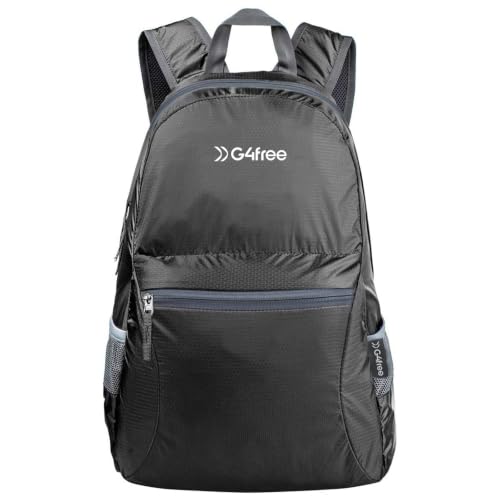
The G4Free 30L Packable Daypack is an ultra-lightweight, frameless travel and hiking backpack designed for quick excursions, summit pushes, and minimalist day outings. It folds directly into its own built-in interior pouch to roughly sandwich dimensions, making it an appealing secondary bag for travelers who want to leave heavy luggage at a basecamp or hotel and venture onto local trails with essential gear.
In terms of volume and organization, the pack offers 30 liters of structured space with overall dimensions measuring 18.8 inches high, 13 inches wide, and 7.5 inches deep. The storage layout is split into three main zippered compartments. The primary section easily accommodates lightweight clothing, an extra insulation layer, and bulkier trail necessities, while the outer front pocket holds fast-access items like maps, snacks, or keys. An interior zippered pocket protects personal valuables such as identification and cards, and two wide side mesh pockets hold standard drink containers or compact umbrellas.
Material construction relies on a water-resistant coated polyamide fabric designed to balance minimal weight against abrasion and tear resistance. To withstand the repeated pulling and shifting of regular trail outings, G4Free reinforces more than 14 stress points with heavy-duty bar-tack stitching. The pack also uses updated SBS zippers built without protective fabric flaps, which noticeably reduces the risk of the zipper teeth biting into the lightweight shell fabric during quick access.
Handling and packing the daypack is straightforward due to its collapsible structure. Unfolding the pack takes seconds, and the wide S-shaped shoulder straps feature breathable mesh to assist air circulation across your shoulders during warm outings. The straps adjust easily via standard friction ladders and lock firmly under light to moderate gear loads. Cleaning requires little more than wiping down the coated fabric with a damp cloth and allowing it to air dry before repacking it into its storage pouch.
Because this is a minimalist, packable model, it naturally presents carrying limitations when compared to structured daypacks. Without an internal frame, supportive back panel, load lifters, or a padded hip belt, carrying dense or heavy loads can cause the pack to sag against your back and place all carried weight directly on your shoulders. Additionally, while the coated polyamide shell sheds light rain and trail splatter, it lacks sealed seams or an included rain cover for heavy precipitation, and it does not feature a dedicated hydration reservoir port.
For hikers, travelers, and campers needing an inexpensive, ultra-compact daypack that stows away cleanly until needed, the G4Free 30L Packable Daypack delivers practical everyday functionality. It is best suited for carrying extra jackets, lunches, and water on casual day hikes, sightseeing trips, and airline travel where bulk and weight must be kept to an absolute minimum.
The G4Free 30L Daypack stands out primarily for its collapsibility, folding inward to fit inside its own internal zippered pocket. When packed away, the entire unit shrinks to roughly the size of a sandwich, allowing it to slide into luggage, carry-on bags, or the lid of an expedition backpacking pack without consuming noticeable space.
When unfolded, the 30-liter capacity provides ample room for day hikes that require multiple clothing layers, basic emergency gear, and packed meals. The three-compartment configuration separates clean garments from trail accessories, while the external side mesh pouches keep hydration accessible without opening the main compartment.
The pack is manufactured from a lightweight polyamide fabric treated with a water-resistant coating to shed mist, morning dew, and light drizzle. While this coating shields contents from incidental dampness, it is not engineered for submersion or sustained heavy rain, meaning sensitive electronics should remain in secondary dry bags.
Durability is reinforced through more than 14 bar-tack stitched seams positioned at high-strain junctions, including the shoulder strap connections. The hardware consists of smooth-gliding SBS zippers engineered without overlapping fabric flaps, minimizing snagging issues commonly found on ultra-lightweight nylon and polyamide bags.
Evaluating 30L Backpacks for Modern Travel Needs
Choosing luggage often involves deciding between heavy rolling suitcases and compact travel packs. For many adventurers, is 30l backpack enough for travel is the central question before committing to a one-bag journey. A thirty-liter volume occupies a practical middle ground between everyday commuter packs and full-sized carry-on luggage. Understanding how this specific capacity performs across different itineraries helps you travel efficiently without feeling weighed down by excessive gear.
The Core Capacity Verdict: When 30 Liters Is Plenty
A thirty-liter backpack offers roughly 1,800 cubic inches of internal volume, which is generally ample for three to seven days of travel. Minimalist travelers who wash clothes during transit or utilize quick-drying fabrics often extend this capacity indefinitely. The available packing space comfortably holds three to four shirt changes, two pairs of pants or shorts, adequate underwear, a light jacket, and essential toiletries. Packing efficiency depends heavily on avoiding duplicate items and selecting compact, versatile clothing.
Short weekend getaways, city tours, and temperate summer vacations represent ideal scenarios for a pack in this volume category. When travel does not require heavy cold-weather outer layers or specialized sports gear, thirty liters avoids empty interior slack while keeping total weight manageable. Travelers frequently appreciate the freedom of moving through crowded train stations without dragging cumbersome wheeled bags. For focused itineraries where simplicity is the primary goal, this volume hits a dependable sweet spot.
Trip Duration and Climate Considerations
Destination weather plays an enormous role in determining whether thirty liters provides sufficient packing space. Warm climates allow you to pack lightweight linen, merino wool, or synthetic apparel that compresses into minimal volume. A week of tropical attire takes up less than half the interior room of two bulky winter fleece sweaters. When traveling to sunny regions, a thirty-liter pack often leaves spare room for small souvenirs or extra accessories.
Cold-weather destinations present a much greater volume challenge for compact packs. Heavy knit sweaters, thermal base layers, winter gloves, and insulated footwear quickly consume the primary compartment. Travelers heading into chilly regions must wear their heaviest coat, boots, and thickest layer during transit to conserve internal pack space. If an itinerary requires formal wear or multiple pairs of shoes, thirty liters can feel restrictive without aggressive compression techniques.
Trip duration matters less than your access to laundry facilities while traveling. A traveler with access to a sink or local laundromat can comfortably live out of a thirty-liter bag for several weeks. Packing for five days requires roughly the same clothing as packing for a month if you adopt a weekly washing routine. The practical boundary of thirty-liter packing lies in clothing thickness rather than the number of travel days.
Airline Compliance and Overhead Bin Clearance
One of the strongest arguments for using a thirty-liter pack is seamless airline compliance. Standard carry-on limits typically restrict luggage to 22 by 14 by 9 inches, accommodating bags up to forty liters. A thirty-liter backpack measuring approximately 48 by 33 by 19 centimeters (roughly 19 by 13 by 7.5 inches) easily fits overhead racks on narrow-body aircraft and regional jets. You avoid gate-check mandates and save substantial time by bypassing baggage claim entirely.
Personal item regulations create an additional dimensional consideration for budget airline flyers. Strict budget carriers often set personal item size limits around 18 by 14 by 8 inches to ensure gear fits under the forward passenger seat. Unstructured or compressible thirty-liter packs can often squeeze into these smaller sizer boxes if they are not overstuffed to maximum capacity. Rigid frames or fully packed external pockets, however, may cause a thirty-liter bag to bulge beyond under-seat thresholds.
Checking airline baggage specifications before heading to the departure gate prevents unexpected fees. Soft-sided bags constructed without internal rigid stays provide the flexibility to compress slightly when placed into strict measurement boxes. Keeping the upper corners and external stash pockets lightly packed allows the bag to flex into tighter spaces. This dimensional flexibility makes thirty-liter travel packs vastly superior to rigid hard-shell roller cases on regional flights.
Structured Travel Packs Versus Packable Ultralight Daypacks
Not all thirty-liter backpacks approach cargo management and carrying support in the same way. Structured travel models feature integrated foam padding, shaped back panels, dedicated electronics sleeves, and supportive harness systems. These bags prioritize load stability and tech protection, making them well-suited for carrying laptops, electronics, and dense cargo. The trade-off is a higher unladen bag weight and a fixed external profile that cannot be easily stowed away.
Packable ultralight models, in contrast, utilize thin, flexible fabrics that fold down into small integrated storage pouches roughly the size of a sandwich. These minimalist designs eliminate heavy internal padding and rigid frames to achieve exceptional portability. They serve as reliable secondary bags that travel inside larger luggage until deployed for day hikes, market shopping, or side excursions. When used as a primary travel pack, a packable model requires careful clothing arrangement to prevent hard items from poking into your back.
Choosing between these two designs depends on whether you value carrying ergonomics or pack portability. A structured pack provides superior shoulder cushioning and weight transfer during long walking commutes between transit stations. An ultralight packable option offers practical adaptability for travelers who want minimal tare weight and maximum flexibility. Recognizing your transit style helps you select the right pack architecture for your specific journey.
Harness Ergonomics and Weight Distribution
Carrying comfort depends significantly on how effectively a backpack transfers weight across your upper body. Padded S-shaped shoulder straps lined with breathable air mesh help distribute downward pressure away from sensitive collarbone nerves. Ergonomic contouring keeps the straps centered on your shoulders, reducing the risk of chafing during extended walking tours. Without sufficient strap padding, a fully loaded thirty-liter bag weighing fifteen to twenty pounds can quickly cause shoulder fatigue.
Stowable or integrated hip belts provide vital stabilization when navigating steep hills or moving briskly through terminals. While light frameless packs rely on shoulder suspension, a hip belt anchors the lower edge of the bag against your lumbar spine to prevent swaying. When traversing trails with extra supplies, consulting an internal frame backpack guide illustrates how rigid stays transfer load to the pelvis. On versatile daypacks, a tuck-away belt offers stability on the trail without dangling awkwardly in cities.
Sternum straps further refine harness stability by pulling the shoulder straps slightly inward across your chest. This inward tension prevents the straps from slipping outward when you wear slick synthetic jackets or carry uneven loads. Keeping heavy items, such as laptops or water bladders, positioned close to your spine maintains a natural center of gravity. Proper harness adjustment prevents backward pack sag and protects your lower back from cumulative muscular strain.
Tech Protection and Internal Organization
Modern travel requires dedicated storage for valuable electronic devices alongside traditional apparel. Many structured thirty-liter packs incorporate independent, padded compartments capable of sheltering laptops up to seventeen inches. A dedicated laptop sleeve keeps expensive hardware separated from clothing, toiletries, and exterior moisture. Having top or side zipper access to your computer speeds up security screening lines at airport checkpoints.
Quick-access exterior storage provides immediate convenience when traveling through unfamiliar cities. Pockets positioned on the shoulder harness allow you to grab a smartphone, transit card, or room key without taking the pack off your back. Deep exterior mesh side pockets securely hold water bottles or travel umbrellas, keeping hydration accessible during outdoor excursions. Dedicated inner security pockets with zip closures protect passports, emergency cash, and identity cards against opportunistic loss.
Balancing specialized organizational pockets against open cavity space is an important packing consideration. Excessive internal dividers, pen slots, and small pouches can actually rob usable volume from the main packing compartment. Packs that feature a large, unobstructed primary compartment allow you to utilize modular packing cubes effectively. Selecting a pack with a sensible layout ensures your small gear stays organized without sacrificing the room needed for clothing.
Textile Durability and Weather Resistance
Travel gear encounters intense mechanical friction, rough luggage racks, and unpredictable outdoor weather. High-performance ripstop fabrics woven from nylon or polyamide fibers offer excellent resistance against tears and abrasions. A ripstop weave incorporates reinforced cross-hatch grid patterns that stop small punctures from expanding across the panel. Reinforced bar-tack stitching at high-stress points ensures the seams withstand heavy loads over time.
Surface water-resistant finishes help protect internal contents from sudden rain showers and damp transit floors. These topical coatings cause light precipitation to bead up and roll off the fabric rather than soaking through the weave. However, water-resistant fabrics do not make a pack completely waterproof during sustained downpours. Seams, needle perforations, and zipper coils remain vulnerable entry points for moisture unless protected by storm flaps or waterproof laminates.
Zipper hardware durability is equally essential for trouble-free travel. Heavy-duty SBS or reverse-coil zippers engineered without snag-prone fabric flaps operate smoothly even when the compartment is fully packed. Smooth zipper action prevents split teeth, derailed sliders, and fabric jams that can ruin a trip. Checking zipper tracks periodically for dirt and lint helps maintain reliable performance across diverse travel environments.
Strategic Packing Methods to Maximize Thirty Liters
Maximizing thirty liters requires thoughtful organization and space management techniques. Compression packing cubes represent one of the most effective tools for condensing clothing volume inside a mid-sized bag. By squeezing out excess air between fabric fibers, compression cubes reduce clothing bulk by twenty to thirty percent. Grouping shirts, underwear, and pants into separate color-coded cubes also simplifies unpacking in tight hotel rooms or hostel dorms.
Rolling garments instead of traditional flat folding prevents deep wrinkles while filling negative space efficiently. Tightly rolled t-shirts and socks fit neatly into perimeter gaps and corners around structured packing cubes. Footwear selection demands strict discipline, as extra shoes represent the single largest consumer of internal luggage volume. Wearing your primary walking shoes during transit and packing at most one flat pair of sandals or loafers preserves vital space.
Decanting liquids into compliant three-ounce containers minimizes toiletry kit bulk. Solid grooming products, such as shampoo bars, solid deodorants, and toothpaste tablets, eliminate liquid restrictions and prevent messy bag leaks. Stashing dense charging cables and power adapters in a compact tech pouch keeps loose cords from tangling around clothing. These methodical habits transform thirty liters from a cramped container into a spacious, organized travel kit.
Backpack Maintenance and Coating Preservation
Proper cleaning and routine maintenance keep technical fabrics looking sharp and performing reliably for years. Travel exposes bags to street dust, airport conveyor grime, and spilled beverages. Machine washing a travel backpack is strongly discouraged because mechanical agitators and spin cycles can tear reinforced stitching. Harsh detergents and warm water can also cause internal polyurethane water-resistant backings to peel, flake, or become sticky.
Hand washing represents the safest method for cleaning coated synthetic packs. Use a soft nylon brush, lukewarm water, and a mild non-detergent soap to spot-clean soiled exterior panels. Submerging the entire pack in a tub of cool water allows you to rinse away embedded trail sweat and grime without stressing bonded seams. After rinsing thoroughly, hang the backpack upside down in a shaded, well-ventilated area to air-dry completely.
Never expose a technical backpack to high heat in a tumble dryer or direct midday sunlight. Excessive heat can warp molded panels, degrade foam shoulder strap padding, and melt thin waterproof laminates. Inspecting stress points and zipper tracks after each journey ensures your gear remains ready for subsequent adventures. Consistent, gentle care preserves the structural integrity and weather resistance of your travel pack over time.
Final Practical Checklist for 30L Travel
Deciding if thirty liters works for your next trip requires an honest evaluation of your personal travel style. If your itinerary involves hopping between transit hubs, staying in modest accommodations, and traveling light, this capacity delivers unmatched mobility. You gain the agility to walk directly off the airplane into the city center without waiting for baggage handlers. For travelers willing to curate a compact capsule wardrobe, thirty liters provides more than enough capability for unforgettable journeys.
Before packing your bag for an upcoming departure, assemble all desired gear on your bed and test-fit everything inside the main compartment. Ensure the bag zips shut smoothly without placing excessive lateral tension on the zipper teeth or seams. Weigh the packed bag to confirm it stays within your airline carry-on weight limits and feels comfortable on your shoulders. Mastering thirty-liter travel opens up a more liberating, agile, and stress-free way to explore the world.






Write Your Review
No reviews yet. Be the first to share your experience!