


Transitioning from casual day hikes to overnight wilderness trips often prompts hikers to assess their existing gear before investing in heavy multi-day haulers. Packing an overnight load into a compact 20 to 35-liter bag presents severe spatial challenges, raising the question of whether can you use a daypack for backpacking without compromising trail safety. Standard daypacks prioritize agility, minimal unladen tare weight, and streamlined panel access for light gear like water bottles and rain shells. When hikers attempt to compress sleeping bags, shelter components, and cooking kits into small volumes, the structural limits of unpadded waist belts and flexible back panels quickly become obvious. Exploring whether an everyday trail bag can manage overnight journeys requires balancing gear bulk against human endurance.
Ultralight enthusiasts frequently demonstrate that minimal overnight base weights make sub-30-liter trips feasible during fair-weather conditions. However, typical recreational hikers carry bulkier synthetic sleeping insulation, rigid tent poles, and multiple days of dense food rations that overwhelm lightweight suspension systems. Relying on an unstructured bag for heavy loads shifts weight away from the pelvis directly onto the collarbones, creating trapezius pinching and spine fatigue. Comparing technical frameless bags with dedicated internal frame backpack options clarifies the physical boundaries between single-day outings and backcountry expeditions. Understanding how volume limits, harness architecture, and gear compression intersect helps hikers decide when a daypack suffices and when a dedicated multi-day rig is essential.

Pros
- High-strength NanoFly fabric reinforced with triple-grid UHMWPE ripstop for rugged trail environments
- Injection-molded framesheet and adjustable torso system provide structured load support
- Lightweight 2.11-pound design with an integrated hipbelt for stable, active carrying
- Internal hydration sleeve with a central pass-through port simplifies water bladder management
- Convenient panel-loading zipper access makes packing and retrieving gear straightforward
Cons
- 20-liter capacity requires disciplined packing and will not accommodate bulkier multi-day gear
- Hydration reservoir is not included and must be purchased separately
- Does not include an integrated rain cover for wet weather conditions
The Osprey Tempest Pro 20L is a technical, women-specific daypack engineered for active day hikers, scramblers, and fast-moving trail enthusiasts who need structural support without unnecessary bulk. Sized at 20 liters and weighing 2.11 pounds, this pack bridges the gap between ultralight trail bags and fully framed packs. It is built for day trips where gear demands durability against brush, rock, and rough terrain, while remaining compact enough to encourage swift movement on steep ascents.
Structured around an injection-molded framesheet, the Tempest Pro 20L provides a solid back foundation that supports gear weight without collapsing under tension. The integrated torso adjustment allows users to customize the distance between the shoulder harness and hipbelt, accommodating a spectrum of women's torso lengths. Combined with the stabilizing hipbelt, this suspension system transfers pack weight toward the hips and stabilizes cargo against body sway during technical scrambles or brisk hiking.
Durability is a key focus of the Tempest Pro series, highlighted by the use of Osprey's proprietary NanoFly fabric. This material is reinforced with a triple-grid UHMWPE (Ultra-High-Molecular-Weight Polyethylene) ripstop designed to resist abrasions, tears, and abrasive surfaces encountered along rocky trails. Complementing the main body, extra-tough stretch pockets provide flexible exterior storage that resists snagging, making the pack resilient in overgrown environments where standard nylon meshes might fail.
Loading and organizing gear is handled through a wide panel-loading design that zips open directly into the main compartment. This eliminates the need to dig through a top-loading collar to retrieve mid-layers or snacks. For on-trail hydration, an internal reservoir sleeve features a center pass-through port, allowing you to route a drinking hose smoothly over either shoulder. Note that while the sleeve accommodates a bladder, the hydration reservoir itself is not included with the pack and must be purchased separately.
While the Tempest Pro 20L excels on fast-paced day outings, its compact 20-liter capacity limits gear volume, making it unsuitable for gear-heavy cold-weather treks or overnight backpacking without extreme ultralight gear. Additionally, the pack does not come with an integrated rain cover, meaning hikers facing persistent or heavy rain will need to invest in a separate pack cover or waterproof pack liner. The technical focus and high-end materials also cater toward performance-oriented users rather than casual around-town walkers.
For female hikers seeking a durable, lightweight daypack with genuine frame structure and custom torso adjustability, the Osprey Tempest Pro 20L is a dependable choice. Its combination of UHMWPE-reinforced fabric, streamlined panel access, and stabilizing hipbelt delivers reliable performance across rocky ridges, steep day hikes, and athletic outdoor pursuits.
The Osprey Tempest Pro 20L features an injection-molded framesheet that delivers consistent structural rigidity across the pack body. This helps keep heavier trail items from pressing uncomfortably into your back while maintaining an even shape.
Equipped with an adjustable torso design, the pack allows female hikers to align the shoulder harness with their specific back length. The integrated hipbelt provides essential contact points to anchor the lower pack and prevent side-to-side shifting on uneven terrain.
The pack exterior utilizes technical NanoFly fabric integrated with a triple-grid UHMWPE (Ultra-High-Molecular-Weight Polyethylene) ripstop grid. This construction offers superior strength-to-weight performance and exceptional resistance against scrapes from granite, branches, and rough surfaces.
The exterior stretch pockets are also constructed from heavy-duty stretch materials engineered to withstand friction and repeated stretching without fraying or puncturing under typical trail conditions.
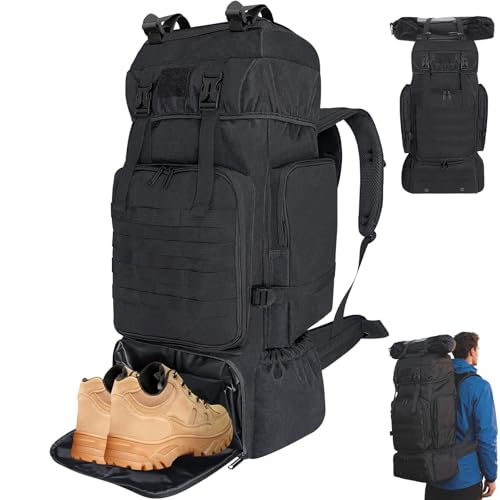
Pros
- High 70-liter gear volume combined with a lightweight empty pack weight under 2.9 pounds
- Separate ventilated footwear pocket keeps dirty shoes away from main pack contents
- External MOLLE loops and top lash webbing allow modular gear attachment
- Extensive pocket layout makes organizing camp accessories straightforward
Cons
- Lacks rigid internal frame stays for transferring heavy loads directly to the hips
- Water-resistant fabric does not substitute for a fully waterproof rain cover during heavy downpours
- Large 70L profile can feel bulky when carried without a full load
The Vaupan 70L Hiking Backpack is a high-volume, tactical-inspired outdoor rucksack tailored for budget-minded campers, travelers, and recreationists who need substantial storage space. Blending the top-loading format of a trekking rucksack with modular MOLLE utility, this pack suits weekend campers, road-trippers, and outdoor hobbyists seeking extensive organization without the premium price tag of high-end mountaineering packs.
Trail utility centers on an expansive 70-liter cargo capacity that easily holds sleeping bags, clothing layers, and camping cookware. Weighing approximately 2.87 pounds with dimensions of 27.6 by 17.3 by 10.2 inches, the pack remains relatively light given its overall physical dimensions. Weight management relies on an adjustable sternum strap and a waist belt to stabilize the pack against your body, while widened S-curve shoulder straps and an elastic, breathable back panel help cushion the contact points and encourage basic airflow during warmer outings.
In terms of materials, the pack is built from 900D Oxford fabric selected for water-resistant and tear-resistant resilience on abrasive outdoor terrain. Vaupan reinforces stress points with heavy-duty stitching and installs sturdy zippers across the exterior accessory pockets. While the treated Oxford shell provides reliable protection against light trail dampness or mist, hikers facing steady rainfall will still want to use dry sacks or an aftermarket rain cover since the pack is not fully seam-sealed.
Organization is a major strong point, anchored by an accessible multi-compartment design. The main cargo area uses a traditional top drawstring closure, supported by a zippered lid pocket, a front zipper pocket, two side zippered compartments, and two stretch mesh pockets for quick water bottle access. At the base, a specialized waterproof compartment with dual ventilation eyelets isolates muddy boots or damp apparel from the rest of your equipment. When not carrying extra shoes, this lower pouch can be collapsed upward into the main compartment to maximize internal packing volume.
Prospective buyers should keep realistic expectations regarding load support and framing. Because this pack is soft-structured without rigid internal aluminum stays or micro-adjustable torso sizing, carrying extremely heavy or dense equipment over rough backcountry terrain can place greater strain on the shoulders. Furthermore, while the upper lash straps and front MOLLE webbing make attaching sleeping pads or small pouches easy, placing heavy accessories too far outward can shift your center of gravity.
For campers, weekend backpackers, and travelers seeking massive carrying capacity and versatile pocket layouts at an accessible price, the Vaupan 70L Tactical Backpack delivers solid everyday utility. Its combination of lightweight empty carry, modular webbing, and dedicated shoe storage makes it a practical option for casual outdoor recreation and gear-heavy travel.
With a rated 70-liter capacity, this rucksack offers abundant space for sleeping systems, extra clothing, camp accessories, and food supplies. The main body loads from the top via a drawstring closure, allowing easy access to bulky gear packed in the center.
Dedicated storage options include a top zippered hood pocket for quick-grab essentials, a front accessory pocket, two zippered side compartments, and dual side stretch pouches. The lower compartment features waterproof lining and twin ventilation grommets designed specifically for dirty hiking footwear or wet layers, and it folds flat when not in use to leave the main cavity completely open.
The exterior shell is crafted from 900D Oxford fabric, offering durable tear resistance and water-resistant performance against light trail moisture and brush abrasions. Heavy stitching at key harness joints and sturdy zipper pulls enhance overall durability during outdoor trips.
To assist with load management, the backpack incorporates widened and padded S-curve shoulder straps alongside a high-elasticity breathable back panel. An adjustable chest strap and integrated waist belt help keep the load snug against your center of gravity during transit.
Assessing Daypack Viability for Overnight Backpacking Trips
Using a single-day bag for multi-day backcountry trips is technically possible under strict ultralight parameters, but it presents distinct physical challenges. The primary difference lies in how volume, suspension architecture, and carried mass interact over extended trail miles. While experienced fastpackers occasionally complete weekend routes with sub-30-liter bags, doing so requires specialized, low-bulk gear. For the average hiker carrying standard gear, attempting an overnight journey with a compact daypack often leads to compromised comfort.
The Technical Feasibility of Overnight Daypack Trips
A direct answer to whether a daypack works for backpacking depends on your total gear volume and weight. Traditional backpacking setups generally demand 45 to 70 liters of pack volume to fit tents, sleeping systems, and cookware. A typical daypack offers only 15 to 35 liters, cutting available packing space significantly. Using a daypack therefore requires reducing your gear down to minimal essentials.
Weather conditions dictate whether this minimalist approach remains safe in backcountry terrain. In warm, dry summer climates, packing a compact tarp and down quilt into a 25-liter cavity is manageable. Conversely, colder seasons demand insulated garments, heavy-gauge rain gear, and extra food that rapidly overflow a small bag. Pushing a daypack into freezing environments often leaves insufficient space for critical gear.
Harness support represents another critical boundary that limits single-day packs during overnight travel. Daypacks are engineered to carry loads weighing between 8 and 15 pounds. When loaded past 20 pounds with overnight supplies, unpadded shoulder straps dig into the trapezius muscles. Without an internal frame to transfer mass down to the hips, carrying overnight weight in a daypack quickly causes muscular fatigue.
Capacity Constraints: Analyzing Liters Versus Bulk
Volume displacement is the primary hurdle when attempting to load overnight gear into a daypack. Sleeping insulation, weather shelters, and sleeping pads represent the bulkiest gear items in any backcountry kit. In a full-sized multi-day hauler, these items occupy roughly half the pack interior. In a 20-liter pack, an average synthetic sleeping bag can consume the entire main compartment alone.
Packing small requires an honest evaluation of item compressibility alongside weight. Down-filled sleeping quilts compress significantly tighter than synthetic-fill bags, fitting into tiny stuff sacks. Compact foam pads or ultralight inflatable mats also displace minimal space compared to traditional camp mattresses. Unless every bulky item in your sleep kit compresses to micro proportions, forcing items into a daypack causes zipper stress.
Compartment layout also influences how efficiently volume can be utilized in smaller packs. Many everyday daypacks feature partitioned interiors and padded laptop sleeves that consume interior clearance. Outdoor-specific technical daypacks, like the Osprey Tempest Pro 20L Women’s Hiking Backpack, utilize streamlined panel access and resilient NanoFly fabric to maximize room. However, rigid pocket dividers in standard bags restrict irregular shapes like cook pots.
Suspension Architecture and Load Transfer Mechanics
The suspension system separates dedicated multi-day packs from standard everyday daypacks. True backpacking packs rely on rigid internal stays or composite framesheets engineered to transfer pack weight directly to the pelvic girdle. This biomechanical transfer spares the shoulders and spine from carrying dense vertical loads over steep ascents. A broad, padded hip belt wraps securely over the iliac crest to anchor the pack.
Most standard daypacks lack rigid frame structures entirely, relying instead on flexible foam back sheets or unstructured fabric panels. While high-end technical daypacks incorporate injection-molded framesheets and adjustable torso harnesses to stabilize moderate loads, their hip belts remain minimal. Thin webbing belts keep a daypack from swaying laterally, but they cannot support heavy downward pressure. Heavy loads then rest directly on the shoulders.
Carrying unsupported weight changes your posture and increases energy expenditure on rugged trails. Without load-lifter straps to pull the pack top closer to your center of gravity, the bag sags backward, exerting torque on your lumbar spine. Hikers naturally compensate by leaning forward at the waist, placing continuous tension on the back. Over an extended hike, this poor posture contributes to premature exhaustion.
The Role of Ultralight Base Weight
Backpacking with a daypack becomes realistic only when a hiker achieves a true ultralight base weight. Base weight refers to the total mass of all carried gear, excluding consumables such as food, water, and fuel. Ultralight hikers maintain a base weight under 10 pounds, allowing total pack weight to remain under 18 pounds. At this diminished threshold, the absence of a heavy frame is manageable.
Achieving a sub-10-pound base weight demands significant financial investment in specialized gear materials. Hikers rely on shelter systems crafted from composite fabrics, technical ripstop textiles, and premium down insulation. These materials provide exceptional warmth-to-weight ratios and compress down into minuscule footprints. Hikers operating with standard nylon tents and budget sleeping gear typically carry base weights of 18 to 25 pounds, which overwhelm daypack harnesses.
Hikers exploring budget-conscious options often look for balanced solutions that avoid the extremes of fragile minimalist kits. Examining affordable trail backpack options demonstrates that higher-volume internal frame packs can frequently be acquired without spending excessive funds on fragile gear. Carrying a slightly heavier pack that distributes weight properly is far more comfortable than cramming heavy budget gear into a tiny daypack.
Managing the Big Three: Shelter, Sleep, and Pack
Outdoor enthusiasts frequently refer to shelter, sleeping systems, and the pack itself as the core big three. In conventional backpacking, these three components weigh between 10 and 15 pounds combined and require considerable space. To fit everything into a daypack, the total volume of your shelter and sleep kit must shrink dramatically. Hikers often swap freestanding tents for minimalist flat tarps or bivy sacks.
Sleep systems also undergo extreme reduction when using a small daypack. Down quilts without full-length zippers or hoods save considerable bulk compared to traditional mummy sleeping bags. Inflatable sleeping pads must be rolled tightly with all air evacuated, sometimes replacing full-length pads with torso-length foam mats. If you carry a standard three-person tent and synthetic sleeping bag, using a daypack is practically impossible.
The daypack itself must also possess high tear strength to withstand dense packing. Technical fabrics like the triple-grid ripstop found on premium outdoor packs resist seam failure when gear is pushed firmly into corners. When an unstructured daypack is packed to maximum capacity, fabric tension creates a barrel shape. This rounded shape pushes against the hiker’s spine, preventing the back panel from sitting flat.
Exterior Attachment Risks and Center of Gravity
When interior volume runs out, hikers frequently attempt to lash bulky gear to the outside of a daypack. Tying sleeping pads, tents, and camp shoes to exterior daisy chains or compression straps seems like a quick solution. However, strapping heavy items to the exterior introduces severe balance problems. Exterior loads shift dynamically with every step, throwing off your balance on narrow ridgelines or rock crossings.
External gear is also highly vulnerable to trail hazards like dense brush, rock abrasion, and inclement weather. Sleeping bags lashed to the bottom of a pack can easily snag on low branches, puncturing stuff sacks and exposing dry insulation to rain. Once down insulation gets wet on a backcountry trip, it loses its loft and thermal efficiency. Keeping all critical sleep layers sealed inside remains essential.
Leverage mechanics also work against the hiker when heavy gear sits far away from the body. Dense gear should always sit directly against your spine between shoulder blade height and lumbar level. When tents are tied to the outer panel of a daypack, their mass acts as a lever pulling your torso backward. This continuous backward drag strains shoulder harnesses and accelerates physical fatigue.
Consumable Storage: Food, Water, and Bear Safety
Consumables constitute the heaviest and least compressible portion of any backpacking kit. A standard hiker consumes approximately 1.5 to 2.5 pounds of food per day, alongside two to three liters of water weighing roughly 4.4 to 6.6 pounds. On a two-night trip, food and water alone add nearly 12 pounds of dense weight. Fitting several days of meals alongside hydration bladders leaves very little remaining daypack space.
Bear canisters create an absolute physical barrier to using daypacks in regulated wilderness zones. Many national parks and wilderness preserves require hard-sided bear canisters to store food and scented items securely. Standard canisters measure roughly 8 to 9 inches in diameter and 12 inches in height, with a rigid shape that cannot be compressed. Fitting a hard-sided canister inside a daypack consumes virtually the entire main compartment.
Carrying a bear canister on the exterior of a daypack is equally impractical and hazardous. Smooth plastic canisters offer poor attachment points, tending to slip out of webbing straps during steep ascents. Also, placing a five-pound canister on the outside of a tiny daypack severely alters your center of gravity. If your route passes through bear-managed wilderness requiring canisters, you must use a larger pack.
Comparing Compact Daypacks to Dedicated Wilderness Haulers
Understanding where specific models fit across the gear spectrum helps clarify practical pack selection. A technical single-day bag like the Osprey Tempest Pro 20L Women’s Hiking Backpack excels on fast-moving day ascents, scrambles, and alpine trail runs. Its injection-molded framesheet and adjustable torso system provide stability for 10- to 15-pound loads, while internal hydration ports simplify fluid intake. However, with only 20 liters of volume, it is built for single-day agility.
At the opposite end of the capacity spectrum, large expedition packs like the Vaupan 70L Hiking Backpack for Men Women Camping provide the vast volume needed for extended camping expeditions. With dedicated shoe compartments, tactical webbing straps, and sprawling interior volume, a 70-liter pack easily accommodates bulky tents, sleeping systems, food stores, and cookware. Such large haulers are designed to carry multiple days of supplies without requiring expensive micro-gear.
The ideal middle ground for weekend backpacking trips typically sits between 45 and 55 liters for most hikers. This volume bracket accommodates standard compact tents, sleeping pads, and three days of food comfortably without bulging seams. Attempting to force a 20-liter daypack to do the job of a 50-liter backpack creates safety risks, whereas carrying an underfilled 70-liter pack adds empty fabric weight. Evaluating your actual gear inventory prevents choosing an improper pack.
Pre-Trip Assessment and Practical Packing Protocol
Before attempting an overnight outing with a daypack, hikers must perform a thorough pre-trip packing trial at home. Lay out every necessary item, including base layer clothing, rain protection, shelter, sleep insulation, water filtration, first aid, and planned rations. If any mandatory safety item must be left behind to make the load fit into your daypack, you must immediately abandon the daypack plan. Never compromise emergency warmth or basic safety gear.
Test your loaded daypack on a challenging three-mile local hike before venturing into remote wilderness areas. Walk at a normal pace and monitor how the shoulder harness and back panel feel across varied terrain. Notice whether the shoulder straps pinch your neck muscles or if the pack rubs against your lower lumbar spine. If you experience upper back soreness during a short trial, carrying that load all day will prove exhausting.
Verify that your pack fabric and zipper seams are not under structural strain once everything is loaded. Overstuffed zippers can burst open unexpectedly on the trail when lateral stress overcomes the zipper coils. Check that water bottles remain accessible from side pockets without popping out when you lean forward over rocks. A methodical home assessment guarantees that your pack matches the demands of your journey.
Selecting the right pack ultimately comes down to matching your personal gear inventory with trail safety demands. While skilled ultralight hikers with high-end micro-gear can occasionally use a daypack for short overnight trips, standard weekend backpacking requires the dedicated support of a larger framed pack. Prioritizing proper load transfer, adequate volume for essential safety items, and balanced weight distribution ensures every backcountry adventure remains safe and rewarding.






Write Your Review
No reviews yet. Be the first to share your experience!