


Stepping onto a rocky mountain trail with a thirty-pound load on your spine quickly reveals every weak point in your knees, ankles, and posture. While some traditionalists prefer walking empty-handed, a vast majority of multi-day hikers rely on dual supports to stabilize their center of gravity and distribute heavy gear weight across four points of contact. Understanding whether do you need trekking poles for backpacking comes down to the terrain you tackle, the weight of your gear, and how your joints handle sustained descents. Pairing your kit with a supportive heavy-load hiking backpack helps anchor pack weight against your hips, but your legs still absorb every footfall.
Modern trekking poles are far more than simple walking sticks; they are precision-engineered stability tools crafted from resilient materials like aircraft-grade aluminum and lightweight carbon fiber. They reduce repetitive strain on your lower extremities, provide rhythm during steep climbs, and offer immediate reassurance on slick river crossings or loose scree fields. In this guide, we break down the biomechanical realities of hiking with poles, compare essential shaft and grip designs, and help you determine whether adding poles to your packing list is the right choice for your next wilderness expedition.

Pros
- Durable 7075 aluminum shaft construction resists bending on rocky and uneven trail surfaces
- Moisture-wicking cork handles mold to hand shape for a comfortable grip during warm-weather treks
- Convenient lever locks allow quick, secure height adjustments even while wearing gloves
- Disassembles down to 21 inches for straightforward packing inside carry-ons or external pack attachments
Cons
- At 24.5 inches collapsed and 21 inches disassembled, they pack down longer than folding Z-style trekking poles
- Lever locks require periodic screw tightening to maintain firm clamping pressure over extended trail use
- At 9.7 ounces per pole, aluminum construction is slightly heavier than premium carbon-fiber options
The TrailBuddy Trekking Poles are three-section telescoping hiking sticks engineered for day hikers, backpackers, travelers, and outdoor enthusiasts needing balance assistance. Made with aircraft-grade 7075 aluminum shafts and natural cork grips, these poles serve trail walkers tackling rocky switchbacks, seniors wanting extra stability, and backpackers looking to distribute pack weight off their knees.
Each pole weighs 9.7 ounces, keeping swing weight manageable over high-mileage day hikes and multi-day routes. Height adjusts from a fully collapsed 24.5 inches up to 54 inches, accommodating tall adults down to youth hikers. Quick-release lever locks allow one-handed height changes on trail, making it simple to shorten poles for steep ascents or extend them when descending steep switchbacks.
Aircraft-grade 7075 aluminum provides greater impact resistance and tensile strength than standard aluminum tubing, bending under extreme stress rather than snapping abruptly. Moisture-wicking cork handles mold to the user's palms over time, reducing sweat buildup and friction during humid hikes. Padded wrist straps relieve downward hand strain, while threaded tips prevent mud and snow accessories from twisting off in deep substrate.
Operating these poles requires flipping open the lever locks, sliding the sections to the marked height indicators, and clamping the levers shut. For transport, collapsing the shafts down to 24.5 inches allows them to mount securely onto backpack trekking-pole loops or compression straps. For suitcase packing or compact backpack side pockets, the shafts can be disassembled completely down to 21 inches. Routine maintenance involves wiping off trail grit and inspecting lever tension screws between outings.
While 7075 aluminum offers reliable resilience, each pole weighs 9.7 ounces, which is slightly heavier than ultralight carbon-fiber poles. The telescoping design also has a longer packed profile than compact folding Z-poles, meaning they might protrude higher when lashed to smaller daypacks. Additionally, the manual lever-lock screws must be checked periodically to prevent slippage on steep descents.
For hikers, backpackers, and travelers seeking dependable trail balance at an approachable value, the TrailBuddy 7075 Aluminum Trekking Poles offer a practical mix of rugged construction, ergonomic cork grips, and simple lever adjustments. They are well suited for anyone needing a sturdy, travel-ready walking stick without paying premium carbon-fiber prices.
The TrailBuddy trekking poles feature an adjustable length range spanning from 24.5 inches when fully collapsed up to 54 inches at full extension. This wide vertical adjustment allows users of varied heights, including kids aged seven and up through tall adults, to set proper ninety-degree elbow angles for efficient uphill pushing and downhill braking.
Height adjustments rely on quick-cam lever locks that can be flipped open and closed with one hand. Unlike internal twist mechanisms that can seize up from trail dust or freeze in sub-freezing temperatures, the exterior lever clamps offer visible locking status and easy field tightening via standard adjustment screws.
When preparing for travel or stowing gear at camp, these poles collapse to 24.5 inches, making them compatible with most external backpack gear loops, bungee tie-offs, and side compression straps. For airline luggage or smaller pack interiors, completely separating the three telescoping segments reduces overall length to 21 inches.
This disassembled 21-inch profile allows hikers to slide the shafts into luggage or secure them inside travel-hiking daypacks. The threaded tip design also ensures that baskets and protective rubber covers stay attached during transit rather than falling off inside gear bags.
Crafted from aircraft-grade 7075 aluminum, the shafts provide dependable bending resistance under heavy pack loads and rocky impacts. Aluminum offers a distinct safety benefit over carbon fiber on rugged trails, as it tends to bend rather than splinter under lateral shock.
Ergonomics are handled by genuine cork grips that naturally wick moisture and absorb vibration on hard-packed trails. Over repeated miles, cork contours to individual hand profiles to minimize pressure points, while the padded wrist straps transfer load directly from the forearm to the pole.
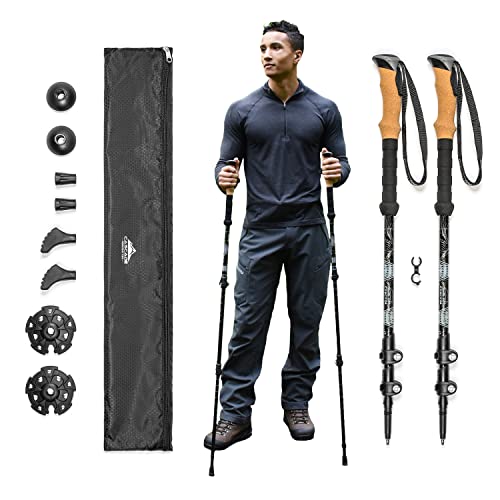
Pros
- Natural cork upper grip combined with extended EVA foam down grip offers versatile hand placement on steep ascents
- Quick Lock mechanism allows quick, secure adjustments from 26 to 54 inches to match changing slope angles
- Comes fully equipped with all-season tip attachments including snow baskets, mud baskets, and rubber boots
- Sturdy 6061 aluminum shafts resist bending and provide reassuring stability on rocky descents
Cons
- A 26-inch collapsed length may protrude past the top collar of compact daypacks and hydration packs
- At roughly 10 ounces per pole, they carry slightly more swing weight than specialized ultralight carbon fiber poles
- Quick-lock lever tension screws require occasional thumb tightening to prevent slippage over rough terrain
The Cascade Mountain Tech Aluminum Trekking Poles are designed for day hikers, weekend backpackers, and trail travelers who want dependable lower-body relief and trail stability. Built around three telescoping sections of aircraft-grade 6061 aluminum, these poles balance structural durability with accessible usability across varied terrain.
On the trail, height adjustments are managed by an external Quick Lock system that expands from 26 inches up to 54 inches. This adjustment range accommodates a wide variety of hiker heights and allows you to shorten the poles for steep climbs or lengthen them for descents. At approximately 10 ounces per pole, the aluminum tubing provides a solid, confidence-inspiring feel under load when navigating slick mud, loose scree, or stream crossings.
Handle ergonomics stand out thanks to a two-part grip layout. The upper handle is shaped from natural cork, which conforms comfortably to the hand and helps reduce vibrations from hard ground impacts. Directly beneath the cork is an extended EVA foam down grip, giving you a secondary lower grab point to choke down on steep switchbacks without pausing to unlock and resize the pole shafts.
Pack transport and trail handling are straightforward. Collapsing down to 26 inches, the poles can be secured to standard backpack trekking-pole bungees, ice axe loops, or side compression straps. Cascade Mountain Tech includes an all-terrain accessory set featuring tungsten carbide tips, rubber boots for pavement or hard rock, mud baskets, snow baskets, and a zippered storage bag to protect your pack fabric from sharp tips during transit.
While aluminum offers excellent impact resilience against trail rocks, the 10-ounce per-pole weight is slightly heavier than high-end carbon fiber options. Additionally, hikers using low-capacity daypacks should note that the 26-inch minimum length does not fold as compactly as Z-style folding poles, requiring external lashing rather than internal pack storage.
For day hikers, section backpackers, and outdoor enthusiasts seeking a durable, fully accessorized pair of trekking poles with comfortable cork handles, this Cascade Mountain Tech set delivers reliable stability and strong practical value for any trail system.
The combination of a natural cork upper grip and an extended EVA foam sleeve gives hikers versatile ergonomics across varying terrain gradients. Natural cork absorbs trail vibrations and wicks moisture during hot weather, helping minimize hot spots over long trail miles.
The extended EVA down grip allows you to quickly adjust your hand position when ascending steep trail sections without stopping to operate the locking levers. Height adjustments from 26 to 54 inches are secured via external Quick Lock clamps, which can be operated easily even while wearing light hiking gloves.
With a collapsed length of 26 inches, these poles attach securely to most daypacks, overnight packs, and backpacking bags equipped with lower tool loops and upper compression straps. They can also be tucked into side stretch pockets and secured using side compression webbing.
The included lightweight travel bag keeps the poles bundled together and prevents wet mud, trail grit, and carbide tips from scratching backpack fabrics, tent bodies, or vehicle upholstery during travel to and from the trailhead.
Cascade Mountain Tech supplies an extensive tip accessory kit designed for four-season versatility. The bare tungsten carbide tips provide direct grip on dirt, ice, and hard-packed trails.
The package also includes rubber protective caps, rubber walking boots for asphalt and slick rock, mud baskets for soft spring trails, and wider snow baskets for winter hiking, ensuring you have the appropriate attachment ready for varying trail surfaces.

Pros
- Lightweight 3K carbon fiber construction reduces carried and swinging weight to 7.6 ounces per pole
- Metal flip locks offer secure, slip-resistant tension compared to traditional twist-lock mechanisms
- Ergonomic cork handles paired with secondary EVA foam grips provide versatile hand positioning on varying trail grades
- Wide 24-inch to 55-inch adjustment span suits a diverse range of user heights and terrain angles
Cons
- Carbon fiber shafts can fracture if wedged between rocks and subjected to severe lateral bending forces
- Collapsed length of 24 inches may extend beyond the top or bottom of ultra-compact daypacks when mounted externally
- Metal flip lock levers require occasional thumb-screw tension checks to prevent slippage over extended mileage
The Hiker Hunger 100% Carbon Fiber Trekking Poles are adjustable three-section telescoping trail poles built for day hikers, section hikers, backpackers, and campers seeking to shed weight without giving up stability. Constructed from 3K carbon fiber, each pole weighs approximately 7.6 ounces, making them an excellent choice for hikers looking to reduce joint impact on rugged trails while keeping their base gear manageable.
In terms of trail adjustment, these poles expand from a compact 24 inches up to a full 55 inches, comfortably serving both shorter and taller hikers across diverse terrain grades. Rather than relying on twist locks that can slip or freeze when exposed to dirt and moisture, Hiker Hunger equips these poles with quick-adjust flip locks built with metal hardware. This provides firm, slip-resistant clamping whether you are lengthening the poles for a steep downhill descent or shortening them for an aggressive ridge climb.
Grip comfort is a primary design focus, featuring ergonomic natural cork handles that actively wick moisture away from your palms while molding to your hand shape over time. Directly beneath the cork handles, secondary nonslip EVA foam extensions provide an immediate choke-down point for short, steep switchbacks, eliminating the need to stop and adjust pole length. Soft neoprene-padded wrist straps further enhance comfort, distributing downward pressure across your wrists without causing chafing during long mileage days.
Transporting and maintaining these poles on the trail is straightforward. When not in use, the shafts collapse down to 24 inches, allowing them to nest securely into side water bottle pockets, slide behind backpack compression straps, or strap onto front trekking-pole attachment loops. Maintenance involves basic trail hygiene: simply wipe away grit and moisture after wet outings and periodically check the thumbscrew tension on the metal flip locks to preserve optimal clamping force.
While carbon fiber provides exceptional weight savings and natural vibration damping, it behaves differently than aluminum under severe lateral stress. If a carbon pole becomes trapped between roots or granite boulders and is subjected to heavy sideways leverage, it is susceptible to cracking or snapping rather than bending. Additionally, hikers using compact daypacks under 20 liters should note that the 24-inch collapsed height will protrude somewhat above the pack rim when lashed to external straps.
For day hikers, multi-day backpackers, and travelers seeking an agile pair of poles with natural cork ergonomics and durable metal locking mechanisms, the Hiker Hunger Carbon Fiber Trekking Poles represent strong trail value. Backed by a 1-year warranty and a USA-based company, they provide dependable knee-saving support and steady balance across varied backcountry trails.
The Hiker Hunger trekking poles feature a telescoping three-section shaft that adjusts smoothly between 24 inches and 55 inches. This expansive range accommodates men, women, and younger hikers across flat paths, steep alpine ascents, and knee-jarring descents.
Length adjustments are secured using external flip locks equipped with metal levers. Unlike plastic components that can warp or weaken over time, the metal locking mechanism maintains consistent clamping pressure against the carbon fiber sections to help prevent unexpected slippage while hiking under load.
Constructed entirely from 100% 3K carbon fiber, these poles offer high tensile strength and natural vibration absorption while weighing only 7.6 ounces per pole. This lightweight profile substantially lowers the energy required per arm swing over long trail days.
The upper handle combines natural moisture-wicking cork with dense EVA foam for the lower grip extension, providing comfortable handholds in both warm and cold weather. To maintain the structural integrity of carbon fiber, hikers should avoid using the poles as pry bars and keep the locking collars clean of trail debris.
With a collapsed length of 24 inches, these poles integrate easily with standard hiking daypacks and multi-day backpacking packs. They can be threaded through dedicated lower trekking-pole loops, secured via upper bungee cords, or held fast by side compression straps.
For travel or public transit to the trailhead, the 24-inch collapsed size allows the pair to fit inside standard checked luggage or across larger duffel bags, keeping your trail gear neatly consolidated between outings.
Biomechanics, Trail Utility, and Gear Decisions for Backpackers
Deciding whether to carry poles on an extended backcountry trip requires weighing the added carry weight against proven biomechanical benefits. While casual day walkers on groomed flat paths rarely require extra balance aids, carrying a loaded multi-day pack fundamentally shifts your center of gravity higher and farther away from your natural base of support. Taking the time to understand your physical needs on the trail helps you make an informed decision before setting out.
How Trekking Poles Alter Load Distribution and Joint Impact
Carrying substantial backpack weight amplifies the downward force placed on your musculoskeletal system with every step. Downhill steps generate impact forces on knees and ankles that can exceed three times your total body weight plus pack load. By planting two poles slightly ahead of your stride, your triceps, shoulders, and upper back absorb a measurable percentage of that descending shock.
This upper-body load transfer preserves cartilage and delays muscular fatigue over long trail days. Hikers dealing with meniscus sensitivity or patellar tendinitis often discover that descending steep mountain passes becomes significantly more manageable when their arms actively share the braking duties. Wearing trail apparel designed for joint relief can offer extra mechanical comfort on rugged descents, but mechanical stability sticks remain the first line of defense against direct joint stress.
Uphill travel presents a different physiological challenge where poles transform into climbing aids rather than shock absorbers. Rather than relying solely on your quadriceps and calves to lift your loaded pack upward, your latissimus dorsi and core muscles engage through the wrist straps and grips. This propulsion spreads cardiovascular exertion across a wider muscle group, helping you sustain a consistent hiking cadence without burning out your legs prematurely.
Balance, Stability, and Terrain Negotiation Under Heavy Pack Weight
A shifting backpack reduces your natural lateral stability, especially when navigating uneven trail surfaces like granite boulder fields, exposed tree roots, and muddy switchbacks. Two poles effectively expand your base of support from a narrow two-point stance into a broad four-point tripod. This expanded platform provides instantaneous correction whenever your footing slips on wet rocks or loose gravel.
Fording fast-moving backcountry streams is one of the most perilous moments of any backpacking trip, where losing your footing can lead to soaked gear or serious injury. Submerged river stones are frequently coated in slick algae, and cloudy glacier runoff often hides deep holes from view. Trekking poles serve as rigid probes that allow you to test water depth and rock stability before committing your entire body weight to a step.
Navigating snowfields and early-season packed snow also demands dependable balance points to avoid dangerous sliding falls. Equipping your poles with wide snow or mud baskets prevents the tips from sinking too deep into soft surfaces, allowing the shafts to provide reliable purchase. With two solid anchor points firmly planted, you can traverse narrow ridges and exposed side-hills with greater confidence and reduced psychological tension.
Situations Where Poles Are Essential Versus When They Become Baggage
Despite their clear advantages, poles are not mandatory for every wilderness scenario and can occasionally become an encumbrance. Flat, well-graded rail trails or smooth forested dirt tracks rarely require four-point stability, making hand-held poles feel like unnecessary hand clutter. In these gentle environments, swinging your arms naturally can promote better shoulder relaxation and finger circulation than clutching grips for miles.
Technical scrambling over rocky Class 3 terrain represents another scenario where trekking poles should be stowed away immediately. When you must use both hands to grip rock features, poles dangling from wrist straps create severe snagging hazards and compromise your balance. Collapsing your poles and securing them to the exterior lash points of your pack keeps your hands free to grasp solid rock safely.
Dense bushwhacking through untamed brush, thick willow corridors, and overgrown forest trails also makes poles frustrating to handle. Shafts easily catch in horizontal branches, and tips can wedge under hidden fallen logs, potentially snapping the pole or twisting your wrists. Knowing when to pack your poles away into budget hiking backpack selections ensures that you deploy them only when the terrain genuinely rewards their stability.
Shaft Materials: Evaluating Carbon Fiber Versus Aircraft-Grade Aluminum
The material composition of a trekking pole dictates its overall swing weight, durability under lateral load, and behavior under sudden stress. Backpackers typically choose between high-strength aluminum alloys and layered carbon fiber weaves. Each material presents distinct performance characteristics that suit different trail environments, packing philosophies, and budget tolerances.
Aircraft-grade 7075 aluminum, featured in designs like the TrailBuddy Trekking Poles, represents an exceptional sweet spot between structural resilience and manageable weight. With individual poles weighing around 9.7 ounces, 7075 aluminum is harder and stiffer than standard 6061 alloy while remaining remarkably forgiving under extreme lateral stress. When an aluminum pole gets wedged between boulders under a heavy backpack load, it tends to bend rather than snap catastrophically, often allowing the hiker to bend it back into service to complete the trek.
Standard 6061 aluminum, utilized in options like the Cascade Mountain Tech Lightweight Aircraft-Grade poles, delivers proven strength at an accessible price point while weighing approximately 10 ounces per pole. This alloy offers dependable toughness in diverse climates, resisting surface abrasions from sharp scree and rocky pathways. For beginner backpackers or hikers who demand rugged durability without worrying about delicate care routines, 6061 aluminum remains a reliable workhorse.
In contrast, 100% carbon fiber poles, such as the 100% Carbon Fiber Trekking Poles by USA Brand from Hiker Hunger Outfitters, prioritize absolute weight reduction by utilizing 3K carbon fiber weaves that weigh only 7.6 ounces per pole. Carbon fiber dramatically lowers the swing weight of the pole, requiring less muscular energy to swing forward through tens of thousands of daily strides. Carbon fiber also naturally dampens ground vibrations before they reach your elbows, although it lacks the bending tolerance of aluminum and can fracture suddenly under sharp sideways impacts.
Grip Ergonomics, Secondary Foam Sleeves, and Wrist Strap Technique
Your hands remain in direct contact with your trekking poles for six to eight hours during a typical backcountry day, making grip material and shape crucial to hand comfort. Natural cork grips excel in warm and humid conditions because cork is naturally breathable, resists moisture absorption, and gradually molds to the distinct contours of your palm. Over prolonged trips, cork handles help prevent hot spots and blisters that frequently plague hikers using smooth, non-porous rubber handles.
Extended downward grips made of nonslip EVA foam, present on both the Cascade Mountain Tech and Hiker Hunger designs, add tremendous versatility on steep, rolling terrain. When ascending a sudden steep pitch, choking down onto the lower foam sleeve lets you shorten your practical pole length instantly without stopping to adjust mechanical lever clamps. This immediate adjustability preserves your hiking momentum and keeps your shoulders level when traversing uneven side-slope contours.
Proper wrist strap technique is equally vital yet frequently misunderstood by beginner backpackers. Instead of sliding your hand downward through the loop, bring your hand upward through the bottom of the strap and grasp both the webbing and grip together. This technique transfers your body weight directly through the padded strap onto the pole, allowing you to relax your hand grip on level ground without dropping the shaft.
Locking Mechanisms and Pack Attachment Geometry
Reliable adjustment mechanisms ensure your poles do not slip and suddenly collapse beneath you when you lean your full weight into a descent. Modern trekking poles favor external lever flip locks over internal twist locks because lever clamps can be operated effortlessly with cold, gloved hands. Metal flip locks, like those engineered onto Hiker Hunger poles, provide superior clamping strength and resist the plastic fatigue that can plague budget hardware over years of heavy use.
Telescoping poles typically adjust across a broad height spectrum, extending from roughly 24 to 55 inches to accommodate hikers of varied statures and terrain angles. Setting your poles to the correct height requires standing upright on a flat surface with your elbow bent at a ninety-degree angle; adjusting the shafts so your forearms rest parallel to the ground provides optimal biomechanical leverage. When descending steep inclines, lengthening the poles by two to three inches prevents you from leaning forward past your center of gravity.
When traversing terrain that does not require poles, their collapsed dimensions determine how cleanly they stow on your backpack. Poles that collapse down to 24.5 inches or disassemble into 21-inch sections, like the TrailBuddy models, fit neatly into side stretch pockets or strap into external trekking pole attachment loops without sticking up excessively above your pack lid. Compact packed lengths also make transport convenient when checking gear for backcountry flights or packing tightly into transit vehicles.
Secondary Trail Functions: Shelter Pitching and Gear Utility
Ultralight backpackers often view trekking poles as dual-purpose survival gear that replaces dedicated structural components in their kit. A growing category of non-freestanding trekking-pole tents and modular tarps relies on rigid hiking poles to form the primary vertical ridgelines. Utilizing your walking poles to pitch your evening shelter eliminates the need to carry heavy aluminum tent poles, trimming significant base weight from your overall pack load.
Beyond pitching shelters, poles provide practical defensive utility and gear clearing options on wild trails. Sweeping a pole ahead of you clears dense, dewy spiderwebs across morning tracks and parts wet brush before moisture can soak through your pants. Rigid metal tips, such as tungsten carbide points, also offer a reliable tactile barrier and defensive presence if you encounter aggressive dogs or curious wildlife along remote backcountry routes.
Choosing the Right Pole Configuration for Your Backpacking Style
Selecting the ideal trekking pole setup requires assessing your typical trail profile, your pack weight, and your tolerance for gear maintenance. Hikers who routinely carry base weights exceeding thirty pounds across rugged mountain ranges benefit enormously from the structural security of 7075 aluminum shafts paired with ergonomic cork grips. The peace of mind that comes with durable aluminum means you can lean aggressively into your supports without fearing sudden structural failure on remote passes.
Conversely, fastpackers and ultralight enthusiasts who count every single ounce will appreciate the featherlight swing weight and vibration dampening offered by 3K carbon fiber constructions. Regardless of the material you choose, incorporating reliable lever locks, moisture-wicking cork handles, and all-terrain accessory kits featuring mud baskets and rubber road boots ensures you are prepared for whatever terrain the trail presents. Investing in proper technique and dependable poles ultimately transforms demanding backpack loads into stable, comfortable wilderness adventures.







Write Your Review
No reviews yet. Be the first to share your experience!