


Choosing the right pack volume for an outing often leaves outdoor enthusiasts wondering if a larger bag creates excess bulk or unnecessary fatigue. When assessing whether is 30l too big for a daypack, trail conditions, personal gear lists, and shifting seasonal weather play central roles in deciding total pack volume. A compact fifteen-liter bag handles short summer excursions, but carrying extra layers, hydration reservoirs, and safety essentials quickly stretches minimalist bags past their physical limits. Looking at practical carrying capacity helps clarify whether that extra interior space enhances trail convenience or weighs down your stride.
Load stability and harness support become essential factors whenever you pack thirty liters of gear for a full day outdoors. Quality technical packs utilize load lifters, ventilated back panels, and structured hip belts to distribute weight evenly across your hips rather than pinching your trapezius muscles. Buyers exploring affordable hiking backpack options can evaluate whether lightweight unstructured bags or fully supported technical frames match their packing habits. Finding the right balance between internal volume and empty pack weight ensures your daypack remains comfortable across every mile without excessive bulk.


Pros
- Lightweight pack weight of roughly 2.26 lbs despite offering a supportive padded hipbelt and 30L capacity
- Sliding-yoke system allows quick and precise torso adjustment for various body sizes
- Load lifters and dual side compression provide superior load management compared to standard minimalist daypacks
- Multiple external storage options including front shove-it sleeve, dual hipbelt pockets, and trekking pole loops
- Constructed with certified bluesign 100% recycled nylon ripstop materials
Cons
- Hydration reservoir is not included and must be purchased separately
- Does not include an integrated rain cover for heavy downpours
- Top-loading design lacks a separate bottom sleeping-bag zipper or full front-panel access
The Osprey Sportlite 30L is a streamlined, technical daypack tailored for hikers who require generous gear volume without the cumbersome weight of a full multiday frame pack. Designed for all-day trail outings, peak bagging, and gear-intensive excursions, it suits day hikers and active travelers who need a balance of structured load support and stripped-down efficiency. With an overall pack weight of approximately 2.26 pounds (1.02 kg) and exterior dimensions of 21.7 x 11.8 x 11 inches, it provides substantial packing space while remaining noticeably agile on foot.
Carrying comfort centers on an adjustable sliding-yoke harness system paired with Osprey's AirScape backpanel. The backpanel features mesh-covered foam with integrated airflow channels that keep the pack positioned close to your natural center of gravity while encouraging ventilation. Unlike many lightweight daypacks that use fixed harness sizing, the sliding-yoke design allows hikers to fine-tune the torso length for a precise, unisex fit. Weight distribution is assisted by an integrated padded hipbelt, adjustable load lifters, and a sliding sternum strap, while dual side compression straps secure internal gear to prevent shifting on uneven paths.
In terms of construction, the Sportlite 30L uses a 100% recycled nylon ripstop main body fabric that meets rigorous bluesign criteria for sustainable manufacturing. The ripstop weave offers dependable trail durability against brush, branches, and rock abrasion. The pack's buckles, webbing, and zippers are designed for functional outdoor use, maintaining mechanical tension across the load lifters and hipbelt without excessive bulk or complexity.
Trail organization is intuitive and geared toward quick gear access. A spacious top-loading main compartment accommodates bulkier items such as an extra jacket, fleece, cook kit, and packed lunch. On the outside, two stretch side pockets hold standard water bottles, while a front shove-it pocket allows you to quickly stash a wet rain shell or map. Two zippered hipbelt pockets keep smaller necessities like snacks, lip balm, or keys within reach without taking the pack off. Dedicated trekking pole loops provide secure exterior lash points when your hands need to be free, and the internal hydration sleeve accommodates an aftermarket water bladder with dedicated hose routing.
There are a few practical limitations to keep in mind before purchasing. The Sportlite 30L does not include a built-in rain cover, meaning hikers who frequently encounter wet weather will need to bring an aftermarket pack cover or waterproof dry sacks. Access to the main compartment is exclusively top-loading, so reaching items packed near the bottom requires unloading gear from above. Furthermore, while the pack features a hydration sleeve, the reservoir itself is sold separately.
For hikers wanting an agile, 30-liter technical daypack that skips unnecessary bulk while retaining essential suspension adjustability, the Osprey Sportlite 30L stands out as a reliable choice. It offers eco-conscious recycled materials, genuine torso adjustability, and a stable close-to-body carry that handles long miles with ease.
The Osprey Sportlite 30L incorporates a sliding-yoke torso adjustment mechanism designed to fit a broad spectrum of unisex body shapes and back lengths. This feature allows users to reposition the shoulder harness up or down the frame sheet to align the hipbelt precisely over the iliac crest for proper weight distribution.
Load management is further enhanced by upper load-lifter straps on the shoulder harness, an adjustable sternum strap, and a padded, ventilated hipbelt. Together with dual side compression webbing, these components stabilize the load close to the body, preventing sway during steep ascents or technical descents.
Storage on the Sportlite 30L is divided between a cavernous top-loading main compartment and versatile exterior quick-access pockets. The exterior includes a front shove-it pocket for quick layer changes, a small front zippered compartment for smaller gear, and dual stretch side pockets for water bottles.
Twin zippered pockets on the padded hipbelt offer on-the-go access to trail snacks and small personal items without removing the pack. For hands-free hydration, the pack features an internal hydration sleeve designed to hold a standard hydration reservoir, though the bladder is sold separately.

Pros
- Weighs less than 1.3 pounds, making it easy to pack down or carry for long distances
- Multiple external lash points including a front bungee net, trekking pole loops, and bottom gear straps
- Dedicated hydration tube port and interior bladder suspension loop
- 210D water-repellent nylon protects gear from morning dew, trail mist, and minor splashes
Cons
- Water-resistant fabric is not engineered for heavy downpours or submerged conditions
- Hydration bladder is not included and must be purchased separately
- Frameless design lacks rigid internal stays for carrying heavy or dense loads comfortably
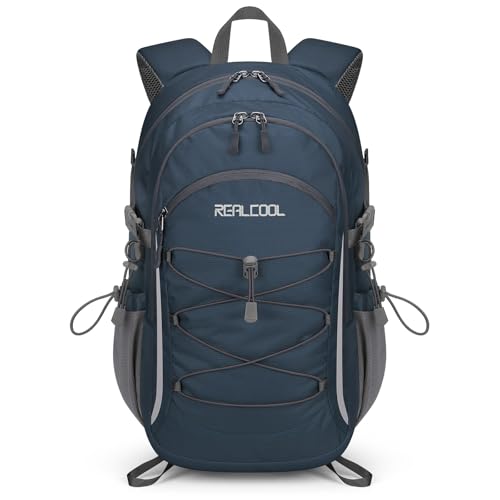
The RealCool 30L Lightweight Hiking Backpack is a versatile, frameless daypack tailored for day hikers, campers, and travelers seeking generous pack volume without carrying excess empty weight. With dimensions of 9 x 11 x 18.9 inches and a dry weight of approximately 1.28 pounds, it fits easily into the lightweight daypack category. This pack suits single-day excursions, casual camping getaways, and day-to-trail travel where extra clothing layers, snacks, and personal gear need a dependable home.
Trail organization centers around a multi-pocket system that balances internal volume with external accessibility. Inside the main compartment, a built-in Velcro loop holds a hydration reservoir upright, feeding through a dedicated upper-right hose exit so you can hydrate without stopping. On the exterior, two side elastic loops keep trekking poles locked in place, while the front elastic bungee netting provides a quick stash zone for wet rain shells. Additional bottom buckle straps allow you to secure a compact tent or sleeping mat beneath the main pack body.
Construction relies on 210D nylon fabric, which is selected for tear and scratch resistance when moving through light brush or rocky paths. The exterior fabric features a water-repellent coating designed to shield your belongings from damp grass, morning dew, and light drizzle. While the product title references waterproof daypack qualities, manufacturer specifications state that the pack is water-resistant rather than fully waterproof. It will not withstand steady downpours or submerged conditions, making an aftermarket rain cover or internal dry bag necessary for severe weather.
Carrying comfort relies on an ergonomic design intended to follow the natural contours of the back and distribute moderate weights evenly. Padded shoulder straps lined with breathable mesh cushion the shoulders while encouraging airflow on warm hikes. Because this pack uses a soft, frameless build without rigid aluminum stays, packing technique is critical. Placing flat items like folded clothing against the back panel prevents rigid objects from pressing awkwardly against your spine.
For hikers and travelers looking for an affordable, ultralight 30-liter pack, the RealCool daypack provides practical organization and multiple gear-attachment options. Buyers should keep in mind that a hydration bladder is not included, and the pack is best reserved for moderate trail loads rather than heavy multi-day gear. Handled within those parameters, it serves as a lightweight, dependable companion for fair-weather trail days and everyday outdoor adventures.
The RealCool 30L daypack features a built-in Velcro hanging strap inside the main compartment to keep an aftermarket hydration bladder upright during movement. A dedicated water tube exit hole is positioned at the upper right corner, allowing a drinking hose to route over the shoulder for easy trail-side sips.
Beyond the internal reservoir sleeve, the pack provides versatile exterior tie-downs. Elastic loops on both sides secure trekking poles, the front bungee cord holds quick-access layers, and dual bottom straps allow you to carry bulkier gear like a roll mat or compact camping gear externally.
Built using 210D nylon fabric, this daypack is designed to withstand normal trail abrasion, scratches, and snagging from branches. The fabric includes a water-repellent surface finish that repels minor moisture, light dew, and light drizzle.
Because the seams and zippers are not fully sealed against prolonged water immersion, this pack should not be treated as a fully waterproof dry bag. For sustained rain or severe weather, hikers should use a waterproof pack liner or an external rain cover to keep electronics and clothing dry.
Pros
- Lightweight 1.2-pound design prevents unnecessary fatigue from excessive pack weight.
- Multiple external lash points including bottom straps, trekking pole bungees, and a front cord net.
- Dedicated hydration routing with an internal bladder hanging loop and top hose exit port.
- 210D nylon construction resists light tears and brush scratches along overgrown trails.
Cons
- Water-repellent coating protects against light mist and splashes but cannot withstand heavy rain or prolonged downpours.
- Frameless design offers limited rigid structural support when loaded with heavy or dense cargo.
- Hydration bladder is not included and must be purchased separately.
The RealCool 30L Lightweight Hiking Backpack is a frameless outdoor daypack designed for day hikers, campers, travelers, and outdoor enthusiasts seeking generous cargo volume at minimal base pack weight. With a 30-liter capacity and a listed weight of roughly 1.2 pounds, this pack provides ample room for extra clothing layers, trail food, emergency items, and hydration gear without weighing down the carrier. Its clean external lash setup and dimensions of 9 x 11 x 18.9 inches make it equally adaptable for national park day hikes, casual weekend outings, and summit-pack travel duty.
Cargo management is a primary strength of this daypack, combining multi-compartment interior storage with functional exterior lash points. Inside the main compartment, an integrated Velcro hanger secures a hydration reservoir, working alongside a dedicated hose port at the upper right corner to facilitate on-the-go drinking (bladder sold separately). Externally, dual elastic cords secure trekking poles along the pack sides, while the front elastic bungee net holds damp rain shells or light layers. Underneath, integrated bottom buckle straps allow hikers to lash bulkier items such as a compact camping pad or lightweight shelter directly to the base.
The backpack is constructed from 210D nylon fabric designed to resist light tears and scrapes encountered alongside brushy trail corridors. While the product title mentions waterproof qualities, the manufacturer explicitly notes that the 210D nylon features a water-repellent surface treatment rather than seam-sealed waterproof construction. This coating easily sheds light dew, splashing water, and intermittent drizzle, but it is not designed to withstand heavy downpours. Hikers anticipating severe mountain weather should pair this pack with an aftermarket rain cover or pack liner to safeguard sensitive electronics and spare clothing.
Comfort is supported through breathable mesh shoulder straps cushioned with foam padding, working to reduce direct pressure across the upper body. The back panel is engineered to follow natural back contours and facilitate airflow during warm-weather ascents. Because this is a frameless, lightweight daypack without a rigid internal stay system or heavy padded hip belt, proper load distribution relies on thoughtful packing technique. Stowing heavier items close to the back panel prevents the pack from sagging away from the shoulders on steep ascents.
Setting up and maintaining the pack is straightforward thanks to its low-bulk synthetic construction. The flexible nylon body folds down easily into luggage or storage bins when empty, making it an excellent secondary daypack for vacations and road trips. For trail cleaning, wiping down the 210D nylon with a damp cloth and mild soap preserves the water-repellent coating, followed by hang-drying in the shade. Checking tension on the bottom lash straps and trekking pole bungees before heading out ensures external gear remains balanced and rattle-free during transit.
For hikers seeking a balance between budget-friendly pricing, 30-liter packing volume, and lightweight daypack versatility, the RealCool 30L Daypack delivers practical trail utility. It is not built for multi-day expedition loads or severe monsoon conditions, but for single-day loops, casual camping outings, and everyday active pursuits, its combination of hydration readiness, trekking pole storage, and external attachment points offers genuine everyday trail value.
The RealCool 30L Daypack includes dedicated hydration integration consisting of an internal Velcro hanging strap in the main compartment and an exit port positioned at the upper right corner for routing a drinking tube. A hydration reservoir is not included with the pack, so users must supply their own compatible bladder.
External gear storage is supported through multiple attachment systems. Dual elastic cords on both sides secure trekking poles flat against the exterior, while the front bungee net accommodates wet rain gear or lightweight jackets. Adjustable bottom buckle straps offer dedicated lash space for carrying a tent, bedroll, or sleeping pad beneath the main pack body.
Built from 210D nylon fabric, this daypack is engineered to resist everyday abrasion and scratching from twigs and trail obstacles. The exterior is treated with a water-repellent coating that causes light moisture, dew, and brief rain sprinkles to bead up on the surface.
Hikers should note that the pack is water-repellent rather than fully waterproof. It does not feature taped seams or waterproof zippers and is explicitly not designed to withstand heavy rainfall or downpours. For wet-weather reliability, packing sensitive gear in dry sacks or using a waterproof pack cover is strongly recommended.
Evaluating Daypack Sizing: Is a Thirty-Liter Capacity Right for You?
Determining whether thirty liters is excessive for a daypack comes down to your gear volume, environment, and how well the pack compresses when partially empty. A thirty-liter bag represents the upper boundary of traditional daypack sizing, sitting directly between lightweight commuter bags and multi-day ultralight packs. Understanding how this capacity behaves on the trail or during daily travel allows you to choose a bag that provides adequate space without burdening your back.
The Direct Verdict: When Thirty Liters Excels and When It Feels Excessive
A thirty-liter daypack is generally too big for short two-hour summer hikes where you only carry a single water bottle, a small snack, and a smartphone. Under those lightweight conditions, carrying thirty liters means you are hauling unnecessary fabric, extra zipper tracks, and excess harness weight that serves no functional purpose. The loose interior space also allows lightweight items to tumble around, which pulls the pack away from your natural center of gravity. For quick morning outings or warm-weather walks on well-marked paths, a compact pack between twelve and eighteen liters provides a far more nimble experience.
Conversely, thirty liters is the sweet spot for challenging full-day excursions that involve variable mountain weather, technical terrain, or winter conditions. When hiking in the shoulder seasons of autumn and spring, you must accommodate a waterproof rain shell, an insulating fleece, gloves, a beanie, and emergency traction devices. Bulky apparel layers take up significant volume inside the main compartment without necessarily adding heavy physical weight. In these scenarios, a thirty-liter volume lets you stow and retrieve clothing layers quickly without forcing you to unpack your entire bag at every rest break.
Group hikers, parents with young children, and pet owners also find thirty liters to be an exceptionally practical size for single-day adventures. Leaders of family hikes routinely carry extra snacks, extra water bottles, sunscreen, and spare layers for others who may lack adequate carrying capacity. Packing emergency essentials, such as a comprehensive first-aid kit, a headlamp, and a water filtration system, rapidly fills smaller daypacks. Having thirty liters of usable space prevents you from having to strap sensitive gear to the outside of your pack where it is exposed to brush and rain.
Comparing Capacity Brackets: Twelve to Twenty Liters Versus Twenty-Five to Thirty Liters
The twelve to twenty-liter capacity tier caters directly to fast-and-light trail enthusiasts and minimalist commuters. Packs in this smaller category focus on streamlined silhouettes that hug your torso tightly, minimizing aerodynamic drag and body sway during active movement. They provide dedicated space for a two-liter hydration bladder, a compact windbreaker, energy bars, and small personal essentials. However, this compact bracket offers virtually zero margin for error if sudden weather shifts require heavy fleece jackets or storm-rated outer shells.
The twenty to twenty-five-liter bracket functions as the traditional industry standard for general three-season day hiking. This middle capacity accommodates standard gear lists comfortably while maintaining a relatively slim exterior footprint. Bags in this category fit well in crowded public transit cars and slide neatly into most airline overhead storage compartments without hassle. For hikers who pack strictly for themselves and stick to moderate trail conditions, twenty-two to twenty-four liters often proves to be an ideal compromise.
Stepping up to the twenty-five to thirty-liter bracket provides the expanded capability needed for all-day autonomy. This bracket bridges the gap between casual outings and serious backcountry ventures where self-reliance is mandatory. The additional cubic inches allow you to carry three liters of water, substantial meal supplies, navigation equipment, and cold-weather clothing without stretching exterior seams. If you frequently find yourself stuffing your current pack to the point where the zippers strain under lateral tension, moving to thirty liters is a logical upgrade.
Harness Engineering and Weight Distribution at Thirty Liters
Carrying a fully loaded thirty-liter backpack can easily result in a total carry weight of fifteen to twenty-five pounds once food and water are included. At this weight threshold, the structural design of the shoulder harness and back panel becomes far more important than it is on a tiny summit pack. Thin webbing straps and unpadded nylon yokes will cut into your trapezius muscles and collarbones after only a couple of miles on the trail. Proper weight distribution requires contoured shoulder straps with dense dual-density foam that spreads pressure evenly across the upper chest.
A supportive hip belt transforms how a thirty-liter pack carries by transferring the majority of downward force directly onto your iliac crest. The Osprey Sportlite 30L Lightweight Hiking Backpack exemplifies this principle with its padded, ventilated hipbelt and sliding-yoke torso adjustment system. By allowing hikers to dial in a precise torso length, this design anchors the base of the pack firmly against the pelvic girdle. When the hip belt bears sixty to seventy percent of the total load, your shoulders are freed from carrying dead weight, drastically reducing upper-body muscle fatigue.
Sternum straps and load-lifter tensioners provide the final elements of upper-body stabilization for heavier daypacks. Load lifters attach the upper shoulder straps to the top of the pack frame at roughly a forty-five-degree angle, allowing you to pull the pack closer to your spine. Cinching these straps eliminates backward pack sway and prevents the bag from pulling your upper torso backward during steep ascents. Meanwhile, an adjustable sternum strap keeps the shoulder straps positioned correctly over your pectoral muscles, preventing abrasive strap slippage and arm chafing.
Unstructured Packable Daypacks Versus Technical Suspension Frames
Not all thirty-liter backpacks carry weight in the same manner, and the presence of an internal frame creates a massive functional distinction. An ultralight model like the SUIKIHUM 30L Large Hiking Daypack prioritizes packability, weighing under ten ounces and folding down into a compact pouch. This type of frameless nylon daypack excels as a secondary backup bag that stows inside your rolling luggage for casual sightseeing or grocery runs. Because it lacks rigid internal stays or thick foam backings, it adds virtually zero empty tare weight to your luggage.
However, unstructured packable bags reveal distinct physical limitations when loaded with dense or heavy equipment. Without a rigid back sheet, hard items like water bottles, cooking stoves, or food containers can press directly against your spine, creating painful pressure points. Furthermore, when you fill a frameless thirty-liter pack to maximum capacity, the unsupported nylon fabric tends to sag downward like a duffel bag, pulling your shoulders back. Using an unstructured thirty-liter pack works best when your contents consist of bulky but lightweight gear, such as jackets, towels, and sleeping garments.
Hikers carrying substantial trail gear benefit substantially from structured designs that incorporate internal perimeter wires or molded back panels. Evaluating framed hiking backpacks reveals how rigid internal supports maintain the pack’s upright shape regardless of how the interior contents are arranged. A structured frame keeps the back panel flat against your spine and channels downward pressure straight into the hip belt. If you plan to carry heavy hydration reservoirs and technical gear across rocky trails, opting for a structured frame makes a thirty-liter pack feel noticeably lighter and more balanced.
Compression Straps and Managing Unused Internal Capacity
The most common complaint about thirty-liter daypacks is that they feel sloppy and cavernous when you only pack ten or fifteen liters of gear. When empty volume is left unchecked inside a pack, your supplies shift around with every step, altering your physical balance during technical scrambles. This loose gear movement not only causes annoying trail noise but also increases energy expenditure as your core muscles constantly correct for shifting loads. Fortunately, well-engineered daypacks incorporate dedicated compression hardware to solve this exact problem.
Dual side compression straps allow you to cinch down the exterior fabric, flattening the pack profile against your back when it is not fully loaded. The RealCool 30L Lightweight Hiking Backpack includes functional compression elements along with front bungee cords and bottom buckle straps to manage exterior volume. Pulling compression webbing tight pulls the load closer to your body and prevents interior items from sinking to the bottom of the bag. This compression mechanism effectively transforms a thirty-liter pack into a compact twenty-liter silhouette whenever your gear requirements are modest.
Smart internal packing geometry complements external compression straps by keeping the heaviest items secured against your anatomical center of gravity. You should always position dense items, such as full water bladders and heavy food supplies, upright and directly against the back panel. Lighter items, including extra clothing layers, emergency blankets, and hats, should fill the bottom of the main compartment and the outward-facing perimeter. Organizing your pack in this manner prevents the thirty-liter capacity from feeling awkward, ensuring your center of mass remains centered over your hips.
Airline Travel and Daily Commute Considerations
Beyond wilderness trails, many travelers choose thirty-liter daypacks as versatile carry-on companions for domestic and international flights. A thirty-liter backpack with dimensions around twenty-two inches tall and twelve inches wide easily complies with standard domestic overhead bin rules. Its spacious main compartment holds several days of clothing, a toiletry kit, and electronics, making it a favorite for one-bag minimalist travelers. Travelers can navigate airport terminals comfortably with a backpack on their shoulders, avoiding the checked baggage fees associated with rolling luggage.
However, prospective buyers must understand that a fully packed thirty-liter bag will rarely qualify as an airline personal item under regional airline guidelines. Most major airlines limit under-seat personal items to approximately eighteen by fourteen by eight inches, which corresponds roughly to a fifteen to twenty-liter bag. A rigid thirty-liter daypack measuring over twenty-one inches in height will extend into your footwell space, potentially violating airline safety regulations. If your primary goal is finding a bag that slides under the seat in front of you on budget airlines, thirty liters is generally too large.
For daily college campus use or urban office commuting, thirty liters can also feel slightly oversized unless you carry specific gear combinations. A student carrying large textbooks, a fifteen-inch laptop in a protective sleeve, a lunch container, and gym apparel will readily utilize thirty liters of space. Conversely, a professional commuter carrying only an ultrabook, a tablet, and a notebook will find a thirty-liter pack unnecessarily bulky on crowded transit trains. In urban environments, technical trail straps and loose compression cords can also snag on turnstiles and subway seating if not properly tucked away.
Back Panel Ventilation, Fabric Durability, and Weather Resistance
Covering your entire upper back with a large thirty-liter pack can create significant thermal buildup and perspiration on warm-weather hikes. Because a thirty-liter bag features a taller and wider back panel than an eighteen-liter pack, it covers more surface area against your skin. Without proper airflow channels, trapped perspiration dampens your shirt, leading to uncomfortable chafing and rapid chilling when temperatures drop at breezy summits. Choosing a pack with an engineered suspension system mitigates this issue by encouraging continuous airflow behind your torso.
Packs with suspended mesh panels or grooved foam channels create physical separation between your spine and the pack’s main cargo cavity. Osprey utilizes an AirScape backpanel with mesh-covered ribbed foam, providing a close-to-body carry while maintaining functional ventilation chimneys. This balanced configuration prevents the load from pulling backward while still allowing body heat to dissipate naturally during strenuous uphill climbs. When evaluating larger daypacks, prioritizing open air channels ensures that the expanded thirty-liter size does not turn into an uncomfortable heat trap.
Hikers who tackle warm trails can also supplement their gear setup by using dedicated accessories to improve on-trail hydration and cooling. Exploring specialized options like hiking cooler backpacks illustrates how targeted insulation and ventilation features maintain comfort during day outings. Regardless of your pack volume, pairing breathable synthetic apparel with a well-ventilated back panel prevents sweat buildup from ruining an otherwise great hike. Taking short trail breaks to loosen your shoulder straps and air out your back panel further enhances all-day carrying comfort.
Practical Guidelines for Determining Your Ideal Daypack Volume
Deciding whether thirty liters is too big ultimately depends on matching your pack’s physical capacity to your specific hiking habits and seasonal gear needs. If your outings consist primarily of well-traveled trails in warm summer weather, a twenty-liter pack provides all the space you need without excess bulk. However, if you hike year-round, venture into rugged alpine backcountry, or carry gear for family members, a thirty-liter pack offers indispensable capability. Having that extra volume eliminates packing anxiety, allowing you to carry vital safety equipment without cramming your bag to the breaking point.
Look for a thirty-liter pack equipped with robust side compression straps, a supportive hip belt, and an adjustable harness system. These technical features allow the bag to adapt gracefully to different load sizes, compressing down compactly when lightly packed and stabilizing heavier loads on long treks. Checking the unladen pack weight ensures that the backpack itself does not add excessive burden before you even pack your trail gear. With the right harness engineering and packing discipline, a thirty-liter daypack provides an exceptional balance of comfort, versatility, and trail readiness.







Write Your Review
No reviews yet. Be the first to share your experience!