


Navigating crowded airport concourses and narrow train aisles becomes significantly easier when your luggage matches your body and your itinerary. Determining what size backpack for travelling depends directly on your transit style, your packing habits, and the strict dimensional limits enforced by regional transportation carriers. Overstuffed bags frequently trigger unexpected gate-check fees and cause unnecessary physical strain during long walks between terminals. Conversely, undersized packs force you to leave essential garments and tools behind. Choosing the proper liter capacity allows you to maintain nimble mobility without sacrificing daily travel comfort.
Baggage sizing guidelines vary noticeably between international airlines, budget carriers, and regional train networks. While looking into affordable day-hiking backpacks demonstrates how outdoor daypacks prioritize vertical hydration storage, dedicated travel bags must balance accessible packing compartments with rigid metal sizer frames. Understanding the distinction between volume in liters and physical exterior measurements ensures your bag clears gate agents without delays. A properly proportioned pack stabilizes gear across your torso, protecting your neck and shoulders throughout demanding journeys.
Pros
- Weighs only 4.59 ounces and packs neatly into its own pocket for hassle-free travel storage.
- Durable SBS zippers and tear-resistant polyamide fabric provide good build quality for an ultralight bag.
- Four total storage zones include two zippered compartments and two side mesh pockets for simple organization.
- Compact 11L profile keeps trail loads small and eliminates unnecessary bulk on easy walks.
Cons
- Compact 11-liter capacity cannot accommodate bulky clothing layers, heavy trail gear, or cold-weather essentials.
- Frameless, ultralight construction has no back padding, hip belt, or sternum strap to support heavy loads.
- Water-resistant fabric handles light drizzles but will allow moisture in during heavy or prolonged rain.
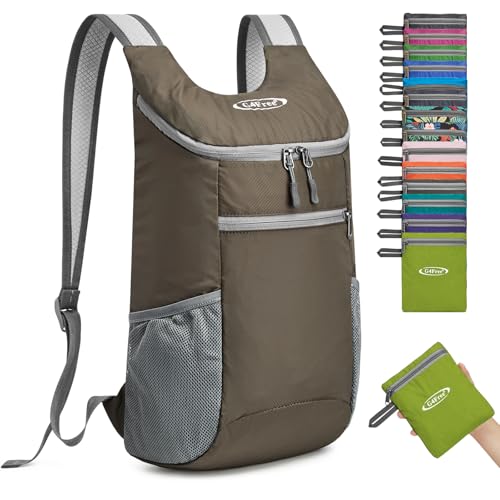
The G4Free 11L Ultra Lightweight Small Rucksack is a packable, frameless daypack engineered specifically for minimalist day hikers, vacationers, and commuters who prioritize portability over heavy suspension systems. Weighing just 4.59 ounces (approximately 0.29 pounds), the pack collapses completely into an integrated pouch, making it an excellent companion for travelers seeking a secondary summit pack inside their luggage or outdoor walkers who need a quick grab-and-go option for casual local trails.
With an 11-liter total volume and unfolded dimensions of 8.27 x 5.12 x 12.99 inches, this daypack is scaled for basic essentials rather than multi-hour wilderness trips. The main compartment offers enough room for an extra windbreaker, lightweight towel, trail snacks, and small personal gear, while the front zippered compartment secures items like keys, cards, or a passport. Because the pack lacks a rigid frame sheet, internal stays, or a supportive hip belt, carrying comfort relies entirely on packing soft items against the rear panel and keeping total carried weight modest.
The pack is constructed from a tear-resistant polyamide fabric paired with SBS zippers, providing a solid balance between low weight and reliable trail utility. The water-resistant surface treatment helps shed light rain, dust, and trail debris during short walks. Two exterior side mesh pockets give quick access to slim hydration bottles or snacks, keeping essential gear within easy reach without requiring you to reopen the main compartment.
Deploying and packing down the rucksack is straightforward and takes only seconds. To stow the backpack, you simply invert the built-in storage pouch and fold the polyamide fabric inward, resulting in a pocket-sized bundle that stores neatly in a carry-on suitcase, duffel bag, or vehicle console. For post-hike cleaning, the synthetic polyamide material can be spot cleaned with a damp cloth and mild soap, then air-dried before folding back into its pouch.
Hikers should keep in mind that an 11-liter frameless daypack comes with distinct trail limitations. It is not built for rough backcountry terrain, overnight backpacking, or carrying dense, heavy gear. In addition, while the fabric repels light drizzles, the lack of taped seams and a dedicated rain cover means it cannot protect sensitive electronics during extended downpours. The unpadded shoulder straps will also cause noticeable pressure if the bag is overloaded with heavy items.
For day hikers, campers, and travelers who want a dependable, featherweight daypack that takes up virtually zero luggage space, the G4Free 11L Packable Backpack delivers practical functionality at an accessible price. It serves as an efficient solution for short park trails, city sightseeing, and campground errands where carrying a full-sized hiking pack would be unnecessary bulk.
The G4Free 11L daypack provides four designated storage areas, including two zippered compartments and two flexible side mesh pockets. The main storage compartment holds small trail essentials such as a packable jacket, trail food, and small travel accessories, while the front zippered pocket keeps smaller items like wallets, phones, and trail passes secure.
Because the pack is 11 liters in volume with an 8.3 x 5.1 x 13-inch footprint, careful packing is recommended. Arranging flat, soft garments against the interior back section creates a natural cushion, ensuring comfortable carry on short walks and preventing hard-edged objects from poking through the lightweight fabric.
Built with lightweight polyamide fabric, the G4Free daypack is designed to resist light abrasion and trail dust while keeping total pack weight down to 4.59 ounces. SBS zippers secure both compartments, offering smooth pull action that holds up well under routine trail and travel usage.
When not on trail, the entire daypack folds into its own interior pouch, creating a compact bundle that fits inside travel duffels, large backpacking packs, or car glove boxes. The exterior material provides light water resistance for brief drizzles, though full dry bags or rain covers should be used for wet weather.
How to Choose the Right Backpack Capacity for Travel
Selecting the right backpack capacity for a journey requires balancing packing volume, physical carry comfort, and airline baggage restrictions. Most travelers find that packs ranging between 30 and 40 liters offer the most versatile performance for general carry-on travel. Smaller packs between 10 and 25 liters function exceptionally well as secondary daypacks or strict personal items. Larger models exceeding 45 liters generally require checking at airline ticket counters and become burdensome during urban transit.
Understanding Liter Volume Versus Exterior Dimensions
Backpack capacity is universally measured in liters, which represents the total cubic volume across all internal and external compartments. However, two backpacks sharing an identical 35-liter rating can pack gear completely differently based on interior pocket architecture. A single open main compartment accommodates clothing packing cubes and bulky layers far better than a pack split into multiple narrow organizational sleeves. Stiff internal dividers often consume valuable packing space and restrict how easily you can pack odd-shaped travel items.
Exterior dimensions present another critical variable that liter volume alone fails to show. Airline gate agents assess luggage compliance using physical height, width, and depth measurements rather than interior cubic liters. A structured pack with an internal frame might measure 22 inches in height, fitting overhead bins with ease. In contrast, an unstructured pack of the same liter rating can bulge outward when overpacked, exceeding depth allowances and triggering gate-check fees.
Under-Seat Personal Items: 10L to 25L Sizing Guidelines
Packs in the 10-liter to 25-liter bracket serve primarily as personal item bags designed to slide beneath the seat in front of you on commercial flights. Most domestic and international airlines maintain strict personal item dimensions, typically around 18 inches high, 14 inches wide, and 8 inches deep. Keeping your pack within these boundaries allows you to avoid checked baggage fees on budget airlines. An under-seat pack keeps critical items like passports, medication, and headphones immediately accessible throughout your flight.
Within this compact category, ultra-light packable daypacks offer incredible flexibility for minimalist sightseers and urban day trips. Compact models like the 11-liter foldable rucksack weigh under five ounces and collapse into a tiny pouch that stows inside larger luggage. This setup lets you leave your primary luggage at your accommodation while carrying daily essentials around town. The modest volume easily handles a light windbreaker, water bottle, phone, and travel documents without feeling bulky.
Standard Overhead Carry-On: 30L to 45L Capacity Limits
The 30-liter to 45-liter range represents the standard sweet spot for independent one-bag travel across the globe. Standard domestic airline carry-on allowances usually cap exterior dimensions at 22 by 14 by 9 inches, which corresponds to roughly 40 to 45 liters of uncompressed volume. Backpacks in this size class eliminate the need to check baggage, saving valuable time at luggage carousels and avoiding lost baggage mishaps. They provide sufficient interior depth to pack multiple changes of clothing, toiletries, and secondary footwear.
For travelers moving between hostels, hotels, and train stations, selecting a bag around 35 to 40 liters provides an optimal balance between storage space and manageable carry weight. Unlike top-loading trekking rucksacks that require digging from the top down, travel-specific packs in this size range frequently feature full clamshell openings. This luggage-style opening lays flat on a bed or table, letting you organize packing cubes with minimal effort. Quick-access exterior pockets keep electronics accessible during security screenings without exposing your clothing.
Carrying a pack at the maximum 45-liter carry-on boundary requires mindful packing to avoid excessive total weight. Fully packed 45-liter bags can easily exceed 20 to 25 pounds, creating noticeable shoulder strain on walking commutes. When carrying dense loads, investigating structured internal frame backpacks illustrates how rigid internal stays transfer weight off your shoulders directly onto your hips. For air travel, bags pushing past 45 liters regularly fail international carry-on sizer checks, especially on regional European and Asian carriers.
Checked Luggage Packs: Evaluating 50L and Larger Capacities
Backpacks offering 50 liters of volume or more cross firmly into checked luggage territory for virtually all commercial passenger flights. These large packs are primarily built for extended wilderness trekking, winter expeditions, or specialized gear transport rather than standard city travel. Navigating crowded subway platforms, narrow bus aisles, and historic cobblestone alleys becomes exhausting when carrying a massive 60-liter bag. Furthermore, airlines frequently assess oversize handling charges if external webbing straps snag on airport conveyor belts.
Carrying a bag of this magnitude requires an advanced suspension system featuring a rigid internal frame and an extensively padded hip belt. Without those load-bearing components, hauling 30 to 40 pounds of gear will quickly strain your spinal alignment and tire your legs. If your itinerary genuinely demands a checked backpack, look for models with stowable harness straps or dedicated protective flight covers. Exposed shoulder straps and plastic buckles are vulnerable to damage during airport baggage handling.
Matching Liter Size to Trip Duration and Style
Your intended trip length and daily transit style should directly dictate the volume capacity you choose. For weekend getaways spanning two to three days, an 18-liter to 28-liter pack easily accommodates two outfits, basic toiletries, and a small tech organizer. This compact setup moves seamlessly from an airplane cabin directly into a business meeting or casual restaurant. You avoid baggage drop lines entirely and navigate public transit without bumping into fellow commuters.
Trips lasting anywhere from four days to several months can be comfortably managed with a 35-liter to 40-liter pack if you adopt a rotational wardrobe. Packing five to seven days worth of versatile, quick-drying clothing allows you to travel indefinitely by doing laundry weekly. This approach keeps your overall pack weight under 18 pounds, which remains comfortable for long walking days. You also retain enough spare room to bring home small regional souvenirs or snacks.
Digital nomads and hybrid business travelers often face unique volume challenges due to dedicated electronic hardware. Laptops, portable monitors, power banks, and charging cables consume substantial packing space and add noticeable density. If your work setup requires a 16-inch laptop with a padded sleeve, a 30-liter to 38-liter pack provides the necessary protective clearance without squeezing out your garments. Dedicated tech compartments isolate fragile screens from the compression forces of tightly packed clothes.
Harness Fit, Torso Sizing, and Load Stabilization
Choosing the correct liter capacity is only effective if the backpack harness properly matches your physical torso length. A 40-liter backpack designed for a tall torso will sit awkwardly low on a shorter individual, pulling backward and straining the lower lumbar spine. Measuring your torso requires finding the distance between your C7 vertebra at the base of your neck down to the top of your iliac crest along your hip line. Matching this measurement to manufacturer harness sizing charts ensures balanced weight distribution.
Shoulder strap contouring and foam density play an essential role in preventing collarbone fatigue during continuous transit. Dual-density EVA foam straps distribute downward pressure across a broader surface area, preventing painful pressure points. An adjustable sternum strap connects the shoulder straps across your mid-chest, preventing them from slipping outward when walking briskly. Load-lifter straps at the top of the harness pull the upper pack closer to your center of gravity, stopping backward sway.
Proper weight distribution inside the pack cavity is just as vital as harness adjustment. Pack your densest items, such as shoes, toiletries, and heavy electronics, close to your spine in the mid-to-lower portion of the bag. Lighter items like fleece jackets and sleeping shirts should occupy the bottom and outer perimeter of the compartment. Positioning dense mass high and far from your back creates rotational torque that tires your trapezius muscles within minutes.
Fabric Durability, Tare Weight, and Weather Protection
Unladen pack weight, known as tare weight, directly affects how comfortable your bag feels before you even insert your gear. Heavy travel packs constructed from 1000D ballistic nylon can weigh four to five pounds empty, eating into strict airline carry-on weight limits. In contrast, packable travel daypacks crafted from tear-resistant polyamide fabrics weigh mere ounces while offering reliable daily utility. Balancing structural abrasion resistance against empty pack weight helps you stay beneath strict international carry-on limits.
Weather resistance is another major factor when moving through unpredictable climates. While few travel bags are completely waterproof without taped seams and roll-top closures, durable water-repellent coatings shed light rain and sidewalk spray effectively. High-quality SBS or reverse-coil zippers prevent moisture from seeping through teeth during quick sprints between transit shelters. If your itinerary involves day hikes or day trips, bringing a travel cooler backpack demonstrates how specialized insulation and coated liners protect contents from ambient heat.
Maintaining your travel backpack fabrics extends the life of their internal polyurethane coatings and water-repellent treatments. Avoid washing synthetic packs in standard household washing machines, as aggressive agitators can delaminate protective waterproof backings. Instead, spot-clean exterior dirt using a soft damp cloth, lukewarm water, and mild detergent. Always allow the pack to air dry completely away from direct heat sources before folding or storing it for your next trip.
Avoiding Common Travel Sizing and Packing Errors
One of the most frequent travel mistakes is purchasing an oversized backpack with the intention of leaving empty space inside. Human nature usually leads travelers to fill any available volume with unnecessary items, resulting in an overly heavy bag that causes fatigue. Choosing a slightly smaller pack enforces packing discipline and ensures you only carry gear that serves a genuine purpose. Traveling light enhances your overall travel experience by keeping you nimble on trains, buses, and city sidewalks.
Another common sizing pitfall involves ignoring external pocket expansion when preparing for airline boarding. Stashing bulky jackets, water bottles, and thick books into exterior stretch sleeves can increase a bag’s depth by several inches. That extra bulk can prevent the pack from sliding into rigid metal sizer boxes at the gate, resulting in forced gate-checking fees. Keep exterior pockets streamlined and utilize interior compression straps to keep the pack profile flat and compact.
Travelers also frequently misjudge the carrying limitations of ultralight packable daypacks. While an 11-liter foldable rucksack is phenomenal for holding snacks, a water bottle, and a windbreaker during day excursions, it lacks structured padding for heavy electronics. Attempting to haul heavy laptops or dense textbooks in an unpadded frameless rucksack will cause shoulder strap digging and lacks drop protection. Use packable daypacks for lightweight daily exploration while relying on your structured carry-on for primary transit.
Final Practical Sizing Recommendations for Your Journey
Determining what size backpack for travelling ultimately comes down to your personal travel style, trip duration, and physical comfort threshold. For strict under-seat compliance and ultra-minimalist transit, keep your pack volume between 15 and 25 liters. If you want the ideal one-bag solution that fits standard overhead bins while providing ample space for a multi-week wardrobe, select a versatile 35-liter to 40-liter carry-on pack. Reserving 50-liter and larger bags for wilderness expeditions ensures you never struggle with oversized luggage in urban terminals.
Pairing a primary 35-liter carry-on bag with an ultralight, packable 11-liter rucksack offers an exceptionally versatile travel combination. You can stow the packable bag flat inside your main compartment during flights, deploying it for day hikes, walking tours, and grocery runs at your destination. This two-bag strategy delivers effortless mobility during long transit days while keeping your daily carry light and responsive. Selecting the proper capacity empowers you to focus on your travel adventures rather than managing cumbersome luggage.






Write Your Review
No reviews yet. Be the first to share your experience!