


Steep downhill descents place enormous force on your lower body, and a trekking pole that collapses under weight can quickly compromise your balance on technical trails. Learning how to fix trekking pole issues before reaching remote backcountry passes prevents sudden falls and protects knees and ankles from unnecessary shock. When an external lever clamp slips or a folding shaft fails to lock into place, simple mechanical adjustments often restore full stability. Hikers managing chronic joint fatigue frequently combine reliable poles with trail clothing that supports knee stability to maintain proper cadence over rocky terrain.
Most pole malfunctions stem from everyday trail wear, accumulated grit in telescoping joints, or loose clamp hardware rather than permanent structural failure. Understanding how lever locks, push-button pins, and replacement rubber caps function helps you diagnose problems quickly at camp or in the garage. With a few routine field adjustments and regular hardware inspections, you can keep your gear solid and trail-ready for every journey.

Pros
- Collapses down to a compact 15 inches, fitting easily inside backpacks or carry luggage bags
- Natural cork handles absorb hand perspiration effectively during strenuous hikes
- Sturdy aircraft-grade aluminum construction with protective metal caps at the folding joints
- Simple height adjustment between 110 cm and 130 cm via a sturdy metal flip lock lever
Cons
- TSA regulations require trekking poles to be packed in checked luggage rather than carry-on bags
- Users must verify the push-button lock is fully popped out to ensure shaft stability before hiking
- At 11.5 oz per pole, aluminum construction is heavier than ultralight carbon-fiber alternatives
The Trekology Trek-Z Cork Grip Collapsible Trekking Poles are three-section folding hiking sticks designed for day hikers, backpackers, and adventure travelers who require portable stability on uneven trails. Rather than using traditional telescoping designs that remain long when collapsed, these poles utilize a tri-fold folding cable system that stows down to a compact 15 inches. This makes them a strong match for hikers who prefer storing their poles directly inside a daypack or securing them flat against external pack compression straps without poles protruding past the top lid.
On trail, these poles offer an adjustable length range of 110 cm to 130 cm, covering a stated user height range between 5'2" and 6'5". Each pole weighs 11.5 oz (330 g), delivering a solid feel that helps distribute carried weight and stabilize joint impact on steep descents. The main handle is shaped from natural cork, which naturally absorbs hand moisture and sweat during warm trail outings. Trekology notes that the cork grips incorporate a slight rotational flex as an anti-torque ergonomic feature. Below the cork, secondary EVA foam grips allow hikers to quickly choke down on the poles when negotiating short, steep step-ups without adjusting overall pole length.
Build quality centers on aircraft-grade aluminum alloy shafts, chosen to withstand lateral loads and rocky terrain where brittle materials might crack. To reinforce high-stress connection points, Trekology adds metal caps around the folding joints, reducing play once the poles are deployed. Extension and length adjustments are secured using a durable metal flip lock at the upper section, ensuring reliable clamping power once clamped to the hiker's preferred height marker.
Deploying the poles requires extending the folding sections until the internal tension cable pulls tight and an internal metal lock button pops through the shaft hole. Ensuring this button is fully seated is essential for complete structural rigidity before latching the upper flip lock. For transport, collapsing the poles takes seconds, allowing both poles to slip neatly into the included storage bag. When traveling by commercial air to hiking destinations, keep in mind that TSA and airline policies classify trekking poles as checked luggage, meaning they must be stowed inside checked duffels or backpacks rather than overhead carry-on bags.
While the folding mechanism provides impressive packability, the design does present a few practical limitations. The total adjustment range is 20 cm (110 to 130 cm), which may not suit hikers under 5'2" who require a shorter pole setup. Additionally, at 11.5 oz per pole, weight-conscious thru-hikers aiming for sub-pound base weights might find aluminum folding poles heavier than fixed-length carbon options. The locking button also requires careful initial alignment during assembly to ensure the segments seat properly without wobbling.
For hikers, backpackers, and travelers seeking dependable trail support without spending top-tier outdoor brand prices, the Trekology Trek-Z Cork poles offer exceptional value. The combination of sweat-wicking cork handles, reinforced aluminum joints, and an ultra-packable 15-inch folded size makes them a versatile accessory for everything from local forest walks to rugged mountain backpacking trips.
The Trekology Trek-Z poles adjust between 110 cm and 130 cm in length, accommodating hikers measuring roughly 5'2" to 6'5" (159 to 195 cm) in height. Length adjustments are managed via a metal flip lock clamp on the top shaft section, allowing users to fine-tune height based on trail slope or individual arm ergonomics.
Hikers shorter than 5'2" may find the minimum 110 cm setting too tall for standard 90-degree elbow positioning on level terrain. Always confirm that your forearm rests parallel to the ground when holding the cork grip before clamping the metal flip lock.
Thanks to a three-piece folding design, the Trek-Z poles collapse down to just 15 inches (38 cm) in length. This compact size allows them to fit horizontally or vertically inside most standard daypacks, carry duffels, or luggage cases without hanging loosely off external attachment points.
The poles come with a dedicated carry bag to keep trail mud and dust away from clean gear inside your backpack. Hikers traveling by air should remember that TSA guidelines prohibit trekking poles in carry-on baggage, requiring these poles to travel inside checked luggage.
The pole shafts are manufactured from aircraft-grade aluminum alloy, delivering reliable strength-to-weight performance and high resistance to bending stresses on demanding rocky routes. The connection joints are strengthened with metal caps to guard against joint wear and slippage over time.
The handles feature genuine cork, which helps manage perspiration and adapts comfortably to hand pressure over long miles. A secondary EVA foam grip sits directly beneath the cork for quick hand repositioning on steep gradients without stopping to change shaft length.

Pros
- Folds down to 15 inches, making it significantly easier to pack inside travel luggage or strap to compact daypacks than standard telescoping poles
- Moisture-wicking natural cork handles keep palms dry and comfortable across humid hiking conditions
- Sturdy metal flip locks and reinforced joint caps provide solid structural support without slippage when properly tensioned
- Lower EVA foam grips allow instant trail adjustment for steep uphill climbing
Cons
- At 11.5 ounces per pole, they carry more weight than specialized ultralight carbon fiber poles
- The 110 cm minimum height setting may feel slightly too long for hikers under 5 feet 2 inches
- Per TSA regulations, trekking poles with metal tips must be packed in checked luggage rather than carried on flights
The Trekology Trek-Z Cork Grip Trekking Poles are folding, multi-section hiking sticks designed for hikers, backpackers, and travelers who require sturdy trail stability without the awkward bulk of traditional telescoping poles. Sold as a pair with an included carry bag, these poles suit day hikers tackling uneven paths, weekend backpackers managing load transfer on descents, and outdoor enthusiasts who need compact gear that fits inside travel luggage or standard daypack side sleeves.
Trail packability is one of the standout characteristics of this design. Utilizing a retractable tri-fold cable system, each pole breaks down to just 15 inches (38 cm) in overall length. This short folded dimension lets you slip the pair directly into the main compartment of an overnight pack, tuck them into side stretch-mesh water bottle pockets, or strap them beneath external compression straps without snagging overhead brush. For length adjustment, an upper aluminum section provides a 20 cm sliding range from 110 cm to 130 cm, catering to user heights between 5 feet 2 inches and 6 feet 5 inches.
Component construction focuses on long-term trail durability. Trekology builds the Trek-Z poles from aircraft-grade aluminum alloy, which provides higher impact resistance and flex tolerance against rocky crevices compared to brittle carbon fiber. The folding shaft joints feature protective metal caps to resist wear at stress points during repeated assembly. Up top, the natural cork grip wicks moisture away from sweaty palms during steep ascents, while a secondary EVA foam grip sleeve allows you to lower your hand placement instantly on steep trail grades without adjusting the shaft length.
Deploying and adjusting the poles requires a straightforward two-step setup. After letting the lower segments drop into place, you pull the upper shaft section until an internal metal locking button pops outward with a firm click. A durable metal external flip lock then secures the upper telescoping section at your desired height marker. Proper setup is essential; if the lower shaft feels loose or disconnected, the metal lock button must be firmly pulled until fully seated in its designated catch hole. Maintenance is simple, requiring only an occasional wipe-down with a dry cloth after muddy hikes before packing into the included storage sleeve.
While practical and durable, the Trek-Z design carries a few realistic limitations. Each pole weighs 11.5 ounces (330 grams), resulting in a combined pair weight around 23 ounces, which may deter dedicated ultralight thru-hikers who prefer minimal swing weight. Additionally, the minimum length of 110 cm means youth hikers or adults under 5 feet 2 inches might find the grip positioning too elevated on flat terrain. Travelers should also remember that TSA guidelines require trekking poles with rigid tips to travel inside checked baggage rather than carry-on packs.
For hikers seeking an affordable, compact, and robust set of walking poles, the Trekology Trek-Z Cork Grip poles deliver excellent overall value. They provide dependable joint support, sweat-wicking cork comfort, and pack-friendly folding convenience that fits easily into standard hiking backpacks and travel duffels.
The Trekology Trek-Z poles feature an adjustable working range between 110 cm and 130 cm, making them compatible with users measuring between 5 feet 2 inches and 6 feet 5 inches in height. Sizing adjustments are controlled via a durable metal flip-lock clamp positioned on the upper shaft section, marked with clear centimeter increments for quick alignment.
Hikers can lengthen the poles slightly for steep downhill sections to maintain an upright posture, or shorten them for prolonged uphill climbs. For fast grade transitions where stopping to loosen the clamp is impractical, the extended EVA foam grip below the primary cork handle allows instant choke-down positioning.
Thanks to a three-section folding architecture linked by an internal tension cable, the Trek-Z poles collapse down to an ultra-compact 15 inches (38 cm). This compact footprint allows them to slide vertically inside most 20-liter to 65-liter hiking backpacks, eliminating the tip-heavy snagging hazards common with longer two-piece or three-piece telescoping poles.
A matching carry bag is included to keep trail mud and dust away from sleeping bags, pack liners, and clothing when stored internally. When flying to destination trailheads, note that airline security guidelines require trekking poles to be packed within checked baggage rather than carry-on luggage.
The shafts are manufactured from aircraft-grade aluminum alloy, delivering high tensile strength and resilience against bending forces when supporting heavy backpack loads on rocky trails. The connection joints between segments are reinforced with metal caps to resist cracking and wall deformation under load.
The upper handle utilizes natural cork material that absorbs hand moisture, resisting slick spots during warm summer outings. The handle is engineered with a slight rotational flex that acts as an anti-torque buffer, reducing jarring impacts transmitted through the hands and wrists across prolonged trail miles.
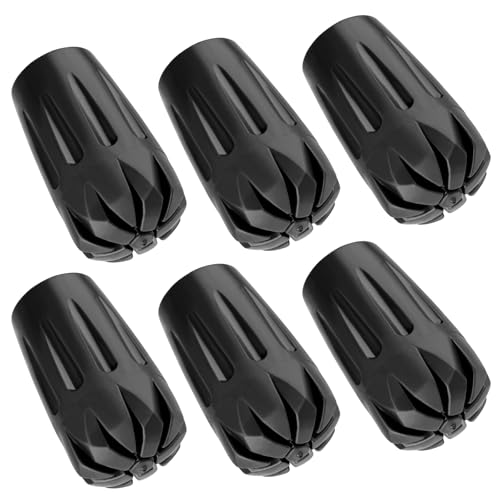
Pros
- Budget-friendly 6-piece bundle provides ample backup tips for long-distance hikes or multiple pairs of poles
- Universal 11mm inner diameter fits standard trekking poles and walking sticks
- Shock-absorbing rubber dampens impact and significantly reduces noise on paved or rocky terrain
- Simple push-on installation requires no tools or hardware
Cons
- Friction-fit rubber caps can be pulled off when wedged into thick mud, wet clay, or tight rock crevices
- The product specifications do not list an embedded metal washer, which may allow sharp metal pole tips to wear through over extended use
- Sized specifically for standard 11mm shafts and will not fit non-standard or oversized pole tips
The AISUNOUTDOOR Trekking Pole Rubber Tips are replacement traction caps designed to fit standard 11mm hiking sticks, trekking poles, and walking canes. Sold as a convenient 6-pack, this accessory caters to day hikers, backpackers, thru-hikers, and trail walkers who need to replace missing or worn-down pole feet. Rather than replacing entire trekking poles when factory tips degrade, these push-on rubber caps provide an affordable way to maintain traction and extend pole lifespan across paved walkways, rocky switchbacks, and hardpacked forest trails.
Trail performance with rubber tips centers on surface traction and impact dampening. The manufacturer highlights an anti-slip textured bottom designed to give stability on slick surfaces such as wet pavement, smooth granite, concrete paths, and wooden boardwalks. By substituting bare carbide or tungsten pole points with rubber, these tips also reduce the sharp, repetitive jarring transmitted to the user's wrists, elbows, and shoulders. Furthermore, using rubber caps on popular trails helps prevent the loud metallic clicking sound of hiking poles while reducing surface scarring on sensitive rocks in national parks.
The tips are molded from black rubber engineered to withstand everyday abrasion on mixed terrain. According to the product specifications, the entire set weighs approximately 0.032 pounds, making individual caps virtually unnoticeable when stashed inside a backpack hip-belt pocket, top lid, or first-aid kit. The interior sleeve is sized for standard 11mm pole tips, using a snug friction fit that slides securely over the bottom shaft. While the rubber body offers shock absorption and road grip, the product listing does not state whether these caps contain an embedded metal washer to prevent sharp metal tips from puncturing through over long distances.
Installing and carrying these replacement tips is straightforward for any outdoor activity. Hikers can simply press the rubber caps onto clean pole ends until fully seated, requiring no tools, adhesives, or mechanical fasteners. Because rubber tips can occasionally loosen or pull free when stuck in sticky mud, wet soil, or deep gravel, carrying multiple spares from this 6-pack ensures uninterrupted support during multi-day backpacking trips. For routine care, rinsing dirt and grit from inside the sleeve after muddy outings will help maintain a tight friction grip against the pole shaft.
Despite their practical utility, these replacement tips have clear limitations that buyers should understand before heading into the backcountry. The push-on friction fit is susceptible to pulling off if a pole tip gets wedged between boulders, caught in tree roots, or buried in heavy clay. Additionally, because rubber is inherently softer than tungsten carbide, regular use on coarse asphalt and abrasive rock will eventually wear down the tread. Hikers with specialized, ultra-slim, or oversized trekking poles should also verify tip diameter, as an 11mm opening will not fit non-standard pole designs.
The AISUNOUTDOOR 11mm Trekking Pole Rubber Tips offer solid practical value for hikers seeking an economical way to maintain grip, dampen vibration, and protect trails. While aggressive backpackers navigating deep mud or technical talus will want to monitor their pole tips closely, this 6-pack provides ample backup caps for routine trail walking, road walking, and day hiking. If your current trekking pole tips are worn down to the metal or you need dependable spares for your gear closet, this set is a practical and budget-friendly upgrade.
The AISUNOUTDOOR replacement tips feature an interior sleeve designed specifically for standard 11mm trekking pole and walking cane tips. This 11mm inner diameter matches the industry-standard sizing used on the majority of telescoping and folding hiking poles available in the outdoor market.
Before purchasing, hikers should verify the tip diameter of their current poles, as non-standard ultra-light shafts or heavy-duty walking sticks may require different dimensions. The push-on friction fit allows users to swap worn tips in seconds without needing extra tools, glue, or clamps.
Rubber pole tips excel on hard, solid surfaces where bare metal carbide spikes tend to slip, vibrate, or make excessive noise. These tips provide dependable friction on paved paths, concrete steps, exposed rock slabs, and bridge decking, making them ideal for road walking, urban trails, and maintained park switchbacks.
To maintain a tight friction fit, remove the tips periodically to clear out trapped moisture, fine sand, and mud from the interior socket. Storing the spare caps in a dry pocket of your daypack or gear bag ensures you are always prepared if a tip is pulled off in wet soil or deep gravel.
Restoring a malfunctioning hiking staff requires identifying whether the breakdown is an external friction loss, an internal alignment error, or standard surface wear. Most hikers experience lock slippage or joint sticking after high-mileage trips through fine silt, rain, or talus fields. Taking a methodical approach to disassembly, surface cleaning, and mechanical calibration resolves the vast majority of problems without requiring expensive replacement gear. Addressing these mechanical issues early ensures your poles provide reliable third and fourth points of contact whenever you encounter uneven terrain.
Diagnosing and Fixing Slipping External Lever Locks
External flip locks rely on mechanical clamp friction to hold telescoping aluminum or composite sections securely under downward force. When a lever closes with little resistance, the pole shaft often slides inward under vertical body weight, creating an unexpected fall risk on descents. The primary cause of this slipping is a loosened clamp screw or an accumulation of slick dirt along the shaft tube. Inspecting the clamp housing reveals whether the tension screw has backed out during trail vibration.
To recalibrate the clamping force, flip the external lever into the open position before attempting any adjustment. Rotate the knurled metal thumb screw clockwise by a quarter turn to tighten the clamp diameter slightly. Close the lever firmly and test the resistance, ensuring the cam mechanism snaps shut with solid thumb pressure without requiring excessive force. If the lever feels impossible to close, back off the screw slightly to avoid cracking the composite collar or stripping the threads.
If adjusting the tension screw does not eliminate slippage, the pole shaft itself likely has a coating of fine dust or skin oils. Pull the sections apart completely and wipe down the exterior anodized surface using a clean, dry microfiber cloth or a small splash of isopropyl alcohol. Never apply oil, grease, silicone spray, or WD-40 to the sliding shaft sections, as lubricants destroy the friction required for cam locks to hold. Reassemble the dry sections and verify that the height adjustment markings hold steady under downward pressure.
Troubleshooting Folding Z-Pole Push Buttons and Tension Cords
Retractable tri-fold designs operate differently than standard telescoping poles, relying on an internal tension cable and a spring-loaded pop-out pin to secure the joints. Models such as the Trekology Trek-Z Cork Grip Collapsible Lightweight fold down to a compact 15 inches for travel and deploy by extending the top shaft until a metal locking button pops outward. When users report that a folding pole feels loose or collapses unexpectedly, the root issue is almost always an unseated button rather than broken internal hardware.
If the shaft segments wiggle or pull apart easily, grasp the upper section firmly and pull downward until the brass or steel pin clicks fully into its designated aperture. Sometimes trail grit or moisture enters the button housing, preventing the spring from pushing the pin out all the way. Applying a quick blast of compressed air or cycling the button manually several times frees up trapped sediment. If the pole still feels unstable, check each joint to ensure the protective metal caps seat squarely into the adjoining shaft tubes.
Tension cords inside folding poles can occasionally lose tension if the knot slips or the inner elastic stretches after extensive use. Inspect the cable exposed at the hinges for fraying, sheath abrasion, or loose retention knots inside the top shaft cavity. If the knot has crept downward, gently pulling the cord to access the stopper knot allows you to retie it slightly tighter. Ensuring consistent cord tension keeps the tri-fold segments aligned without allowing lateral play during technical descents.
Clearing Jammed Telescoping Sections and Trail Silt
Hiking through boggy mud, river crossings, or dry volcanic scree frequently forces abrasive particles between the concentric aluminum shafts. Over time, trapped silt and mineral deposits create friction that locks telescoping segments together, making collapsed storage or length adjustments nearly impossible. Forcing a stuck pole with brute rotational force can twist or ovalize the aluminum tubing, permanently damaging the sliding interface. Freeing seized shafts requires patience and gentle mechanical leverage.
Begin by opening all external lever locks and tapping the joint gently against the sole of a hiking boot or a firm piece of wood to dislodge loose sand. If the tubes remain locked, wrap a rubber jar opener or wide rubber band around each section to maximize your grip without gouging the metal. Twist the sections in opposite directions with firm, controlled pressure until the joint breaks free from the debris seal. In stubborn situations caused by dried mineral crust, soaking the joint line in warm, soapy water for several minutes helps dissolve residue.
Once the sections separate, pull them apart completely and flush the interior cavities with clean water to remove remaining sediment. Use a long bottle brush or a cloth wrapped around a thin wooden dowel to scour the inside of the outer tube. Allow all pieces to dry thoroughly in an open room before sliding them back together, preventing moisture from causing internal oxidation. Regular post-hike cleaning prevents galvanic corrosion between metal surfaces and keeps telescoping adjustments smooth.
Replacing Worn Rubber Tips and Protecting Carbide Hardware
Trekking pole tips endure severe ground impact across miles of asphalt, packed dirt, and granite slabs. Bare tungsten carbide flex tips offer bite on dirt and mud, but hard pavement rapidly grinds down unprotected tips and creates distracting metallic clatter. Removable rubber caps protect the metal point, absorb joint shock, and prevent trail erosion on fragile alpine switchbacks. Over continuous mileage, the interior metal washer inside rubber caps can punch through, leaving the rubber sleeve loose or split.
Installing durable accessories like the Durable Replacement Rubber Tips for Trekking Poles restores grip on hard surfaces and protects your investment. These universal rubber caps fit standard 11mm pole ends, sliding straight over the tapered plastic flex tip collar. Before sliding a new rubber cap into place, scrape away caked mud or dried clay from the carbide point and surrounding base. Press the rubber tip firmly against a flat surface until it seats securely over the end of the shaft.
Keeping extra rubber tips in your pack ensures you never have to hike on hard roads with compromised traction. When navigating mixed terrain where rocky scrambles transition to paved trailheads, switching to fresh rubber caps cushions your wrists and elbows. Checking the base of the rubber cap after long hikes helps you spot deep splits before the carbide core punctures through the bottom. Replacing worn tips promptly maintains dependable traction and prevents premature wear on the pole’s permanent flex tip assembly.
Understanding Cork Grip Flex and Handle Maintenance
Grip comfort plays a significant role in hand fatigue, blister prevention, and moisture regulation during warm-weather treks. Handles crafted with natural cork naturally wick perspiration away from your palms, keeping your grip dry over high-mileage days. On gear like the Trekology Trek-Z Cork Grip Collapsible Lightweight, hikers sometimes notice a subtle rotational flex in the cork handle. This slight rotational movement is an intentional ergonomic feature designed to absorb anti-torque forces rather than a sign of structural failure or broken glue.
Distinguishing between intentional ergonomic flex and a damaged grip comes down to checking the lower attachment points. If the handle spins freely or lifts off the aluminum shaft, the internal adhesive has failed and requires reseating with outdoor-grade epoxy. However, if the cork merely yields slightly to torque during wrist rotation, the handle is functioning exactly as intended. Keeping the cork surface clean involves wiping it periodically with a damp rag to remove sweat salts and body oils that degrade natural cork over time.
Lower grip extensions made from closed-cell EVA foam provide a quick choke-up option when traversing steep sidehills without pausing to shorten the pole. Inspecting these foam sleeves for tears or separation from the upper shaft keeps your secondary hand positions secure. If trail dirt becomes embedded in the EVA foam pores, wash the area with mild dish soap and lukewarm water, then air-dry away from direct heat. Regular grip cleaning keeps the materials supple, prevents odor buildup, and maintains a secure handhold across varied gradients.
Straightening Bent Aluminum Shafts Versus Retiring Damaged Carbon
Aluminum trekking pole shafts constructed from aircraft-grade alloys provide high tensile strength while retaining ductile flexibility under heavy loads. If an aluminum pole bends after getting wedged in a boulder crevice, it can sometimes be straightened enough to complete your backcountry trip. Carbon fiber shafts, in contrast, do not bend; they fail catastrophically through brittle fracture, splintering into sharp fibers under high shear loads. Recognizing the material limitations of your poles determines whether a trailside repair is feasible or dangerous.
To attempt a field fix on a slightly bent aluminum section, remove the damaged tube from the assembly completely. Place the curved portion across a flat wooden log or smooth rock with the convex bend facing upward. Apply gentle, progressive downward hand pressure at the center of the bend, checking the alignment frequently to prevent over-correcting. Never hammer the shaft or bend it back aggressively, as metal fatigue will create micro-fractures that weaken the structural integrity of the tube.
If an aluminum tube develops a visible crease, kink, or sharp dent, it has lost its load-bearing capacity and must be replaced immediately. Applying body weight to a creased shaft on a steep downhill descent risks sudden buckling and severe personal injury. Similarly, any carbon fiber pole exhibiting hairline cracks, delamination, or crushing from cam clamp overtightening should be retired immediately. Contacting the manufacturer or purchasing a replacement lower shaft section is the only dependable solution when structural deformation occurs.
Calibrating Wrist Straps for Proper Load Transfer
Wrist straps are engineered to bear the primary downward load of your upper body, allowing you to maintain an open, relaxed grip without death-gripping the handle. When straps slip loose or twist incorrectly, hikers exert excessive forearm energy, leading to hand cramps and wrist fatigue. Proper adjustment begins by inserting your hand up through the bottom of the loop before resting your palm over the top of the grip. This configuration transfers your weight directly through the broad webbing rather than your thumb joints.
Most modern poles utilize an internal wedge block or cam buckle concealed within the top of the handle to lock strap webbing in place. If the strap slips longer during use, pull the release tab or slide the internal wedge upward to free the webbing tail. Pull the lower loop to shorten the strap until your elbow rests at a natural 90-degree angle when holding the pole upright on flat ground. Push the locking wedge firmly back into the grip housing to secure the strap length before stepping onto the trail.
Transport Precautions, Airline Rules, and Pre-Trail Verification
Proper packing habits prevent trekking poles from suffering accidental damage inside luggage or against backpack frames during transit. Collapsible tri-fold poles that condense down to 15 inches slide neatly into travel duffels or side sleeves, keeping joints protected from crushing impacts. When preparing gear for flights, hikers must remember that airport security regulations prohibit trekking poles in cabin luggage due to sharp metal carbide tips. Checking your poles as hold luggage or aligning them with carry on backpack capacity guidelines for other gear prevents frustrating confiscations at airport security checkpoints.
Before leaving the trailhead or beginning a steep descent, always perform a full downward load verification test on both poles. Extend the shafts to your desired height, ensuring the length markers match on both sides and the cam levers snap shut securely. Place both tips on solid ground directly in front of you and lean your upper body weight firmly onto the grips. If either section creeps downward even a few millimeters, immediately unclamp the lever, tighten the tension thumbscrew, and test again until the shaft holds rock-solid.
Carrying a reliable pair of hiking sticks transforms difficult mountain mileage by absorbing knee impact and providing critical stability across unpredictable terrain. Mastering basic maintenance techniques like tensioning lever clamps, resetting folding push buttons, and swapping worn rubber tips keeps your equipment performing safely season after season. Taking a few minutes to clean trail grit from joint interfaces and verifying clamping tension before each hike eliminates unexpected failures in the backcountry. With well-maintained hardware and a clear understanding of your pole mechanics, you can tackle steep ascents and rugged descents with absolute confidence.





Write Your Review
No reviews yet. Be the first to share your experience!