


Setting out on a rugged mountain trail with ill-adjusted gear quickly turns a rewarding day into an exhausting struggle against sore shoulders and aching joints. When you dial in your pole length correctly, each plant of the tip absorbs downward force and establishes a steady rhythm across uneven ground. Learning %how to set height of trekking poles% creates a solid foundation for energy conservation and spinal stability on steep terrain. Pairing well-measured poles with comfortable footwear and supportive hiking pants for joint comfort keeps your body aligned through high-mileage backcountry treks.
Trekking pole adjustments directly influence how efficiently your upper body shares the physical burden of each ascent and rocky descent. Locking mechanisms like external lever clamps, internal twist expanders, and folding push buttons allow hikers to customize shaft dimensions to match personal height and fluctuating slope angles. Taking a few moments to understand the mechanical limits and anatomical baselines of your gear ensures reliable performance before you step onto the trail. Dependable adjustment prevents sudden slip hazards and shields vulnerable knee joints from cumulative impact during downhill travel.

Pros
- Built-in anti-shock spring reduces joint stress when descending rocky trails
- Snag-free twist-lock mechanism keeps pole profile slim against pack straps
- Includes a versatile four-piece tip and basket set for rocks, mud, snow, and pavement
- Disassembles to 21.46 inches for easier transport in luggage or duffels
- High-strength aluminum alloy provides reliable durability at an accessible price point
Cons
- Twist-lock collars require firm hand tightening to prevent accidental collapse under heavy loads
- Collapsed length of 25.6 inches typically requires external backpack attachment rather than internal storage
- Rubber grips lack the sweat absorption of natural cork handles on warm-weather hikes
The TheFitLife Telescopic Trekking Poles provide practical stability and joint protection for day hikers, weekend backpackers, and fitness walkers. Designed as an accessible external trail accessory, these poles help balance shifting loads when carrying a daypack or overnight backpack over uneven terrain. Hikers looking to minimize joint strain will appreciate the integrated anti-shock mechanism that softens ground impacts with every stride.
On the trail, adjustability and weight balance are essential. Each pole weighs 9.92 ounces (282 grams), resulting in an agile swing weight that does not prematurely tire your arms. The three-section telescoping shaft expands from a minimum length of 25.6 inches (65 cm) up to 51.2 inches (130 cm). This generous adjustment range allows hikers to set proper pole lengths for steep ascents, descending grades, or flat trail cruising, accommodating a broad spectrum of user heights.
Crafted from durable aluminum alloy, the pole shafts are engineered to withstand rocky paths, root-strewn tracks, and variable temperatures. Instead of external cam levers, TheFitLife uses an internal twist-lock mechanism. This design creates a smooth, snag-free exterior that slides easily into backpack gear loops or under side compression straps without catching on webbing. The molded rubber grip features an ergonomic, non-slip profile suited for all-day trail handling.
For backpackers and travelers, transport flexibility is a notable advantage. The poles collapse to 25.6 inches for trail lashing. When fully separated into three individual sections, the longest piece measures 21.46 inches (54.5 cm), allowing them to fit diagonally inside most 22-inch or larger travel luggage. The package also includes rubber tips, road-walking caps, mud baskets, and snow baskets, giving hikers the correct ground interface across all four seasons.
Potential buyers should consider a few mechanical factors before hitting the trail. Twist-lock mechanisms require deliberate, firm hand tightening to ensure the internal expanders bite securely under full body weight. Additionally, while the 25.6-inch collapsed length attaches well to external pack loops, it is generally too long to fit inside compact daypack main compartments. Hikers who prefer porous cork grips for sweaty summer hikes should note that these feature molded rubber handles.
Overall, TheFitLife Telescopic Trekking Poles deliver dependable build quality, useful anti-shock dampening, and full accessory coverage at an approachable price. They are a smart addition for hikers who want reliable extra balance on rocky trails without spending premium gear prices.
Securing trekking poles properly on your backpack prevents shifting weight and snagging on low branches. TheFitLife poles collapse down to 25.6 inches (65 cm), making them well-suited for side compression straps, tool loops, or dedicated trekking-pole bungees on standard daypacks and multi-day packs. For travelers, the poles can be fully disassembled into three sections measuring 21.46 inches (54.5 cm), which fits diagonally inside checked luggage or travel duffels.
The height adjustment ranges from 25.6 inches to 51.2 inches (130 cm), making it simple to achieve an ergonomic 90-degree elbow bend on level terrain. Markings on the pole sections help you quickly match heights between the left and right poles after packing or adjusting for uphill and downhill sections.
TheFitLife poles come equipped with a comprehensive accessory set designed to adapt to varied trail surfaces. Standard carbide tips provide direct grip on hard-packed dirt, ice, and rock. For paved surfaces or rocky trails where you want to minimize noise and tip wear, push-on rubber tips and curved walking caps provide added grip and cushioning.
For loose or seasonal ground conditions, screw-on mud baskets prevent the poles from sinking deep into wet soil, sand, or scree. Wider snow baskets are also included to distribute weight across soft winter powder or crust, making these poles fully functional for year-round outdoor hiking.

Pros
- Lightweight carbon fiber shaft keeps total carried weight low on long hikes
- Comfortable cork handles wick moisture effectively during warm-weather ascents
- Fast and reliable quick-lock clamps make height adjustments simple on the move
- Generous accessory package covers varied surfaces from pavement to deep snow
- Includes a travel carry bag and pole clip for organized transport and pack storage
Cons
- Minimum collapsed length of 26 inches extends beyond the frame of compact daypacks
- Carbon fiber shafts can fracture if subjected to severe lateral leverage or rock jams
- Quick-lock tension screws require occasional manual tightening to avoid slippage
The Cascade Mountain Tech Carbon Fiber Trekking Poles are three-section telescoping trail sticks engineered for day hikers, weekend backpackers, and thru-hikers who want to minimize pack weight without paying premium prices. Weighing roughly 8.1 oz per pole, these carbon fiber hiking sticks serve as high-utility trail equipment that easily complements daypacks, overnight packs, and ultralight gear setups. For hikers traversing uneven switchbacks, descending loose scree, or fording streams, these poles provide essential stability, help maintain rhythm, and distribute physical effort across the upper body.
Adjustability is handled through a pair of external quick-lock lever clamps on each shaft, allowing the poles to extend from a 26-inch collapsed length up to a maximum height of 54 inches. This broad adjustment range accommodates a wide variety of hiker heights and allows fast on-trail modifications when alternating between steep uphill climbs and controlled downhill descents. The quick-lock design enables swift height changes in cold or wet conditions without requiring the frustrating twisting motions typical of internal expander mechanisms. When stowed, the 26-inch collapsed size slides easily into backpack side pockets and secures under side compression straps.
Shaft construction centers on lightweight carbon fiber tubing, which provides natural vibration dampening that helps lessen shock on wrists, elbows, and shoulders over long miles. The main handles are built with contoured natural cork that wicks sweat and molds comfortably to your grip over time. Below the cork handle, an extended lower grip offers a soft secondary surface for your hands, allowing you to choke down momentarily on steep ascents without stopping to shorten the shafts. At the base, hard tungsten carbide tips offer reliable bite on hard-packed soil and slick rock, while the adjustable wrist straps keep the grips secure in hand.
A notable advantage of this Cascade Mountain Tech set is the complete accessory package supplied in the box. Hikers receive protective rubber tips and rock boot tips for hard surfaces or asphalt road walking, wide mud and sand baskets for soft backcountry trails, and larger snow baskets for winter snowshoeing or shoulder-season drifts. A storage clip holds the poles together during transport, and the included drawstring carry bag protects your vehicle interior and hiking pack fabric from sharp tip abrasion when travelling to and from the trailhead.
While carbon fiber provides an excellent stiffness-to-weight balance, it has practical material tradeoffs compared to heavier aluminum poles. Carbon fiber tubing can crack or snap catastrophically if caught in a deep rock crevice and subjected to extreme sideways bending leverage. Additionally, the 26-inch minimum length is longer than folding Z-pole designs, meaning the poles will stick out above smaller 15-to-20-liter daypacks when strapped to exterior loops. Hikers should also verify and adjust the thumbscrew tension on the quick locks prior to major trips to ensure the clamps stay firmly locked under full body weight.
For beginner hikers, section backpackers, and budget-conscious trail enthusiasts, the Cascade Mountain Tech Carbon Fiber Trekking Poles deliver dependable build quality and exceptional real-world utility. They combine the premium touch of moisture-wicking cork handles with rapid length adjustment and an accessory bundle that many brands sell separately. If you need a reliable, lightweight set of hiking sticks that mounts easily to your backpack and handles multiple seasons of trail use, this package represents one of the strongest values available.
These Cascade Mountain Tech poles feature an adjustable length range spanning from 26 inches up to 54 inches, making them adaptable to most adult hikers as well as growing teenagers. Clear increment markings printed along the upper and lower shaft sections make it easy to align both poles to matching heights after deploying them from your backpack.
The external quick-lock levers can be opened and closed easily, even while wearing trail gloves. If the shafts slide under heavy downward pressure, the integrated tension thumbscrew can be tightened by hand to restore firm clamping force. The padded, adjustable wrist straps can be lengthened or shortened quickly to provide balanced wrist support and prevent hand fatigue during long downhill sections.
At a collapsed length of 26 inches, these poles are designed to attach externally to most medium and large hiking backpacks using standard trekking pole loops, bungee keepers, or lower side compression straps. Placing the pole tips into a side water bottle pocket and securing the shafts with upper compression straps keeps them stabilized against your pack body during bushwhacks or scrambles.
For travel and off-season storage, the included carry bag encloses the complete set to prevent carbide tips from puncturing gear, car upholstery, or luggage liners. The set also comes with a plastic dual-pole clip that snaps the shafts together, preventing loose rattling inside a gear bin or trunk between weekend trail outings.
The package comes equipped with an extensive assortment of interchangeable trail tips and baskets, allowing the poles to adapt to diverse terrain and seasonal weather. The pre-installed tungsten carbide tips provide direct purchase on trail dirt, roots, and bedrock for backcountry hiking.
For paved surfaces, neighborhood walking, or slick rock slabs, the set includes standard rubber tips and angled rubber boot tips that enhance friction and prevent carbide wear. When conditions turn soft, the small mud and sand baskets keep the poles from sinking deep into loose trail beds, while the larger snow baskets provide enough surface area for light winter snowshoeing and cold-weather hiking.

Pros
- Folds down to 15 inches, making it significantly easier to pack inside travel luggage or strap to compact daypacks than standard telescoping poles
- Moisture-wicking natural cork handles keep palms dry and comfortable across humid hiking conditions
- Sturdy metal flip locks and reinforced joint caps provide solid structural support without slippage when properly tensioned
- Lower EVA foam grips allow instant trail adjustment for steep uphill climbing
Cons
- At 11.5 ounces per pole, they carry more weight than specialized ultralight carbon fiber poles
- The 110 cm minimum height setting may feel slightly too long for hikers under 5 feet 2 inches
- Per TSA regulations, trekking poles with metal tips must be packed in checked luggage rather than carried on flights
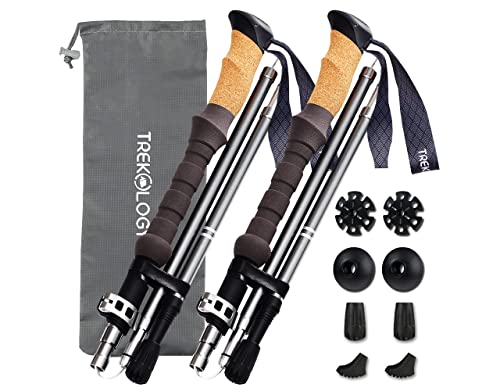
The Trekology Trek-Z Cork Grip Trekking Poles are folding, multi-section hiking sticks designed for hikers, backpackers, and travelers who require sturdy trail stability without the awkward bulk of traditional telescoping poles. Sold as a pair with an included carry bag, these poles suit day hikers tackling uneven paths, weekend backpackers managing load transfer on descents, and outdoor enthusiasts who need compact gear that fits inside travel luggage or standard daypack side sleeves.
Trail packability is one of the standout characteristics of this design. Utilizing a retractable tri-fold cable system, each pole breaks down to just 15 inches (38 cm) in overall length. This short folded dimension lets you slip the pair directly into the main compartment of an overnight pack, tuck them into side stretch-mesh water bottle pockets, or strap them beneath external compression straps without snagging overhead brush. For length adjustment, an upper aluminum section provides a 20 cm sliding range from 110 cm to 130 cm, catering to user heights between 5 feet 2 inches and 6 feet 5 inches.
Component construction focuses on long-term trail durability. Trekology builds the Trek-Z poles from aircraft-grade aluminum alloy, which provides higher impact resistance and flex tolerance against rocky crevices compared to brittle carbon fiber. The folding shaft joints feature protective metal caps to resist wear at stress points during repeated assembly. Up top, the natural cork grip wicks moisture away from sweaty palms during steep ascents, while a secondary EVA foam grip sleeve allows you to lower your hand placement instantly on steep trail grades without adjusting the shaft length.
Deploying and adjusting the poles requires a straightforward two-step setup. After letting the lower segments drop into place, you pull the upper shaft section until an internal metal locking button pops outward with a firm click. A durable metal external flip lock then secures the upper telescoping section at your desired height marker. Proper setup is essential; if the lower shaft feels loose or disconnected, the metal lock button must be firmly pulled until fully seated in its designated catch hole. Maintenance is simple, requiring only an occasional wipe-down with a dry cloth after muddy hikes before packing into the included storage sleeve.
While practical and durable, the Trek-Z design carries a few realistic limitations. Each pole weighs 11.5 ounces (330 grams), resulting in a combined pair weight around 23 ounces, which may deter dedicated ultralight thru-hikers who prefer minimal swing weight. Additionally, the minimum length of 110 cm means youth hikers or adults under 5 feet 2 inches might find the grip positioning too elevated on flat terrain. Travelers should also remember that TSA guidelines require trekking poles with rigid tips to travel inside checked baggage rather than carry-on packs.
For hikers seeking an affordable, compact, and robust set of walking poles, the Trekology Trek-Z Cork Grip poles deliver excellent overall value. They provide dependable joint support, sweat-wicking cork comfort, and pack-friendly folding convenience that fits easily into standard hiking backpacks and travel duffels.
The Trekology Trek-Z poles feature an adjustable working range between 110 cm and 130 cm, making them compatible with users measuring between 5 feet 2 inches and 6 feet 5 inches in height. Sizing adjustments are controlled via a durable metal flip-lock clamp positioned on the upper shaft section, marked with clear centimeter increments for quick alignment.
Hikers can lengthen the poles slightly for steep downhill sections to maintain an upright posture, or shorten them for prolonged uphill climbs. For fast grade transitions where stopping to loosen the clamp is impractical, the extended EVA foam grip below the primary cork handle allows instant choke-down positioning.
Thanks to a three-section folding architecture linked by an internal tension cable, the Trek-Z poles collapse down to an ultra-compact 15 inches (38 cm). This compact footprint allows them to slide vertically inside most 20-liter to 65-liter hiking backpacks, eliminating the tip-heavy snagging hazards common with longer two-piece or three-piece telescoping poles.
A matching carry bag is included to keep trail mud and dust away from sleeping bags, pack liners, and clothing when stored internally. When flying to destination trailheads, note that airline security guidelines require trekking poles to be packed within checked baggage rather than carry-on luggage.
The shafts are manufactured from aircraft-grade aluminum alloy, delivering high tensile strength and resilience against bending forces when supporting heavy backpack loads on rocky trails. The connection joints between segments are reinforced with metal caps to resist cracking and wall deformation under load.
The upper handle utilizes natural cork material that absorbs hand moisture, resisting slick spots during warm summer outings. The handle is engineered with a slight rotational flex that acts as an anti-torque buffer, reducing jarring impacts transmitted through the hands and wrists across prolonged trail miles.
Dialing in Proper Trekking Pole Length for Stability and Biomechanics
Establishing the correct pole height fundamentally alters how your body distributes mechanical stress over variable backcountry terrain. When shafts are set too long, your shoulders stay tense and arms fatigue rapidly, while overly short poles cause you to hunch forward and compromise balance. Taking time to dial in your equipment before stepping onto the trail ensures maximum stability, dependable joint protection, and efficient forward momentum. The following guidelines walk through proper height adjustments for level trails, grueling climbs, technical descents, and distinct locking hardware.
The 90-Degree Elbow Baseline on Level Terrain
A proper baseline measurement begins on a flat, even surface while wearing your standard hiking boots or trail runners. Stand upright with your shoulders relaxed, lace your trail footwear, and grasp the pole handles naturally while letting your arms hang at your sides. Adjust the telescoping shafts until your elbow forms a clean 90-degree right angle with your forearm positioned parallel to the ground. This neutral anatomical stance accounts for outsole thickness and allows your upper body to absorb ground feedback without forcing your shoulders upward.
Maintaining this 90-degree bend keeps the pole tip planted slightly behind your trailing foot during a normal walking cadence. This placement creates forward momentum as you push off, transferring kinetic energy efficiently with every stride. If the grip sits too high, your biceps remain in constant contraction, leading to premature arm exhaustion over long trail days. Conversely, a grip positioned too low forces your lumbar spine to bend forward, disrupting natural walking posture and placing unwanted strain on your lower back.
Uphill Adjustments and Climbing Posture
Ascending steep mountain switchbacks requires a deliberate adjustment to keep your center of gravity balanced over your feet. As the trail gradient tilts upward, the ground meets the pole tips much earlier in your forward stride. Shortening both poles by 5 to 10 centimeters (roughly 2 to 4 inches) prevents you from reaching upward and straining your shoulders. This adjustment lets you press down firmly through your triceps, generating useful upward propulsion while keeping your chest open for effortless breathing.
Leaving poles at their standard flat-ground length during steep ascents forces your hands above your chest, which restricts circulation and accelerates arm fatigue. Many modern designs solve this issue by incorporating extended lower grip sleeves directly beneath the main handle. Poles like the Cascade Mountain Tech Trekking Poles and the Trekology Trek-Z Cork Grip Collapsible Lightweight feature these lower foam sections for rapid hand repositioning. Sliding your hands down onto these secondary grips allows you to tackle brief uphill pitches without stopping to unlock and re-clamp your shafts.
Downhill Lengthening for Knee and Joint Relief
Steep descents present the greatest mechanical challenge to your knees, hips, and stabilizing leg muscles. On downhill paths, the ground falls away beneath your feet, forcing you to reach farther downward to find solid footing. Lengthening each trekking pole by 5 to 10 centimeters allows the tips to contact the terrain well before your lead foot lands. This extension provides an early contact point that steadies your descent, keeps your torso upright, and prevents dangerous forward tipping.
When poles are lengthened properly, a significant portion of your body weight and pack load transfers directly through your arms into the ground. This load distribution spares the patellofemoral joints from punishing braking forces that frequently cause chronic knee pain. Placing both poles slightly ahead during steep drops also creates a reliable braking mechanism for each downward step. Hikers can palm the rounded tops of rubber handles, such as those on the Telescopic Trekking Poles for Hiking, to bear downward force without bending or straining their wrists.
Balancing Symmetrical Extension on Telescoping Shafts
Most adjustable trekking poles utilize three telescoping sections to provide a wide range of height configurations. When sizing these poles, you should extend the middle and lower shaft sections by equal increments to maintain structural integrity. For example, if you need 120 centimeters of total height, align both sections to the 120-centimeter marks rather than extending one fully and leaving the other collapsed. Symmetrical extension balances the shaft diameter taper and prevents excessive flex under heavy downward pressure.
Every telescoping pole section features a clearly marked stop line or maximum extension boundary etched into the shaft. Extending any section past this warning marker leaves too little overlap inside the locking collar, creating a severe failure hazard under sudden impact. The Telescopic Trekking Poles for Hiking feature clear measurement markings along their aluminum tubes spanning from 25.6 inches (65 cm) to 51.2 inches (130 cm). Keeping your chosen settings within these marked boundaries guarantees balanced support and prevents joint buckling on technical trails.
Calibrating External Lever Locks Versus Internal Twist Expanders
The specific locking mechanism on your poles determines how you adjust length and verify holding security in the field. External cam lever locks use an outside clamp that compresses the outer shaft sleeve around the inner section. The Cascade Mountain Tech Trekking Poles utilize quick-adjust lever locks paired with knurled thumb screws. To calibrate holding power, open the lever, tighten the thumb screw clockwise slightly, and snap the clamp shut until firm thumb pressure is required.
Internal twist locks operate through an expanding internal plastic plug that grips the inner walls of the shaft as you rotate the sections. The Telescopic Trekking Poles for Hiking feature a refined, glove-friendly twist-lock system that tightens securely without external hardware. To set the height, hold the upper section steady and rotate the lower section clockwise until the internal expander bites firmly. Twist locks provide a sleek, streamlined profile that will not snag on dense brush or branches along narrow backcountry corridors.
Both locking styles require clean, unlubricated contact surfaces between the interlocking shaft sections to maintain dependable friction. Trail dust, mud, or moisture inside the tubes can cause internal expanders or external clamps to slip unexpectedly under load. Never apply oils, grease, or silicone sprays to your trekking pole shafts, as lubricants destroy the holding power of the locking mechanisms. If a section slips, pull the poles apart, wipe the bare metal with a clean, dry cloth, and readjust the tension.
Sizing Folding Z-Poles with Telescoping Top Sections
Collapsible tri-fold Z-poles operate differently from traditional telescoping models because their lower segments feature fixed lengths connected by internal tension cords. The Trekology Trek-Z Cork Grip Collapsible Lightweight uses this design to achieve exceptional portability while maintaining custom height flexibility. To assemble these poles, slide the lower sections together and pull the upper shaft downward until the metal lock button pops out securely. Only after this primary button engages can you adjust the total pole length using the top flip lock.
The top telescoping section on the Trek-Z provides a 20-centimeter adjustment window spanning from 110 centimeters to 130 centimeters. This range accommodates hikers between 5 feet 2 inches and 6 feet 5 inches tall across varied terrain conditions. Open the metal flip lock collar, slide the grip handle to your desired height setting, and snap the clamp firmly shut. If the pole feels loose at the joints, ensure the spring-loaded lock button is fully seated through its alignment hole before trusting the shaft with your weight.
Wrist Strap Sizing and Ergonomic Load Transfer
Adjusting the length of your wrist straps is just as critical to efficient hiking as setting the pole shaft height. Many hikers incorrectly insert their hands into the strap loops from the top down, which offers minimal support and risks thumb injuries during a fall. To use straps properly, thread your hand up from underneath the loop, pull down, and wrap your fingers around the grip. The webbing should rest flat against the base of your palm and cross the back of your carpal bones.
When straps are adjusted to the correct tension, you can bear significant downward weight without squeezing the handle tightly. Sizing the webbing so your hand rests naturally on the grip allows you to open your fingers during the forward swing to relieve muscular tension. This relaxed grip style prevents blister formation, palm hot spots, and forearm cramping over long mountain treks. Both natural cork grips, such as those on the Cascade Mountain Tech and Trekology models, and rubber handles benefit greatly from proper strap support.
Packability, Storage Dimensions, and Transport Rules
Understanding collapsed dimensions is essential when transitioning from backcountry trails to public transport, duffel bags, or airport terminals. The Trekology Trek-Z Cork Grip Collapsible Lightweight folds down to a compact 15 inches (38 cm), making it simple to slide into luggage cases or daypack side sleeves. In comparison, standard three-section telescoping models, such as the Cascade Mountain Tech Trekking Poles, collapse to approximately 26 inches. Choosing the right folding architecture directly affects how comfortably you can pack your gear alongside other trail essentials.
Air travelers must pay close attention to airline regulations regarding outdoor equipment before heading to the departure gate. The Transportation Security Administration (TSA) and international aviation authorities generally prohibit trekking poles in carry-on baggage due to their sharp tungsten carbide tips. Poles must almost always be stowed in checked luggage to pass security inspections without confiscation. When planning gear logistics for remote flights, reviewing our practical guide to carry-on travel backpack capacity helps you organize your checked and carry-on packing strategies.
The Telescopic Trekking Poles for Hiking offer a versatile pack-and-go solution by disassembling completely into three separate sections measuring 21.46 inches (54.5 cm). This disassembled length allows the aluminum sections to fit diagonally inside most standard 22-inch checked suitcases with ease. For daily trail outings, securing collapsed poles externally using backpack compression straps keeps your interior pack volume free for extra layers and hydration. Protecting your pack fabric with rubber walking tips prevents sharp carbide ends from abrading delicate nylon during transit.
Pre-Trail Load Verification and Field Maintenance
Before committing your full body weight to adjusted poles on exposed mountain terrain, always perform a quick downward load verification test. Stand on level ground, grasp the handles firmly, and lean your upper body downward onto the grips with decisive force. If either shaft section slips or clicks downward, the locking mechanism lacks adequate clamp tension. Addressing loose hardware while standing safely in the parking lot prevents catastrophic joint collapse when stepping off high trail boulders.
Routine field maintenance preserves the holding power of both lever clamps and internal expanders across hundreds of trail miles. After hiking through rain, river crossings, or muddy bogs, pull your telescoping poles apart completely and allow all shaft sections to air dry. Trapped moisture inside closed aluminum shafts causes mineral buildup, oxidation, and corrosion that can seize locking mechanisms permanently. Similarly, inspect carbon fiber shafts regularly for hairline cracks or deep gouges caused by rocks, as damaged composite shafts must be retired immediately.
Replacing worn trail accessories ensures your height-adjusted poles bite securely into whatever surface you encounter. Tungsten carbide flex tips deliver aggressive traction on loose dirt, gravel, and alpine granite slabs, while removable rubber tips protect sensitive pavement and rock surfaces from wear. Swapping small mud discs for wide powder snow baskets during winter snowshoeing prevents the poles from sinking deep into the snowpack. When your accessories match the ground conditions, your carefully configured pole height delivers maximum stability on every step of your journey.
Dialing in the correct height on your trekking poles transforms them from simple walking sticks into high-performance extensions of your body. Taking a few moments to establish a 90-degree elbow baseline, adapt to changing slope angles, and secure your locking hardware ensures lasting trail comfort. Whether you prefer ultralight carbon fiber construction or rugged aircraft-grade aluminum, proper adjustment protects your joints and maximizes efficiency across every backcountry mile.




Write Your Review
No reviews yet. Be the first to share your experience!