


Rocky descents and paved access roads often send jarring vibrations up through your wrists, forearms, and shoulders whenever bare metal tips strike hard ground. Bare tungsten carbide tips excel at clawing into loose soil and slick gravel, but their sharp bite creates distinct drawbacks on solid stone, concrete, and asphalt. Many hikers wonder should you use rubber tips on trekking poles when transitioning from backcountry singletrack to hardpack fire roads or paved greenways. Equipping the bottom of your staff with flexible rubber dampeners changes how energy transfers into your upper body, which pairs naturally with supportive trail clothing like hiking pants designed for joint comfort during steep mountain descents.
Aside from vibration control, rubber accessories preserve sensitive natural surfaces, eliminate piercing metallic clatter, and prevent premature tip erosion. Backcountry regulations in some national parks even recommend rubber caps to prevent scratching fragile sandstone or leaving visual scars across popular climbing approaches. Understanding when to cap your poles and when to expose the underlying carbide point ensures that your trekking hardware provides dependable stability without compromising footing or accelerating trail wear.

Pros
- Durable vulcanized rubber construction designed for mixed hard-surface use.
- Fits standard 0.4-inch (1 cm) pole ends across most major trekking pole brands.
- Extremely light at 0.0875 pounds for all four tips, making spares easy to pack.
- Cost-effective solution to refresh traction without replacing entire poles.
Cons
- Not compatible with Black Diamond Z Poles due to non-standard tip dimensions.
- Friction-fit tips can occasionally dislodge if caught between rocks or in heavy mud.
- Naturally wears down over time on rough pavement and coarse asphalt.
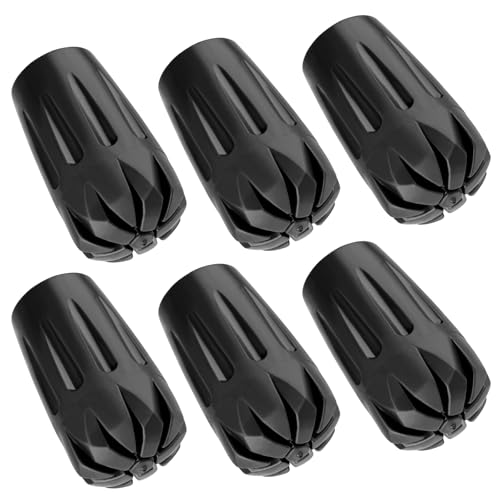
The York Nordic VTread Tapered Four Pack is a dedicated trekking pole accessory designed for hikers, fitness walkers, and backpackers who frequently encounter paved sections, rock slabs, or concrete walkways. Metal carbide tips perform well on loose soil, but hard surfaces can cause them to slip, vibrate excessively, and wear out prematurely. These vulcanized rubber replacement caps slide directly over standard pole ferrules to provide a quieter, more secure contact point while preserving the underlying hardware.
On the trail, adaptability matters when a route transitions from forest floor to paved greenways, rocky summits, or road connectors. The VTread tips feature a tapered profile made from vulcanized rubber that helps absorb repeated impacts and provides solid grip on unforgiving terrain. With a total weight of roughly 0.0875 pounds for all four units, carrying two spares in a backpack hip-belt pocket, shoulder strap pouch, or top lid compartment adds virtually no noticeable base weight to your hiking setup.
Build quality centers on resilient vulcanized rubber, which offers better density and abrasion resistance than standard soft plastic caps. The interior sleeve relies on a firm friction fit around the pole ferrule, seating tightly against the metal end to keep dirt and debris from packing into the tip cavity. Because trekking pole feet endure friction and pressure with every stride, having a four-pack ensures you have backup traction available when tips naturally wear thin after extensive mileage.
Installing and managing the VTread tips is completely tool-free. To install, simply align the 1-centimeter (0.4-inch) opening with the clean tip of your pole and push firmly against a firm surface until fully seated. When moving into deep mud, snow, or loose scree where exposed carbide points are required, you can twist and pull the caps off, storing them securely inside a pack pocket until hard pavement or smooth rock returns.
There are a few practical limitations to keep in mind regarding fit and retention. While the 0.4-inch diameter fits the vast majority of standard hiking and Nordic walking poles, the manufacturer explicitly notes these tips do not work with Black Diamond Z Poles. Additionally, like any push-on rubber tip, they can occasionally pull free if wedged tightly between roots, boulders, or deep clay, making occasional visual checks good practice on rough trails.
For hikers, commuters, and fitness walkers looking to extend the life of their trekking poles and reduce joint jarring on hard surfaces, the York Nordic VTread 4-Pack is an affordable, sensible addition to any gear bag. It provides dependable grip where metal tips struggle, fits standard pole shafts easily, and offers immediate backup security on long journeys.
The York Nordic VTread tips feature an internal diameter opening of 1 centimeter (approximately 0.4 inches). This measurement matches the standard ferrule taper found across most major hiking, trekking, and Nordic walking pole brands.
Compatibility is not entirely universal across specialty hardware. York Nordic explicitly states that these tips do not work with Black Diamond Z Poles, which feature a distinct tip geometry. Before purchasing, verify your pole tip diameter to ensure a secure friction fit.
Carrying replacement tips requires minimal organization. At 0.0875 pounds and compact exterior dimensions, a pair of spare tips can stay permanently inside a pack zipper pocket, ditty bag, or first-aid kit without crowding your primary gear space.
Beyond traction on asphalt and concrete, rubber tips serve a valuable role in low-impact hiking. They eliminate the repetitive clicking noise of metal tips on stone pathways and help prevent scratch marks on delicate sandstone, granite slabs, and historical trail features.
Core Decisions and Field Dynamics for Trekking Pole Rubber Tips
Deciding whether to cap your trekking poles with rubber attachments comes down to the exact terrain beneath your boots. On hard pavement, flat granite slabs, road transitions, and wooden bridges, rubber tips provide critical friction and sound dampening that bare metal cannot match. Out in loose dirt, thick mud, wet snow, or steep gravel switchbacks, keeping rubber tips on your poles can actively compromise your stability. The decision is never an all-or-nothing choice, but rather an active adjustment based on trail conditions.
Carbide flex tips are engineered to penetrate the ground and bite into dirt, creating a firm anchor point that resists lateral slippage. Rubber tips work through surface friction, flattening against hard materials to create a grippy footprint without penetrating the surface. When you leave rubber tips on over soft soil, the poles cannot sink into the earth, forcing your arms to work harder to maintain balance. Understanding this mechanical difference allows you to swap your pole hardware based on the trail rather than leaving one setup on permanently.
The Fundamental Rule: Hard Surfaces Versus Soft Backcountry Terrain
Trekking pole manufacturers provide rubber tips primarily for hard, unforgiving surfaces where metal tips struggle to find purchase. Concrete sidewalks, asphalt roadways, rocky approach trails, and slick urban pathways cause bare carbide to skid uncontrollably. Rubber compounds grip these polished surfaces securely, turning potential slip hazards into reliable points of contact. If your typical walking route includes paved greenways or suburban asphalt, rubber feet are essential equipment.
Soft backcountry terrain demands the exact opposite approach. When you hike across loamy soil, wet pine needles, loose talus, or mud, bare tungsten carbide tips sink into the ground to provide reliable mechanical purchase. Leaving rubber tips attached in soft dirt prevents your poles from penetrating, which increases the likelihood of slipping when pushing up steep switchbacks or stabilizing heavy descents. The rounded rubber base simply skates over loose organic matter, robbing you of the secure purchase needed on tricky terrain.
How Bare Carbide Tips Differ Mechanically from Vulcanized Rubber Feet
Tungsten carbide sits at the very base of hiking pole shafts because of its exceptional hardness and resistance to abrasion. This sharp, concave or crowned metal tip acts like an ice pick, digging into rock crevices and hardpack earth to arrest your momentum. While carbide is remarkably durable against rock impacts, it transfers high-frequency vibration directly through the shaft and produces a persistent metallic clicking noise. Over miles of exposed bedrock, that repeated metal impact can also dull the tip edges prematurely.
Vulcanized rubber feet alter this mechanical connection entirely by cushioning the point of contact. The pliable rubber absorbs micro-impacts before they travel into aluminum or carbon fiber shafts, muting the harsh trail chatter that fatigues wrists and forearms over long distances. Rubber also spreads the downward force across a wider surface area, which generates steady friction on slick granite slabs where carbide points would simply scrape and slide. This grip dynamic provides a reassuring plant when descending smooth slickrock.
Protecting Sensitive Geological Features and Practicing Leave No Trace
Environmental preservation is one of the most compelling arguments for using rubber tips on popular trails. Bare metal tips scratch exposed bedrock, strip away delicate trailside lichen, and leave permanent white pockmarks across ancient sandstone formations. In high-traffic outdoor destinations like the desert Southwest, thousands of bare pole strikes each season cause visible aesthetic and physical erosion to natural rock surfaces. These small scars accumulate over decades into noticeable grooves along popular corridors.
Adhering to Leave No Trace ethics often means slipping rubber caps over your poles when traversing slickrock sections or historic mountain routes. Rubber shields the rock from chipping and abrasion while preserving the natural appearance of the trail for future hikers. Many park stewards and conservation groups actively encourage rubber tips specifically to protect sensitive geological formations from cumulative wear. Carrying a pair of lightweight caps in an easily accessible pocket makes it simple to practice responsible trail stewardship.
Eliminating Trail Chatter and Upper-Body Vibration Fatigue
Repeatedly planting trekking poles into solid rock sends repetitive shockwaves through the pole shafts into your hands, wrists, and elbows. Over the course of a twenty-mile mountain trek, this continuous mechanical buzzing can irritate sensitive tendons and aggravate existing joint inflammation. Rubber tips serve as an effective vibration dampener, isolating your hands from sharp impact shocks on hard trails. This subtle dampening effect helps hikers conserve upper-body energy during long days on rocky paths.
Beyond physical joint comfort, rubber dampeners create a far quieter hiking experience. Bare carbide tips produce a rhythmic, metallic clicking sound that echoes through quiet mountain canyons and disturbs native wildlife. Using rubber caps silences each pole plant, allowing you to walk in peace and maintain a low-impact presence on the trail. Quiet footsteps can improve your chances of observing wildlife while preserving the tranquil atmosphere of wilderness environments.
Varieties of Rubber Feet: Boot Paws, Tapered Nordic, and Standard Round Caps
Rubber tips are not one-size-fits-all accessories, and different shapes serve distinct hiking and walking styles. Standard round rubber caps resemble small thimbles with textured bottoms, offering a balanced contact patch for casual walking and moderate mountain trails. These rounded caps work well when poles plant at varied angles during uneven ascents. Their symmetrical design means they grip consistently regardless of how the pole rotates in your hand.
Angled walking paws, often called Nordic boot tips, feature a beveled, shoe-like profile with deep treads designed specifically for power walking and fitness strides. These angled designs keep maximum rubber in contact with the ground as the pole angles backward behind your stride, propelling you forward on flat pavement. For hikers who prefer versatility, the VTread Tapered Four Pack of Extra Durable Rubber from York Nordic offers multiple configurations, including Nordic tapered medium styles for power walking, round designs for general hiking, and extra firm options built for maximum rubber longevity. Founder Lauren DeLong developed these varied profiles to support walkers across different fitness disciplines.
Narrow trek caps provide a more streamlined alternative that shields the carbide tip while maintaining a minimal profile. Selecting the right shape depends largely on whether your route consists of flat urban roads, rolling paved pathways, or mixed rocky terrain. Having a variety pack on hand lets you experiment with different tread profiles to match your walking biomechanics. Swapping between a round profile for backcountry scrambles and a tapered paw for road approaches gives you optimal traction in every scenario.
Shaft Fitment, Internal Washers, and Why Tips Push Through
A common complaint among hikers is that sharp carbide tips eventually punch straight through the bottom of cheap rubber caps. High-quality replacement feet address this issue by embedding a small metal washer deep inside the internal rubber sleeve. This interior steel disc prevents the narrow tungsten tip from puncturing the rubber under heavy vertical loads. Without that internal metal reinforcement, a single steep descent can drive the metal tip directly through the rubber sole.
Fitment dimensions also play a major role in tip security and longevity. Most standard trekking and walking poles utilize a base opening diameter of roughly 1 centimeter, or 0.4 inches, which allows universal rubber ferrules to slide snugly over the plastic tip assembly. However, certain specialized designs, such as Black Diamond Z-Poles, feature unique tip profiles that are not compatible with standard slip-on rubber feet, making it essential to verify your pole brand before purchasing replacements. A snug, friction-fit seal ensures the cap stays firmly attached during normal movement.
The Mud Suction Trap and Common Mistakes on Soft Trails
One of the fastest ways to lose a rubber tip is failing to remove it before stepping into deep backcountry mud. Soft mud creates a powerful vacuum around the wide base of the rubber cap as you plant your pole. When you pull the pole upward to take your next stride, the suction frequently pulls the rubber cap right off the shaft, burying it invisibly beneath the trail surface. This leaves hikers searching through deep mud or continuing the hike with mismatched pole tips.
To prevent leaving non-biodegradable rubber waste on the trail, always remove your rubber caps before entering marshy bogs, thick mud pits, or deep snow. Stow the caps inside a secure zippered pocket on your hip belt or inside your pack until you return to dry, rocky, or paved surfaces. Taking a few seconds to pull the caps off saves you the frustration of losing gear and protects backcountry trails from lost plastics. It also ensures that your carbide flex tips can do their intended job in soft soil.
Luggage Protection and Transport Safety in Transit
Rubber tips serve an indispensable logistical purpose long before you ever arrive at the trailhead. Exposed carbide points are razor-sharp and can easily puncture backpack nylon, tear tent fabrics, or scratch vehicle upholstery during transport. Slipping thick rubber covers over your tips prevents accidental gear punctures whenever your poles are strapped to the exterior of your pack. It also protects your hands when rummaging through a crowded car trunk or gear duffel.
Travelers navigating airport security and packing gear for flights must also consider pole safety. Sharp metal points can damage other items in transit, making protective rubber caps essential when organizing your gear according to our carry-on backpack sizing guide. Keeping the caps pressed firmly onto the poles ensures that delicate fabrics remain protected throughout transit. Once you reach your destination, the caps stay on for city transit and come off once you reach backcountry soil.
Stability Under Heavy Backpacking Loads on Hardpack
Carrying an expedition-weight load places extreme downward force onto your trekking poles, testing the limits of both the shafts and the tip attachments. When traversing hard-packed fire roads or rocky paths with a heavy pack, rubber tips help absorb the substantial downward kinetic energy generated by each step. This extra cushioning reduces the cumulative strain felt in your shoulders and spine as your poles take on part of the load. The softer contact point also creates a more predictable plant when stepping across slick pavement under weight.
Pairing dependable rubber feet with proper weight distribution from a sturdy frame hiking backpack guide allows you to maintain balanced posture on steep, hardpack descents. The rubber dampens harsh vibrations while preventing the poles from slipping outward on hard surfaces under full pack weight. Inspecting your rubber tips before embarking on heavily loaded treks ensures that the internal steel washers remain intact and ready to support the load. When the internal washer stays solid, your poles provide reliable stability mile after mile.
Step-by-Step Maintenance and Field Inspection for Replacement Caps
Maintaining your rubber tips requires minimal effort but significantly extends the life of both the caps and your pole assemblies. After hiking through wet or sandy environments, remove the rubber caps and flush out any accumulated grit, sand, or moisture from inside the cavity. Allowing trapped moisture to sit inside the rubber cap can corrode metal pole components or degrade the plastic ferrule over time. A quick rinse with tap water and thorough air-drying keeps the rubber pliable and clean.
Inspect the exterior tread and the interior base of your rubber tips regularly for signs of excessive wear. When the bottom tread pattern wears smooth, or if you can feel the sharp outline of the carbide tip pressing against the rubber from within, it is time to install a fresh set. Keeping a spare set of replacement tips in your repair kit ensures that you never find yourself stuck on a long paved descent with worn-out rubber. Fresh rubber maintains dependable grip, whereas balding tips can slip unexpectedly on wet rock.
Mastering when to use rubber tips on trekking poles ultimately comes down to reading the trail beneath your feet. Keep your tips securely installed whenever you walk on asphalt, concrete, wooden boardwalks, and fragile slickrock where friction, quiet strides, and rock conservation matter most. Pop them off and stow them safely in your pack whenever the trail transitions into loamy soil, wet gravel, deep mud, or backcountry talus where your carbide tips need to bite. Making this a routine trail habit maximizes both safety and comfort.
Treating rubber tips as dynamic, modular tools rather than permanent fixtures will protect your gear, spare your joints from unnecessary trail buzz, and improve your footing across every surface. With the right pair of rubber dampeners suited to your walking style, you can transition smoothly from paved road approaches to rugged alpine ridgelines with complete confidence. Keep an extra set in your pack, mind the terrain changes, and let your poles work for you on every mile.






Write Your Review
No reviews yet. Be the first to share your experience!