


Unsteady footing on sloped paths or persistent stiffness in the knees often turns a routine neighborhood stroll into a frustrating experience. Walking aids provide physical contact points that steady your cadence, restore rhythm, and distribute impact forces away from lower joints. Many active adults wondering whether do walking poles help find that engaging the upper body creates immediate posture improvements while reducing strain on weary hips and ankles. Pairing proper footwear and supportive knee mobility apparel with upper-body stability tools helps users maintain an active lifestyle without feeling restricted to indoor environments.
Trekking shafts and walking sticks function differently from traditional medical canes by encouraging an upright, reciprocal arm swing rather than an asymmetrical lean. Utilizing dual contact points allows walkers to share downward force across their shoulders, arms, and core muscles on flat pavements and steep trails alike. Understanding how these tools work empowers buyers to match lightweight aluminum shafts, ergonomic cork grips, and secure locking collars to their specific personal needs. Evaluating shaft materials and adjustment mechanisms ensures you select equipment that delivers dependable outdoor support without sacrificing packability.
Pros
- Sturdy 6061 aluminum shafts resist bending under load across rocky trails and uneven terrain
- Ergonomic cork handles combined with EVA lower grips provide comfortable, versatile hand positions
- Lever-style quick locks allow fast, tool-free length adjustments between 26 and 54 inches
- Generous accessory bundle includes mud baskets, snow baskets, rubber boots, tip covers, and a carry bag
Cons
- Collapsed length of 26 inches may extend above the top collar of smaller 15L to 20L daypacks
- At 10 ounces per pole, aluminum construction is heavier than ultralight carbon fiber designs
- Quick-lock cam tensioners require occasional thumb-screw checks to maintain firm holding pressure over time
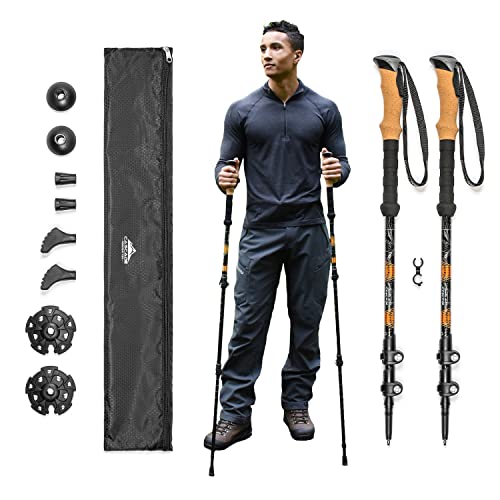
The Cascade Mountain Tech 6061 Aluminum Trekking Poles serve as a dependable, budget-conscious trail accessory designed for day hikers, weekend backpackers, and outdoor walkers seeking upper-body engagement and knee relief. Built to pair with standard hiking daypacks and larger backpacking packs, these two-section adjustable poles provide steady points of contact across varied outdoor surfaces.
On the trail, the quick-lock lever mechanism allows smooth height adjustments spanning from 26 inches up to 54 inches to accommodate various hiker heights and changing slope angles. Weighing approximately 10 ounces per pole, the shafts offer solid balance without excessive swing weight. When you reach a flat trail section or scramble where free hands are required, the poles collapse to a manageable 26-inch profile that fits neatly onto external backpack gear loops, side compression straps, or inside the included travel bag.
Material construction centers on aircraft-grade 6061 aluminum, which provides dependable bend resistance when navigating rocky terrain, boulder fields, or stream crossings. The ergonomic handles combine genuine cork tops with extended EVA down grips. The cork sections help dampen ground vibrations and wick moisture away during warm summer hikes, while the lower foam sections let hikers quickly lower their hand positions during steep switchbacks without pausing to readjust pole length.
Dialing in the poles for specific trails is straightforward thanks to the included accessory bundle. The core shafts feature tungsten carbide tips that bite into hard-packed dirt and slick rock surfaces. For paved greenways or sensitive rock paths, push-on rubber boots and tip covers provide traction and prevent surface scarring. When transitioning to wet spring trails or winter routes, the interchangeable mud and snow baskets screw on easily to prevent the poles from sinking deeply into soft ground.
While these poles provide dependable trail stability, prospective buyers should recognize a few practical design tradeoffs. The three-section telescoping design collapses to 26 inches, which is longer than folding Z-style poles and may extend beyond the top of compact 15-liter to 20-liter daypacks. At roughly 10 ounces per pole, aluminum construction also carries a modest weight penalty compared to premium carbon fiber poles. In addition, the quick-lock cam tensioners may require occasional finger-tightening of the thumbscrews to maintain positive locking force over miles of continuous vibration.
For beginner hikers, weekend backpackers, and budget-conscious outdoor enthusiasts looking for reliable trekking poles with comprehensive multi-season accessories, the Cascade Mountain Tech 6061 Aluminum Trekking Poles offer balanced durability and practical trail support.
When not in use, each pole collapses down to a compact 26 inches, allowing hikers to stow them easily along the exterior of most hiking backpacks. Hikers can thread the tungsten carbide tips through standard lower trekking-pole attachment loops and secure the upper shafts using side compression straps or elastic bungi cords.
For travel or vehicle storage, the set includes a lightweight zippered travel bag that prevents dirt, mud, and trail debris on the baskets and tips from contacting the interior fabric of your backpack or luggage. At 10 ounces per pole, carrying them on your pack adds minimal base weight during trail approaches.
The poles arrive with an extensive accessory package configured for year-round hiking versatility. Hard tungsten carbide tips serve as the baseline contact point for dirt singletrack, loose scree, and rugged mountain paths where maximum purchase is necessary.
For asphalt trails, slick boardwalks, or indoor transit, the included rubber boots and tip covers slip over the metal ends to dampen noise and enhance surface grip. The kit also includes wide rubber snow baskets and medium mud baskets, which prevent the poles from sinking into deep drifts, boggy soil, or loose river gravel.

Pros
- Collapses down to a compact 15 inches, fitting easily inside backpacks or carry luggage bags
- Natural cork handles absorb hand perspiration effectively during strenuous hikes
- Sturdy aircraft-grade aluminum construction with protective metal caps at the folding joints
- Simple height adjustment between 110 cm and 130 cm via a sturdy metal flip lock lever
Cons
- TSA regulations require trekking poles to be packed in checked luggage rather than carry-on bags
- Users must verify the push-button lock is fully popped out to ensure shaft stability before hiking
- At 11.5 oz per pole, aluminum construction is heavier than ultralight carbon-fiber alternatives
The Trekology Trek-Z Cork Grip Collapsible Trekking Poles are three-section folding hiking sticks designed for day hikers, backpackers, and adventure travelers who require portable stability on uneven trails. Rather than using traditional telescoping designs that remain long when collapsed, these poles utilize a tri-fold folding cable system that stows down to a compact 15 inches. This makes them a strong match for hikers who prefer storing their poles directly inside a daypack or securing them flat against external pack compression straps without poles protruding past the top lid.
On trail, these poles offer an adjustable length range of 110 cm to 130 cm, covering a stated user height range between 5'2" and 6'5". Each pole weighs 11.5 oz (330 g), delivering a solid feel that helps distribute carried weight and stabilize joint impact on steep descents. The main handle is shaped from natural cork, which naturally absorbs hand moisture and sweat during warm trail outings. Trekology notes that the cork grips incorporate a slight rotational flex as an anti-torque ergonomic feature. Below the cork, secondary EVA foam grips allow hikers to quickly choke down on the poles when negotiating short, steep step-ups without adjusting overall pole length.
Build quality centers on aircraft-grade aluminum alloy shafts, chosen to withstand lateral loads and rocky terrain where brittle materials might crack. To reinforce high-stress connection points, Trekology adds metal caps around the folding joints, reducing play once the poles are deployed. Extension and length adjustments are secured using a durable metal flip lock at the upper section, ensuring reliable clamping power once clamped to the hiker's preferred height marker.
Deploying the poles requires extending the folding sections until the internal tension cable pulls tight and an internal metal lock button pops through the shaft hole. Ensuring this button is fully seated is essential for complete structural rigidity before latching the upper flip lock. For transport, collapsing the poles takes seconds, allowing both poles to slip neatly into the included storage bag. When traveling by commercial air to hiking destinations, keep in mind that TSA and airline policies classify trekking poles as checked luggage, meaning they must be stowed inside checked duffels or backpacks rather than overhead carry-on bags.
While the folding mechanism provides impressive packability, the design does present a few practical limitations. The total adjustment range is 20 cm (110 to 130 cm), which may not suit hikers under 5'2" who require a shorter pole setup. Additionally, at 11.5 oz per pole, weight-conscious thru-hikers aiming for sub-pound base weights might find aluminum folding poles heavier than fixed-length carbon options. The locking button also requires careful initial alignment during assembly to ensure the segments seat properly without wobbling.
For hikers, backpackers, and travelers seeking dependable trail support without spending top-tier outdoor brand prices, the Trekology Trek-Z Cork poles offer exceptional value. The combination of sweat-wicking cork handles, reinforced aluminum joints, and an ultra-packable 15-inch folded size makes them a versatile accessory for everything from local forest walks to rugged mountain backpacking trips.
The Trekology Trek-Z poles adjust between 110 cm and 130 cm in length, accommodating hikers measuring roughly 5'2" to 6'5" (159 to 195 cm) in height. Length adjustments are managed via a metal flip lock clamp on the top shaft section, allowing users to fine-tune height based on trail slope or individual arm ergonomics.
Hikers shorter than 5'2" may find the minimum 110 cm setting too tall for standard 90-degree elbow positioning on level terrain. Always confirm that your forearm rests parallel to the ground when holding the cork grip before clamping the metal flip lock.
Thanks to a three-piece folding design, the Trek-Z poles collapse down to just 15 inches (38 cm) in length. This compact size allows them to fit horizontally or vertically inside most standard daypacks, carry duffels, or luggage cases without hanging loosely off external attachment points.
The poles come with a dedicated carry bag to keep trail mud and dust away from clean gear inside your backpack. Hikers traveling by air should remember that TSA guidelines prohibit trekking poles in carry-on baggage, requiring these poles to travel inside checked luggage.
The pole shafts are manufactured from aircraft-grade aluminum alloy, delivering reliable strength-to-weight performance and high resistance to bending stresses on demanding rocky routes. The connection joints are strengthened with metal caps to guard against joint wear and slippage over time.
The handles feature genuine cork, which helps manage perspiration and adapts comfortably to hand pressure over long miles. A secondary EVA foam grip sits directly beneath the cork for quick hand repositioning on steep gradients without stopping to change shaft length.

Pros
- Compact 13.4-inch folded size packs easily into daypacks, travel luggage, or side bottle sleeves
- Aircraft-grade 7075 aluminum alloy provides reliable strength against bending on rocky trails
- External Quick Lock mechanism allows simple height adjustments from 43.3 to 49.2 inches
- Grooved EVA foam handle absorbs hand sweat while maintaining a comfortable, non-slip grip
- Includes a durable tungsten steel tip with a protective rubber foot for varied surfaces
Cons
- Sold as a single pole (1 PC), meaning hikers who prefer dual-pole stability must purchase two units
- Maximum extended length of 49.2 inches may not suit taller hikers above 6 feet 2 inches
- Fixed adjustment range (43.3 to 49.2 inches) may be too long for individuals under 5 feet 3 inches
The A ALAFEN 7075 Aluminum Collapsible Trekking Pole is a single, folding walking stick designed for day hikers, backpackers, and travelers who require portable stability on the trail. Unlike standard telescoping poles that can remain awkwardly long when strapped to a backpack, this model folds down to a compact 13.4 inches. That manageable profile makes it especially suitable for hikers carrying mid-sized daypacks, overnight packs with external gear attachments, or travel bags where packing volume is limited.
Real-world trail utility centers on how easily the pole stows and deploys. Weighing approximately 0.6875 pounds (about 11 ounces), the pole adds very little base weight to your hiking pack. When assembled, its Quick Lock mechanism allows you to adjust the functional length between 43.3 inches and 49.2 inches. The pole shaft includes a printed measuring scale, which helps you quickly set your preferred height depending on whether you are climbing uphill or descending steep terrain. According to manufacturer specifications, this adjustment range accommodates hikers between 5 feet 3 inches and 6 feet 2 inches.
Construction quality centers on aircraft-grade 7075 aluminum alloy, a material well-regarded in the outdoor gear space for its resilience against bending and impact deformation. At the handle, an EVA foam grip features a skid-resistant grooved surface and sweat-absorbent texture to help maintain control during warm-weather hikes or strenuous ascents. The attached wrist strap adds stability and helps distribute grip pressure. For ground traction, the bottom houses a rugged tungsten steel tip that bites into packed dirt, mud, and scree, while an included rubber footing covers the metal tip for pavement or slick rock slabs.
Packing and trail-side handling are straightforward thanks to the multi-section folding design. When collapsed to 13.4 inches, the pole easily slips inside standard backpack main compartments, fits into tall side water bottle sleeves, or lashes onto external compression straps and trekking pole loops. Deploying the pole involves extending the connected segments until the internal tension cord locks in place, followed by securing the lever-action Quick Lock clamp at your desired height mark. Maintenance requires minimal effort, mainly consisting of wiping away trail grit, rinsing off mud, and allowing the sections to air dry completely before long-term storage.
Potential buyers should consider a few practical limitations before ordering. This listing includes only a single pole (1 PC), so hikers who rely on a dual-pole setup for knee relief or balance will need to purchase a second unit. Additionally, the adjustment range of 43.3 to 49.2 inches limits proper ergonomic fit for hikers under 5 feet 3 inches or taller than 6 feet 2 inches. While 7075 aluminum is durable and impact-resistant, it does weigh slightly more than high-end carbon fiber options, and the folding mechanism requires careful locking to prevent slippage under heavy downward force.
For hikers, campers, and travel enthusiasts seeking a reliable and budget-friendly single walking stick, the A ALAFEN collapsible pole delivers excellent practical value. Its ability to tuck neatly into or onto almost any hiking backpack makes it a hassle-free addition to your gear lineup. If you fall within the supported height range and want dependable trail support without the bulk of traditional full-length poles, this compact aluminum model is a sensible choice.
When fully collapsed, the A ALAFEN trekking pole measures 13.4 inches, making it short enough to fit inside most daypacks or slide into exterior side pockets without protruding excessively. This makes it far more pack-friendly than conventional three-section telescoping poles that typically collapse to 24 inches or more.
The working length adjusts from 43.3 inches (110 cm) to 49.2 inches (125 cm) using an external Quick Lock lever. The manufacturer lists a recommended user height range of 5 feet 3 inches to 6 feet 2 inches (160 cm to 187 cm). If your height falls outside this window, the pole may not provide an optimal 90-degree elbow angle on flat terrain.
The pole shaft is constructed from aircraft-grade 7075 aluminum alloy, offering solid structural resistance to bending forces common on rocky descents. The handle is shaped from grooved EVA foam designed to absorb hand moisture and reduce slippage during humid trail conditions.
The tip features a tungsten steel point engineered for firm penetration into dirt, gravel, and packed forest trails. A removable rubber foot is included to shield the metal tip and provide traction on asphalt, stone walkways, or slick granite slabs.
Biomechanical Benefits and Practical Performance of Walking Poles
Exploring whether walking poles enhance mobility requires examining how physical support points alter human gait dynamics and load distribution. These versatile tools offer active adults a practical way to offload joint pressure, steady their cadence, and build confidence across challenging outdoor surfaces. By analyzing mechanical construction, ergonomic handles, and sizing techniques, walkers can determine whether dual poles suit their personal wellness routines.
Biomechanical Joint Offloading and Upper Body Engagement
Maintaining joint comfort during extended walks requires distributing ground reaction forces across multiple muscle groups. When walkers plant a pole on the ground, a portion of their downward body weight transfers through the hand, wrist, and shoulder rather than directly compressing the knee or hip joint. This upper-body engagement reduces repetitive impact shock on lower extremities by sharing the mechanical workload across the torso and arms. Walking with poles also encourages an upright spine, preventing the forward hunched posture that frequently triggers lower back fatigue.
The rhythmic cadence established by dual poles promotes a balanced, symmetrical gait cycle. Instead of favoring one leg or absorbing heavy heel strikes, users distribute propulsion evenly between their lower limbs and arm swings. This dynamic distribution helps individuals managing mild joint stiffness or early osteoarthritis maintain longer walking sessions with less post-walk soreness. Steady pole placement creates a wider base of support, giving walkers greater confidence when navigating uneven gravel, grassy parks, or sloping sidewalks.
Distinguishing Walking Poles from Medical Mobility Canes
Clarifying the functional differences between fitness walking poles and clinical mobility aids is vital for personal safety. Standard single-point walking canes and quad canes are engineered specifically to provide unilateral partial weight-bearing assistance, typically offloading between fifteen and twenty-five percent of body weight for individuals recovering from surgery or acute injury. Medical canes feature load-tested vertical shafts designed to remain stable under direct, concentrated downward pressure directly adjacent to the body. In contrast, walking poles are designed for dynamic forward propulsion and bilateral balance enhancement during continuous movement.
Substituting a lightweight trekking pole for a prescribed medical cane can introduce serious stability risks for users with significant balance impairments. Fitness poles feature flexible shafts designed to dampen ground vibrations rather than support heavy static loads. Furthermore, walking poles require sufficient bilateral upper-body coordination, grip strength, and arm endurance to plant both poles in rhythm. Individuals managing acute neurological deficits, severe vestibular disorders, or strict non-weight-bearing orthopedic orders must rely on certified medical mobility devices rather than recreational trekking equipment.
Accurate Height Sizing and Biomechanical Arm Angles
Achieving proper pole height is essential for maximizing stability and preventing upper-body strain during daily walks. When standing upright on level ground wearing everyday walking shoes, your elbow should bend at a comfortable ninety-degree angle when holding the grip. An elbow bend ranging between fifteen and twenty degrees of flexion can also work well for faster cadences, but a right angle offers the optimal mechanical advantage for joint offloading. Setting the poles too high forces your shoulders to hike upward, leading to neck tension, while setting them too low causes an inefficient forward hunch.
Adjustable poles simplify this sizing process through printed measurement markings along the telescoping aluminum shafts. Models like the Cascade Mountain Tech Trekking Poles expand up to fifty-four inches, allowing users of diverse heights to dial in exact shaft lengths. Similarly, the Trekology Trek-Z poles accommodate individuals between five feet two inches and six feet five inches using a broad twenty-centimeter adjustment range. Sizing adjustments should also adapt to outdoor terrain, where shortening the poles by two to three inches aids uphill climbs, while lengthening them by the same amount provides secure bracing during downhill descents.
Shaft Materials and Structural Durability Under Load
Pole durability and swing weight depend directly on the specific alloy selected for the telescoping shaft sections. Manufacturers frequently choose aircraft-grade 6061 aluminum because it offers excellent tensile strength, dependable impact resistance, and cost-effective durability. This alloy withstands accidental lateral bending stresses against trail rocks or sidewalk cracks without snapping abruptly. Each Cascade Mountain Tech pole weighs approximately ten ounces, offering an approachable balance of structural firmness and manageable swing weight for everyday walking routines.
High-strength 7075 aluminum alloy represents an alternative material engineered for demanding conditions where higher rigidity and weight reduction are essential. The A ALAFEN pole utilizes ultralight 7075 aluminum to create a rigid, deformation-resistant shaft that withstands heavy trail feedback while remaining easy to swing forward. Aluminum shafts also provide natural flex characteristics that absorb terrain impact before it reaches the hands and wrists. Comparing shaft materials helps walkers identify the ideal balance between overall carry weight and rugged structural dependability.
Locking Mechanisms and Telescoping Security
Dependable locking systems ensure that telescoping pole segments remain firmly locked under active walking pressure. External quick-lock levers made from durable metal or dense polymer allow walkers to adjust length rapidly without removing gloves or breaking stride. These clamp-style flip locks use an adjustable tension screw that compresses the outer tube sleeve around the inner shaft, preventing unwanted slippage. Inspecting the clamp tension before each walk ensures the lever snaps closed with firm resistance, verifying that the shaft will not collapse unexpectedly.
Collapsible tri-fold systems use an internal tension cord paired with a spring-loaded metal pop-up button to secure the segmented joints. The Trekology Trek-Z design incorporates metal caps at each joint sleeve to reinforce structural rigidity and prevent segment wobble. When assembling folding poles, users pull the upper shaft section until the metal lock button pops out securely through the guide hole. If the shaft feels loose or rattles during movement, reseating the locking button and snugging the external flip lock restores structural tightness and eliminates vibration.
Handle Ergonomics and Grip Material Selection
Grip ergonomics play a decisive role in hand comfort, blister prevention, and wrist joint protection over long walking routes. Natural cork grips excel in warm weather and humid climates because cork naturally absorbs surface sweat while molding to the user’s hand shape over time. The Trekology Trek-Z poles feature natural cork handles engineered with a slight rotational flex to disperse torque forces away from the palm and forearm. Natural cork also dampens ground vibrations effectively, sparing sensitive finger joints from repetitive micro-shocks.
High-density EVA foam serves as a soft, resilient alternative that delivers a non-slip textured hold across all weather conditions. The A ALAFEN trekking pole incorporates an ergonomic EVA foam handle with moisture-absorbing grooves that enhance hand traction on steep inclines. Many premium models also include an extended secondary EVA foam grip directly beneath the main cork handle. This extended lower grip allows walkers to choke down on the shaft during brief uphill climbs without stopping to readjust the mechanical locking clamps.
Traction Accessories and Multi-Surface Interchangeability
Interchangeable tips and protective footings allow walking poles to adapt seamlessly across diverse walking environments. Hardened tungsten carbide or steel tips provide biting traction on natural dirt trails, packed gravel pathways, and slippery outdoor roots. These durable metal tips bite into loose earth to prevent unexpected slips, but they create loud clicking noises and poor traction on hard paved surfaces. Covering the carbide point with a dense rubber boot or tip protector creates a grippy, slip-resistant footprint ideal for asphalt, concrete sidewalks, and indoor tile.
Specialized terrain baskets prevent pole shafts from sinking deeply into soft soil, mud, or winter snowdrifts. Mud baskets feature a compact disc shape that deflects trail debris without catching on low shrubs or sidewalk curbs. Snow baskets utilize a wider surface diameter that distributes downward force over soft powder or slushy winter paths. Swapping out worn rubber footings and cleaning internal tip threads regularly preserves shaft performance and maintains secure contact across every walking surface.
Travel Portability and Luggage Storage Regulations
Portability considerations determine how easily walkers can transport their equipment on road trips, daily errands, or commercial flights. Multi-segment folding designs collapse into ultra-compact lengths that fit neatly inside daypacks, duffel bags, or vehicle trunks. The Trekology Trek-Z tri-fold system collapses down to just fifteen inches, while the A ALAFEN folding pole compacts to thirteen point four inches for effortless packing. When planning air travel, review a carry-on travel backpack sizing guide to understand luggage volume limits and ensure your gear packs away efficiently.
Navigating airport security requires understanding federal transportation guidelines regarding sports and mobility gear. Aviation security agencies, including the Transportation Security Administration, generally require trekking poles with metal tips to be stowed inside checked baggage rather than carried into airplane passenger cabins. Medical walking canes with rubber ferrules are permitted through security checkpoints, but recreational poles with pointed tips face strict cabin restrictions. Checking your collapsible poles inside a dedicated travel sleeve protects the locking levers and tension cords during baggage handling.
Proper Walking Technique and Cadence Coordination
Adopting the correct walking technique transforms walking poles from awkward sticks into natural extensions of your arms. The foundational gait pattern relies on reciprocal arm-leg coordination, where your right pole strikes the ground simultaneously with your left heel strike. Walkers should maintain a relaxed grip and keep the poles angled slightly backward rather than planting them straight down in front of their toes. Pushing gently backward through the wrist strap and grip propels your body forward smoothly, maximizing walking momentum while easing lower-limb stress.
Navigating elevation changes requires subtle adjustments to your posture, pole plant timing, and shaft length. When walking uphill, lean slightly forward from your ankles, shorten your stride length, and push firmly through both poles to take advantage of upper-body power. During downhill sections, keep your knees slightly bent to absorb impact, widen your stance, and plant the poles slightly ahead of your feet to provide controlled braking support. Maintaining relaxed shoulders throughout your walk prevents neck fatigue and promotes a rhythmic, enjoyable cadence.
Clinical Precautions and Consulting Healthcare Professionals
Recognizing the boundary where recreational walking aids end and clinical mobility interventions begin is essential for preventing fall injuries. Individuals experiencing sudden balance deterioration, frequent dizziness, or persistent leg weakness should avoid relying solely on self-selected walking poles. While poles offer valuable dynamic balance support for active walkers, they cannot compensate for severe neuromuscular deficits or profound lower-limb instability. A licensed physical therapist can conduct a comprehensive gait evaluation to determine whether walking poles, an ergonomic single-point cane, or a bilateral walker offers the safest mobility solution.
Professional guidance also ensures that individuals with preexisting joint conditions learn personalized movement patterns tailored to their recovery goals. A physical therapist can verify handle height, assess upper-body posture, and recommend specific exercise regimens to strengthen the core muscles supporting your gait. Regularly inspecting pole segments for structural hairline cracks, testing clamp security, and replacing worn rubber footings guarantees dependable daily performance. Taking a proactive approach to equipment maintenance and gait assessment allows you to enjoy outdoor walking with safety, comfort, and enduring confidence.
Long-Term Maintenance and Pre-Walk Safety Inspections
Routine hardware inspections preserve the structural integrity and operational safety of your walking poles over years of regular use. Dirt, fine sand, and moisture can accumulate inside telescoping shaft joints, causing friction or preventing locking clamps from seating properly. Disassembling the individual pole sections periodically allows you to wipe down aluminum tubes with a dry lint-free cloth and inspect the metal surfaces for stress fractures. Storing clean, dry poles in a climate-controlled room prevents internal corrosion and keeps tension cords resilient.
Conducting a quick physical check before heading out on any walking trail ensures complete mechanical reliability. Press your full upper-body weight down onto each extended pole on a flat surface to verify that the locking clamps hold firm without slipping. Examine the bottom rubber boot or carbide tip for uneven tread wear, cracking, or embedded stones that could reduce traction on hard pavement. Tightening any loose thumbscrews on external flip locks takes only seconds and prevents unexpected shaft collapse during your outing.
Integrating walking poles into your daily fitness routine provides an effective, low-impact strategy for protecting lower-body joints and maintaining steady balance. Whether choosing aircraft-grade aluminum shafts, sweat-absorbing cork grips, or ultra-compact tri-fold designs, matching equipment to your walking environment ensures reliable outdoor mobility. Prioritizing correct elbow alignment, practicing rhythmic arm cadence, and consulting a healthcare provider when balance concerns arise ensures every walk remains active, comfortable, and secure.





Write Your Review
No reviews yet. Be the first to share your experience!