


Gait stability relies on subtle biomechanical alignment, yet an improperly sized mobility aid can quietly throw off your entire balance. When an individual asks how tall should a walking cane be, they are often dealing with unsteady steps, post-surgical recovery, or nagging joint fatigue in the lower extremities. Setting a cane to the wrong height forces the shoulder to hike up or causes the spine to pitch forward, transforming a supportive mobility aid into an ergonomic liability. Taking a few moments to understand correct anatomical sizing establishes a solid foundation for steady, pain-free walking.
A properly adjusted cane transfers approximately fifteen to twenty-five percent of lower-body load away from compromised joints, protecting vulnerable hips, knees, and ankles. Individuals managing chronic joint stiffness often pair their daily walking routines with supportive knee apparel to maintain comfortable joint mobility throughout the afternoon. Modern mobility sticks offer telescoping shafts, contoured palm grips, and shock-absorbing rubber bases to ensure every stride feels secure on slick floors or uneven outdoor sidewalks. Ensuring your cane handle aligns accurately with your body lets you walk with renewed confidence and upright posture.



Complete Sizing and Biomechanical Guide for Walking Canes
A walking cane should reach exactly to the level of your wrist crease when you stand upright with your arms hanging naturally at your sides. This anatomical landmark positions the handle at a height that allows your elbow to maintain a comfortable bend between fifteen and twenty degrees. When sized accurately, the cane provides optimal mechanical leverage to offload body weight without forcing your upper body into unnatural compensatory postures. Getting this initial measurement right ensures that your mobility aid enhances your balance rather than creating new physical strains.
The Standard Wrist Crease Measurement Method
Measuring for a walking cane requires wearing the specific shoes you plan to walk in most frequently during the day. Athletic sneakers, supportive orthotics, and dress shoes all feature distinct sole thicknesses that alter the distance between your wrist and the floor. Stand on a flat, even surface rather than a plush rug, keeping your back straight and your shoulders relaxed. Let your arms hang freely along your sides without leaning forward.
Locate the small crease on the inside of your wrist where your hand meets your forearm. A caregiver or family member should measure the vertical distance from that wrist crease straight down to the floor using a flexible measuring tape. Measuring without an assistant often causes users to twist their torso, which skews the result and produces an improperly fitted stick. This wrist crease line directly corresponds to the greater trochanter bone at your hip, confirming the proper target handle height.
The Elbow Flexion Rule and Leverage
When your hand rests securely on the cane handle with the tip on the ground, your elbow should form a bend between fifteen and twenty degrees. This slight angle provides essential mechanical shock absorption during initial ground impact. A joint held in rigid extension transfers jarring vibrations directly into the wrist, elbow, and shoulder joints. The slight flexion angle also enables your forearm and triceps muscles to push down effectively to bear weight when stepping.
Excessive elbow flexion above thirty degrees significantly degrades your mechanical advantage during forward walking. A bend that is too steep forces arm muscles to work under continuous tension, creating rapid fatigue in the biceps and rotator cuff. Maintaining a gentle fifteen to twenty degree bend strikes the ideal balance between muscular efficiency, joint protection, and walking stability.
Postural Consequences of Incorrect Cane Height
Using a walking cane that is too tall forces the shoulder on the support side to hike upward continuously throughout the gait cycle. This repetitive elevation strains the trapezius muscle and can irritate the cervical spine, leading to persistent neck stiffness. A handle positioned too high also shifts your center of gravity backward, which diminishes your ability to push down firmly during forward steps. Users often end up dragging an oversized cane rather than placing it down with purpose.
A cane adjusted too low causes an equally problematic set of biomechanical issues by encouraging a stooped, forward-leaning posture. Bending forward to reach a short cane increases compressive loads on the lumbar spine and accelerates muscular fatigue in the lower back. This forward tilt also reduces your visual field, making it harder to spot ground hazards such as rug edges or slick tile. Setting the handle to the precise height prescribed by anatomical landmarks prevents these avoidable secondary pains.
Telescoping Adjustments and Hardware Security
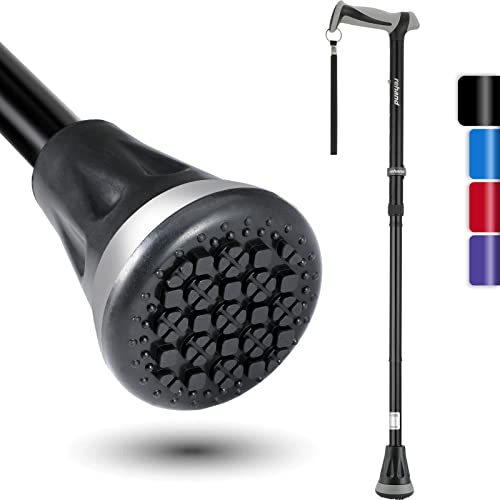
Most modern aluminum walking sticks feature telescoping shafts equipped with push-button brass pins that adjust in one-inch increments. Models such as the REHAND adjustable cane provide eight distinct height settings, accommodating individuals from five feet tall up to six feet five inches. Similarly, the supregear folding cane offers five height positions spanning from thirty-three to thirty-seven inches. These incremental settings allow users to fine-tune handle elevation to match their exact footwear and leg length.
Securing the adjustment pin requires pressing the spring-loaded button firmly while sliding the inner shaft until the pin snaps completely through the desired hole. You should always hear a distinct click and visually confirm that the button protrudes fully past the outer tube wall. Many quality models from DMI and REHAND also include a threaded anti-rattle locking nut below the adjustment collar. Tightening this ring clockwise firmly secures the tubing, preventing loose wobbling and noisy clicking during daily walking.
Contralateral Placement and Natural Reciprocal Gait
A walking cane should almost always be held in the hand opposite the weak, injured, or painful leg. This biomechanical placement is known as contralateral positioning, and it mimics the body’s natural reciprocal arm swing. When humans walk, the right arm naturally swings forward in tandem with the left leg to counterbalance rotational forces. Holding your cane on the unaffected side preserves this coordinated movement pattern, allowing your stride to remain fluid and balanced.
Placing the cane on the opposite side allows you to transfer fifteen to twenty-five percent of your total body weight away from the compromised joint. As your affected leg steps forward, the cane moves forward simultaneously, creating a broad base of support between the cane tip and your foot. You push down through the cane handle at the exact moment your weaker leg strikes the floor, redirecting joint reaction forces through the shaft. Carrying the cane on the injured side disrupts this cadence and increases joint shear stress.
Stair Navigation Mechanics for Daily Safety
Navigating steps requires a deliberate, step-by-step sequence often remembered through the clinical phrase “up with the good, down with the bad.” When ascending a staircase, your stronger, unaffected leg should step up onto the first step first. Once your strong foot is firmly planted, push down through that leg to lift your body weight, then bring the cane and your weaker leg up to the same step together. Leading with your sound limb ensures that your strongest muscles handle the demanding work of lifting your body upward.
Descending a staircase reverses this sequence to provide continuous balance support. When going down, place your cane down onto the lower step first, followed immediately by your weaker or recovering leg. Step your stronger leg down to meet them on the same step while holding any available handrail for added security. Take special caution with wide quad canes on narrow stairs, as oversized bases can hang over step edges and cause a severe trip hazard.
Handle Ergonomics and Grip Selection
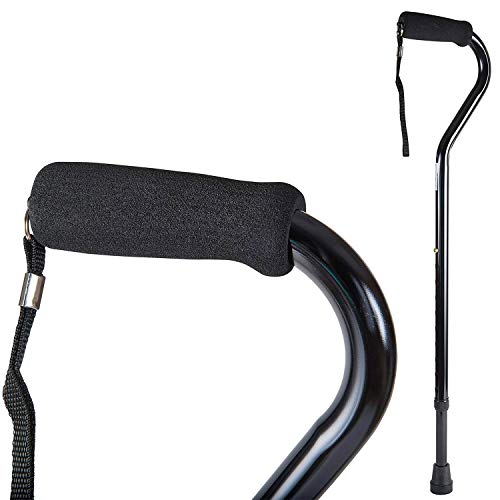
Handle geometry plays a fundamental role in how effectively body weight is directed down the cane shaft. Offset handle designs, such as those found on KINGGEAR and DMI walking sticks, curve the neck backward before aligning the grip directly above the vertical shaft. This engineering centers downward pressure directly over the cane tip, minimizing rotational torque and providing superior stability during heavy weight-bearing. Offset grips are particularly beneficial for individuals recovering from hip or knee replacement procedures.
Traditional narrow crook or basic T-handles concentrate downward pressure onto a small surface area across the center of your palm. Over extended walking sessions, this focused pressure can compress sensitive nerves, causing painful numbness, tingling, or carpal tunnel flare-ups. Modern ergonomic grips, such as contoured thermoplastic rubber or cushioned EVA foam, broaden the contact surface beneath the hand. Distributing downward force across a wider palm area substantially reduces hand fatigue and absorbs road shock before it travels into sensitive finger joints.
Base Configurations and Ground Stability Tradeoffs
Choosing between a single-point tip, a quad base, or an articulating pivot base depends on your specific balance requirements and daily walking environment. Standard single-point rubber tips provide maximum maneuverability, lightweight swing cadence, and effortless clearance through tight indoor spaces. However, single tips cannot stand on their own and require the user to maintain full balance control during pauses. Single-point designs work best for individuals with mild gait hesitations who value brisk, unhindered walking speeds.
Quad canes feature a four-legged base that provides an expanded footprint, allowing the stick to stand upright beside chairs and counters without toppling over. This self-standing capability eliminates the dangerous need to bend down to retrieve dropped canes, protecting vulnerable backs and hips. Articulating pivot bases bridge the gap between agility and stability by flexing smoothly to mimic natural ankle motion. Checking rubber traction pads regularly ensures that tread wear does not compromise your grip on slick tile, wet linoleum, or polished hardwood floors.
Folding Shaft Mechanics and Travel Practicality
Collapsible walking canes offer remarkable convenience for active users who travel frequently by car, train, or airplane. Folding models from brands like supregear and Comfkey break down into four or five compact segments linked together by a heavy-duty internal elastic cord. When pulled apart, these sections fold down into a package measuring ten to twelve inches in length. This compact folded profile fits effortlessly into standard totes, briefcases, or luggage aligned with standard carry-on luggage guidelines for hassle-free transit.
When deploying a folding cane, internal elastic cords snap the interlocking aluminum joints together almost automatically. Users must verify that each tubing section has seated fully into its mating collar before bearing downward weight. Weight capacity ratings on folding models typically range from two hundred pounds up to three hundred pounds on reinforced aluminum frames. Checking manufacturer load specifications ensures that your chosen travel aid provides adequate structural rigidity for your body weight without flexing during assertive strides.
Clinical Indicators for Upgrading Beyond a Cane
While a properly sized walking cane provides excellent unilateral assistance, it is not suitable for every stage of mobility decline. A walking cane is designed to offload partial body weight and assist with mild to moderate balance instability. If an individual experiences frequent near-falls, noticeable gait freezing, or bilateral leg weakness, a single walking stick may provide insufficient support. Relying on a cane when bilateral stability is required increases the likelihood of dangerous tipping accidents.
Transitioning to a two-handed mobility aid, such as a folding walker or four-wheeled rollator, becomes necessary when weight offloading demands exceed twenty-five percent of body weight. Walkers provide a symmetrical base of support that encircles the user, stabilizing both sides of the body simultaneously. Always consult a licensed physical therapist or physician if you notice progressive balance hesitation, severe joint pain, or persistent difficulty navigating everyday household obstacles. Professional gait evaluations ensure your mobility equipment directly matches your functional rehabilitation goals.
Setting your walking stick to the exact height of your wrist crease establishes the mechanical foundation for safe, confident, and pain-free movement. Take the time to verify your footwear sole thickness, engage all push-button pins securely, and practice walking with the cane held firmly on your unaffected side. Regular inspection of your rubber tip tread and locking hardware will keep your mobility aid performing dependably across all your journeys. When adjusted properly, a quality cane serves as an intuitive extension of your body that restores balance to every step.




Write Your Review
No reviews yet. Be the first to share your experience!