


Maintaining steady joint mobility and daily cardiovascular endurance often becomes challenging when lower limb stiffness or balance hesitation sets in. Many active adults and individuals managing joint soreness explore rhythmic pole-assisted exercise to keep moving comfortably without overloading their knees. Understanding what is nordic walking good for reveals how bilateral pole engagement activates the upper body, redistributes ground impact forces, and reinforces upright posture during neighborhood strolls or gentle trail walks. Paired with proper footwear and flexible attire like supportive knee apparel, this rhythmic technique transforms an ordinary walk into an invigorating full-body workout that protects vulnerable joints.
While traditional single-point canes focus strictly on unilateral offloading for post-surgical recovery or acute injury, pole-assisted fitness offers a dynamic way to rebuild stamina and coordination. Adjustable equipment such as the TheFitLife Telescopic Trekking Poles for Hiking incorporates lightweight aluminum construction, non-slip rubber grips, and shock-absorbing internal springs to smooth out rough pavement. Exploring the biomechanical advantages, correct pole height adjustments, and safety boundaries will help you decide whether this active conditioning method aligns with your mobility goals.
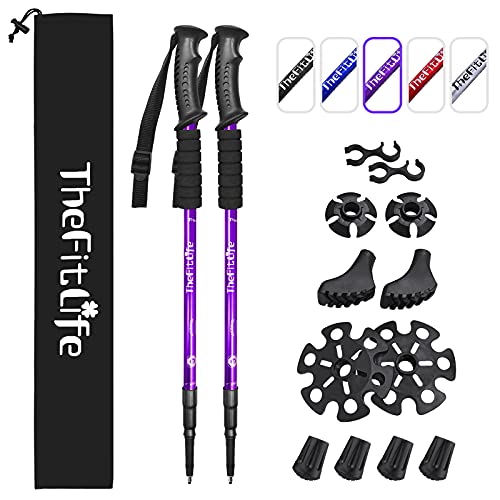
Pros
- Lightweight build at only 9.92 oz per pole reduces arm fatigue on long day hikes and backpacking trips
- Internal anti-shock springs help absorb repeated trail impacts on rocky or downhill terrain
- Includes full set of mud baskets, snow baskets, walking caps, and rubber tips for varied trail surfaces
- Disassembles down to 21.46 inches for practical packing inside standard 22-inch travel luggage
Cons
- Internal twist locks require firm manual tightening compared to external flick-lock levers
- Collapsed length of 25.6 inches may protrude above compact daypacks when lashed to external straps
- Rubber grips offer dependable traction but may feel less breathable on hot, sweaty summer hikes than natural cork
TheFitLife Telescopic Trekking Poles are adjustable three-section aluminum hiking sticks designed for day hikers, weekend backpackers, fitness walkers, and travelers who need reliable balance assistance on the trail. Weighing just 9.92 ounces (282 grams) per pole, this set adds minimal weight when strapped to a backpack while offering structural stability for ascending steep inclines and navigating uneven terrain.
Built to accommodate a broad range of user heights, each pole extends from 25.6 inches (65 cm) up to 51.2 inches (130 cm). The internal anti-shock spring system is engineered to dampen trail vibrations each time the pole plants on hard rock or packed dirt. This subtle cushioning effect is particularly helpful during long descents where repetitive shock transfers directly into the wrists, elbows, and knees.
The shafts are constructed from high-strength aluminum alloy, balancing impact resistance with fatigue durability on rocky paths. Rather than using external clamp levers that can catch on underbrush or gear webbing, TheFitLife utilizes a refined internal twist-lock system. It tightens securely with a simple twist, maintaining a streamlined profile that is easy to operate even while wearing trail gloves. Ergonomic non-slip rubber grips provide a firm and comfortable hold throughout changing weather.
Packing and trail transport are straightforward. Outdoor hikers can secure the poles externally using backpack gear loops and compression straps at their collapsed length of 25.6 inches. For travelers packing for distant trailheads, the poles separate completely into three sections measuring 21.46 inches (54.5 cm), allowing them to fit diagonally inside most standard 22-inch or larger travel suitcases. The package also includes mud baskets, snow baskets, protective rubber tips, and walking caps to handle mud, scree, snow, or paved paths.
A realistic consideration is the twist-lock design itself. While it eliminates bulky external hardware, twist mechanisms require deliberate tightening to prevent slipping under heavy vertical pressure, which can be harder to gauge in freezing weather compared to quick-cam levers. Additionally, hikers using small daypacks under 20 liters may find the 25.6-inch collapsed length slightly tall when mounted to smaller exterior pack pockets.
For recreational day hikers, entry-level backpackers, and fitness walkers seeking reliable trail support at a budget-conscious price point, TheFitLife Telescopic Trekking Poles offer strong value. Their combination of joint-cushioning anti-shock springs, solid aluminum durability, and comprehensive seasonal attachments makes them a versatile companion for trails across the country.
TheFitLife Trekking Poles offer a versatile length adjustment range spanning from 25.6 inches (65 cm) to 51.2 inches (130 cm). This broad range allows men, women, teenagers, and seniors to set an optimal pole height that maintains an efficient 90-degree elbow bend on flat terrain.
Height adjustments are controlled by twisting the telescoping sections. Hikers can shorten the shafts during steep uphill climbs to maintain forward momentum or lengthen them on descents to improve balance and stability across rough trail sections.
When hiking with a daypack or backpacking pack, these poles can be secured externally to trekking-pole loops, daisy chains, or side compression straps. Their collapsed profile of 25.6 inches sits comfortably alongside standard 30 to 65-liter backpacks without excessive overhang.
For air travel or off-season storage, the three aluminum sections can be separated entirely. In this disassembled state, the longest section measures 21.46 inches (54.5 cm), making the set compact enough to fit diagonally within most 22-inch or larger luggage bags.
TheFitLife provides a multi-terrain accessory kit with every pair. Included are rubber tips for hard rock surfaces, walking caps designed for paved surfaces and fitness walking, mud baskets to prevent poles from sinking into soft soil, and broader snow baskets for winter trail use.
All included attachments screw on and off quickly in the field without tools. This modular system allows hikers to adapt the poles seamlessly whether navigating muddy spring switchbacks or paved park trails.

Pros
- Lightweight 9.92 oz aluminum build delivers sturdy trail balance without unnecessary swing weight
- Three-section breakdown fits diagonally in 22-inch suitcases or straps cleanly to hiking daypack loops
- Internal anti-shock spring cushions downward pressure during steep, sustained mountain descents
- Comes complete with four versatile tip and basket attachments suited for year-round trail conditions
Cons
- Twist-lock mechanisms require firm manual tightening and lack the visual verification of external lever flick-locks
- Rubber grips do not wick perspiration as naturally as cork handles during hot summer hikes
- Full 25.6-inch collapsed length may extend beyond the top of compact daypacks unless disassembled
TheFitLife Telescopic Trekking Poles are three-section aluminum hiking sticks designed for day hikers, weekend backpackers, and travel-oriented walkers seeking joint support and trail balance. Featuring an integrated anti-shock spring and an internal twist-lock system, this pole pair caters to budget-conscious outdoor enthusiasts, beginners, and fitness walkers. Because they collapse and disassemble into three compact segments, they serve hikers who regularly transport their gear via 22-inch travel luggage or external backpack attachment loops.
On the trail, weight management and proper height adjustment remain critical for maintaining a steady rhythm. Each pole weighs 9.92 ounces (282 grams), resulting in an aggregate weight of just over 1.5 pounds for the pair. The telescopic aluminum shafts adjust across a usable range of 25.6 inches (65 cm) up to 51.2 inches (130 cm), accommodating men, women, teens, and seniors. When navigating steep descents, the internal anti-shock mechanism activates under downward pressure to absorb trail vibration, while the ergonomic rubber grips deliver steady hand placement across varied walking paces.
The shafts are fabricated from high-strength aluminum alloy, engineered to offer dependable impact resistance against roots, scree, and rocky paths without premature fatigue. TheFitLife utilizes an internal twist-lock mechanism rather than external cam levers, creating a streamlined, low-profile outer diameter that will not catch on dense brush or snag against backpack compression webbing. While the rubber grips lack the moisture-wicking properties of natural cork, their textured surface provides a non-slip grasp in damp conditions, paired with an adjustable wrist strap to help secure your grip.
Transporting these poles alongside your hiking pack or travel baggage is straightforward. When fully collapsed, the poles measure 25.6 inches, making them ideal for securing directly against backpack trekking-pole loops and upper compression straps. For air travel or compact gear totes, each pole disassembles into three independent sections measuring 21.46 inches (54.5 cm), allowing them to slip diagonally into most 22-inch or larger suitcases. Swapping the included rubber tips, flat walking caps, mud baskets, and snow baskets is tool-free, enabling quick configuration changes before heading onto muddy switchbacks or hard pavement.
While practical and versatile, this design presents a few real-world limitations. The internal twist locks require careful hand tightening to avoid accidental slippage under heavy body loads, and they lack the visual security checks provided by external lever locks. In addition, the 25.6-inch collapsed length can extend noticeably above smaller hydration packs or 15-liter daypacks if you do not disassemble them completely. Hikers who prefer ultralight carbon fiber construction or naturally cooling cork handles will also notice the denser feel and moisture retention of the rubber grip material on warm afternoon treks.
For hikers, campers, and travelers searching for an affordable, full-featured trekking pole set that integrates smoothly with backpack lash loops and standard luggage, TheFitLife Telescopic Trekking Poles offer balanced utility. Their aluminum strength, internal anti-shock cushioning, and comprehensive basket kit make them a practical gear choice for everyday trail walks and weekend mountain outings alike.
When preparing for trail outings or flights, gear packability is essential. TheFitLife Telescopic Trekking Poles adjust from a minimum collapsed height of 25.6 inches (65 cm) to a maximum deployed length of 51.2 inches (130 cm). For routine day hiking, the collapsed poles slide easily through lower trekking-pole gear loops on standard daypacks and secure firmly under side compression straps.
For travelers flying to trail destinations, the three aluminum segments can be pulled apart completely. Disassembled, the longest pole section measures 21.46 inches (54.5 cm), allowing the set to lay diagonally inside standard 22-inch or larger hard-shell and soft-sided suitcases. Hikers should verify their pack dimensions and luggage interior measurements before departure to ensure compliant packing.
TheFitLife provides a multi-season accessory kit that expands the poles' versatility across various terrain types. The package includes standard rubber tips for road walking and pavement, wide walking caps for improved asphalt traction, mud baskets to prevent pole sinkage on soft soil, and wide snow baskets for winter trail excursions.
All accessories thread and press securely onto the pole ends without specialized tools. Hikers should inspect the wear on rubber tips and check basket tightness prior to hitting rocky backcountry routes, storing unused attachments in an organizer pouch inside their backpack until needed.
The Biomechanical and Health Benefits of Nordic Walking
Nordic walking originated as an off-season training exercise for cross-country skiers, but it has quickly evolved into one of the most effective low-impact fitness activities for adults of all ages. By using a pair of specially designed poles to push off the ground while stepping, walkers transform a simple lower-body stroll into a complete upper-body conditioning session. The rhythm of coordinating pole plants with natural arm swings creates steady momentum, improves balance, and relieves strain on vulnerable joints. Understanding how this activity works physiologically helps walkers decide if bilateral pole training fits their physical therapy, fitness, or daily mobility needs.
Understanding the Fundamentals of Pole-Assisted Walking
Ordinary walking relies almost exclusively on the muscles of the lower body, including the quadriceps, hamstrings, glutes, and calves. Incorporating poles changes this movement dynamic by recruiting the upper body with every forward step. The action requires a continuous, active push backward through the poles, which immediately engages the triceps, shoulders, chest, and latissimus dorsi. This bilateral arm drive helps propel the body forward, turning everyday walking into an efficient full-body routine.
The biomechanical motion mirrors natural reciprocal gait, where the opposite arm and leg move forward in sync. Unlike rigid hiking or trekking where poles often serve as static crutches on steep ascents, Nordic walking maintains a continuous fluid cadence on level pathways. The user maintains a relaxed grip during the forward swing and applies downward and backward pressure through the handle as the foot strikes the ground. This simple adjustment activates up to ninety percent of the body’s skeletal muscle mass without feeling overly strenuous.
Significant Joint Offloading and Lower-Limb Impact Reduction
One of the primary reasons adults turn to pole walking is the immediate relief it offers to sensitive joints. Each step taken during standard walking generates ground reaction forces that travel directly through the ankle, knee, and hip joints. By planting poles with every stride, a noticeable portion of body weight and downward shock transfers through the upper extremities instead. This redistribution significantly decreases peak compressive stress on the patellofemoral and tibiofemoral joints with every mile completed.
Individuals managing mild to moderate knee osteoarthritis often find that this mechanical offloading allows them to walk longer distances without triggering joint inflammation. The downward drive of the arms shares the load that would otherwise fall squarely on worn cartilage. Also, the cushioning effect of walking on softer surfaces combined with bilateral pole support helps alleviate chronic hip and lower back discomfort. This mechanical relief makes the activity an appealing option for individuals recovering from joint flare-ups or gradual cartilage wear.
Cardiovascular Conditioning and Increased Caloric Expenditure
Engaging large upper-body muscle groups naturally demands more oxygen and energy from the cardiovascular system. Because the arms, shoulders, and back work alongside the legs, the heart pumps more blood per minute to sustain muscle contraction. Studies examining pole walking consistently show a notable increase in heart rate and overall oxygen consumption compared to walking without poles at the exact same pace. This allows participants to achieve moderate-intensity aerobic conditioning without needing to run or jog.
The higher muscular workload also translates to a noticeable boost in total caloric burn. Walkers can expend up to twenty to forty percent more energy during a pole-assisted session than during an unassisted walk across identical terrain. Fascinatingly, most participants report that their rate of perceived exertion remains surprisingly low despite the higher energy expenditure. The supportive momentum generated by the poles makes the workout feel easier, encouraging greater adherence to daily fitness regimens.
Postural Alignment and Spinal Decompression Benefits
Sedentary lifestyles, desk work, and natural aging frequently lead to a forward-leaning posture, rounded shoulders, and a compressed thoracic spine. Traditional walking can inadvertently reinforce this slouched position if the walker tends to gaze at the ground. Nordic walking naturally counteracts this tendency because planting the poles requires an upright torso and active shoulder retraction. As the arm drives downward and back, the chest opens up and the spine lengthens into proper alignment.
This upright posture also activates the deep stabilizer muscles of the core, including the transverse abdominis and multifidus. Regular engagement of these postural stabilizers helps support the lumbar spine, taking excessive pressure off the lower spinal discs. Walkers often discover that recurring lower back stiffness eases after adopting a consistent pole-walking schedule. Improved spinal positioning also expands lung capacity, allowing for deeper diaphragmatic breathing during exercise.
Balance Confidence, Stability, and Fall Risk Mitigation
Balance instability can create hesitation, leading older adults to restrict their physical activity and inadvertently accelerate muscle weakness. Utilizing two poles creates a wide, four-point base of support that dramatically enhances spatial stability. With two secure ground contact points operating alongside alternating foot placements, the user experiences improved lateral stability across uneven sidewalks, park paths, and gravel trails. This wide foundation instills immediate psychological confidence in walkers who feel unsteady on open ground.
The continuous sensory feedback transmitted from the poles through the hands also sharpens proprioception. Walkers receive instant tactile information about surface changes, slopes, and ground textures before placing full body weight onto a foot. This heightened awareness helps prevent unexpected trips, missteps, and ankle rolling. For individuals hesitant to walk outdoors alone, the physical security of dual poles provides the stability necessary to stay active in the community.
Mobility Support for Chronic Conditions and Active Rehabilitation
Bilateral pole walking serves as a practical rehabilitative exercise for individuals managing diverse chronic health conditions. In neurological rehabilitation, such as for individuals with Parkinson’s disease, the rhythmic cueing of pole planting helps normalize stride length and reduce gait freezing episodes. The repetitive, cross-body movement pattern stimulates neural pathways, improving bilateral coordination and functional walking speed over time. This makes pole exercise a common recommendation in specialized senior mobility programs.
Adults managing peripheral neuropathy or mild vestibular imbalances also benefit from the dual tactile guidance provided by the poles. By substituting lost sensory feedback in the feet with tactile signals through the hands, users navigate varied ground conditions with greater security. In addition, individuals recovering from lower-extremity orthopedic procedures can use pole walking to transition from physical therapy exercises back into outdoor walking. The exercise re-establishes a symmetrical gait cadence without overloading healing structures.
Nordic Walking Poles Versus Medical Walking Canes: Key Distinctions
It is crucial to recognize that fitness walking poles and medical walking canes serve fundamentally different functional purposes. A medical walking cane, whether a single-point model or a quad cane, is specifically engineered for unilateral partial weight-bearing and acute fall prevention. Medical canes feature load-tested vertical shafts, offset handles, and broad non-skid rubber ferrules designed to bear fifteen to twenty-five percent of body weight during sudden balance loss. In contrast, fitness poles are designed for dynamic propulsion and bilateral exercise rather than static weight support.
Substituting fitness trekking or Nordic poles for a prescribed mobility cane can present serious safety hazards. Poles with narrow tips or flexing shafts cannot safely absorb your full body weight if you experience acute lower-limb collapse or severe vertigo. Anyone with prescribed weight-bearing restrictions, acute post-surgical limitations, or severe balance impairment must use an approved medical cane or walker. Always consult a licensed physical therapist or physician to determine whether your functional balance is safe for fitness poles.
Proper Pole Sizing and Ergonomic Height Adjustment
Achieving the correct pole height is essential for unlocking the biomechanical benefits of the exercise without straining your upper body. When standing upright in your regular walking shoes, your elbow should form roughly a ninety-degree angle when holding the grip. Setting poles too high forces the shoulders to shrug upward, creating tension in the trapezius and cervical spine. Conversely, setting poles too low causes the user to hunch forward, undermining the postural benefits of the technique.
Telescopic options like the Telescopic Trekking Poles for Hiking from TheFitLife provide practical versatility by adjusting smoothly from 25.6 inches (65 cm) up to 51.2 inches (130 cm). This generous adjustment range accommodates men, women, teens, and seniors of varying heights. The quick twist-lock mechanism allows users to fine-tune pole length in seconds without needing tools or dealing with bulky external levers. Tightening the internal mechanism securely prevents slippage during firm ground pushes, ensuring consistent height stability on every outing.
Hardware Mechanics: Shock Absorption, Grip Comfort, and Terrain Tips
Hardware quality directly dictates comfort and joint protection during repetitive ground impacts. High-strength aluminum alloy shafts provide an optimal balance of structural resilience and lightweight maneuverability. Weighing just 9.92 ounces (282 grams) each, lightweight poles minimize arm fatigue during extended walking sessions. Built-in shock-absorbing springs further reduce strain by dampening the vibrations that travel through the shaft upon impact with hard pavement, shielding sensitive wrist and elbow joints from repetitive micro-trauma.
Grip ergonomics and interchangeable accessories also play a pivotal role across changing seasonal conditions. Non-slip ergonomic rubber grips offer a comfortable, secure hold that resists hand fatigue, even during humid or chilly weather. Outfitting the poles with angled rubber walking caps ensures quiet, slip-resistant traction across paved asphalt, concrete, and indoor surfaces. When venturing onto outdoor paths, swapping to mud baskets or snow baskets prevents the poles from sinking into soft ground, maintaining reliable propulsion across all four seasons.
Packability and Travel Considerations for Active Walkers
Maintaining a consistent walking habit requires equipment that adapts easily to travel schedules and daily transit. Telescoping poles that collapse to 25.6 inches can be strapped securely to backpacks or stowed neatly in the trunk of a car. Poles that disassemble completely into three separate sections reach a compact length of 21.46 inches (54.5 cm). This reduced profile allows the poles to fit diagonally inside standard 22-inch suitcases, making them convenient companions for flights and road trips.
If you plan to fly with your walking gear, review airline baggage rules ahead of time to confirm whether poles must be stowed in checked luggage. Pairing compact poles with a dedicated carry on travel pack guide ensures your overall luggage dimensions comply with standard carry-on allowances. Keeping your gear organized and easily portable encourages regular exercise whether you are exploring new vacation destinations or walking through your home neighborhood.
Establishing a Safe, Sustainable Daily Walking Routine
Starting a new pole-walking habit is most effective when approached gradually to allow your upper body muscles to adapt. Begin with ten- to fifteen-minute sessions on smooth, level turf or asphalt paths two to three times per week. Focus initially on relaxed, natural arm swings and gentle pole planting rather than pushing aggressively for speed. As your coordination and shoulder stamina improve, you can progressively extend your walking duration and introduce gentle inclines.
Before every outing, perform a quick equipment check to confirm that both twist locks are tightly secured and rubber tips show ample tread. Avoid walking on slick ice or polished wet tile without specialized traction attachments, as standard rubber caps can slide on frictionless surfaces. Listening to your body, maintaining proper hydration, and wearing supportive walking shoes will ensure your routine remains safe, enjoyable, and sustainable. Integrating bilateral pole walking into your weekly routine provides an accessible path toward lifelong mobility and vitality.




Write Your Review
No reviews yet. Be the first to share your experience!