


Walking with specialized poles provides a remarkable boost in physical stability and functional endurance for adults navigating joint discomfort or mild balance hesitation. Active individuals frequently ask %what are the benefits of nordic pole walking% when seeking ways to reduce impact without giving up daily outdoor movement. By distributing body weight through the arms, chest, and back, this bilateral technique transfers up to twenty percent of joint stress away from vulnerable knees, hips, and ankles. Pairing consistent technique with supportive joint apparel helps protect lower-body alignment during extended walks on neighborhood sidewalks or community tracks.
Unlike standard single-point canes that provide unilateral support, bilateral pole walking promotes an upright posture, a symmetrical stride, and active core engagement. Sturdy aluminum and carbon fiber shafts absorb surface vibration while providing dependable ground contact across smooth concrete, packed gravel, and grass. Ergonomic hand grips and secure wrist straps allow walkers to push backward effectively, propelling the body forward with less lower back strain. Understanding the distinct biomechanical advantages of this exercise style helps individuals choose suitable equipment for their rehabilitation or conditioning goals.


Biomechanical and Health Benefits of Nordic Pole Walking
Nordic pole walking transforms a standard stroll into an efficient, full-body activity that supports physical conditioning and orthopedic recovery. By incorporating two poles that move in harmony with your natural stride, you create four points of contact with the ground at all times. This movement dynamic fundamentally alters how gravitational forces and body weight travel through your joints. The following sections examine how this fitness practice improves lower-limb comfort, spinal alignment, cardiovascular endurance, and daily stability.
Biomechanical Joint Offloading and Lower-Limb Impact Reduction
Every step taken during ordinary walking sends ground reaction forces upward through the ankles, knees, hips, and lumbar spine. When you plant a pole firmly into the ground, a portion of that downward force redirects through the hands, arms, and upper back. Studies in functional movement show that this action can offload fifteen to twenty-five percent of body weight from the lower extremities. That reduction offers welcome relief for individuals managing osteoarthritis, meniscus wear, or post-surgical tenderness.
Unilateral mobility aids, such as single canes, often cause users to lean toward one side to compensate for weakness. In contrast, bilateral poles provide balanced support on both sides of the body, encouraging even weight distribution. This symmetrical pattern prevents secondary muscle tightness in the lower back and pelvic area. The natural shock-damping properties of high-grade aluminum and carbon fiber shafts further diminish sharp jolts that travel into arthritic joints.
Regular pole use also allows people recovering from joint replacement to walk longer distances without triggering excessive inflammation. Because the arms share the workload, joint compression decreases during the stance phase of each stride. This mechanical advantage allows users to rebuild walking stamina safely while protecting sensitive joint cartilage. Over time, reducing repetitive impact helps preserve mobility and encourages an active lifestyle.
Postural Realignment and Core Muscle Recruitment
Many adults develop a forward-leaning posture when walking, especially if they experience balance hesitation or look down at the ground. Nordic poles encourage a taller, more erect spinal alignment because the handles remain positioned forward and slightly outward. To plant and propel the poles properly, you must lift your chest, retract your shoulder blades, and direct your gaze straight ahead. This mechanical shift counteracts the rounded-shoulder posture common in sedentary lifestyles.
Engaging the poles with each stride activates the deep core musculature, including the transverse abdominis and internal obliques. As your torso rotates naturally with the reciprocal arm swing, these core muscles contract dynamically to stabilize the lumbar spine. Poles like the Urban Poling ACTIVATOR feature specialized ergonomic CoreGrip handles specifically contoured to strengthen core muscle groups during walking. This consistent core recruitment provides ongoing functional conditioning without requiring floor exercises.
Improved spinal posture also relieves chronic tension in the neck, upper back, and shoulder girdle. By opening up the thoracic cavity, upright walking allows deeper diaphragmatic breathing and better oxygen exchange during physical activity. Walkers frequently report fewer tension headaches and less mid-back stiffness after establishing an upright pole walking routine. Maintaining a tall posture ultimately creates a more efficient and comfortable walking pattern.
Elevated Caloric Burn and Cardiovascular Conditioning
Traditional walking primarily activates the lower body, leaving large upper-body muscle groups relatively dormant. Nordic pole walking recruits the latissimus dorsi, pectorals, triceps, and deltoids with every backward push. Because significantly more muscle mass participates in the movement, your body consumes more oxygen and expends greater metabolic energy. Product data and movement research indicate this activity can burn twenty to forty-six percent more calories than standard walking at the same pace.
The remarkable aspect of this increased workload is that the rate of perceived exertion remains surprisingly low. Because the effort distributes across four limbs rather than two, walkers rarely feel as fatigued as they would during brisk jogging. Heart rates elevate into a moderate aerobic training zone without causing shortness of breath or joint soreness. This makes pole walking an outstanding cardiovascular exercise for individuals managing blood pressure, cholesterol, or blood sugar levels.
For seniors and fitness enthusiasts alike, this elevated conditioning builds sustained muscular endurance over time. The rhythmic pushing motion trains upper-body muscle fibers that are rarely challenged during routine daily strolls. Over several weeks of regular sessions, users often notice improved arm tone and enhanced stamina during everyday chores. It delivers the conditioning benefits of cross-country skiing across standard neighborhood walking paths.
Balance Enhancement, Gait Stability, and Fall Prevention
Fear of falling is a major factor that causes older adults to restrict their outdoor activities and reduce physical movement. Nordic walking poles create an expanded base of support by providing two extra points of contact with the ground. Having wide, stable points of contact significantly decreases lateral sway and prevents tripping over minor ground irregularities. Walkers can step forward confidently, knowing they have steady support beneath both hands.
The rhythmic planting of poles also stimulates proprioceptive pathways in the nervous system, sharpening balance awareness. Feeling the ground through the pole shafts provides real-time sensory feedback about terrain changes, slopes, and surface firmness. This tactile input helps your brain make rapid micro-adjustments in foot placement before a loss of balance can occur. For people with mild sensory loss in their feet, the poles act as functional extensions of their sensory system.
Bilateral support is particularly reassuring when traversing unpredictable surfaces such as wet leaves, loose gravel, or cracked asphalt. When navigating gentle slopes or outdoor ramps, having poles in both hands prevents the feeling of forward or backward tipping. This physical security directly reduces fall-related anxiety and restores personal independence. Users can explore parks, community paths, and nature trails that previously felt too risky to attempt alone.
Rehabilitation Roles for Orthopedic and Neurological Recovery
Physical therapists frequently incorporate specialized walking poles into rehabilitation regimens for orthopedic and neurological conditions. Following hip or knee arthroplasty, bilateral poles facilitate a smooth transition away from institutional walkers while preserving proper gait symmetry. Models such as the Urban Poling ACTIVATOR poles provide up to 200 pounds of weight-bearing capacity per pole, offering substantial off-loading during recovery. This allows recovering patients to practice a reciprocal gait without limping or placing excessive load on healing tissues.
Nordic walking also offers distinct advantages for individuals managing neurological disorders such as Parkinson’s disease or stroke deficits. The auditory and physical rhythm of planting poles acts as an external cue that helps overcome freezing of gait and short, shuffling strides. Pushing through the arms prompts longer, more deliberate steps and encourages reciprocal arm-leg coordination. Stroke rehabilitation patients can rebuild side-to-side weight shifting skills in a controlled, supportive movement pattern.
Grip designs tailored for rehabilitation focus on joint preservation for users with arthritic hands or thumb weakness. The York Nordic Motivator poles feature a patented stability grip that positions the thumb in a pinching alignment on top of the handle. This design reduces stress on the thumb carpometacarpal joint, allowing prolonged walking without aggravating thumb arthritis. These ergonomic refinements make active mobility accessible even for individuals with significant upper-extremity joint limitations.
Grip Architectures: Classic Nordic Straps Versus Strapless Rehab Handles
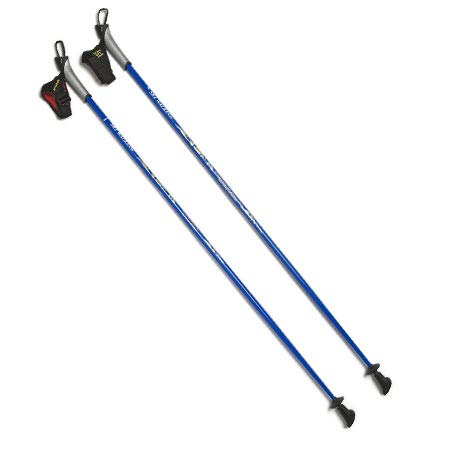
Choosing the correct handle configuration is essential because different designs serve entirely different walking intentions. Classic Nordic walking poles, like the York Nordic Official poles or SWIX models from American Nordic Walking System, feature specialized glove straps. These straps wrap snugly around the palm and wrist, securing the hand to the pole with a quick-release mechanism. This harness allows walkers to release their grip at the back of the swing, pushing backward entirely through the strap before catching the handle again.
In contrast, rehabilitation-focused poles deliberately omit tight wrist straps in favor of strapless ergonomic handles. The Urban Poling ACTIVATOR uses a strapless CoreGrip design equipped with a wide bottom ledge to support the outer edge of the hand. Strapless handles are safer for balance-impaired walkers because they prevent the hand from becoming trapped if a stumble occurs. If a walker loses stability, their hands can release the poles instantly to break a fall or reach for a handrail.
Grip materials also influence comfort, perspiration management, and joint fatigue over long distances. Natural cork grips offer comfortable thermal insulation in cold weather while absorbing hand sweat on warm summer mornings. Molded rubber and textured polymer grips provide durable slip resistance and are easy to sanitize in clinical settings. Matching the handle style to your specific balance needs ensures optimal comfort and safety during every session.
Shaft Engineering: One-Piece Rigid Poles Versus Adjustable Collapsible Systems
Pole shaft construction directly influences vibration dampening, structural strength, and daily convenience. One-piece poles, such as the custom-fitted SWIX and carbon models from American Nordic Walking System, feature a continuous rigid shaft without telescoping joints. These single-piece poles eliminate internal rattling, mechanical vibration, and the possibility of accidental joint slippage under load. Athletes, fitness walkers, and individuals seeking maximum structural dependability often prefer fixed-length poles for their solid feel.
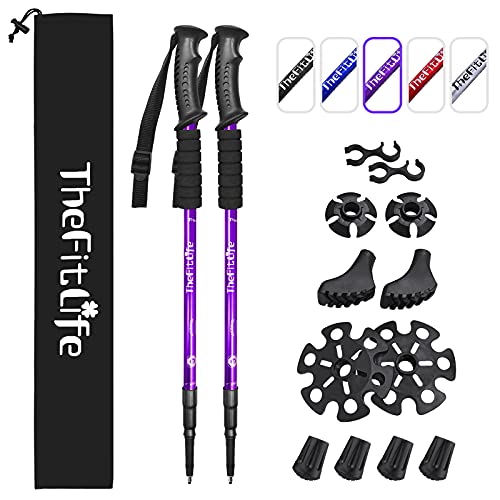
Telescoping poles provide adjustable sizing and compact storage, making them popular for households with multiple walkers. Two-section and three-section poles use either external flip-lock clamps or internal twist-lock mechanisms to adjust height. York Nordic models use aluminum flip locks that secure firmly without requiring high hand strength to tighten. TheFitLife poles feature internal twist-lock systems with built-in anti-shock springs to absorb ground impact on rugged surfaces.
For individuals who travel frequently, collapsible poles fit easily into car trunks or suitcases for weekend trips. If you plan to fly with your walking equipment, review standard carry-on luggage sizing guidelines before packing disassembled poles. High-grade 7075 aircraft aluminum provides an exceptional balance of light weight and impact resistance, while carbon fiber reduces overall carry weight. Selecting between fixed-length rigidity and telescoping versatility depends primarily on your transport needs and personal stability priorities.
Traction Mechanics: Asphalt Paws, Boot Feet, and Carbide Metal Tips
The ground contact point of a walking pole determines how securely it grips different outdoor surfaces. Most quality Nordic poles come equipped with durable tungsten carbide or steel tips beneath removable rubber feet. The exposed metal spike bites into natural surfaces such as forest dirt, grass, sand dunes, and packed winter snow. These durable tips prevent slippage on loose soil where rubber tips would merely skid across the surface.
For walking on hard surfaces such as cement sidewalks, asphalt roads, and indoor tile, walkers install removable rubber tips. Classic Nordic walking uses angled rubber boot tips, often called asphalt paws, that feature a slanted tread pattern. This angled design grips pavement securely when the pole is planted behind the body at an acute propulsion angle. The dense rubber compound absorbs impact vibration and prevents annoying metallic clicking sounds on hard city pavement.
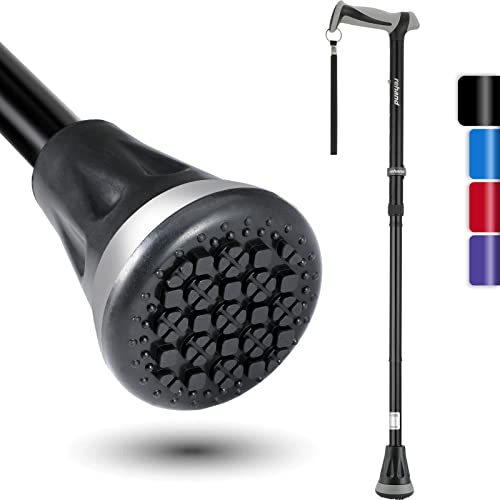
Rehabilitation poles often use broad, bell-shaped rubber tips instead of angled fitness paws. Bell-shaped tips provide a wider base of support that grips securely when the pole is placed vertically next to the body for balance. Regularly inspecting rubber tips for tread wear is vital because worn rubber can expose the slick metal tip on smooth surfaces. Replacing worn rubber feet ensures continuous grip and protects indoor flooring from scratches.
Proper Height Sizing and Biomechanical Walking Technique
Achieving proper pole height is essential for unlocking the postural and offloading advantages of Nordic walking. When standing upright in your regular walking shoes, hold the grips with the poles resting vertically on the floor. Your elbow should rest at approximately a ninety-degree angle, with your forearm parallel to the ground. If your elbow flexes past ninety degrees, the poles are too tall and may cause compensatory shoulder shrugging.
Proper fitness walking technique relies on a natural reciprocal arm swing that matches your leg movement. As your left foot steps forward, your right arm swings forward naturally from the shoulder socket, planting the pole opposite the foot. The pole tip plants angled backward, allowing you to press downward and backward through the grip to propel your stride. Walkers should maintain relaxed shoulders and avoid clutching the grips with excessive hand tension.
For rehabilitation and balance support, the technique shifts slightly toward a more vertical pole placement. Rather than planting the poles backward for speed, users plant them slightly forward and closer to the body to establish a stable support base. This upright placement offloads the lower limbs and provides immediate lateral stability during hesitation. Adjusting your pole angle according to your physical goals ensures safe and comfortable movement.
Clinical Boundaries: Nordic Poles Versus Traditional Mobility Aids
While Nordic walking poles offer outstanding benefits for fitness and mild stability support, they are not universal substitutes for medical mobility aids. Canes and walkers are engineered for specific clinical indications, including strict partial or non-weight-bearing restrictions. Nordic poles require adequate cognitive awareness and bilateral upper-extremity coordination to manipulate safely. Individuals with severe balance disorders, unmanaged vestibular dizziness, or profound lower-limb weakness require medical-grade assistive devices.
If you experience frequent stumbling, sudden balance loss, or significant leg weakness, a single cane or bilateral poles may provide insufficient fall protection. In those clinical scenarios, a rollator or standard walker provides a continuous, rigid framework that supports full body weight. Transitioning between mobility aids should always reflect your current physical capabilities rather than personal preference. Using an under-supportive device on unstable terrain creates unnecessary fall risks.
Before beginning a new pole walking program for rehabilitation or balance improvement, consult a licensed physical therapist or physician. A mobility clinician can evaluate your gait mechanics, confirm appropriate height settings, and recommend suitable grip styles for your joints. With professional guidance and proper equipment, Nordic pole walking can serve as a safe, empowering practice that enhances endurance, protects joints, and restores confidence in everyday movement.





Write Your Review
No reviews yet. Be the first to share your experience!