


Restoring gait stability and reducing joint pressure on painful knees or hips often requires active support that engages the entire body. Learning how to nordic pole walk transforms an ordinary stroll into a rhythmic, whole-body exercise that enhances posture, distributes body weight, and eases strain across the lower extremities. Unlike conventional walking canes that provide unilateral downward support, Nordic poles work as a paired system designed to propel you forward while providing steady balance on flat paths and uneven trails. Active walkers looking to improve cardiovascular stamina and reduce knee discomfort often combine consistent walking routines with flexible gear such as outdoor knee comfort pants to maintain free joint motion across changing terrain.
When you push through specialized wrist straps and angled rubber paws, you transfer significant impact away from your lower joints while engaging your arms, shoulders, and core. Manufacturer designs from brands like York Nordic, American Nordic Walking System, and FitTrek offer varied grip geometries and locking shafts tailored for fitness walking, balance rehabilitation, and everyday stability. Mastering the foundational mechanics of pole plant, arm swing, and strap release ensures you build endurance safely while avoiding common posture errors.


Essential Technique and Equipment Guidelines for Nordic Pole Walking
Learning the proper method of Nordic walking unlocks substantial physical benefits that regular walking cannot match. By coordinating your natural arm swing with intentional backward pole thrusts, you distribute work across your upper torso while protecting delicate hip, knee, and ankle joints. Understanding the core mechanics, pole sizing rules, grip ergonomics, and surface attachments allows you to walk with upright posture, rhythmic fluid cadence, and dependable ground stability.
How Nordic Pole Walking Differs from Traditional Canes and Trekking Poles
Many adults initially confuse Nordic walking poles with standard single-point walking canes or backcountry trekking sticks. Standard mobility canes are engineered for unilateral weight offloading, where you lean downward through a single handle to support an injured or weakened leg. In contrast, Nordic walking utilizes a matched pair of poles held at an angle behind the body to drive forward momentum. This propulsion mechanism activates the upper back, latissimus dorsi, and triceps, which turns a basic stroll into an active cardiovascular routine.
Trekking poles also differ fundamentally because hikers plant them vertically in front of the body to brake against downhill descents. Nordic poles feature specialized angled rubber feet and harness-style glove straps that facilitate a continuous backward push rather than vertical bracing. Educational guides published by Bloomsbury, such as the Complete Guide to Nordic Walking, highlight how this rearward angle maintains fluid momentum without interrupting your natural walking pace. Recognizing these functional distinctions ensures you choose the proper technique and equipment for your personal fitness and mobility goals.
Measuring Proper Pole Height and Elbow Alignment
Setting your poles to the correct height establishes proper body alignment and prevents upper-body fatigue. Unlike walking canes that align with the wrist crease for a slight 15- to 20-degree bend, standard Nordic poles require your elbow to form an approximate 90-degree angle when the pole is held vertically with the tip resting on the ground. A practical sizing formula involves multiplying your standing height in centimeters by 0.68, which provides a reliable starting pole length for recreational walkers. Setting poles too high forces your shoulders to hike upward, which can trigger neck soreness and trapezius stiffness over longer walks.
Conversely, setting the poles too short limits your stride length and reduces the propulsive drive generated by your upper arms. Adjustable telescoping models, such as the FitTrek Nordic Walking Poles, feature lever locks that permit quick height adjustments to accommodate different shoe soles or gradual progression. Rigid fixed-length options like the Swix models from American Nordic Walking System come custom-sized to exact heights, eliminating any risk of mechanical slippage during vigorous training. Checking your elbow angle in a mirror while wearing your regular walking shoes confirms your poles are positioned for maximum efficiency.
Understanding the Glove Strap and Hand Release Mechanism
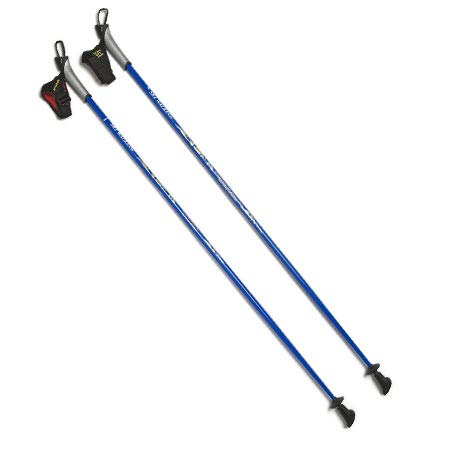
The glove-style strap is the defining biomechanical component of authentic Nordic walking poles. Traditional hiking poles use simple webbing loops that require you to clench the grip continuously, which can lead to forearm cramps and hand fatigue. True Nordic poles feature an ergonomically contoured strap that wraps securely around the palm and wrist, securing with durable hook-and-loop fasteners. This wrap transfers pushing force directly from the wrist and heel of the hand into the shaft, which eliminates the need to squeeze the handle tightly with your fingers.
Models like the York Nordic Official Nordic Walking Poles feature quick-release buttons that allow you to unclip the hand strap from the grip in seconds when you need to grab water or check a phone. Other designs, including the York Nordic Motivator Walking Poles, incorporate patented contoured grips with dual thumb resting zones that reduce stress on the thumb carpometacarpal joint for individuals managing hand osteoarthritis. When executed correctly, the strap permits a continuous cycle of gripping during the forward plant and releasing your fingers as your arm pushes past your hip.
Step-by-Step Gait Mechanics: The Diagonal Stride
Executing the classic diagonal stride requires coordinating opposite arm and leg movements in a relaxed, rhythmic cadence. Begin by walking forward naturally while dragging the poles behind you with your hands open, allowing the shafts to angle backward at approximately 45 degrees. Once your legs establish a steady, rhythmic stride, begin swinging your arms forward naturally from the shoulder joints rather than bending from the elbows. Your left arm swings forward in unison with your right heel striking the ground, matching your body’s natural reciprocal walking pattern.
As the forward pole tip contacts the ground roughly level with your opposite heel, gently close your fingers around the handle and press downward and backward through the wrist strap. Continue pushing backward through the strap until your hand travels past your hip, extending your elbow fully behind your torso. At the end of the backward push, open your hand completely to let the strap bear the final propulsion before your arm swings forward again. Keeping your chin level, shoulders relaxed, and torso slightly tilted forward from the ankles ensures smooth power transfer with every step.
Navigating Pavement and Natural Surfaces with Interchangeable Tips
Adapting your pole tips to specific walking surfaces ensures dependable traction and dampens ground impact. Nordic poles typically feature sharp tungsten carbide metal tips designed to bite firmly into dirt, grass, gravel, and packed snow. While carbide tips excel on natural woodland trails, placing bare metal against hard concrete or asphalt creates jarring vibration and loud clattering that undermines user comfort. Hard-surface walking requires slipping detachable rubber boots, often referred to as asphalt paws or fitness feet, directly over the carbide points.
Asphalt paws feature an angled, treaded base that matches the backward tilt of the pole shaft, creating a broad contact patch that grips smooth pavement securely. When installing rubber feet, always ensure the toe of the paw points backward, away from your direction of travel, so the angled tread makes flat contact with the ground. Walkers navigating mixed park pathways should carry rubber tips in a small pouch or pocket, popping them on for sidewalks and removing them when transitioning onto packed soil. Regularly checking the rubber tread for wear prevents sudden slipping and keeps your arm joints shielded from pavement impact.
Fixed-Length versus Adjustable Telescoping Shafts
Choosing between one-piece fixed shafts and multi-piece adjustable telescoping poles involves balancing structural rigidity against packing convenience. Solid one-piece aluminum shafts, such as custom-sized models from American Nordic Walking System, offer exceptional rigidity with virtually zero vibration or rattling during aggressive arm pushes. Athletes, fitness enthusiasts, and seniors requiring predictable balance often favor fixed poles because they eliminate the possibility of an adjustment clamp loosening unexpectedly during a walk. However, one-piece poles do not collapse, making them cumbersome to store inside compact car trunks or transport on commercial flights.
Multi-piece telescoping poles utilize external flip locks or secure push buttons to compress down to portable lengths for travel and shared family use. Telescoping aluminum poles like the York Nordic Motivator can adjust between 32 and 54 inches, accommodating various user heights and differing trail inclines. For individuals requiring reinforced weight ratings, the York Nordic Big and Tall Motivator Walking Poles feature heavy-duty push-button mechanisms capable of supporting up to 500 pounds for heights up to 7 feet. Inspecting locking levers before every outing ensures the telescoping sections remain firmly clamped under full dynamic body weight.
Joint Offloading and Upper-Torso Conditioning Benefits
One of the primary health benefits of Nordic pole walking is the significant reduction of compressive force placed on the lower-body joints. Biomechanical studies indicate that pushing through poles can offload between 15 and 25 percent of body weight from the knees, hips, and lower spine during forward movement. This reduction in joint stress allows individuals recovering from joint replacements or managing mild arthritis to walk longer distances without triggering debilitating flare-ups. At the same time, the continuous arm push elevates heart rate and oxygen consumption, delivering a more rigorous aerobic workout than passive walking.
Engaging the upper body activates postural muscles throughout the thoracic spine, helping walkers counter the forward-slouching posture common in desk workers and older adults. Walkers navigating cooler breezes or mixed trail paths often wear breathable lightweight walking pants to stay comfortable during extended cardiovascular sessions. The rhythmic arm action also encourages rotational movement through the torso, which strengthens core abdominal muscles and improves functional balance. This combination of lower-limb joint preservation and upper-body muscle engagement makes the activity an effective rehabilitation tool for neurological conditions like Parkinson’s disease.
Correcting Common Technique Mistakes
Beginners frequently encounter several technique pitfalls that diminish the effectiveness of Nordic walking and cause premature fatigue. The most common error is known as pacing, where the walker swings the same arm and leg forward simultaneously instead of maintaining an alternating reciprocal gait. If you catch yourself pacing, stop pushing, let your arms hang loosely with the poles trailing on the ground, and walk naturally until your normal opposite-arm swing returns. Another widespread mistake is over-reaching, where users plant the pole tip far ahead of their front foot, which creates a braking force that slows momentum.
Clenching the handle with a death grip throughout the entire stride cycle is another habit that leads to sore forearms and stiff wrists. Remember to trust the glove strap: push through the palm strap, release your finger grasp as your hand passes your hip, and gently reclench only as the pole swings forward. Additionally, avoid holding the poles completely upright like trekking sticks, as a vertical angle prevents the rubber paw from gripping the asphalt properly. Keeping the poles angled backward at roughly 45 degrees allows the angled paw to bite the surface and propel you forward smoothly.
Safety Verification, Maintenance, and When to Consult a Specialist
Performing basic equipment checks before every walk ensures your poles function reliably and support your safety across all terrains. Inspect the rubber paw treads for thinning spots or exposed metal tips, replacing worn rubber boots promptly to avoid slips on wet surfaces. For adjustable poles, test each locking collar or push-button pin by placing moderate downward pressure on the grip while standing on a level surface. If you hear rattling or feel shaft slipping, tighten the external lever tension screw or wipe away any dirt lodged inside the telescoping collar.
While Nordic walking poles provide outstanding balance assistance for active individuals, they are not designed to replace prescribed medical canes or walkers for non-weight-bearing recovery. Individuals with severe vestibular deficits, pronounced gait ataxia, or acute post-surgical weight-bearing restrictions should consult a physical therapist or physician before initiating a pole walking regimen. A clinical gait specialist can evaluate your balance status, verify your pole sizing, and ensure your movement patterns support long-term mobility without compromising joint integrity.
Consistent practice with correct form allows you to turn every walk into an invigorating, joint-friendly workout. By dialing in your pole height, mastering the open-hand strap release, and matching your rubber tips to the terrain, you build cardiovascular stamina while preserving lower-body joint health. Focus on maintaining an upright posture, relax your shoulders, and let the rhythmic backward push propel your mobility forward safely on every route.





Write Your Review
No reviews yet. Be the first to share your experience!