


Walking with an improperly sized mobility aid often leads to persistent shoulder hiking, wrist strain, and compensatory lower back fatigue. Establishing the correct handle position allows an adult walking stick to transfer roughly fifteen to twenty-five percent of body weight away from a painful hip, knee, or ankle joint while encouraging an upright, confident gait cadence. Learning how to measure walking cane height with precision ensures that your cane acts as a natural extension of your arm rather than an awkward obstacle. Individuals recovering from joint procedures often pair mobility devices with tendon knee support wear to stabilize lower limbs during daily rehabilitation routines.
A cane set too high elevates the shoulder girdle unnaturally, while a shaft adjusted too low forces the user into a forward stoop that compromises balance on slick tile or uneven pavement. Standard clinical mobility guidelines emphasize aligning the top of the cane grip directly with the user’s wrist crease while standing naturally in standard walking shoes. Accounting for personal posture, shoe sole thickness, and proper elbow flexion creates dependable stability across daily indoor and outdoor activities. Taking a few moments to verify these physical dimensions protects joint mechanics and restores lasting walking confidence.


The Complete Biomechanical Guide to Measuring and Adjusting Walking Cane Height
Setting the correct handle elevation is the most vital step in preparing any adult mobility stick for daily use. When a walking aid matches your anatomical proportions, it channels downward force along the central shaft and offloads substantial pressure from vulnerable lower joints. Physical therapists and mobility manufacturers universally rely on specific skeletal landmarks to determine this baseline measurement. Understanding these physical checkpoints ensures you achieve optimal joint protection and reliable balance on every walking surface.
The Anatomical Landmarks: Wrist Crease and Greater Trochanter Alignment
The primary anatomical target for sizing a walking stick is the distal wrist crease, which sits where the base of your hand meets the forearm. When an individual stands erect with arms resting naturally at the sides, this crease directly corresponds to the ideal grip platform of a cane. Aligning the top of the handle with this specific crease ensures that your arm maintains a natural resting position without forcing your shoulders upward. Bypassing this checkpoint by guessing cane length often results in sustained muscular tension across the neck and upper back.
Another reliable skeletal reference point used in clinical gait assessments is the greater trochanter of the femur. The greater trochanter is the prominent bony projection located on the upper outer side of your thigh bone. In an upright standing posture, the horizontal level of the greater trochanter aligns closely with the wrist crease of a relaxed arm. Using both landmarks provides a dependable cross-reference, especially for individuals who experience mild postural asymmetry or slight spinal flexion.
Step-by-Step Measurement Procedure with Walking Shoes
Before taking any physical measurements, you must put on the specific walking shoes you wear most frequently outdoors. Athletic sneakers, supportive orthopedic shoes, and firm walking boots add between half an inch and an inch and a half of sole thickness to your standing height. Sizing a cane while barefoot or wearing thin indoor socks results in a cane shaft that is noticeably too short when stepping outdoors. Maintaining realistic sole height during measurement prevents dangerous postural stooping and gait instability on sidewalks.
To execute the measurement accurately, stand on a flat, level floor near a firm wall or sturdy doorway for balance. Stand with your feet approximately shoulder-width apart, keep your weight distributed evenly across both feet, and allow your shoulders to remain completely relaxed. Let both arms hang loosely at your sides with your wrists relaxed and your fingers pointing gently toward the floor. Avoid looking down at your feet, as tilting your head downward immediately pulls your torso forward and alters your true vertical height.
Having a family member or caregiver assist with the tape measure produces the most dependable sizing result. The assistant should measure from the hard floor surface directly to the primary crease on the inside of your wrist. If measuring without assistance, you can back up against a wall, hold a small pencil horizontally at your wrist crease, and place a light mark on the wall behind you. You can then step away and measure the vertical distance from the floor to that mark using a standard rigid tape measure.
The Elbow Flexion Test: Verifying the Fifteen to Twenty Degree Angle
Once you place your hand on the adjusted cane grip, your elbow should form a gentle flexion angle between fifteen and twenty degrees. This slight mechanical bend serves as an essential shock absorber for your upper extremities during foot strike. A flexed elbow enables the biceps and triceps muscles to modulate downward load smoothly instead of transferring jarring impact directly into your shoulder joint. It also provides functional leverage, allowing your arm to push downward dynamically whenever your footing wavers.
An elbow that is completely straight indicates that the walking cane has been adjusted too short for your frame. Walking with a locked, straight arm forces you to lean your entire upper torso toward the cane side, creating an unnatural compensatory limp known as a lateral trunk lean. Conversely, an elbow bent beyond thirty degrees means the cane handle is set far too high, which elevates your shoulder girdle and rapidly fatigues your trapezius muscles. Verifying this gentle fifteen-degree elbow flex in a mirror confirms that your downward leverage remains efficient and comfortable.
Adjusting Telescoping Push-Button Pins and Silencing Collars
Most modern aluminum mobility canes utilize a telescoping shaft secured by a spring-loaded brass push-button detent pin. Adjustable models such as the Medline Aluminum Offset Walking Cane provide telescoping ranges from twenty-nine to thirty-eight inches to accommodate a broad spectrum of user heights. To adjust the shaft, depress the spring pin fully into the outer tube and slide the inner leg section until the pin snaps cleanly into the appropriate hole. Always visually inspect the pin to ensure that the brass button has fully popped through the hole and seated flush against the outer rim.
Dual-locking mechanisms offer enhanced structural security for users who require higher load stability. The PELEGON Folding Cane integrates both a push-button height control adjusting from thirty-two to thirty-seven inches and a separate threaded twist-lock collar tested to support up to three hundred pounds. Threading this anti-rattle collar tight against the outer shaft eliminates internal clearance play between the telescoping tubes. Failing to tighten this collar often leads to irritating clicking noises during each stride and can cause subtle joint wobble under weight-bearing loads.
Sizing Considerations for Offset, Ergonomic, and Tall Canes
Different handle geometries influence how downward force travels into the cane shaft and how the handle rests against your palm. An offset cane design curves the upper neck forward so the hand grip sits directly over the vertical centerline of the lower shaft. This geometry centers your body weight directly above the ground contact point, providing superior stability for post-surgical rehabilitation and knee recovery. Traditional crook handles, by comparison, position the hand slightly behind the shaft axis, which can increase rotational torque across a weak wrist.
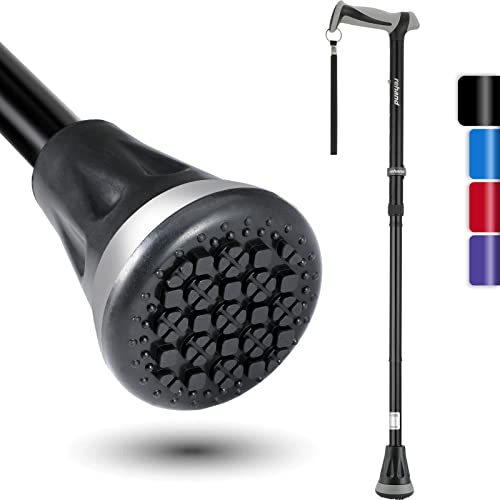
Handle grip contours also alter functional hand height and palm pressure distribution during long walks. Ergonomic models such as the REHAND Folding Cane feature an elongated, wider palm grip crafted from soft thermoplastic rubber to relieve pressure across the thenar eminence. These contoured designs prevent focal nerve compression and reduce wrist fatigue for users living with osteoarthritis or rheumatoid arthritis. Because thick ergonomic palm pads can elevate your hand position by several millimeters, always re-check your elbow flexion after switching from a slender foam or wooden grip.
User height extremes require dedicated shaft sizing ranges to preserve ergonomic posture without compromise. Canes such as the Honmido Foldable Cane and the REHAND Adjustable Walking Cane offer ten adjustment settings spanning forty to forty-nine inches, supporting taller adults and individuals up to three hundred and fifty pounds. Taller users who attempt to use standard thirty-inch canes inevitably suffer from neck strain and hunched posture. Selecting a cane whose adjustment span places your target measurement near the middle of its extension range ensures maximum tube overlap and structural rigidity.
Factoring Base Types: Single Point, Quad Cane, and Articulating Pivot Pods
The style of base attached to the bottom of the cane directly influences the overall height of the grip and changes how the device interacts with the ground. Traditional single-point walking sticks terminate in a flexible rubber ferrule that provides agile ground clearance and minimal swing weight. These compact rubber tips suit active individuals who require mild balance assistance and rapid stride cadence across indoor flooring and smooth outdoor pavements. Single-point tips add minimal vertical stack height, making floor-to-crease sizing straightforward and predictable.
Self-standing pivot bases utilize a wide footplate mounted to an articulating ball joint that mimics natural human ankle movement. Models like the TIRAROME Walking Cane and the REHAND pivot cane employ four-layer shock-absorbing bases that maintain full rubber contact even when the cane shaft angles forward during stride. These articulated assemblies add between one and two inches of vertical height compared to standard flat rubber tips. When retrofitting a wide pivot base onto an existing stick, you must lower the telescoping shaft by one adjustment notch to preserve your target wrist-crease alignment.
Quad canes feature a welded steel or aluminum baseplate with four individual rubber-tipped feet for maximum static standing stability. Small-base and large-base quad canes stand independently on flat floors, freeing the user from leaning the cane against counters or chairs where it might fall. However, quad baseplates have an offset design with two straight legs and two flared legs. When sizing and positioning a quad cane, you must turn the flat side of the baseplate toward your body to prevent your foot from catching on the protruding legs during forward swing.
Proper Gait Sequencing and Side Placement After Sizing
A properly measured walking cane must always be held in the hand opposite your injured, recovering, or weaker leg. Holding the cane on the strong side maintains your natural reciprocal arm swing, where the opposite arm and leg move forward in tandem. If your left knee is painful or recovering from surgery, you hold the cane in your right hand and advance the cane simultaneously with your left leg. This biomechanical positioning allows you to push downward through the cane to offload fifteen to twenty-five percent of your body weight off the injured joint.
Holding a walking stick on the same side as an injured leg creates an awkward, waddling gait that disrupts balance and overloads hip muscles. Advancing the cane simultaneously with the affected leg broadens your base of support and creates a stable tripod effect on the ground. As your heel strikes the floor, your arm presses firmly onto the ergonomic grip, transferring ground reaction forces away from the damaged cartilage or healing bone. This smooth coordination prevents unnatural pelvic dropping and preserves symmetrical walking cadence throughout the day.
Navigating staircases requires a distinct step-by-step sequence to maintain stability and prevent missteps. Clinical physical therapy practice teaches the classic rule of stepping up with the unaffected leg first and stepping down with the affected leg first. When ascending stairs, place your strong foot on the upper step, push down to lift your body, and then bring the cane and weaker leg up to meet it. When descending stairs, lower the cane and your weaker leg onto the step below first, providing a solid support base before stepping down with your strong leg.
Troubleshooting Sizing Errors: Identifying Handle Height Problems
Recognizing subtle physical symptoms helps users identify when their walking cane has shifted or was adjusted to the incorrect height. If you experience persistent soreness in your shoulder, neck stiffness, or wrist joint compression, your cane is almost certainly adjusted too tall. A cane that sits too high forces you to hike your shoulder blade upward with every single step, creating continuous tension in the upper trapezius muscles. Lowering the shaft by one or two detent holes immediately restores a relaxed shoulder posture and relieves cervical strain.
Soreness in your lower back, excessive forward trunk bending, and feeling unsteady when stepping forward signal that your cane is set too short. Users often compensate for a short cane by stooping forward or leaning heavily to one side, which drastically narrows their field of vision and increases fall risk. In addition, inspect your rubber cane tip regularly for signs of uneven tread wear. A worn, smooth rubber tip cannot grip wet tile or polished hardwood securely, creating dangerous slipping hazards that compromise user safety regardless of shaft height.
Travel and Packability: Maintaining Sizing Across Collapsible Frames
Collapsible walking canes offer immense convenience for active seniors and travelers who need compact storage in vehicles or aircraft cabins. Models such as the PELEGON Folding Cane fold down to roughly ten and a half inches, slipping effortlessly into totes, car consoles, or daypacks. When traveling by air, planning your gear with resources like our carry on luggage backpack guide makes it simple to stow folding mobility sticks alongside daily travel necessities. Collapsible aluminum tubes rely on internal heavy-duty elastic bungee cords that pull the segment joints firmly together during assembly.
Whenever you unfold a collapsible walking stick, you must verify that every interlocking joint ferrule has fully seated into its receiving sleeve. A joint that is only partially seated can slip suddenly under full body weight, causing the cane shaft to shorten unexpectedly and triggering a fall. Check that the push-button height pins remain locked in your established sizing position rather than slipping during transit. Developing the habit of giving your unfolded cane a firm downward press against the floor before stepping out guarantees structural integrity.
Recognizing When a Cane Is Insufficient for Balance Needs
Walking canes are designed to provide unilateral balance support and partial joint unloading for individuals with mild to moderate mobility limitations. A single cane cannot safely support non-weight-bearing rehabilitation protocols or severe bilateral weakness resulting from advanced neurological disorders. When a person experiences frequent balance loss, leg giving way, or severe freezing of gait, continuing to rely on a single walking stick increases fall risks. Canes provide a broad base of support, but they cannot replace the full bilateral frame stability offered by a walker or rollator.
If you find yourself requiring more than twenty-five percent body weight offloading or gripping furniture while walking with your cane, you should seek professional medical evaluation. A licensed physical therapist or physician can conduct a formal gait analysis to evaluate your balance thresholds, joint stability, and muscle strength. They can determine whether advancing to a two-wheeled walker, four-wheel rollator, or specialized forearm platform provides the necessary stability for independent mobility. Choosing the right mobility aid preserves your independence, protects vulnerable joints, and ensures safe mobility across every environment.
Achieving an accurate cane height measurement transforms a simple walking stick into a reliable, posture-friendly mobility partner. By aligning the handle with your wrist crease, maintaining a fifteen-degree elbow flex, and securing the locking collar tightly, you protect your body from unnecessary fatigue and joint strain. Always remember to walk with the cane on your stronger side and inspect your rubber tip tread periodically for signs of abrasion or hardening. Regular sizing checks ensure that your mobility aid continues to deliver dependable stability, dignified independence, and lasting walking confidence every day.




Write Your Review
No reviews yet. Be the first to share your experience!