


Experiencing unsteady balance during daily movement often prompts immediate questions about the best mobility devices for stability and joint relief. Whether recovering from lower-limb orthopedic surgery or managing persistent joint stiffness, determining what do you use to walk establishes a foundation for maintaining personal independence. Many individuals find that matching their physical needs with the correct support tool reduces up to twenty-five percent of joint load on vulnerable hips, knees, and ankles. Pairing proper movement habits with supportive knee mobility apparel and dependable footwear can further enhance overall stride security during routine daily activities.
Selecting an appropriate walking aid requires evaluating your specific balance demands, upper-body strength, and daily travel routines. A standard single-point cane offers agile support for minor balance hesitations, while quad canes and pivot bases provide broader surface contact across challenging indoor and outdoor surfaces. Sizing your equipment to align precisely with your wrist crease prevents compensatory shoulder hiking, lower back fatigue, and wrist discomfort. Consulting a licensed physical therapist or physician ensures your mobility aid delivers proper biomechanical offloading tailored to your personalized physical recovery plan.


Understanding Walking Aids and Mobility Equipment for Daily Independence
Choosing the right mobility device is an essential step toward preserving balance, preventing falls, and maintaining personal freedom. When people ask what equipment they should use to support their stride, the answer depends entirely on their specific stability needs, joint discomfort, and daily activity level. Single-point walking canes, quad canes, articulating pivot bases, and multi-wheeled walkers each fulfill distinct biomechanical roles in offloading joint stress and steadying footing. Understanding the structural capabilities, proper sizing protocols, and movement techniques of these aids ensures you select the safest device for your unique mobility profile.
Identifying the Core Categories of Walking Aids
Standard single-point canes represent the most widespread mobility aid for individuals experiencing minor balance hesitation or mild knee and hip arthritis. These lightweight devices feature a straight or gently curved shaft terminating in a single rubber traction ferrule that delivers quick, agile maneuverability across smooth indoor floors. Many active users prefer single-point aluminum or carbon fiber designs because they swing forward effortlessly without adding fatigue to the arm during extended walks. While they provide dependable sensory feedback and partial weight redistribution, single-point models do not stand independently and offer limited support for severe instability.
Quad canes expand upon standard designs by incorporating a wide four-point rectangular metal base that rests flat against the ground. Available in small-base and large-base configurations, quad canes supply substantial stationary stability for stroke survivors, neurological patients, or individuals recovering from major orthopedic surgery. Articulating pivot-base canes bridge the gap between single-point agility and quad stability by utilizing a wide triangular or circular foot with an internal rubber flex joint that maintains constant ground contact on sloped surfaces. When balance deficits or bilateral leg weakness become more pronounced, four-wheeled rollators and standard medical walkers offer complete bilateral frame support that exceeds the capabilities of any single cane.
Biomechanical Support and Partial Joint Offloading Principles
A primary mechanical purpose of using a walking cane is redistributing downward body weight away from a compromised lower extremity. A properly utilized cane can offload between fifteen and twenty-five percent of body weight from an injured or arthritic hip, knee, or ankle joint during the stance phase of walking. This partial weight transfer reduces intra-articular contact stress, decreases inflammatory irritation, and helps protect cartilage from accelerated degenerative wear. Bypassing excess load through the hand, forearm, and shoulder structure allows recovering tissues to heal without forcing the individual into complete bed rest.
Proper biomechanical offloading requires holding the cane in the hand opposite your weak, painful, or surgically repaired leg. Holding the device on the stronger side allows the cane and the affected limb to swing forward in unison, recreating natural reciprocal human gait patterns. This contralateral positioning widens your base of support and shifts your center of gravity toward the stronger limb without distorting spinal alignment. Placing the cane on the injured side disrupts normal pelvic mechanics, forces awkward lateral leaning, and substantially increases joint stress across the lower back and hips.
Handle Geometry and Grip Ergonomics for Hand Comfort
Selecting an appropriate handle geometry is essential for preventing hand fatigue, palm bruising, and median nerve irritation during daily ambulation. Traditional crook handles offer classic styling and convenient hooking over armrests, but their narrow circular diameter concentrates pressure directly into the center of the palm. Derby and Fritz handles feature broader, flattened top surfaces that distribute downward forces across a larger surface area, making them far more comfortable for seniors with mild hand stiffness. Fritz handles also incorporate an open front cutout that prevents painful pinching between the index finger and the vertical shaft.
Offset handle canes introduce an intentional forward bend in the upper neck that aligns the user hand directly over the vertical center of the cane shaft. This physical alignment eliminates rotational torque on the wrist and directs downward force straight into the rubber tip for enhanced structural stability. For individuals managing severe rheumatoid arthritis or carpal tunnel syndrome, anatomically contoured palm grips molded specifically for the left or right hand provide maximum pressure dispersion across the thenar eminence. Soft textured rubber, closed-cell foam, and silicone grip overlays further dampen ground strike vibrations before they reach sensitive wrist and elbow joints.
Measuring Proper Cane Height and Wrist Crease Alignment
Using a cane adjusted to an incorrect height introduces significant postural compensation, upper back tension, and an elevated risk of stumbling. When an aid is adjusted too tall, the user must hike the shoulder upward, which strains the trapezius muscles and prevents effective downward weight transfer. Conversely, a cane that is adjusted too short forces the user into a bent forward posture that strains lumbar spinal discs and shifts the body center of gravity dangerously forward. Accurate sizing establishes an upright, balanced posture where the upper body can safely support partial weight-bearing requirements.
To measure proper cane height accurately at home, stand upright on a flat floor wearing your standard supportive walking shoes with your arms hanging naturally at your sides. The top crest of the cane handle should align horizontally with the skin crease of your wrist or the bony protrusion of your greater trochanter at the hip. When you grip the handle during active standing, your elbow should form a comfortable fifteen to twenty degree flexion angle. This gentle bend provides sufficient mechanical leverage to push down firmly during each step without locking the joint or hyper-extending the shoulder.
Step-by-Step Gait Mechanics on Level Ground
Mastering a smooth, coordinated walking cadence prevents tripping and optimizes joint offloading across standard indoor flooring and outdoor sidewalks. Begin standing with your feet hip-width apart and your cane placed roughly two to four inches forward and two inches outward from your stronger foot. To initiate movement, advance the cane forward approximately one comfortable step length, keeping the rubber tip firmly planted before transferring body weight. Never reach the cane excessively far ahead, as over-extension reduces downward stability and increases the likelihood of the tip slipping forward.
Step forward with your weaker or recovering leg so that its heel contacts the ground simultaneously with or slightly after the cane placement. As you bear weight down through both the cane handle and your weaker leg, push through your palm to offload joint pressure while bringing your stronger leg forward past the cane. Once your stronger foot is firmly planted on the ground, repeat the cycle by advancing the cane and weaker leg together in a rhythmic sequence. Maintaining a steady, unhurried cadence ensures continuous balance and prevents compensatory hip swaying or sudden loss of footing.
Safe Stair and Curb Navigation Sequences
Staircases and high outdoor curbs present substantial fall hazards that require strict adherence to clinical movement sequences. The universally taught physical therapy guideline for navigating elevation changes relies on the simple phrase up with the good, down with the bad. When ascending a staircase, grasp a sturdy wall-mounted handrail with your free hand whenever available while holding your cane in the opposite hand. Step up first with your stronger, unaffected leg, press down through that foot to elevate your body weight, and then bring the cane and your recovering leg up onto the same step.
Descending stairs requires reversing the sequence to ensure your stronger leg safely controls the descent of your entire body weight. Lower the cane tip down to the target step first, and immediately follow by stepping down with your weaker leg onto the same step surface. Finally, lower your stronger leg down to meet them, keeping your hand resting firmly on the handrail for secondary balance support. Quad canes should generally be avoided on narrow stair treads because their wide metal bases frequently overhang the step edge, creating a severe tipping hazard.
Base Stability Options and Quad Cane Clearance
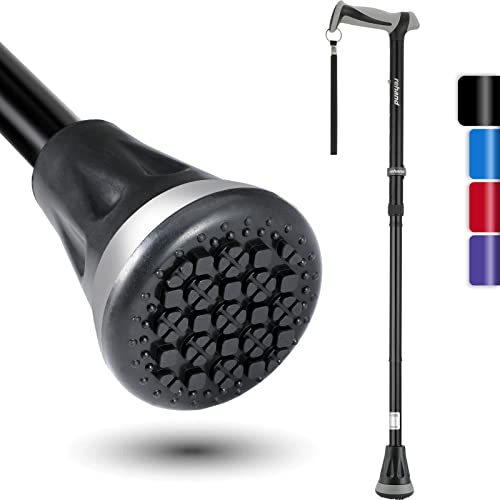
The choice between single-point rubber tips, articulating pivot bases, and quad platforms directly determines how a cane interacts with flooring surfaces. Single-point tips offer unmatched speed and fluid maneuverability, making them ideal for navigating crowded grocery aisles, narrow hallways, and turning tight corners. Articulating multi-flex bases incorporate three or four mini rubber traction pods that flex smoothly over sloped sidewalks and gravel, allowing the cane to stand upright on flat indoor floors when unattended. This self-standing capability eliminates the frustrating problem of canes clattering to the floor and forcing painful bending to retrieve them.
Quad canes provide substantial ground stability through their welded steel or aluminum rectangular frames, but they require careful mechanical orientation during use. The vertical shaft is manufactured with an intentional offset so that the flatter side of the quad base faces inward toward the user legs, while the wider angled legs face outward. Turning the flat side toward your body prevents you from accidentally kicking or tripping over the metal feet while swinging your legs forward during your normal stride. Small-base quad canes offer easier clearance through interior doorways and around home furniture, whereas large-base models provide maximum stationary support for slow, deliberate rehabilitation walking.
Shaft Materials, Structural Ratings, and Weight Capacities
Walking aid frames are engineered from several distinct materials that balance carrying weight, structural stiffness, and vibration absorption characteristics. Anodized aluminum tubing represents the industry standard for height-adjustable canes, delivering excellent corrosion resistance, high tensile strength, and minimal tare weight. Solid turned hardwoods, such as ash, walnut, and oak, provide timeless elegance and rigid structural support, though they must be permanently cut to size with a handsaw rather than adjusted with telescoping pins. Carbon fiber canes represent a premium lightweight alternative, offering exceptional strength-to-weight ratios and natural vibration-damping properties that cushion hand joints on hard concrete.
Verifying the certified weight capacity of any walking cane is a critical safety consideration before beginning daily use. Standard aluminum and wooden canes are typically engineered to accommodate static loads between two hundred fifty and three hundred pounds. Bariatric mobility canes feature heavy-duty reinforced steel or thick-gauge structural aluminum tubing designed to support four hundred to five hundred pounds safely. Differentiating between static ratings and dynamic stability is essential, as dynamic loads generated when stumbling or catching a sudden fall exert substantially higher momentary forces through the shaft and adjustment pins.
Travel Convenience, Maintenance, and Transitioning to Walkers
Folding walking canes provide exceptional portability for active adults who only require balance assistance during long outings, shopping trips, or community transit. These collapsible models consist of interlocking aluminum tube segments connected internally by a heavy-duty elastic shock cord that folds down into a compact ten to twelve inch bundle. Active travelers who pack a collapsible travel cane alongside their personal gear often consult our carry on travel pack sizing advice to confirm overhead luggage space. Maintaining any cane also requires weekly inspection of the bottom rubber ferrule to ensure tread depth remains intact and the internal metal reinforcement washer has not punctured the rubber compound.
While walking canes provide valuable assistance for mild to moderate instability, recognizing when to transition to a two-wheeled walker or four-wheeled rollator is vital for ongoing fall prevention. When an individual experiences progressive bilateral leg weakness, frequent near-miss stumbles, or severe vestibular balance loss, relying solely on a unilateral cane becomes insufficient. Rollators provide complete bilateral frame support, ergonomic hand braking systems, and built-in seating platforms that allow users to rest safely during longer community outings. Scheduling a formal gait evaluation with a licensed physical therapist or physician ensures you receive personalized mobility equipment recommendations tailored precisely to your evolving physical balance needs.
Ultimately, selecting what you use to walk comes down to matching your personal balance requirements with a properly fitted, structurally reliable mobility device. Whether you benefit most from an ergonomic offset cane, a stable quad base, or a folding travel model, verifying correct wrist crease height and maintaining fresh rubber traction ensure every step remains secure. Staying mindful of subtle changes in your walking cadence and consulting healthcare professionals whenever balance shifts guarantee that your equipment continues to support active, independent living for years to come.





Write Your Review
No reviews yet. Be the first to share your experience!