


Many active adults and rehabilitation walkers look for ways to enhance stability without feeling restricted by clinical mobility aids. Learning what does nordic walking mean reveals how specialized fitness poles transform a routine neighborhood stroll into an active, posture-boosting exercise. Unlike ordinary strolling, this technique recruits the muscles of the upper torso and arms to propel the body forward while actively cushioning steps. Pairing your daily routine with supportive knee mobility apparel can further ease joint strain and encourage steady movement across various surfaces.
Proper execution relies on coordinated pole strikes that encourage an upright spine and a fluid, rhythmic cadence. The deliberate movement offloads repetitive impact from the lower joints while building core stability and endurance. Understanding the distinction between fitness walking poles and medical canes ensures you choose the right tool for your specific balance and rehabilitation goals. While Nordic poles promote symmetry and aerobic fitness, individuals requiring prescribed weight-bearing offloading should always consult a physical therapist before modifying their daily mobility routine.



The Mechanics, Biomechanics, and Mobility Role of Nordic Walking
Nordic walking is an enhanced walking method that uses specially engineered poles to engage the upper body while driving forward momentum. It originated in Finland as an off-season training protocol for cross-country skiers and quickly developed into an accessible health activity for all fitness levels. By adding pole push-off to a normal walking stride, users activate their back, shoulders, and arms to ease lower-body stress. Understanding how this activity works helps individuals determine whether it fits their balance, conditioning, or rehabilitation needs.
Core Mechanics of Nordic Walking and Full-Body Muscle Recruitment
The defining characteristic of Nordic walking is the purposeful use of two specialized poles that push backward against the ground. Standard walking primarily challenges the legs and hips while the upper body remains largely passive during regular movement. Nordic walking changes this dynamic by forcing the latissimus dorsi, pectorals, triceps, and abdominal core to engage with each step. This continuous muscular recruitment increases caloric expenditure and cardiovascular demand without feeling like exhausting labor.
Upper-body activation also counteracts the tendency to slouch or slump forward during extended walks. Planting the poles at a backward angle naturally lifts the ribcage and encourages upright thoracic spine alignment. This posture helps open the chest cavity, which can support deeper breathing and improved oxygen intake during daily exercise. For aging adults seeking better posture, this gentle biomechanical cue provides valuable structural support across every stride.
Biomechanical Gait Alterations and Lower-Extremity Joint Relief
Ground reaction forces place significant stress on the knees, hips, and lower back during unassisted walking. Nordic walking redistributes a portion of that downward force into the upper extremities through the pole shafts. Observational biomechanical studies indicate that transferring kinetic energy through the arms reduces joint compression on the knees and ankles. Walkers managing mild knee osteoarthritis often find that this redistribution allows them to travel farther with less post-walk discomfort.
The movement also subtly lengthens the user’s natural stride and promotes a smoother heel-to-toe foot roll. Because the arms actively push the body forward, the legs do not have to work as aggressively to maintain forward momentum. This smoother kinetic flow reduces braking forces when the forward heel strikes the ground. Over time, the balanced rhythm helps reduce joint fatigue and promotes a more stable, confident walking pattern.
Nordic Walking Poles Compared to Medical Walking Canes
A frequent point of confusion is whether Nordic walking poles can replace a traditional medical walking cane. Medical walking canes, such as standard single-point or offset canes, are engineered to offload 15% to 25% of body weight from an injured or unstable leg. A cane is held in the hand opposite the affected limb and placed vertically adjacent to the foot to provide direct unilateral weight-bearing relief. Nordic poles, in contrast, are used as a bilateral pair and planted at an angle behind the body to create forward propulsion rather than vertical offloading.
Quad canes and heavy-duty bariatric canes feature wide structural bases and static load certifications that Nordic poles simply do not provide. Leaning full body weight onto a Nordic pole during a sudden balance loss can cause the angled shaft to slide outward and compromise stability. While Nordic poles offer bilateral sensory feedback that helps with mild posture hesitation, they cannot support non-weight-bearing orthopedic recovery. Dedicated mobility canes remain the clinically appropriate choice whenever substantial body weight must be offloaded from a compromised joint.
Anatomical Sizing: Ninety-Degree Angles Versus Wrist-Crease Cane Measurements
Setting the correct equipment height is critical for both walking efficiency and injury prevention. Medical canes require sizing from the floor to the user’s wrist crease while wearing everyday walking shoes, ensuring a 15- to 20-degree elbow bend. Nordic walking poles follow a distinct sizing rule that positions the elbow at an approximate 90-degree angle when holding the grip. A common sizing formula involves multiplying the walker’s total height in centimeters by 0.68 to establish the starting pole length.
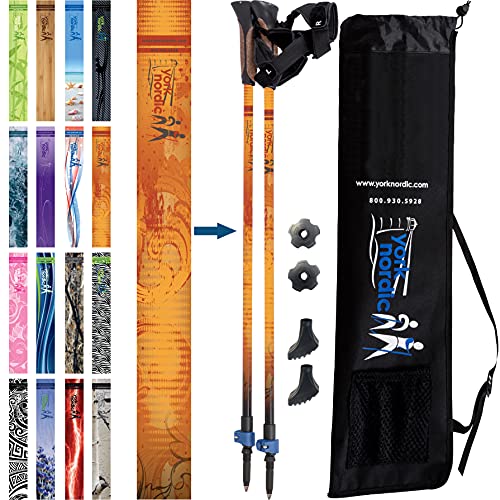
Telescoping shafts make fine-tuning this measurement straightforward across varying footwear and body proportions. York Nordic walking poles, for example, adjust smoothly from 32 inches to 54 inches to accommodate user heights between 5’4″ and 6’2″. Setting poles too tall forces the shoulders to shrug upward, creating tension across the trapezius muscles and neck. Conversely, setting poles too short causes the user to lean forward excessively, negating the postural benefits of the technique.
Grip Geometry and Wrist Harness Systems
The handle design of a Nordic walking pole differs dramatically from the ergonomic palm rests or Derby handles found on medical canes. Nordic poles feature slender, contoured grips typically paired with a specialized glove strap that secures around the hand. This harness connects the user’s palm to the pole, allowing an open-handed push during the backward propulsion phase of the stride. York Nordic poles incorporate classic glove grips with quick-release thumb buttons and secure hook-and-loop straps for rapid adjustments.
Releasing the grip at the back of each swing prevents continuous clenching and protects the hand from repetitive strain. Walkers with mild hand osteoarthritis or carpal tunnel tendencies often appreciate how the strap transfers force without demanding a tight grip. Medical canes, by comparison, require constant palm contact to channel downward body weight safely through the shaft. Understanding this mechanical difference ensures users do not attempt to grip a Nordic pole like a rigid cane handle.
Traction Engineering: Angled Rubber Paws and Carbide Metal Tips
Ground contact mechanisms dictate how well a pole or cane grips various indoor and outdoor surfaces. Nordic walking poles utilize detachable, wedge-shaped rubber feet often referred to as fitness paws for hard surfaces like asphalt or concrete. These angled rubber paws grip the ground at an oblique angle, cushioning impacts and preventing slipping during backward push-off. Traditional medical canes rely on flat, wide rubber ferrules with internal metal washers designed to maintain perpendicular ground contact.
Removing the rubber paw exposes a sharp tungsten steel or carbide tip suited for dirt trails, grass, and packed gravel. The hard metal tip bites into soft soil to deliver dependable traction during outdoor cross-country sessions. Walkers should never use exposed metal tips on indoor tile or polished hardwood, as they slip easily and cause surface damage. Regularly inspecting rubber paws for tread wear ensures optimal grip and prevents the internal metal ferrule from punching through the rubber base.
Shaft Materials, Weight Factors, and Telescoping Flip Locks
Shaft construction directly affects pole durability, swing weight, and shock absorption during brisk walks. High-grade aluminum alloys, such as aircraft-grade 7075 aluminum used in York Nordic poles, provide dependable strength while keeping weight down. Each pole weighs only 8 ounces, allowing users to swing the equipment effortlessly without causing forearm or shoulder fatigue. While carbon fiber poles offer slight vibration damping, quality 7075 aluminum delivers superior lateral resilience against accidental bending under pressure.
Telescoping adjustment mechanisms have evolved beyond traditional internal twist locks that frequently slip or jam under humidity. Modern designs favor external flip-lock clamps that allow quick height changes and visual confirmation of secure latching. A firm lever lock prevents the pole sections from collapsing unexpectedly when downward force is applied. Users should routinely verify that the lever tension screws remain snug so the telescoping joints stay rigid and rattle-free during walks.
Clinical Boundaries, Rehabilitation Uses, and Fall-Risk Precautions
Physical therapists and rehabilitation specialists frequently incorporate Nordic walking into programs for neurological and cardiovascular health. Individuals managing Parkinson’s disease often benefit from the rhythmic bilateral cues, which can reduce freezing of gait and improve stride length. Wearing comfortable gear, such as lightweight walking pants for outdoor mobility, ensures unhindered leg swing and comfort during structured therapy sessions. The wide arm swings and consistent ground taps stimulate balance centers in the nervous system, helping rebuild spatial awareness.
Nordic poles are not suitable for individuals with significant vestibular dysfunction or unmanaged balance instability. Users who experience sudden balance loss require the stable vertical platform of a quad cane, offset cane, or rolling walker. Attempting to catch a heavy fall with a lightweight, angled Nordic pole can lead to equipment slippage and serious injury. Always seek a formal evaluation from a physician or physical therapist to determine whether your balance profile supports pole walking.
Step-by-Step Technique: Planting, Pushing, and Arm Swing Coordination
Mastering Nordic walking technique requires synchronizing the pole plant with natural contralateral arm and leg swing. As your left foot steps forward, your right arm swings forward naturally with the pole held at an angle pointing backward. The rubber paw strikes the ground roughly level with your trailing heel rather than out in front of your lead toes. Pushing firmly backward through the glove harness propels your torso forward across the ground with minimal extra leg effort.
As the pole moves past the hip line, the hand relaxes and opens slightly, allowing the harness to take the remaining pressure. Once the push is complete, the arm swings forward again, and the hand naturally regrips the contoured handle before the next strike. Beginners often make the mistake of planting poles vertically in front of their feet like hiking sticks, which disrupts forward momentum. Keeping the poles angled backward and arms relaxed at the shoulders ensures an efficient, flowing cadence from the start.
Technical Verification and Safe Mobility Progression
Starting a Nordic walking routine should always involve gradual progression to allow upper-body muscles and joints to adapt safely. Begin with short sessions of fifteen to twenty minutes on level pavement or smooth park paths to establish proper arm rhythm. Pay close attention to shoulder position, keeping the shoulder blades relaxed down the back rather than hunched near the ears. If you experience joint soreness in the elbows or wrists, pause your session to recheck pole height and glove strap tension.
Regularly inspect your equipment before every outing, confirming that flip locks are tight and rubber paws show adequate tread depth. Remember that while Nordic walking provides exceptional conditioning, it remains an active exercise tool rather than an orthopedic crutch. Maintaining this clear distinction allows you to enjoy the cardiovascular and postural benefits of pole walking with total confidence. With proper form and reliable gear, Nordic walking offers an empowering pathway toward enduring mobility and active outdoor wellness.





Write Your Review
No reviews yet. Be the first to share your experience!