


Maintaining steady balance and upright posture becomes challenging when joint soreness or lower-limb fatigue interferes with your natural walking cadence. Many adults experiencing mild knee stiffness or post-rehabilitation weakness wonder whether specialized pole techniques provide real therapeutic benefits, leading them to ask does nordic walking actually work for daily mobility support. Unlike a standard single-point cane designed for localized weight offloading, this bilateral walking style incorporates rhythmic upper-body propulsion to distribute force across your arms, torso, and legs simultaneously. When paired with proper footwear and flexible joint supporting walking apparel, rhythmic movement can encourage an active lifestyle while keeping steps balanced on level ground.
The core concept relies on angled propulsion and active arm extension rather than passive vertical leaning. Standard mobility aids such as quad canes and offset canes specialize in offloading up to twenty-five percent of body weight from an injured joint, whereas bilateral fitness poles distribute cardiovascular effort across the entire frame. Understanding the functional boundary between active cross-training poles and clinical medical aids helps walkers choose the right equipment for their specific balance limitations. Certified rehabilitation specialists often emphasize that while dynamic pole walking improves endurance and core engagement, acute balance disorders or strict non-weight-bearing restrictions still require dedicated orthopedic canes or walkers.




Biomechanical Reality and Mobility Mechanics of Nordic Walking
Scientific observation of human movement confirms that does nordic walking actually work depends on how an individual uses the equipment and what functional goals they expect to achieve. When practiced with correct posture, the technique recruits the upper body to propel the frame forward, redistributing mechanical effort across the torso, arms, and legs. This active motion increases cardiovascular demand while reducing localized peak loading on the lower joints compared to unassisted walking. However, recognizing the difference between athletic conditioning and clinical rehabilitation remains vital for individuals managing specific orthopedic or balance concerns.
How Bilateral Pole Propulsion Alters Gait Biomechanics
Natural human walking involves a reciprocal arm swing that counterbalances the rotational forces generated by the pelvis and legs. Bilateral walking poles modify this basic pattern by extending the reach of your upper limbs and establishing two additional ground contact points during each stride. Instead of carrying poles passively, a proper Nordic stride plants each tip backward at an angle behind the body to drive forward momentum. This angled push activates the latissimus dorsi, triceps, and abdominal core musculature with every completed step.
By engaging the upper torso in continuous propulsion, the body shares kinetic energy across major muscle groups rather than concentrating impact entirely into the lower legs. The cadence becomes smoother as the arms actively assist in driving the pelvis forward. Physical therapy biomechanics notes that this synchronized rhythm helps maintain an upright posture by discouraging forward trunk collapse. Walkers who tend to hunch their shoulders discover that pole placement gently guides their chest open and aligns their spine naturally.
Nordic Walking Poles Versus Medical Walking Canes
Confusion frequently arises when comparing athletic walking poles to standard adult mobility aids like single-point canes, offset handle canes, or quad canes. A standard single-point walking cane is designed primarily for unilateral weight offloading, transferring fifteen to twenty-five percent of body weight away from a weakened lower limb. The user holds a cane on the hand opposite the affected leg to create a stable base of support during the single-leg stance phase. In contrast, bilateral poles are held in both hands simultaneously and require continuous coordination to maintain rhythmic forward propulsion.
Relying on fitness poles for acute orthopedic recovery or severe balance deficits introduces significant stability risks. Canes provide direct vertical load support when you pause or stand still, whereas angled poles with narrow tips can slip outward under sudden static downward force. Quad canes and articulating pivot-base canes provide broad surface contact to prevent lateral falls, a protective feature completely absent in fitness sticks. Anyone recovering from joint surgery or experiencing neurological gait instability should follow physical therapist guidance rather than substituting fitness equipment for medical mobility aids.
Joint Impact and Knee Offloading Considerations
Adults managing mild osteoarthritis in the knees or hips frequently turn to active walking to preserve joint range of motion without triggering inflammatory flare-ups. Bilateral pole movement reduces ground impact force by transferring a portion of vertical deceleration through the arms and shoulders just as the lead heel strikes the ground. This cushioning softens the compressive load experienced by the patellofemoral and tibiofemoral joint spaces. Pairing this steady gait with flexible lightweight mobility apparel allows uninterrupted stride extension across neighborhood sidewalks and park pathways.
The degree of joint comfort achieved depends directly on consistent technique and sensible pacing. If a walker overextends their stride or plants the poles too vertically in front of their toes, braking forces actually increase, which can send unwanted shock up through the patellar tendon. Proper movement requires a relaxed elbow action where the pole pushes backward against the ground behind the hip. For individuals dealing with severe structural cartilage loss, a bilateral routine may still create fatigue if joint tolerance is exceeded, highlighting the value of gradual progression.
Ergonomic Glove Straps and Upper-Body Force Distribution
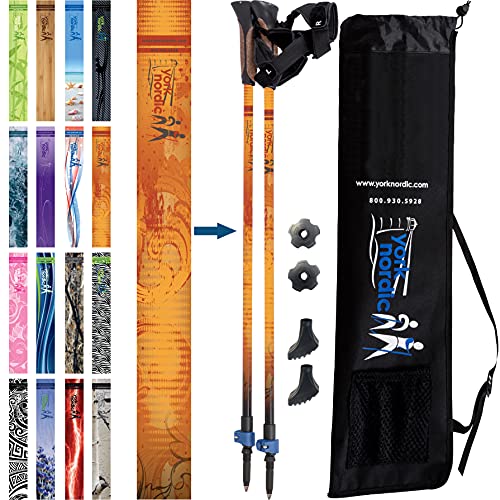
A critical technical distinction separating authentic Nordic walking poles from ordinary trekking poles is the hand attachment system. Traditional hiking sticks rely on simple hanging loops that require the user to grip the shaft tightly throughout the entire swing. Authentic Nordic designs, such as the York Nordic glove system, utilize a fitted strap that wraps securely around the palm and wrist with an adjustable hook-and-loop closure. This glove mechanism connects directly into the handle with a quick-release locking button, keeping the pole aligned with the forearm without demanding constant finger tension.
This specialized grip structure fundamentally changes hand ergonomics and prevents premature hand fatigue. As you push the pole backward behind your hip, you can completely open your palm and release your grip, letting the strap absorb the backward thrust. Once the backward push concludes, the glove pulls the pole back into your hand automatically for the next forward plant. Walkers managing mild hand osteoarthritis or carpal tunnel discomfort benefit from this open-palm release because it eliminates prolonged isometric gripping.
Shaft Materials, Weight Dynamics, and Telescoping Flip Locks
The structural composition of a walking shaft dictates both swing inertia and long-term joint comfort. Aircraft-grade 7075 aluminum is a favored material in quality pole construction because it combines exceptional tensile durability with lightweight handling, often weighing around eight ounces per pole. High-grade aluminum provides strong resistance to sudden bending stress and dampens ground vibration effectively. Minimizing swing weight prevents shoulder fatigue during extended walking sessions, enabling users to maintain consistent rhythmic cadence.
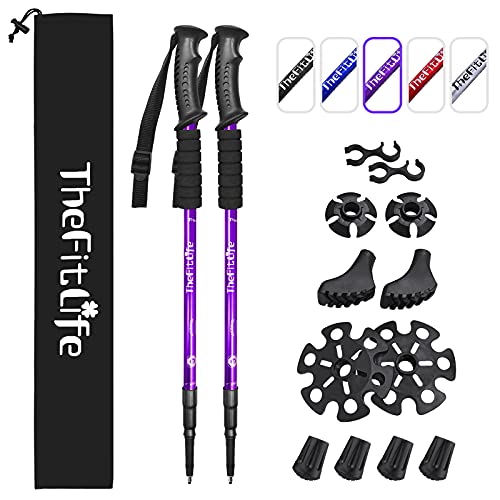
Height adjustment mechanisms also play a major role in user safety and convenience. Modern telescoping shafts utilize external flip-lock clamps that compress the aluminum tubing firmly, offering a noticeably more secure hold than older internal twist locks. Internal twist locks often loosen unexpectedly over time due to ground vibration or moisture ingress, creating a risk of sudden pole slippage. Flip locks allow fast visual confirmation of latch tightness, allowing walkers to adjust length from thirty-two inches up to fifty-four inches to match their exact height requirements.
Proper Sizing and Arm Flexion for Optimal Stability
Accurate height measurement is just as vital for fitness poles as it is for clinical walking canes, although the reference landmarks differ significantly. When sizing a medical cane, the handle must align precisely with the user wrist crease while standing upright with arms hanging naturally, producing a slight elbow bend of fifteen to twenty degrees. For Nordic walking poles, the setup aims for an approximate ninety-degree angle at the elbow joint when holding the grip and resting the tip on level ground. Sizing the pole too high forces the trapezius muscles to hike upward, causing chronic neck stiffness and shoulder impingement over repeated strides.
Setting the poles too short eliminates the mechanical leverage needed to push backward, reducing the cardiovascular and core-strengthening benefits of the activity. Walkers should always adjust their telescoping shafts while wearing their standard outdoor walking shoes, as variations in sole thickness can alter elbow geometry by over an inch. Once the ninety-degree elbow angle is established on level ground, you can fine-tune the length slightly based on personal comfort and terrain slopes. Consistent height ensures that arm push translates directly into smooth forward propulsion without straining upper-body joints.
Surface Traction: Rubber Boot Tips Versus Medical Ferrules
The ground contact point determines how securely a pole grips different outdoor and indoor walking surfaces. Nordic poles come equipped with hard tungsten steel tips for biting into unpaved dirt trails, gravel paths, and packed grass. For hard paved surfaces like asphalt, concrete sidewalks, and community tracks, manufacturers provide angled detachable rubber feet, often called paws or boots. These angled rubber tips feature directional tread grooves designed to maintain maximum surface adhesion as the pole pushes backward at an acute angle to the ground.
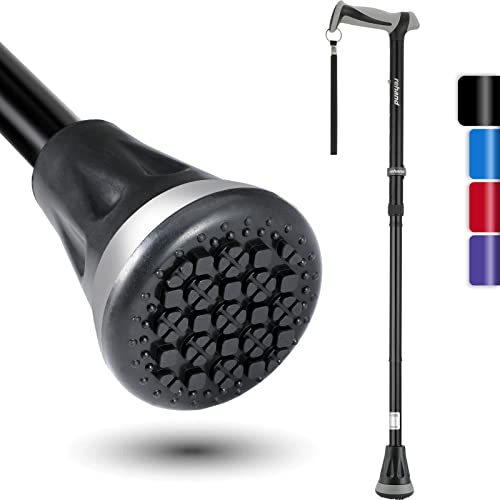
Medical mobility aids employ thick, flat-bottomed rubber ferrules with wide circular bases that maximize static friction in a perpendicular orientation. The angled design of Nordic rubber boots makes them unstable for direct downward vertical support on slick polished floors, such as glazed tile or wet linoleum. Walkers must inspect their rubber boots regularly to check for tread wear, as worn rubber exposes the internal metal shaft, drastically increasing slip risks on smooth pavement. Replacing rubber accessories as soon as the tread grooves flatten preserves reliable ground contact and joint comfort.
Common Technique Errors and Tripping Hazards
Achieving tangible fitness and mobility improvements requires avoiding common movement mistakes that undermine safety. The most frequent error among beginners is pacing, where the walker moves the pole forward on the same side as the stepping foot. Natural human walking relies on contralateral movement, meaning your left arm swings forward with your right leg, and your right arm swings with your left leg. Forcing simultaneous same-side movement causes a clumsy, rigid gait that compromises balance and increases trip hazards.
Another dangerous mistake involves planting the poles too far in front of the body or too close to the feet. Over-reaching forward can cause the pole tips to catch on pavement cracks, curbs, or tree roots, creating an abrupt obstacle that may trip the walker. Navigating indoor staircases or steep outdoor steps with attached glove straps can be hazardous because the hands cannot release quickly if balance is lost. When approaching stairs, walkers should always disengage the quick-release glove mechanism, hold onto a sturdy handrail, and proceed using standard stair navigation techniques.
When to Transition from Poles to Clinical Mobility Aids
While dynamic pole walking offers substantial cardiovascular and postural benefits for active adults, it cannot substitute for dedicated mobility equipment when balance deficits worsen. Progressive neurological conditions, moderate peripheral neuropathy with foot numbness, severe vestibular dysfunction, or frequent near-fall episodes indicate that bilateral fitness poles are no longer appropriate. In these situations, attempting to manage two independent poles increases cognitive load and heightens the likelihood of a fall. A medical evaluation is necessary to determine whether a stable quad cane, hemi-walker, or four-wheel rollator provides better protection.
A transition to a medical walking cane or rollator provides continuous, fail-safe weight support that does not depend on active coordination or arm momentum. Canes can be fitted with wide quad bases or articulating pivot tips that remain flat on uneven flooring even when the shaft angles change. If you find yourself hesitating during turns, feeling dizzy while walking, or leaning your full upper-body weight onto pole handles just to stay upright, consult a physical therapist immediately. A professional gait assessment will establish whether your physical condition requires prescription mobility aids, dedicated balance therapy, or supervised rehabilitative exercises.
Practical Verification and Pre-Walk Equipment Checks
Ensuring that your walking gear performs dependably on every outing requires a systematic safety check before stepping outside. Begin by inspecting each telescoping section to verify that the flip-lock levers close with firm resistance. If a flip lock snaps shut too easily without resistance, the internal tension screw must be tightened with a screwdriver or adjustment wheel to prevent the shaft from collapsing under arm pressure. Lightly bearing down on each pole vertically while standing still confirms that the locking collars hold their position securely.
Next, examine the condition of the glove straps and quick-release buttons to ensure they lock and unlock smoothly. The hook-and-loop fabric should grip firmly around your hand without slipping open under tension, and the strap webbing should show no fraying or torn stitching. Finally, ensure that the rubber boot tips are aligned straight with the direction of travel so that the angled tread makes full contact with the pavement during your push phase. Taking two minutes to complete these basic equipment checks guarantees that your walking sessions remain safe, stable, and functionally rewarding.





Write Your Review
No reviews yet. Be the first to share your experience!