


Heavy trail loads push relentless pressure straight down into your feet, turning long mountain miles into a grueling test of endurance. When you carry extra gear in a jumbo size hiking backpack, stock footwear foam compresses rapidly and leaves your arches aching before midday. Upgrading to dependable Hiking Boot Insoles For Men delivers the deep heel stabilization and shock absorption needed to counter harsh terrain. Structured arch support keeps your foot properly aligned across rocky trails, easing strain on your knees and lower back while maintaining balanced stability.
Demanding treks require durable footbeds that will not collapse halfway through your trip. Pairing your trail footwear with flexible hiking pants for trail comfort and proper trail boot inserts noticeably improves how boots handle steep downward slopes. Based on manufacturer specifications and outdoor user feedback, quality replacement insoles lock your heel in place to prevent uncomfortable forward sliding. Better underfoot support creates a reliable foundation for carrying heavy loads across unpredictable backcountry terrain.

Pros
- Reduces impact stress on feet, knees, and the lower back during continuous hiking strides.
- Flexible lateral support accommodates natural foot movement across uneven trail terrain.
- Accommodates men's shoe sizes 8 through 14 across standard sneakers, walking shoes, and hiking boots.
- Provides an economical underfoot cushioning upgrade compared to custom prescription orthotics.
Cons
- Sizing is limited strictly to men's shoe sizes 8 through 14 with no alternate width options specified.
- Flexible athletic construction does not offer the rigid structural support required for severe overpronation.
- Requires sufficient interior footwear volume, typically necessitating removal of the original shoe footbed.
Dr. Scholl's Sport Insoles for Men are drop-in athletic footbeds engineered to cushion impact and support the arch during repetitive foot strikes. These replacement insoles best suit day hikers, outdoor workers, and fitness walkers wearing men's shoe sizes 8 through 14 who want to alleviate joint stress without investing in expensive custom orthotics. By replacing thin, flat factory liners in hiking boots, trail runners, or walking shoes, they deliver immediate underfoot padding for active movement.
Trail terrain places significant shock loads on the body, with impact forces traveling directly upward through the ankles, knees, and lower back. The manufacturer highlights superior shock absorption and flexible side-to-side support, which helps stabilize the foot when stepping across packed dirt, crushed gravel, and gentle trail grades. Because the inserts prioritize flexible motion rather than rigid immobilization, they allow the foot to flex naturally over extended trail walks and fitness sessions.
The build incorporates an athletic blue multi-density structure with contoured arch geometry and cushioning zones. The supplied specifications list a total package weight of approximately 0.37 pounds, maintaining a lightweight profile that avoids adding unnecessary drag to footwear. While the product data does not disclose the proprietary foam or gel compound ratios, the construction is explicitly configured to reduce muscle fatigue and distribute pressure away from vulnerable pressure points.
Proper fit inside footwear generally requires removing the original shoe liner to preserve interior volume in the toe box and instep. Sized for men's sizes 8 to 14, these insoles drop into athletic shoes, light hiking footwear, and everyday work boots. Because adding any cushioned footbed can subtly alter heel cup seating, pairing the inserts with appropriate merino or synthetic hiking socks helps prevent unwanted heel lift.
Realistic limitations must be recognized by serious backcountry users and heavy-pack hikers. These insoles provide flexible athletic shock mitigation rather than the rigid, biomechanical motion control needed for severe plantar fasciitis or high-load expedition backpacking. Additionally, the product data does not list specialized antimicrobial treatments, moisture-wicking metrics, or lab-tested mileage lifespans, meaning aggressive thru-hikers may wear through the cushioning faster than heavy-duty composite orthotics.
For day hikers, trail walkers, and weekend outdoor enthusiasts looking for an economical way to lessen joint strain and refresh tired boots, Dr. Scholl's Sport Insoles provide solid, practical value. They serve as a reliable, budget-friendly replacement for exhausted factory insoles in standard men's trail footwear. Hikers carrying heavy multi-day backpacks or requiring clinical orthopedic alignment should consider dedicated rigid orthotics instead.
Dr. Scholl's Sport Insoles are formatted to fit men's shoe sizes 8 through 14, making them compatible with most standard American athletic and outdoor footwear. To achieve an optimal fit inside hiking boots or trail running shoes, users should take out the existing factory insoles before placing these inserts inside.
The insoles provide full-length underfoot coverage designed to sit flush against the footwear outsole bed. Because footwear lasts vary widely across outdoor brands, checking that the insole sits flat without bunching at the toe box ensures seamless step-in comfort.
The core design focus of these sport insoles is mitigating repetitive ground impact forces before they travel up the lower body. The manufacturer lists targeted shock absorption specifically to help protect the feet, knees, and lower back from continuous shock exposure during athletic strides.
Flexible lateral support assists with stability during multidirectional foot movements, which helps maintain balance when navigating mild switchbacks or uneven walking paths. This balance of flexible arch contouring and impact dampening helps delay foot fatigue during long days outdoors.
Pros
- Flexible dynamic arch bridge avoids the harsh, unforgiving feel of stiff plastic orthotics
- Deep heel cup with anti-slip grip improves stability when stepping over rocks and roots
- Recycled EVA base features air vents to promote interior ventilation inside trail boots
- Trimmable construction makes customization straightforward using existing boot insoles as a template
Cons
- Higher retail price point than basic aftermarket foam replacement footbeds
- Medium arch profile is not suitable for hikers with high arches or very flat feet
- Requires manual trimming to match specific boot toe-box profiles properly
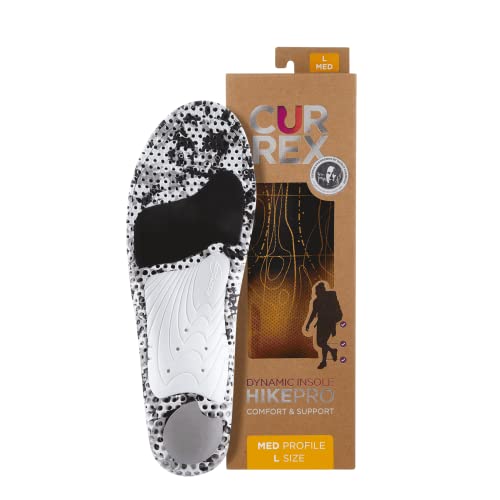
The CURREX HikePro Insole is an aftermarket replacement footbed designed for hikers, backpackers, and outdoor workers who require responsive arch support and impact dampening in their footwear. Sized in XL to accommodate Men's 11 to 12.5 and Women's 12.5 to 14, this medium-arch insert targets trail users who find standard factory insoles flimsy, flat, or lacking in torsional stability. It serves as a direct functional upgrade for hiking boots, mid-cut trail walkers, and rugged outdoor shoes.
Trail stability depends heavily on proper foot positioning, especially when navigating loose scree, wet roots, or steep switchbacks. The manufacturer equips the HikePro with a decoupled, deep heel cup lined with SuperGrip anti-slip material to wrap and anchor the heel. This design aims to limit internal footwear slippage during steep descents, while the integrated shock-absorbing cushioning helps absorb repetitive trail impact to reduce foot fatigue across long outings.
The build centers on 3D Dynamic Arch Technology paired with a recycled EVA foam base. Rather than using an unyielding hard plastic shank, the flexible arch bridge allows natural foot articulation while still maintaining structural support under load. The manufacturer also incorporates air vent technology in the EVA foundation alongside breathable top foam designed to absorb sweat and resist odors during sustained physical effort.
Sizing and footwear installation require removing the existing factory liner and trimming the HikePro to fit. Because size XL spans multiple shoe sizes, users should trace their original boot sockliner onto the CURREX footbed and cut along the toe perimeter using sharp scissors. The medium-volume build fits comfortably in most standard hiking boots without drastically reducing toe room, though boots with very low internal volume may feel snugger across the instep.
A notable limitation of this insert is arch-profile specificity. The yellow-coded medium arch will not provide adequate contouring for hikers with pronounced high arches, nor will it suit those who need low-profile, flat-foot alignment. Additionally, while the dynamic arch supports foot flex, users needing rigid corrective medical orthotics may find the flexible EVA structure softer than desired.
For hikers, backpackers, and trail walkers looking to improve footwear comfort and heel lockdown, the CURREX HikePro Medium Arch Insole offers a well-engineered balance of impact absorption and flexible support. If you experience foot strain on long trail days and have a medium arch profile, replacing your factory boot liners with these inserts provides practical stability on rugged terrain.
The 3D Dynamic Arch Technology in the CURREX HikePro is built to flex with your natural gait rather than lock your foot in place. This flexible bridge supports the plantar fascia during weight transfer without causing the sharp pressure points often associated with rigid composite insoles.
The decoupled heel cup works in tandem with an anti-slip surface to reduce heel slippage inside the boot. Anchoring the rearfoot helps prevent forward foot slide during steep downhill descents, which can help minimize friction and toe-banging at the front of the toe box.
The XL size covers Men's shoe sizes 11 through 12.5 and Women's sizes 12.5 through 14. To achieve an accurate fit, remove the stock insole from your hiking boots and align it heel-to-heel over the CURREX footbed.
Using the original insole as a template, trace around the forefoot with a pen and carefully trim the excess material with sharp shears. Always test the fit inside the boot before making aggressive cuts, ensuring the insole lays flat without curling up at the edges or bunching in the toe box.

Pros
- Double PORON foam inserts offer resilient shock absorption for hard trail surfaces.
- Substantial high-arch reinforcement supports hikers carrying heavy packs or dealing with plantar fasciitis.
- Deep U-heel cup locks the rearfoot in place to reduce heel slip and hot spots inside boots.
- Breathable, sweat-resistant top layer improves underfoot comfort on warm-weather hikes.
Cons
- High arch profile and thicker base require footwear with sufficient interior volume.
- Listed sizing (Men 11.5-12.5 / 305 mm) may require careful trimming to match specific boot shapes.
- Noticeably heavier and more rigid than standard factory foam footbeds.
The Psveb Heavy Duty Orthotic Insoles are specialized replacement footbeds designed for hikers, backpackers, and outdoor workers who require firm arch stabilization and plantar fasciitis relief under heavy pack weights. Engineered specifically with high arch contours and double PORON shock-absorbing inserts, these insoles suit trail walkers navigating rocky terrain, thru-hikers carrying multi-day loads, and workers on their feet all day in structured boots. By prioritizing rigid structural support over soft, compressible foam, this accessory aims to keep the foot properly aligned over long trail miles.
On uneven trails and steep descents, reliable underfoot support helps reduce joint fatigue and arch strain. The manufacturer specifies a Golden Triangle configuration that distributes downward pressure across the forefoot, arch, and heel. This three-point geometry helps prevent arch collapse during repetitive weight-bearing strides, which is especially beneficial when navigating switchbacks with a loaded backpack. Additionally, the deep U-shaped heel cup anchors the rearfoot, helping to prevent side-to-side slippage inside the boot that frequently leads to friction hot spots and blisters.
The physical build combines a durable full-length polyurethane (PU) base with integrated PORON cushioning pads. PORON material is engineered for energy return and high shock attenuation, dampening the impact of sharp stones and hard-packed trails without degrading quickly under repetitive force. Covering the top surface is a breathable, sweat-resistant fabric layer. This lining helps minimize moisture buildup against hiking socks, promoting a cooler, drier underfoot environment during warm-weather hikes and long shifts.
In terms of sizing and boot integration, this variant measures 305 mm in length, corresponding to US Men's sizes 11.5 to 12.5 (Women's 13.5 to 14.5). Because these insoles feature a pronounced arch and thick heel cup, they perform best in high-volume footwear such as standard hiking boots, backpacking boots, and outdoor work shoes. They are designed to completely replace the original factory liners rather than sit on top of them. Hikers using snug trail runners or low-volume approach shoes should verify internal clearance, as the substantial profile can push the instep upward against the footwear tongue and lacing system.
Potential buyers should consider a few realistic limitations before taking these onto rugged trails. The firm arch support and rigid heel geometry can feel overly stiff initially, often requiring a progressive break-in period on short neighborhood walks before tackling long-mile outings. Furthermore, at approximately 5.9 ounces for the pair, they add more weight than standard minimalist insoles. The product data does not specify pre-marked trim lines, meaning users must trace their original boot liners carefully if custom trimming is necessary.
For hikers, backpackers, and outdoor workers needing substantial underfoot reinforcement for flat feet, plantar fasciitis, or loads exceeding 230 pounds, the Psveb Heavy Duty Support Insoles offer a practical, budget-conscious upgrade. They provide targeted PORON cushioning and stable heel containment where soft stock footbeds fall short. Buyers should simply confirm that their hiking boots have sufficient internal volume to accommodate a structured, high-support orthotic.
The core structural advantage of these insoles is the combination of a high-arch bridge and a deep U-shaped heel cup. The manufacturer designs this structure to support body and pack weights exceeding 230 pounds, helping to prevent the plantar fascia from overstretching during extended ascents.
By seating the heel deep into the cup, the insole keeps the foot centered over the midsole of the boot. This alignment reduces rearfoot movement on off-camber trail sections, contributing to consistent foot placement and reduced ankle roll tendency on loose scree.
These insoles are best suited for mid-cut and high-cut hiking boots, backpacking footwear, and rugged outdoor work boots that feature removable factory liners. Because the polyurethane base and PORON pads add substantial vertical thickness, removing the existing footbed is necessary to maintain proper toe-box height.
They are generally less compatible with ultralight, low-profile trail running shoes where vertical volume is tightly constrained. Hikers should ensure their footwear allows enough instep room so the laces do not pinch over the top of the foot when the structured arch is installed.

Pros
- Flexible medium-to-high arch contour helps reduce underfoot strain during long miles with a backpack.
- Adaptive Comfort Technology moves dynamically with each stride instead of feeling excessively rigid.
- Moisturewick top cover works to reduce odors and maintain fresh footwear across warm-weather hikes.
- Trim-to-fit profile allows a tailored match to a wide range of boot and shoe toe boxes.
Cons
- Requires careful manual trimming with scissors before initial installation in footwear.
- Added underfoot cushioning increases internal volume, which may feel snug inside low-profile trail shoes.
- Flexible arch support may not satisfy hikers who require rigid, medical-grade orthotic stabilization.
Superfeet Hike Cushion Insoles are purpose-built replacement footbeds designed to upgrade comfort and stability inside hiking boots, trail shoes, and outdoor footwear. This accessory best suits day hikers, backpackers, and trail walkers who experience foot fatigue over long miles and need structured arch reinforcement paired with flexible cushioning. Sized for Men 9.5-11 and Women 10.5-12, this footbed replaces thin factory insoles with a contoured, shock-absorbing platform made for variable terrain.
On the trail, the footbed utilizes patented Adaptive Comfort Technology that flexes with the foot rather than forcing it into a stiff position. This dynamic movement promotes efficient heel-to-toe turnover when stepping over exposed roots, climbing steep switchbacks, or descending gravel paths. The Moisturewick top cover aids moisture management by helping reduce odor accumulation, which proves especially beneficial during warm summer hikes and humid backcountry treks.
The build centers on durable arch support rated from medium to high, engineered to maintain its shape under constant foot pressure. Formerly marketed as the Superfeet ADAPT Hike Max, this updated Hike Cushion model in Rifle Green provides targeted cushioning without unnecessary bulk under the forefoot. The materials are structured to handle the grit, moisture, and friction typical of outdoor footwear use.
Handling and fit require trimming the insole to match your specific footwear before heading out. Superfeet advises removing your existing boot liner, tracing its profile onto the Hike Cushion insole, and cutting along the marked line with sharp scissors. If your footwear falls between sizes, sizing up and trimming down provides the most accurate fit and ensures the insole sits flat without shifting inside the shoe.
A practical limitation is that these insoles do not act as rigid orthotics, meaning hikers requiring immovable arch support may find the flexible design softer than needed. In addition, the added cushion height takes up vertical space, which can create a tighter fit across the instep in low-volume footwear. Verifying that your boots have adequate internal room before trimming is recommended.
For hikers and backpackers looking to enhance foot stability, lessen fatigue, and manage footwear odor on rugged terrain, the Superfeet Hike Cushion Insoles offer a dependable, customizable upgrade for standard hiking footwear.
Superfeet Hike Cushion Insoles in this size category fit Men 9.5-11 and Women 10.5-12. The footbeds feature a trim-to-fit format designed for customization with standard household scissors.
To obtain the best fit, pull the factory liner from your hiking shoe, place it over the Superfeet footbed, and trace around the perimeter of the forefoot. Trimming conservatively ensures the insole rests flat against the bottom of the boot without bunching or sliding.
The insole provides medium to high arch support powered by Superfeet Adaptive Comfort Technology. This design yields flexible underfoot reinforcement that adapts to each foot strike on rough surfaces.
Unlike stiff plastic footbeds, this flexible arch construction supports natural stride dynamics, absorbing continuous impact while assisting with balanced weight distribution during long-distance trail walking.
Trail Load Support and Hiking Boot Insoles For Men FAQs
Heavier packs and rugged paths place intense stress on lower body joints. Upgrading to structured Hiking Boot Insoles For Men helps stabilize your gait and protects your heels on demanding descents.
Should you remove factory footbeds before installing new Hiking Boot Insoles For Men?
Yes, remove the factory liners before inserting new footbeds into your boots. Layering supportive inserts over stock foam crowds the toe box and causes heel lift. Models like CURREX HikePro Insoles for Hiking Boots & Shoes and Superfeet Hike Cushion Insoles are designed to sit flush against the boot base to maintain proper arch alignment.
How do heavy trail loads affect arch support requirements in 2026?
Heavy pack weights increase downward force, which flattens foot arches and accelerates muscle fatigue. Under sustained loads, inserts like Professional Heavy Duty Support Pain Relief use multi-point support and resilient cushioning to handle over 230 pounds of combined weight. Firm orthotic shapes prevent arch collapse on rough terrain.
What is the best way to trim replacement footbeds to size?
Trace your original factory insole onto the replacement footbed and trim only along the forefoot. Never cut into the structured heel cup or arch area, as this weakens lateral stability. If you fall between sizes, size up and trim down carefully so the insert lays flat without curling.
Can supportive boot inserts reduce heel slip and hot spots on descents?
Yes, deep heel cups hold your rearfoot securely to prevent forward sliding inside boots during downhill descents. Moisture-wicking fabrics also manage sweat buildup to limit friction against your skin. Just as you periodically inspect straps and learn how to clean and care for A hiking backpack, keeping insoles clean maintains steady footing.
How do athletic gel insoles differ from semi-rigid hiking footbeds?
Athletic inserts prioritize shock absorption, while hiking footbeds focus on structural torsional stability. Products like Dr. Scholl’s Sport Insoles provide flexible side-to-side cushioning that softens joint impact during moderate day hikes. Firmer hiking designs deliver rigid arch cradling needed when carrying heavier gear on uneven trails.




Write Your Review
No reviews yet. Be the first to share your experience!