


Steep backcountry descents and rocky switchbacks can place intense repetitive strain on your knees, ankles, and lower back. Hikers often grapple with the question of whether a single walking staff provides enough stability or if a matched pair is necessary for long days on the trail. If you are asking yourself do i need one or two hiking poles, the answer depends on your terrain, pack weight, and personal joint health goals. Using two trekking poles establishes a four-point contact system that actively distributes impact across your upper body, engaging your lats and shoulders while taking pressure off the lower joints. Paired with reliable gear like knee tendon support pants, this setup provides consistent braking force on steep declines.
Conversely, carrying a single staff leaves one hand completely free for navigating trail maps, snacking, or steadying yourself against nearby boulders. That setup often appeals to casual day walkers on rolling terrain who simply want a touch of lateral stability without managing two distinct shafts. However, asymmetrical pole usage can create subtle muscle imbalances when hiking high mileage with a loaded pack. Modern options constructed from 7075 aircraft-grade aluminum or lightweight carbon fiber shafts ensure that carrying two poles will not weigh down your pack or overburden your arms. Analyzing your specific trail objectives helps determine whether a single stick or a synchronized pair will best serve your backcountry cadence.


Evaluating One Versus Two Hiking Poles for Trail Stability
Deciding whether to pack a single staff or a matched pair hinges on your trail terrain, payload weight, and personal joint health goals. While a single pole provides convenient balance assistance on gentle paths, using two trekking poles establishes a rhythmic, four-point contact system that actively distributes impact across your entire body. Hikers carrying multi-day packs or facing steep switchbacks almost universally benefit from a synchronized pair. Understanding how each setup alters your gait, joint loading, and endurance will help you choose the right configuration for your next backcountry journey.
Biomechanics of Joint Relief and Load Redistribution
Downhill hiking generates severe compressive force on the patellofemoral joints, hips, and ankles with every downward step. When you plant two poles ahead of your descent, you create an auxiliary braking framework that transfers kinetic shock into your upper musculature. Muscle groups across your shoulders, chest, and arms absorb impact that would otherwise punish your lower leg joints. This bilateral load distribution reduces quadricep strain and helps preserve your cartilage across steep descents.
A single hiking staff cannot offer this balanced skeletal support because it forces one side of your body to handle all upper-body braking forces. Over long distances, leaning heavily on one side can cause pelvic tilting and asymmetric spinal strain. Dual poles encourage an upright posture with an open chest, which supports natural spinal alignment and facilitates steady diaphragmatic breathing. Hikers carrying heavy gear in a sturdy iron frame hiking backpack gain immense joint relief by spreading the downward payload evenly across both arms.
Four-Point Traction Across Technical Terrain
Navigating loose scree fields, slippery mud, and slick river crossings demands consistent ground contact. Two hiking poles provide a four-point stability system, allowing you to keep at least two solid anchors planted while taking forward strides. This extra point of contact reduces the risk of slipping when your boots encounter loose shale or wet tree roots. A single walking stick only creates three contact points, leaving your balance vulnerable during swift transitional foot movements.
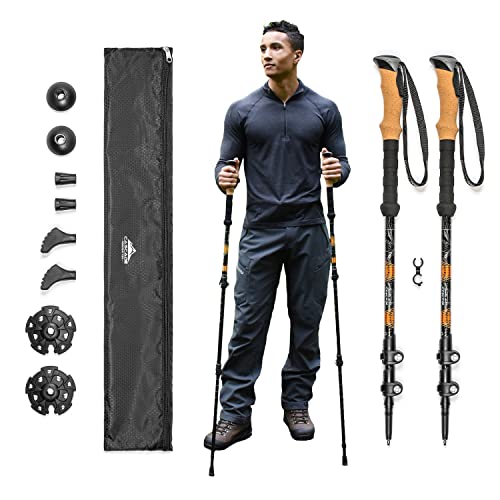
River crossings vividly illustrate the stability differences between single and dual setups. Probing riverbed depth and wedging tips between underwater boulders is far safer when you have two stable anchors resisting swift currents. Carbide flex tips, such as the tungsten carbide tips on the Cascade Mountain Tech Trekking Poles, bite firmly into slick river rock to keep your stance secure. Off-camber sidehill trails also benefit from dual poles, as you can shorten the uphill shaft and lengthen the downhill shaft to keep your shoulders level.
Scenarios Where a Single Staff Performs Best
Despite the physical advantages of two poles, a single walking stick remains a great choice for specific trail situations. Casual hikers exploring flat woodland loops or well-graded gravel paths often prefer carrying just one staff. A single stick offers quick balance checks when stepping over fallen branches or muddy patches without requiring strict arm synchronization. It feels intuitive and lightweight, making it a great companion for relaxed day walks.
Hikers who need one hand continuously free also gain distinct advantages from a single pole setup. Nature photographers frequently carry cameras in hand, while foragers and birders need immediate access to field guides and binoculars. Walking with one stick allows you to manage a dog leash or check GPS navigation on your phone without taking off wrist straps. For low-angle routes where high-cadence propulsion is unnecessary, a single staff provides solid utility with minimal fuss.
When Two Trekking Poles Become Indispensable
Heavy multiday backpacking raises your center of gravity, which amplifies the consequence of every misstep on rough trails. Two trekking poles serve as an external stability cage, catching your momentum if you stumble over loose gravel or hidden rocks. Thru-hikers tackling high-mileage days rely on dual poles to offload leg fatigue and maintain a steady walking rhythm over twelve hours of trekking. The kinetic assistance from two poles helps maintain forward momentum when your legs grow tired.
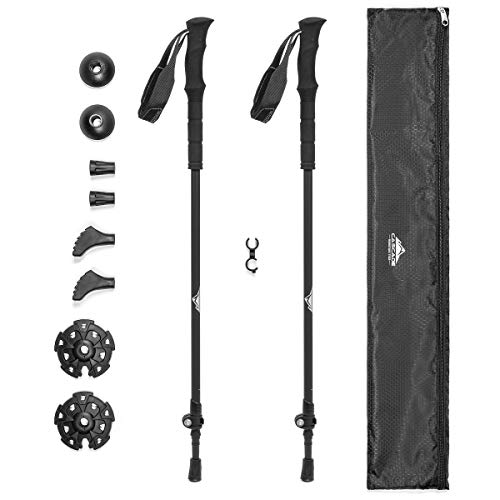
Steep mountain ascents also demonstrate why two poles outperform a single stick. Planting both poles allows you to push down with your lats and arms, generating upward propulsion that assists your calves and glutes. In four-season environments, two poles equipped with broad snow baskets provide essential flotation across deep winter snowpack. Rugged aluminum poles, like the Montem Ultra Strong Trekking, Walking, deliver the structural rigidity needed to handle heavy pack weights and deep winter trails.
Grip Materials and Moisture Dissipation
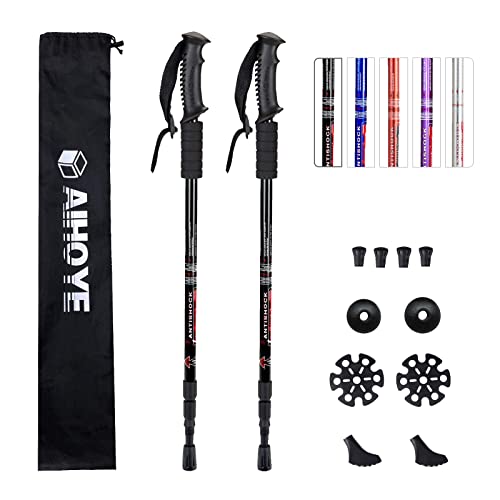
Handle ergonomics directly impact hand comfort and blister prevention during long hours on the trail. Natural cork grips, found on models like the Aihoye Trekking Hiking Poles-2 Pack Lightweight, naturally wick sweat away from your palms while molding to the contours of your hands over time. Cork also moderates vibration transfer, keeping your palms comfortable during warm summer hikes. Rubber grips provide durable cold-weather insulation, but they tend to trap moisture and cause hot spots in humid conditions.
High-density EVA foam represents another popular grip compound prized for its soft texture and moisture absorption. Extended foam sleeves located beneath the main handle let hikers choke down on the pole during brief uphill switchbacks without readjusting the locking clamps. Models like the Clostnature 2 Pack Trekking Poles for Hiking incorporate ergonomic EVA grips with adjustable straps to disperse downward force across your forearms. Choosing the right grip material keeps your hands dry and eliminates friction blisters during continuous trekking.
Shaft Metallurgy and Vibration Damping
Shaft construction dictates how your poles respond to trail impacts and accidental bending stresses. Aircraft-grade 7075 aluminum provides exceptional tensile strength, resisting severe bends when wedged into rocky crevices under your body weight. If an aluminum shaft bends during a trip, the metal can often be gently straightened in the field to allow you to finish your hike safely. High-grade aluminum options, such as the Montem Ultra Strong Trekking, Walking, provide reliable peace of mind across rugged backcountry routes.
Carbon fiber construction excels at reducing swing weight while offering built-in dampening against sharp trail vibrations. Multi-directional carbon weaves absorb trail shock before the resonance travels up the shaft into your wrists and elbows. At only 5.6 ounces per pole, the Cascade Mountain Tech Trekking Poles minimize arm fatigue over high-mileage days. Pairing lightweight carbon poles with flexible, breathable lightweight trail pants allows you to maintain a swift and agile pace across technical mountain passes.
Locking Hardware and Travel Packability
A reliable locking mechanism is essential for preventing sudden shaft slippage under downward body weight. External lever cam locks use outer clamps with adjustable thumb screws, providing dependable holding power that is easy to inspect at a glance. You can easily adjust lever clamp tension in the field if cold weather causes the hardware to contract slightly. In contrast, internal twist-lock systems, found on the Hiking Trekking Poles, 2 Sticks with Anti-Shock, maintain a smooth shaft profile but require regular cleaning to prevent trail dust from causing expander slippage.
Packability is another major consideration for hikers who travel frequently to distant trailheads. Tri-fold folding poles, such as the Hiking Trekking Poles, 2 Pack Hiking Poles, collapse down to an ultra-short 13.78 inches, fitting easily into travel bags and small daypacks. Standard telescoping poles collapse between 23 and 25 inches, attaching securely to external pack loops. When traveling by air, remember that airport security guidelines require trekking poles with carbide tips to be placed in checked luggage rather than carry-on bags.
Sizing Rules, Strap Technique, and Field Care
Proper pole height sizing ensures that your arms operate in an efficient biomechanical power band. On flat ground, adjust your pole length until your elbows form a clean 90-degree angle when holding the grips with tips touching the dirt. Shorten both poles by 5 to 10 centimeters when ascending steep switchbacks so you do not reach uncomfortably upward. Lengthen both poles by 5 to 10 centimeters for steep descents so your poles reach the trail ahead of your lead foot.
Wrist strap mechanics also play a major role in preventing hand fatigue and maintaining control. Always bring your hand upward through the bottom opening of the strap loop before closing your fingers around the handle. This technique allows the strap webbing to support your downward weight across the heel of your palm, letting you loosen your hand grip without dropping the pole. After wet hikes, pull the telescoping sections apart and let them dry completely to prevent galvanic corrosion and lock binding.
Practical Summary for Choosing Your Trail Setup
Choosing between one or two hiking poles ultimately comes down to matching your equipment to the trail ahead. A single walking staff serves casual day walkers well on rolling paths where quick balance checks and a free hand are top priorities. It offers simple, low-maintenance stability without requiring synchronized upper-body movement. If your outdoor plans involve gentle nature trails and light gear, a single staff can be a delightful companion.
For technical terrain, heavy backpacks, steep descents, and joint protection, using two trekking poles is undeniably the better choice. A matched pair balances your posture, absorbs knee-pounding descent shocks, and provides unmatched four-point stability across unpredictable surfaces. Purchasing a quality pair gives you the versatility to use both poles on demanding mountain journeys or grab just one for casual neighborhood walks. Selecting the right setup for your specific route ensures confident, comfortable miles on every trail.






Write Your Review
No reviews yet. Be the first to share your experience!