


Steep mountain descents and rocky switchbacks place tremendous compressive force on the lower body, often leaving backpackers and day hikers with sore knees and strained joints. When planning an expedition, deciding should you use one hiking pole or two directly influences your balance, walking cadence, and energy expenditure across long trail days. A single staff offers an intuitive, minimalist contact point that leaves one hand completely free for trail maps or scrambling across boulders. In contrast, a synchronized pair of trekking poles engages the upper body to offload downward impact from patellofemoral joints while establishing a steady four-point gait across unpredictable terrain.
Hikers managing joint stiffness frequently combine dual trekking poles with supportive outdoor clothing for joint comfort to reduce physical fatigue on continuous downhill gradients. While a single pole works well for casual walks across level forest paths, technical trails with heavy packs demand bilateral support to prevent posture imbalances and lateral slippage. Understanding the distinct biomechanical demands of your route will help you choose the right configuration before you pack your gear. Examining your terrain, pack weight, and personal joint needs ensures you make the most efficient choice for your next backcountry journey.



Evaluating Trekking Pole Dynamics: One Pole Versus Two on the Trail
Determining whether to hike with a single walking stick or a coordinated pair of trekking poles comes down to your terrain, pack weight, and biomechanical needs. A single pole provides an uncomplicated third point of contact that assists with simple balance checks without restricting your movement. Conversely, dual trekking poles create a balanced four-point support structure that transfers downward force to your upper body, protecting joints and maintaining an efficient cadence. Reviewing how each configuration influences your gait, posture, and stability will help you select the ideal setup for your hiking goals.
Biomechanical Load Distribution and Downhill Knee Relief
Descending steep, rocky trails produces severe impact forces that travel directly through the ankles, patellofemoral joints, and hips. Utilizing two trekking poles allows hikers to disperse deceleration stress across the pectorals, latissimus dorsi, and triceps, substantially offloading body weight before the front foot strikes the ground. With a single pole, this load reduction occurs asymmetrically, forcing one knee to absorb considerably more braking force than the other. Over long descents, this one-sided stress can aggravate joint stiffness, tire stabilizing muscles prematurely, and create an unbalanced descent rhythm.
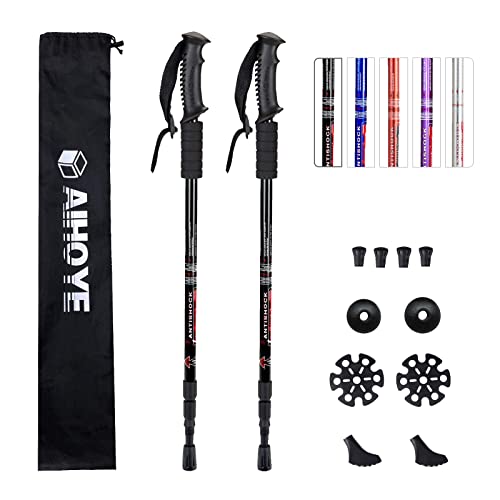
Hikers who struggle with joint sensitivity often benefit from poles engineered with internal damping mechanisms. Models such as the Aihoye Trekking Hiking Poles-2 Pack Lightweight incorporate spring shock absorbers in the lower section, which help cushion wrists and elbows when bearing downhill weight. The Montem Ultra Strong Trekking, Walking poles also feature anti-shock engineering combined with ergonomic cork handles to soften terrain feedback. When both arms share the braking duties using shock-absorbing poles, knee stress decreases and downhill footing feels far more controlled.
Uphill Propulsion and Cadence Synchronization
Climbing high-angle switchbacks requires sustained muscular output from the calves, quadriceps, and glutes. Dual trekking poles allow you to recruit upper body musculature, transforming vertical ascents into a full-body rhythmic motion. By planting two poles behind your center of gravity, you generate forward and upward propulsion with every stride. A single hiking staff can help you pull yourself over occasional high rock ledges, but it cannot deliver the synchronized, continuous push that keeps your momentum fluid on prolonged climbs.
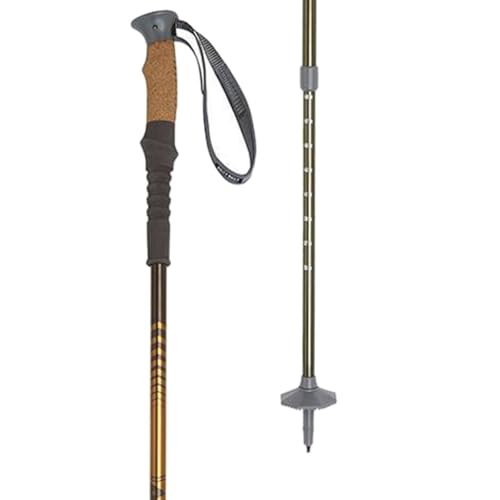
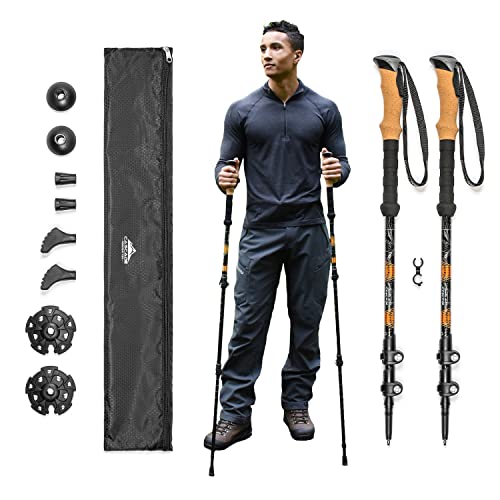
Maintaining a smooth ascending rhythm requires comfortable handholds, especially when trail gradients shift rapidly. The Kelty Range 2.0 Trekking Pole (Pair) addresses this need by providing extended cork and EVA foam grips that allow hikers to choke down on the shaft during steep inclines without stopping to adjust pole length. Similarly, the Cascade Mountain Tech Trekking Poles incorporate extended EVA foam grips along with quick-adjust lever clamps. When both poles provide immediate grip flexibility, your arms help drive you uphill without breaking your stride.
Lateral Stability on Technical Scree, Mud, and River Fords
Navigating off-camber trails, wet river stones, slippery roots, and loose scree demands rapid balance corrections. Dual poles establish a dynamic tripod with every step, ensuring you always have two solid points of ground contact while moving a foot. This bilateral stability prevents ankles from rolling on loose gravel and guards against sudden slips in deep mud. A single pole offers helpful lateral bracing on one side of the body, but it leaves the unsupported side vulnerable when traversing narrow ridges or stepping down awkward drops.
River crossings highlight the safety margin provided by a dual-pole setup. Anchoring two poles upstream forms a rigid triangular base against rushing water currents, allowing you to probe stream depths and test riverbed traction before shifting your balance. A single walking staff can help gauge water depth, but it cannot match the multidirectional bracing required in fast-moving water. Having two independent anchor points ensures superior balance when negotiating slippery boulder fields and challenging backcountry hazards.
Postural Symmetry and Spinal Alignment Considerations
Long-distance hiking with a single pole frequently leads to subtle postural distortions that become problematic over high-mileage days. Leaning repeatedly on one side causes lateral spinal flexion, uneven shoulder elevation, and asymmetrical trapezius fatigue. Over several consecutive hours, this unequal strain can manifest as lower back tightness and neck discomfort. Carrying heavy gear in hiking backpacks with rigid frames amplifies these imbalances because the torso must compensate constantly for the uneven pole loading.
Hikers who prefer a single walking stick should actively switch hands every mile or two to promote muscular balance. However, alternating hands requires consistent focus and can feel unnatural if your non-dominant hand lacks fine motor coordination on technical terrain. Dual poles eliminate this issue entirely by encouraging an upright, symmetrical posture that keeps your spine aligned and your pack weight distributed evenly over your hips. Symmetrical arm swing also promotes deeper breathing by keeping the ribcage expanded throughout strenuous climbs.
Shelter Pitching Compatibility for Ultralight Backpackers
Ultralight backpackers often treat trekking poles as dual-purpose equipment, using them to pitch non-freestanding tarps and pyramid tents. Many popular ultralight shelters require two vertical poles to support the ridge line or opposing vestibule apexes. Hikers who carry only a single pole must pack an extra dedicated tent pole or search for sturdy backcountry sticks to pitch their shelter securely. Relying on found timber introduces unpredictable structural stability, especially during unexpected mountain thunderstorms.
Shaft rigidity is critical when supporting a shelter under high wind and tension loads. Poles built from aircraft-grade 7075 aluminum, such as the Montem Ultra Strong Trekking, Walking poles, offer dependable axial strength that resists bending under taut guylines. Their external quick locks adjust securely from 24 to 53 inches, allowing precise tensioning for varied shelter pitches. Carrying a reliable pair of poles guarantees you have the exact hardware needed to build a rigid, weather-resistant camp anywhere on the trail.
Swing Weight and Upper Body Energy Expenditure
While dual poles provide undeniable balance and propulsion benefits, they also require continuous upper body effort. Lifting and planting two poles thousands of times each day increases heart rate and oxygen consumption compared to walking hands-free. Swing weight, which represents the dynamic inertia felt at the bottom of the pole with every swing, plays a major role in forearm and shoulder fatigue. Choosing exceptionally light poles mitigates this physical tax, allowing hikers to maintain bilateral stability without exhausting their arms.
Shaft material directly influences how light a pole feels during prolonged hikes. The Cascade Mountain Tech Trekking Poles utilize two-piece carbon fiber construction, weighing only 5.6 ounces per pole to keep swing inertia remarkably low. Hikers who prioritize aluminum durability can consider the Clostnature 2 Pack Trekking Poles for Hiking, which weigh 8.9 ounces per pole and feature responsive EVA foam grips. Selecting low swing-weight equipment ensures your arms stay fresh, making dual poles feel effortless over high-mileage days.
Grip Materials and Hand Moisture Management
Grip composition plays an essential role in hand comfort and blister prevention, whether you use one pole or two. Natural cork grips absorb sweat, resist moisture buildup, and gradually conform to the natural contours of your palms over time. EVA foam grips provide a soft, forgiving feel, dampen trail vibrations, and maintain reliable friction in wet weather. Rubber grips offer durability in cold, wet conditions, but they can cause hot spots and friction blisters during warm summer hikes if hands become sweaty.
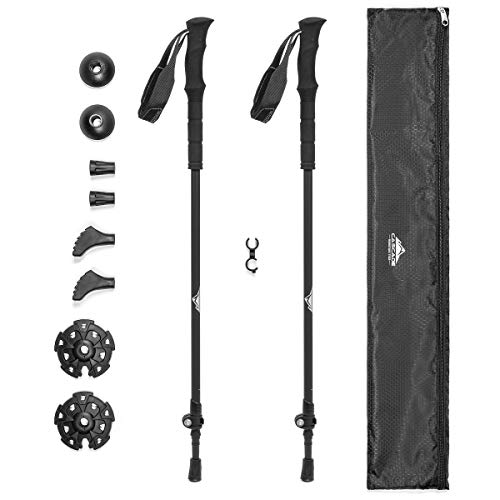
Matching your grip material to trail conditions helps prevent hand fatigue and cramping. The Aihoye Trekking Hiking Poles-2 Pack Lightweight integrate anti-slip cork handles with padded wrist straps, giving hikers a cool, dry contact point during humid treks. Padded straps transfer downward body weight directly across the back of the wrist, allowing you to relax your hand grip between pole plants. Proper strap adjustment reduces forearm strain and prevents the finger cramping that can occur when gripping a pole too tightly.
Shaft Materials and Impact Resistance on Rocky Terrain
Choosing between aluminum and carbon fiber involves balancing weight savings against structural resilience under lateral stress. Aircraft-grade 7075 aluminum features high tensile ductility, allowing the shaft to flex or bend slightly when wedged between boulders rather than snapping catastrophically. Multi-directional carbon fiber provides superior vibration damping and ultralight performance, but it can crack under sharp lateral shear forces if caught in rocky fissures. Hikers navigating rugged talus or carrying heavy expedition packs often prefer aluminum for its forgiving durability.
Durable aluminum construction provides dependable support across rocky terrain and uneven scree fields. Both the Montem Ultra Strong Trekking, Walking and the Clostnature 2 Pack Trekking Poles for Hiking utilize high-grade aluminum shafts designed to withstand downward impact and heavy trail loads. Equipping your poles with durable tungsten carbide tips ensures secure traction on bare rock and hard-packed dirt. Rubber tip protectors can be installed when transitioning to paved roads or rocky slabs to prevent skittering and reduce tip wear.
Locking Mechanism Security and Field Adjustability
Locking mechanisms must hold firm against downward body weight to prevent accidental shaft collapse during steep descents. External cam lever locks, also known as flip locks, allow quick length adjustments and feature external thumbscrews to fine-tune clamping tension in the field. Internal twist locks utilize expanding nylon plugs inside the shaft sections, offering a sleek outer profile but requiring clean, grit-free tubing to avoid slipping. External lever locks are generally easier to operate with cold or gloved hands and provide visible confirmation that the clamp is secure.
Inspecting and calibrating your locking hardware before tackling steep terrain prevents sudden height loss. The Clostnature 2 Pack Trekking Poles for Hiking feature intuitive quick-flip tabs that secure the telescoping sections without complicated dials. Hikers should ensure the shaft sections are never extended past the designated stop lines, as doing so weakens the joint overlap and increases bending risk. Verifying firm clamping tension before descending ensures your poles support full downward weight without unexpected slippage.
Compact Packability and Transport Considerations
Portability is a major factor for trail runners, peak baggers, and travelers who need to stow poles when scrambling over technical terrain. Three-section telescoping poles collapse down to around 23 or 24 inches, strapping neatly to the exterior gear loops of standard hiking packs. Tri-fold and folding Z-pole designs collapse even smaller, packing down into compact bundles that fit completely inside daypacks or travel luggage. Collapsible designs allow hikers who only want a single pole on certain trail sections to stow the second pole effortlessly.
Ultra-compact folding poles offer excellent versatility for hikers who alternate between using one pole and two. The Hiking Trekking Poles, 2 Pack Hiking Poles feature a tri-fold design that collapses down to 13.78 inches, fitting easily into small daypacks or carry-on totes. Hikers wearing lightweight trail pants can move freely across Class 3 scrambles with folded poles securely stowed inside their pack. For younger adventurers, the TrailBuddy Collapsible Hiking Poles for Kids provides scaled proportions and lightweight aluminum construction tailored for smaller hands.
Practical Scenarios for Using a Single Hiking Staff
Despite the clear mechanical advantages of dual poles, certain hiking conditions favor using a single staff. Casual day hikes across gentle rolling terrain, packed nature trails, and wide fire roads do not produce the heavy joint impacts that require two poles. A single pole provides plenty of balance assistance for stepping over mud puddles or traversing minor inclines while keeping your opposite hand free. Hikers who enjoy taking photographs, reading trail maps, or holding a dog leash often prefer the convenience of having one hand unoccupied.
Navigating overgrown trails and dense brush can also make dual poles feel cumbersome. Using one pole leaves your free hand available to push aside branches, grab tree trunks on steep banks, or steady yourself against rocks. If you primarily walk on moderate terrain with a lightweight daypack, a single pole offers practical support without unnecessary gear management. Choosing between one pole and two ultimately comes down to matching your equipment to the steepness of the terrain, your pack load, and your personal comfort on the trail.






Write Your Review
No reviews yet. Be the first to share your experience!