


Navigating steep descents and uneven rocky terrain places significant repetitive impact on your lower joints and stabilizing muscles. Hikers frequently ask whether are hiking poles helpful on moderate day hikes or rugged backcountry loops, especially when managing knee soreness or carrying a loaded pack. Using trekking equipment redistributes downward forces from your knees and quadriceps into your shoulders and core. When paired with proper gear like supportive knee hiking pants, poles transform your stride into an efficient four-point movement system.
Beyond physical comfort, trekking shafts provide critical stability across loose scree, wet roots, and fast stream crossings. Carrying weight on rugged terrain requires dependable balance, particularly when stabilizing a heavy framed hiking backpack over uneven topography. Deciding between ultralight carbon fiber poles, durable 7075 aluminum shafts, or traditional wooden walking sticks depends on your trail objectives and terrain conditions. Understanding the mechanical advantages, sizing rules, and component choices ensures you get the greatest benefit from your equipment on every trail.


The Mechanics and Practical Value of Hiking Poles
Trekking poles offer substantial mechanical advantages for backcountry travelers, trail runners, and casual walkers alike. When used correctly, poles shift significant load away from your lower extremities, reducing repetitive stress on vulnerable tendons and cartilage. They also provide continuous tactile feedback regarding trail surface stability before you commit your full body weight. Whether you tackle technical alpine switchbacks or neighborhood walking paths, understanding how poles interact with your body and terrain reveals why they remain a fundamental trail tool.
Joint Impact Relief and Downhill Braking Mechanics
Descending steep mountain trails generates tremendous compressive force across your knees, ankles, and lumbar spine. Every downward step forces your quadriceps and patellar tendons to act as biological brakes under deceleration. Trekking poles intercept this downward force by providing two forward contact points that absorb impact through your upper body. Hikers managing chronic knee sensitivity often notice that leaning onto locked shafts absorbs significant shock before it reaches their joints.
The transfer of kinetic energy into your upper body engages the pectorals, deltoids, and latissimus dorsi muscles. This energy redistribution spares your quadriceps from premature exhaustion during long descents. Maintaining muscular endurance on descents is crucial because tired leg muscles frequently lead to sloppy foot placement and twisted ankles. When you pair stable poles with flexible apparel like lightweight hiking pants, your lower body moves with greater fluidity and noticeably less cumulative fatigue.
Uphill Cadence, Propulsion, and Core Muscle Engagement
Climbing steep ascents requires substantial cardiovascular output and leg power. Hiking poles transform your movement pattern from a lower-body grind into a synchronized, four-limbed climbing rhythm. By planting the tips behind your center of gravity and pushing backward, your upper body generates forward momentum with each stride. This propulsion relieves pressure on your calves and glutes during prolonged high-angle ascents.
Using poles also promotes an upright posture, keeping your chest open and expanding lung capacity under cardiovascular strain. Hikers without poles often hunch forward on steep grades, constricting their diaphragm and accelerating fatigue. A steady, rhythmic pole cadence establishes a sustainable breathing pattern that prevents burnout on long climbs. The continuous upper body activation also burns additional calories, turning standard hiking into an effective full-body endurance workout.
Surface Traction, Fall Prevention, and Stream Crossings
Maintaining balance across unpredictable backcountry terrain requires constant micro-adjustments from your stabilizing muscles. Poles act as secondary outriggers when negotiating wet granite slabs, loose gravel, muddy bogs, and slick tree roots. By establishing three distinct points of contact before moving your forward foot, you drastically reduce slip-and-fall hazards. Even a minor skid is easily corrected when you have rigid shafts anchored into the surrounding ground.
Stream and river crossings present some of the most serious safety risks on backcountry routes. Rushing currents can push your feet out from under you or obscure submerged, algae-coated rocks. Trekking poles allow you to probe water depth, test rock stability, and anchor against swift water before committing your step. On slippery log bridges or high-exposure ledges, having dual contact points provides confidence that keeps your center of mass centered.
Shaft Materials: Multi-Directional Carbon Fiber Versus 7075 Aluminum
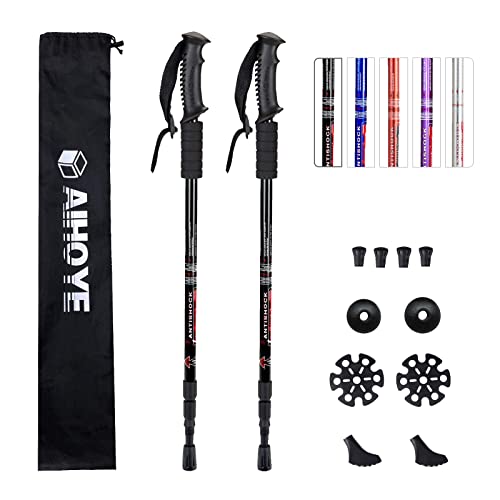
Trekking pole performance depends heavily on the metallurgical and composite properties of the shaft. Aircraft-grade 7075 aluminum, featured in models like the York Nordic Hiking & Walking Poles, offers exceptional tensile strength and ductile resilience. When subjected to accidental bending forces, such as slipping between two granite boulders, aluminum typically bends rather than snapping instantly. Hikers can often bend an aluminum shaft back into workable alignment to complete their backcountry trip.
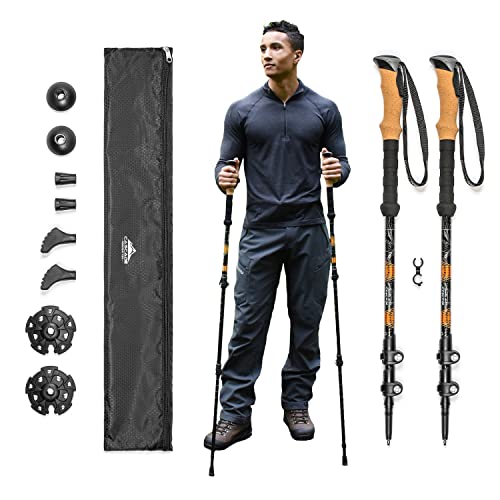
Carbon fiber construction, represented by options like the Foxelli Carbon Fiber Trekking Poles, focuses on weight minimization and vibration dampening. Carbon fiber naturally absorbs trail resonance, preventing high-frequency vibrations from traveling into your wrists and elbows. At approximately 7.6 ounces per pole, carbon models dramatically reduce swing weight over high-mileage days. However, carbon shafts are vulnerable to catastrophic shear failure if wedged laterally between rocks under heavy downward loads.
Single Walking Sticks Versus Dual Trekking Pole Systems
Hikers often debate whether carrying a single walking staff or a matched pair of trekking poles offers superior practical utility. A traditional handcrafted option, such as the Brazos Rustic Wood Walking Stick, provides a rugged single-point support system crafted from solid sweet gum hardwood. A single staff offers straightforward stability on moderate woodland paths and neighborhood walks where dual poles might feel cumbersome. It keeps one hand completely free to check maps, handle trail snacks, or manage pets.
In contrast, dual pole configurations provide balanced biomechanical symmetry that a single staff cannot match. Carrying only one stick creates an asymmetrical gait, placing unequal loads on your shoulders, spine, and knees over extended distances. A paired setup enables the synchronized, alternating pole strike necessary for offloading joint impact on steep downhill grades. For technical alpine routes, heavy multiday backpacking, or high-mileage endurance hikes, dual poles deliver clear performance advantages.
Grip Materials and Ergonomic Hand Placement
The interface between your hands and your poles dictates your comfort across consecutive trail miles. Natural cork handles, featured on Foxelli carbon poles, gradually conform to the anatomical contours of your hands over time. Cork naturally wicks moisture, repels trail sweat, and resists blistering in hot, humid weather conditions. In cold environments, cork provides natural thermal insulation, preventing cold shafts from chilling your palms.
Cushion foam grips, utilized on York Nordic models, offer soft shock absorption and dependable traction across all seasons. Many modern poles also incorporate extended lower EVA foam sleeves positioned beneath the primary handle. These choke-up extensions allow you to lower your grip temporarily when traversing steep sidehills without stopping to adjust telescoping clamps. Selecting the proper grip material prevents hand fatigue, friction hot spots, and painful blisters during long days on the trail.
External Cam Flip Locks Versus Internal Twist Expanders
A trekking pole is only as dependable as the mechanism holding its telescoping sections together. Modern trekking poles favor external lever flip locks over traditional internal twist expanders. Internal twist locks rely on friction wedges that frequently seize, slip, or jam when exposed to trail dust, moisture, and sub-freezing temperatures. External cam levers provide visible, positive clamping force that remains secure under heavy downward body weight.
External flip locks also allow quick tension calibration in the field without requiring specialized tools. When temperature shifts cause shaft metals to contract, tightening the external thumb screw restores proper clamping pressure. Hikers should routinely test their locks before descending by leaning their downward weight onto the poles on flat ground. If a section slips under body weight, a simple quarter-turn of the tension screw will eliminate shaft collapse risks.
Height Calibration and the Ninety-Degree Elbow Rule
Setting your trekking poles to the correct height is essential for achieving proper posture and joint relief. On flat terrain, adjust your poles so your forearm forms a clean ninety-degree right angle with your upper arm while holding the grips. This positioning keeps your shoulders relaxed and ensures optimal mechanical leverage during your stride. Setting poles too high causes shoulder tension, while setting them too low forces you to slouch forward.
Terrain gradients require strategic adjustments to maintain this optimal biomechanical efficiency. When tackling sustained uphill ascents, shorten both pole sections by five to ten centimeters so you do not push from above shoulder level. On steep descents, lengthen both poles by five to ten centimeters to reach downward steps without bending your torso. Telescoping poles with clear measurement markings make these quick trailside adjustments seamless and precise.
Wrist Strap Technique for Efficient Weight Transfer
Many hikers misunderstand the proper method for utilizing trekking pole wrist straps. The correct technique requires inserting your hand upward through the bottom opening of the strap loop before grasping the handle. This orientation drapes the wide webbing flat across the back of your wrist and the heel of your palm. When positioned correctly, your downward body weight transfers directly into the strap rather than relying entirely on grip strength.
Proper strap loading allows you to maintain a loose, relaxed grip on the handle during long treks. Squeezing the grips tightly for hours causes forearm cramps, wrist strain, and carpal tunnel irritation. With the strap bearing your weight, you simply guide the pole with your fingers, flicking it forward effortlessly. Padded straps with soft fleece or breathable webbing prevent chafing and skin irritation along your wrists.
Tip Assemblies, Rubber Protectors, and Basket Selection
The bottom assembly of your trekking pole determines traction across diverse ground surfaces. Tungsten carbide flex tips bite aggressively into dirt, decomposed granite, packed snow, and slick ice. However, bare metal tips can scrape rock surfaces, damage delicate historic trails, or vibrate loudly on paved asphalt. Adding durable rubber protectors, like the Mons Peak IX Trekking Hiking Nordic Walking Sticks replacement tips, absorbs road impact and provides grippy traction on pavement.
Baskets prevent your poles from sinking too deeply into soft ground or catching between narrow roots. Low-profile mud baskets are ideal for standard three-season hiking through woodland loam and scree fields. Wider powder snow baskets distribute surface area across crusty snowpacks and winter snowshoe routes. Always inspect your basket threads and rubber tips periodically to ensure they remain snug before heading into the backcountry.
Real-World Limitations, Scrambling Hazards, and Transit Regulations
Despite their clear benefits, trekking poles are not suitable for every backcountry scenario. During Class 3 or Class 4 rock scrambles, carrying poles in your hands compromises safety by restricting your grip on solid rock holds. Hikers should stow collapsible poles onto pack attachment loops when transitioning to technical rock sections. If you need to manage trail gear, carrying items inside an insulated backpack cooler keeps your hands completely unencumbered for balance.
Air travel also introduces specific logistics that every trekking pole user must navigate. The Transportation Security Administration prohibits hiking poles with sharp metal points in domestic carry-on baggage. Travelers must pack their trekking poles inside checked luggage to avoid checkpoint confiscation. Collapsible three-piece telescoping designs or compact folding poles fit easily into standard travel bags, simplifying transit to your destination.
Hiking poles represent one of the most effective equipment investments for protecting joint longevity and enhancing trail endurance. By absorbing downhill shock, powering uphill climbs, and stabilizing uneven footsteps, they transform demanding terrain into manageable mileage. Selecting between carbon fiber or aluminum shafts and pairing them with ergonomic grips ensures your setup matches your individual hiking style. Taking time to dial in proper height adjustment and strap technique guarantees you will experience their full mechanical benefits on every adventure.





Write Your Review
No reviews yet. Be the first to share your experience!