


Unexpected equipment failures on steep mountain descents can quickly turn a scenic outing into a frustrating physical grind. When an external lever clamp slips or a folding section rattles loose, knowing how to fix hiking pole mechanisms in the backcountry preserves your balance and protects your lower body joints. Trekking poles absorb significant braking forces, effectively offloading compressive stress from your knees and hips while negotiating loose scree. Pairing functional poles with reliable gear such as tendon knee hiking pants ensures your legs stay supported across demanding trail miles. Understanding the basic mechanics of locking collars, inner tension cables, and aluminum shafts allows hikers to resolve sudden hardware failures before balance is compromised.
Most mechanical breakdowns stem from simple trail debris buildup, loose thumbscrew tensioners, or unseated push-button stops rather than permanent structural damage. Aircraft-grade aluminum shafts provide ductile resilience against bending, but external cam levers and folding joints require proper calibration to hold firm under downward body weight. Fine silt, moisture, and road dust frequently work their way between telescoping sections, creating friction loss that makes clamps slide under heavy axial loads. Taking time to diagnose whether a joint needs a quick thumbscrew turn, a thorough dry cleaning, or button repositioning restores dependable stability. This guide walks through practical bench fixes and quick trailside adjustments so your poles stay secure on every rugged ascent.

Pros
- Folds down to 15 inches, making it significantly easier to pack inside travel luggage or strap to compact daypacks than standard telescoping poles
- Moisture-wicking natural cork handles keep palms dry and comfortable across humid hiking conditions
- Sturdy metal flip locks and reinforced joint caps provide solid structural support without slippage when properly tensioned
- Lower EVA foam grips allow instant trail adjustment for steep uphill climbing
Cons
- At 11.5 ounces per pole, they carry more weight than specialized ultralight carbon fiber poles
- The 110 cm minimum height setting may feel slightly too long for hikers under 5 feet 2 inches
- Per TSA regulations, trekking poles with metal tips must be packed in checked luggage rather than carried on flights
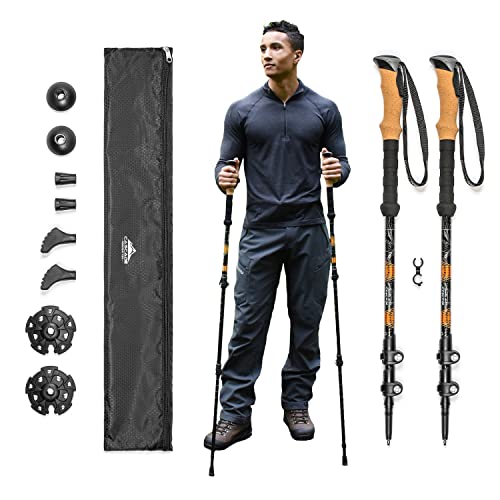
The Trekology Trek-Z Cork Grip Trekking Poles are folding, multi-section hiking sticks designed for hikers, backpackers, and travelers who require sturdy trail stability without the awkward bulk of traditional telescoping poles. Sold as a pair with an included carry bag, these poles suit day hikers tackling uneven paths, weekend backpackers managing load transfer on descents, and outdoor enthusiasts who need compact gear that fits inside travel luggage or standard daypack side sleeves.
Trail packability is one of the standout characteristics of this design. Utilizing a retractable tri-fold cable system, each pole breaks down to just 15 inches (38 cm) in overall length. This short folded dimension lets you slip the pair directly into the main compartment of an overnight pack, tuck them into side stretch-mesh water bottle pockets, or strap them beneath external compression straps without snagging overhead brush. For length adjustment, an upper aluminum section provides a 20 cm sliding range from 110 cm to 130 cm, catering to user heights between 5 feet 2 inches and 6 feet 5 inches.
Component construction focuses on long-term trail durability. Trekology builds the Trek-Z poles from aircraft-grade aluminum alloy, which provides higher impact resistance and flex tolerance against rocky crevices compared to brittle carbon fiber. The folding shaft joints feature protective metal caps to resist wear at stress points during repeated assembly. Up top, the natural cork grip wicks moisture away from sweaty palms during steep ascents, while a secondary EVA foam grip sleeve allows you to lower your hand placement instantly on steep trail grades without adjusting the shaft length.
Deploying and adjusting the poles requires a straightforward two-step setup. After letting the lower segments drop into place, you pull the upper shaft section until an internal metal locking button pops outward with a firm click. A durable metal external flip lock then secures the upper telescoping section at your desired height marker. Proper setup is essential; if the lower shaft feels loose or disconnected, the metal lock button must be firmly pulled until fully seated in its designated catch hole. Maintenance is simple, requiring only an occasional wipe-down with a dry cloth after muddy hikes before packing into the included storage sleeve.
While practical and durable, the Trek-Z design carries a few realistic limitations. Each pole weighs 11.5 ounces (330 grams), resulting in a combined pair weight around 23 ounces, which may deter dedicated ultralight thru-hikers who prefer minimal swing weight. Additionally, the minimum length of 110 cm means youth hikers or adults under 5 feet 2 inches might find the grip positioning too elevated on flat terrain. Travelers should also remember that TSA guidelines require trekking poles with rigid tips to travel inside checked baggage rather than carry-on packs.
For hikers seeking an affordable, compact, and robust set of walking poles, the Trekology Trek-Z Cork Grip poles deliver excellent overall value. They provide dependable joint support, sweat-wicking cork comfort, and pack-friendly folding convenience that fits easily into standard hiking backpacks and travel duffels.
The Trekology Trek-Z poles feature an adjustable working range between 110 cm and 130 cm, making them compatible with users measuring between 5 feet 2 inches and 6 feet 5 inches in height. Sizing adjustments are controlled via a durable metal flip-lock clamp positioned on the upper shaft section, marked with clear centimeter increments for quick alignment.
Hikers can lengthen the poles slightly for steep downhill sections to maintain an upright posture, or shorten them for prolonged uphill climbs. For fast grade transitions where stopping to loosen the clamp is impractical, the extended EVA foam grip below the primary cork handle allows instant choke-down positioning.
Thanks to a three-section folding architecture linked by an internal tension cable, the Trek-Z poles collapse down to an ultra-compact 15 inches (38 cm). This compact footprint allows them to slide vertically inside most 20-liter to 65-liter hiking backpacks, eliminating the tip-heavy snagging hazards common with longer two-piece or three-piece telescoping poles.
A matching carry bag is included to keep trail mud and dust away from sleeping bags, pack liners, and clothing when stored internally. When flying to destination trailheads, note that airline security guidelines require trekking poles to be packed within checked baggage rather than carry-on luggage.
The shafts are manufactured from aircraft-grade aluminum alloy, delivering high tensile strength and resilience against bending forces when supporting heavy backpack loads on rocky trails. The connection joints between segments are reinforced with metal caps to resist cracking and wall deformation under load.
The upper handle utilizes natural cork material that absorbs hand moisture, resisting slick spots during warm summer outings. The handle is engineered with a slight rotational flex that acts as an anti-torque buffer, reducing jarring impacts transmitted through the hands and wrists across prolonged trail miles.
Complete Guide on How to Fix Hiking Pole Failures and Lock Issues
Trekking poles endure immense repetitive impact, supporting your body weight across steep descents and stabilizing your stride through rocky river beds. When a locking collar loosens or an internal cable loses tension, learning how to fix hiking pole components prevents dangerous falls and saves you from replacing expensive gear prematurely. Most hardware malfunctions can be diagnosed quickly by examining the mechanical junction where segments meet. Taking a systematic approach to cleaning, tensioning, and seating components will restore firm structural stability for your upcoming backcountry trips.
Diagnosing the Root Cause of Trekking Pole Slippage and Collapse
A hiking pole that unexpectedly slips under downward pressure poses a real hazard during steep descents. The first step in resolving any failure involves isolating whether the issue stems from hardware fatigue, external dirt buildup, or incomplete assembly. Telescoping poles rely entirely on friction generated by cam clamps or expanding plugs, both of which struggle when fine dust coats the shaft surfaces. Checking where the movement occurs lets you identify whether you need a simple tool-free adjustment or a thorough cleaning session.
Hikers carrying heavy multi-day loads often exert intense axial forces that expose minor mechanical looseness. If your gear setup includes a heavy pack alongside a supportive iron frame hiking backpack, a sudden pole collapse can throw you completely off balance. Inspecting the pole sections under steady body weight on level ground reveals whether slippage happens at the upper adjustment joint or lower folding sections. You should also verify that the shaft is not warped from lateral rock wedging, as deformed tubing prevents locking clamps from applying even circumferential force.
How to Fix Slipping External Cam Levers and Flip Lock Collars
External lever locks allow rapid adjustments, but they frequently lose holding power as metal hardware vibrates along rough trails. When you flip the lever shut, it should require firm thumb pressure to close completely. If the cam lever snaps closed effortlessly without noticeable resistance, the clamp lacks sufficient clamping force to hold your body weight. Fixing this problem requires only a few seconds and does not demand specialized workshop tools.
To recalibrate a slipping flip lock, open the cam lever so the mechanism is fully disengaged. Turn the thumbscrew or adjustment dial situated opposite the lever arm clockwise in small quarter-turn increments. Close the lever and attempt to compress the pole vertically against the ground with your full upper body weight. If the shaft still slides, open the lever and tighten the thumbscrew another quarter turn until the clamp holds securely. High-quality hardware, such as the metal flip lock system on the Trekology Trek-Z Cork Grip Collapsible Lightweight, provides reliable holding strength once adjusted properly.
Resolving Loose Push-Button Locks on Collapsible Folding Poles
Folding trekking poles connect three or more shaft segments via an internal tension cable and lock into rigid alignment using a spring-loaded pop-out metal button. A frequent user concern arises when the pole feels completely loose or disjointed after unfolding. In almost every case, this occurs because the shaft was not pulled far enough to engage the locking pin into its machined detent hole. Understanding how the internal tension cord interacts with the push-button mechanism prevents unnecessary frustration at the trailhead.
To secure a folding model properly, assemble the nested segments together by hand and hold the upper grip firmly. Grasp the section immediately below the flip lock collar and pull it downward away from the handle with steady force until the internal metal lock button pops completely out with an audible click. If the pole feels loose, re-seat the button until fully engaged, as this initial slack during assembly is an expected part of the retractable design rather than a defect. Check that the metal caps at each segment joint sit flush against the adjacent tube ends to eliminate joint wobble while hiking.
Unsticking Seized Telescoping Sections and Clearing Internal Silt
Telescoping poles frequently become stubborn or entirely stuck after exposure to rain, stream crossings, or humid trail conditions. When aluminum shafts remain wet while stored inside a hot pack or vehicle, galvanic oxidation creates a powdery residue that binds the metal tubes together. Fine trail silt acts like sandpaper inside the tight tolerances between the sliding tubes, jamming the mechanical action. Forcing stuck segments by twisting with pliers can easily crush thin-walled aluminum tubing, ruining the pole permanently.
To release a seized shaft safely, loosen all external cam levers completely or back off internal twist expanders. Apply a gentle penetrating lubricant or warm water soak around the joint seam, taking care to avoid getting oil onto rubber or cork grips. Grasp both sections with rubber gripping pads to twist the sections in opposite directions with firm, controlled torque rather than bending sideways. Once disassembled, swab the tube interiors with a dry microfiber cloth and wipe down the exterior shafts with isopropyl alcohol. Never apply silicone spray, WD-40, or grease to the sliding surfaces, as lubricants destroy the mechanical friction required by cam locks.
Troubleshooting Internal Twist Locks and Friction Expander Wedges
Internal twist lock poles rely on an internal threaded rod and an expanding plastic or nylon wedge plug. When you turn the shaft clockwise, the expander wedge travels up the threaded bolt, spreading outward against the inside wall of the outer tube. Over time, these expander plugs can become coated in fine dust or slip off the threads, causing the section to spin endlessly without tightening. A spinning twist lock is a common trail issue, but it is easily serviceable once disassembled.
Pull the spinning shaft completely out of the upper section to inspect the plastic expander plug at the top of the tube. If the expander plug is caked with dry dirt, scrub it with a dry toothbrush and rinse it with clear water, allowing it to dry thoroughly. Before reinserting the shaft, manually twist the expander until it flares outward just enough to create light friction against the inner wall of the receiving tube. Slide the section back inside and twist the lower shaft clockwise until the threads bite firmly. If the expander threads are stripped or cracked from overtightening, replacement expander wedges are widely available and can be installed in minutes.
Managing Natural Cork Grip Rotation and Foam Handle Maintenance
Grip comfort plays a decisive role in warding off hand fatigue and palmar blisters during long backcountry treks. Natural cork grips excel in hot weather because they naturally absorb hand moisture, keeping your grip dry on long hikes. Hikers occasionally notice a small amount of rotational play or flex in their cork handles and assume the grip has come unglued from the aluminum core. On many ergonomic poles, cork grips are intentionally designed with a slight rotational flex to serve as an anti-torque ergonomic feature rather than a defect. This slight rotation cushions wrist joints from repetitive torsional shock during sustained downhill steps.
While anti-torque ergonomic flex is normal, loose foam grip extensions or peeling lower sleeves require attention. Lower EVA foam grips allow hikers to choke down on steep switchbacks without pausing to adjust pole length, which pairs well with flexible apparel like lightweight hiking pants for men during fast uphill ascents. If an EVA foam sleeve begins to slide out of position, clean the aluminum surface underneath with rubbing alcohol to remove body oils. Reattach the foam using a thin coat of outdoor-rated contact adhesive, clamping it lightly with tape until fully cured. Regular inspection of the wrist strap webbing and cam buckles also prevents unexpected strap slippage under heavy descent loading.
Straightening Slightly Bent Aluminum Shafts Versus Replacing Segments
Aircraft-grade aluminum trekking poles are valued for their ductile strength, meaning they tend to bend under excessive lateral stress rather than snapping catastrophically like carbon fiber. Made with aircraft-grade aluminum, quality shafts support heavier weights and withstand rough terrains effectively. If a pole tip becomes wedged between granite boulders while your body moves forward, the lower shaft may develop a visible curve. Minor bends can occasionally be massaged back into shape in the field to allow you to finish your hike safely. However, attempting to straighten a severely kinked aluminum tube will permanently weaken the metal structure and likely lead to a complete fracture.
To correct a gentle bend, locate a sturdy tree branch fork or the gap between two parallel logs to act as a gentle leverage point. Apply gradual, even pressure against the convex side of the bend, checking your progress frequently to avoid over-correcting. Never hammer the shaft against a hard rock, as this creates localized denting that will prevent telescoping sections from collapsing. If the aluminum shows creases, hairline cracks, or deep gouges, retire that section immediately to maintain safety on high-angle trails.
Replacing Worn Carbide Flex Tips and Lost Mud Baskets
Carbide flex tips provide essential purchase on granite slabs, packed soil, and ice, but the hard metal point eventually wears down or fractures after hundreds of trail miles. When the carbide tip wears flush with the plastic tip housing, the pole will begin to skitter uncontrollably across hard rock surfaces. Most hiking poles utilize a press-fit or threaded plastic tip assembly that can be replaced at home. Soaking the worn tip assembly in boiling water for several minutes softens the factory adhesive, allowing you to pull the plastic sheath off the aluminum shaft with a pair of pliers.
Clean any old glue residue from the tip of the aluminum shaft before pressing the new replacement flex tip firmly onto the tube. Many hikers also struggle with lost mud baskets, which tend to unscrew when pulled through deep mud bogs or thick brush. When installing replacement mud or snow baskets, press them past the initial detent ring and twist them until they lock firmly into the molded retention grooves. Checking basket tightness before each hike prevents leaving plastic litter on the trail and ensures your poles stay afloat in soft alpine soil.
Routine Cleaning, Storage Habits, and Transport Regulations
Routine preventive maintenance is the most effective way to eliminate mechanical breakdowns when you are miles away from the trailhead. After completing a wet or muddy trek, resist the urge to store your poles collapsed inside your vehicle or gear closet. Moisture trapped inside sealed aluminum shafts accelerates oxidation and degrades internal locking mechanisms over time. Disassemble all telescoping segments completely, wipe them down with a dry towel, and let them air dry overnight before putting them back together. Store your trekking poles in a dry space with the external cam levers left in the open position to prevent long-term plastic fatigue.
Before heading out on your next wilderness trip, conduct a physical safety check to confirm that all repairs were successful. Assemble each pole, lock the mechanisms firmly, and lean your full upper body weight onto both grips on a flat, non-slip surface. If your hiking plans involve air travel, remember that trekking poles must be checked in as luggage per TSA and most airline rules because of their sharp metal points. Compact designs that fold down to 15 inches fit easily into checked luggage cases or duffel bags for travel. Regular maintenance and proper transport habits ensure your gear delivers dependable stability across every mountain pass.






Write Your Review
No reviews yet. Be the first to share your experience!