


Maintaining balance and easing joint strain on uneven outdoor trails often comes down to dependable contact with the ground. As hikers age, natural joint cushioning decreases, making steep descents and rocky terrain challenging for knees, hips, and lower back muscles. Learning how to use hiking poles for seniors gives older walkers the leverage needed to redistribute body weight, improve cadence, and prevent sudden slips on unpredictable trails. Pairing reliable poles with flexible trail apparel like supportive knee hiking pants can transform an intimidating uphill or downhill route into a comfortable, confident walk in nature.
Modern trekking gear provides mechanical advantages through lightweight aluminum shafts, ergonomic grips, and adjustable locking mechanisms designed to absorb shocks. Many older adults initially hesitate to adopt walking poles because they worry the equipment will feel cumbersome or complicate their natural walking rhythm. Once you master the baseline height adjustments, correct wrist strap positioning, and alternating arm swing cadence, the poles act as functional extensions of your body. Understanding how to set up and handle this equipment ensures you protect sensitive joints while enjoying the outdoors with greater independence.

Pros
- Lightweight 9.92 oz aluminum build delivers sturdy trail balance without unnecessary swing weight
- Three-section breakdown fits diagonally in 22-inch suitcases or straps cleanly to hiking daypack loops
- Internal anti-shock spring cushions downward pressure during steep, sustained mountain descents
- Comes complete with four versatile tip and basket attachments suited for year-round trail conditions
Cons
- Twist-lock mechanisms require firm manual tightening and lack the visual verification of external lever flick-locks
- Rubber grips do not wick perspiration as naturally as cork handles during hot summer hikes
- Full 25.6-inch collapsed length may extend beyond the top of compact daypacks unless disassembled
TheFitLife Telescopic Trekking Poles are three-section aluminum hiking sticks designed for day hikers, weekend backpackers, and travel-oriented walkers seeking joint support and trail balance. Featuring an integrated anti-shock spring and an internal twist-lock system, this pole pair caters to budget-conscious outdoor enthusiasts, beginners, and fitness walkers. Because they collapse and disassemble into three compact segments, they serve hikers who regularly transport their gear via 22-inch travel luggage or external backpack attachment loops.
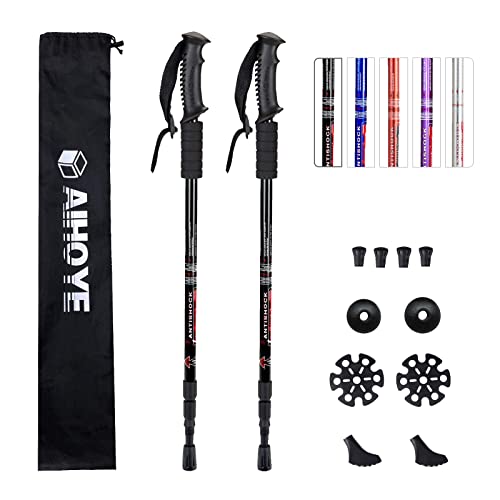
On the trail, weight management and proper height adjustment remain critical for maintaining a steady rhythm. Each pole weighs 9.92 ounces (282 grams), resulting in an aggregate weight of just over 1.5 pounds for the pair. The telescopic aluminum shafts adjust across a usable range of 25.6 inches (65 cm) up to 51.2 inches (130 cm), accommodating men, women, teens, and seniors. When navigating steep descents, the internal anti-shock mechanism activates under downward pressure to absorb trail vibration, while the ergonomic rubber grips deliver steady hand placement across varied walking paces.
The shafts are fabricated from high-strength aluminum alloy, engineered to offer dependable impact resistance against roots, scree, and rocky paths without premature fatigue. TheFitLife utilizes an internal twist-lock mechanism rather than external cam levers, creating a streamlined, low-profile outer diameter that will not catch on dense brush or snag against backpack compression webbing. While the rubber grips lack the moisture-wicking properties of natural cork, their textured surface provides a non-slip grasp in damp conditions, paired with an adjustable wrist strap to help secure your grip.
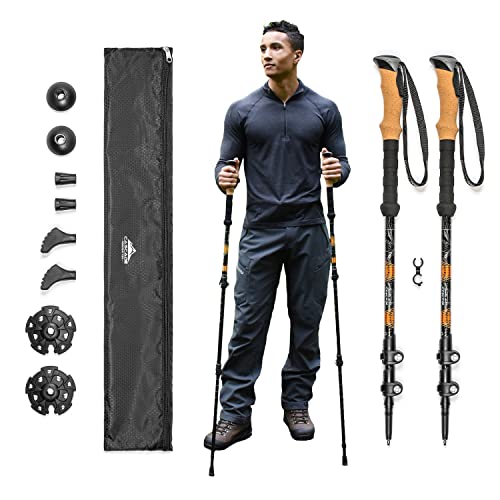
Transporting these poles alongside your hiking pack or travel baggage is straightforward. When fully collapsed, the poles measure 25.6 inches, making them ideal for securing directly against backpack trekking-pole loops and upper compression straps. For air travel or compact gear totes, each pole disassembles into three independent sections measuring 21.46 inches (54.5 cm), allowing them to slip diagonally into most 22-inch or larger suitcases. Swapping the included rubber tips, flat walking caps, mud baskets, and snow baskets is tool-free, enabling quick configuration changes before heading onto muddy switchbacks or hard pavement.
While practical and versatile, this design presents a few real-world limitations. The internal twist locks require careful hand tightening to avoid accidental slippage under heavy body loads, and they lack the visual security checks provided by external lever locks. In addition, the 25.6-inch collapsed length can extend noticeably above smaller hydration packs or 15-liter daypacks if you do not disassemble them completely. Hikers who prefer ultralight carbon fiber construction or naturally cooling cork handles will also notice the denser feel and moisture retention of the rubber grip material on warm afternoon treks.
For hikers, campers, and travelers searching for an affordable, full-featured trekking pole set that integrates smoothly with backpack lash loops and standard luggage, TheFitLife Telescopic Trekking Poles offer balanced utility. Their aluminum strength, internal anti-shock cushioning, and comprehensive basket kit make them a practical gear choice for everyday trail walks and weekend mountain outings alike.
When preparing for trail outings or flights, gear packability is essential. TheFitLife Telescopic Trekking Poles adjust from a minimum collapsed height of 25.6 inches (65 cm) to a maximum deployed length of 51.2 inches (130 cm). For routine day hiking, the collapsed poles slide easily through lower trekking-pole gear loops on standard daypacks and secure firmly under side compression straps.
For travelers flying to trail destinations, the three aluminum segments can be pulled apart completely. Disassembled, the longest pole section measures 21.46 inches (54.5 cm), allowing the set to lay diagonally inside standard 22-inch or larger hard-shell and soft-sided suitcases. Hikers should verify their pack dimensions and luggage interior measurements before departure to ensure compliant packing.
TheFitLife provides a multi-season accessory kit that expands the poles' versatility across various terrain types. The package includes standard rubber tips for road walking and pavement, wide walking caps for improved asphalt traction, mud baskets to prevent pole sinkage on soft soil, and wide snow baskets for winter trail excursions.
All accessories thread and press securely onto the pole ends without specialized tools. Hikers should inspect the wear on rubber tips and check basket tightness prior to hitting rocky backcountry routes, storing unused attachments in an organizer pouch inside their backpack until needed.
Complete Guide to Hiking Pole Mechanics and Stability for Seniors
Using trekking poles effectively involves far more than simply leaning on walking sticks as you stroll down a pathway. For older adults, proper pole mechanics transform routine walking into a coordinated movement pattern that relieves pressure on delicate joints and enhances balance. Understanding the mechanical adjustment of your gear, dialing in personal height settings, and executing correct planting rhythms provide the foundation of trail stability. When you apply sound techniques, you gain immediate confidence across loose gravel, uneven dirt, and challenging slopes.
Establishing Proper Pole Length and the 90-Degree Elbow Baseline
Finding your baseline pole height begins with the classic 90-degree elbow bend rule on flat ground. Stand upright in your regular walking shoes and hold the pole grip comfortably while resting the tip on the floor beside your foot. Adjust the shaft sections until your forearm and upper arm create a clean right angle at the elbow joint. If your forearm points upward or downward, your shoulders or back will quickly tire from compensating.
Three-section poles, such as the Telescopic Trekking Poles for Hiking, feature printed measurement markings on the middle and lower shaft sections. To maintain optimal structural strength and balance, extend both adjustable sections evenly rather than pulling one segment out to its absolute limit while leaving the other collapsed. Distributing the extension evenly across multiple sections preserves structural integrity against bending forces. Make sure you never extend any shaft segment past its marked stop line.
Footwear choice also affects this baseline measurement significantly. Thick-soled hiking boots elevate your standing height compared to thin athletic walking shoes or slippers. Always measure and set your pole length while wearing the actual footwear you intend to use on the trail to prevent unnecessary posture strain during your walk.
Mastering the Upward Wrist Strap Technique for Skeletal Support
Wrist straps are not merely safety tethers designed to keep poles from dropping into bushes. When utilized properly, straps transfer your body weight directly through your skeletal structure, allowing you to relax your hand grip. Insert your hand upward from underneath the strap loop so the fabric rests against the base of your palm. Once your hand emerges through the loop, bring your fingers down to grasp the handle and strap webbing together.
Loading your weight onto the webbing relieves muscular tension in your fingers and palms. Seniors managing joint stiffness or arthritis often make the mistake of gripping the rubber handles with excessive force. White-knuckling the pole handles quickly leads to hand fatigue and wrist soreness over moderate distances. Resting your weight against the properly routed strap allows you to maintain a relaxed, open grip that conserves energy.
Knowing when to remove your hands from the straps is just as critical for safety on technical terrain. If you encounter steep rock steps, muddy scrambling sections, or high trip risks, take your hands completely out of the wrist loops. If you slip while your wrists are secured inside the straps, the handles can trap your hands and prevent you from breaking a fall safely.
Natural Walking Cadence and Coordinated Arm Swing
Walking with poles should mirror your natural, everyday walking gait rather than feeling like a chore. The ideal movement pattern relies on contralateral motion, which means your left pole plants forward simultaneously with your right foot, and your right pole plants forward with your left foot. This alternating rhythm matches the natural counter-swing of your arms when walking without equipment. Try to maintain a loose tempo that allows the poles to swing smoothly.
Plant each pole tip slightly behind or roughly parallel with your lead foot rather than throwing the tip far out in front of your body. Reaching too far forward with the pole tips acts like a brake against forward momentum and increases the risk of tripping over your gear. A neutral plant angle provides a gentle forward push that propels you smoothly down the trail. Keep your elbows tucked comfortably near your ribcage.
If you find the alternating rhythm confusing at first, practice walking with the poles held loosely in your hands without planting them on the ground. Let your arms swing naturally as you walk along a flat sidewalk until the tempo feels automatic. Once your arms swing in sync with your opposite legs, allow the tips to touch down gently with each step.
Adjusting Technique and Length for Uphill Climbs
Ascending hills requires adjustments in both pole length and upper-body engagement to prevent back strain. When approaching a sustained uphill grade, shorten both poles by roughly 5 to 10 cm (2 to 4 inches) depending on the steepness of the slope. If you leave the poles at their flat-ground length, you will be forced to lift your arms above your chest to plant the tips, which quickly exhausts your shoulders. Shortening the poles keeps your elbows bent at an efficient pushing angle.
On moderate inclines, use the poles to recruit your chest, shoulder, and upper back muscles into your walking cadence. Planting the poles firmly and pushing down through the grips offloads your calves, hamstrings, and quadriceps. Lean slightly forward from your ankles rather than bending sharply at your waist, keeping your spine straight and your chest open. This balanced posture ensures that your upper body actively assists your legs on sustained climbs.
For steep uphill switchbacks or rocky trail rises, planting both poles simultaneously can provide an extra burst of climbing leverage. Place both tips slightly ahead of your feet, step up with your stronger leg, and push down through both arms as you straighten your knee. This double-pole technique acts like a handrail on outdoor stairs, offering unmatched stability when stepping over roots or rocks.
Downhill Braking Mechanics to Protect Knees and Hips
Downhill hiking generates intense compressive impact on aging joints, making proper descent technique vital for seniors. Before starting down a steep slope, lengthen your poles by 5 to 10 cm (2 to 4 inches) relative to your baseline flat-ground setting. Lengthening the shafts allows you to plant the tips downhill ahead of your body without bending forward at the waist. Keeping your torso upright during descents prevents your center of gravity from shifting forward.
Plant the poles firmly ahead of your feet before taking each downward step, creating a secure tripod of support between your two poles and your trailing leg. As your lead foot lands, transfer a portion of your weight through your arms and down into the poles to cushion the landing. This braking action significantly reduces the jarring shock that travels through knee cartilage and hip joints. Always keep a slight bend in your knees.
Many experienced walkers choose to rest the palms of their hands directly over the rounded tops of the pole grips on steep descents. Placing your palms over the grip crowns provides a wide platform that lets you lean downward with confidence. Internal shock-absorbing springs, such as those found in the Telescopic Trekking Poles for Hiking, further soften trail vibration on rocky descents. Taking short, deliberate steps while maintaining this cushioned pole contact protects vulnerable joints.
Operating and Securing Twist-Lock Mechanisms Safely
Reliable height adjustment depends on understanding how internal twist-lock systems operate and hold under load. Twist-lock poles utilize expanding internal nylon plugs that flare outward against the inner walls of the aluminum tubes when rotated clockwise. Holding the upper shaft steady while twisting the lower section tightens this internal expander securely in place. The streamlined profile of internal twist locks eliminates external plastic levers that can catch on trail brush.
Achieving the right locking tension requires a firm, positive twist without applying extreme brute force. Over-tightening the mechanism can strip the fine plastic threading on the internal expander plug, making future adjustments difficult. Conversely, an insufficiently tightened collar will slowly slip downward under body weight, causing an unexpected drop in pole height. Turn the section until you feel distinct mechanical resistance, followed by an additional snug quarter-turn.
Before putting your full trust in your adjusted poles, always perform a downward load verification check on flat ground. Place the pole tips on the ground and lean heavily into the grips with both hands, pressing down with substantial upper-body weight. If neither section slips or telescopes downward, the internal expansion plugs are seated correctly and safe for trail use. If a shaft slides downward, loosen the joint and re-tighten firmly.
Selecting Tips and Baskets for Trail, Rock, and Pavement Stability
Trekking poles come equipped with modular tip assemblies and baskets designed to maximize traction across varied ground conditions. The core tip of a hiking pole consists of a hard tungsten carbide point that bites securely into hard-packed dirt, loose gravel, and decomposing granite. Carbide tips offer exceptional grip on natural outdoor surfaces where rubber caps would slip or skid off loose pebbles. However, walking with exposed metal tips on paved asphalt or rock slabs creates clicking noises and can skitter unpredictably.
When walking on paved greenways, concrete neighborhoods, or smooth stone pathways, always slip durable rubber walking caps over the carbide tips. Thick rubber tips absorb surface vibrations, dampen noise, and generate high friction on hard ground. Rubber walking tips also protect sensitive indoor flooring if you bring your poles inside visitor centers or lodges. Keep a pair of rubber walking caps stashed in your pocket so you can switch between dirt trails and pavement seamlessly.
Baskets attached above the tips prevent the poles from sinking too deeply into soft terrain. Low-profile mud baskets are ideal for wet spring trails, forest loam, and sandy tracks where narrow tips might pierce deep into mud and disrupt your cadence. Wider snow baskets provide a broader surface area for winter fitness walks through fresh snow or packed drifts.
Managing Gear Weight, Packability, and Luggage Transit
Trekking pole weight directly influences how quickly your arms and shoulders fatigue during an afternoon outing. Lightweight aluminum construction, such as the 9.92 oz per pole build found on Telescopic Trekking Poles for Hiking, strikes a practical balance between manageable swing weight and rugged bend resistance. Aluminum alloys can absorb substantial trail impacts and moderate bending forces without the sudden fractures that can occur in carbon fiber under heavy lateral stress. For older adults, dependable structural resilience offers invaluable peace of mind.
Packability is another major consideration for seniors who travel to scenic parks, national forests, or distant walking trails. Telescoping poles collapse down to roughly 25.6 inches (65 cm) for standard transport, and disassembling the three sections completely reduces their length to approximately 21.46 inches (54.5 cm). This disassembled length allows the poles to fit diagonally inside most standard 22-inch checked suitcases. When carrying day gear, pairing your walking sticks with a supportive iron frame hiking backpack helps keep your posture upright and your balance centered.
Air travelers must keep federal security rules in mind when taking trekking poles on vacation. The Transportation Security Administration strictly prohibits hiking poles with sharp metal tips in domestic carry-on baggage. Attempting to bring your poles through airport security checkpoints will likely result in confiscation by screening officers. Always pack your trekking poles securely inside checked luggage, making sure to pad the tips so they do not poke through luggage linings.
Routine Field Care and Cleaning to Prevent Lock Jamming
Maintaining telescoping walking poles requires only a few minutes of simple cleaning after each trail outing. When walking through dusty dirt trails, stream crossings, or rainstorms, fine grit and moisture inevitably seep past the shaft joints and settle inside the tubes. If left unattended, trapped moisture can cause aluminum oxidation, while fine sand particles will grind down the nylon expander threads and cause the twist locks to jam. Taking the poles apart for periodic cleaning prevents these mechanical issues.
To clean your poles, twist the sections counter-clockwise until the segments slide completely apart from one another. Wipe down the exterior of each aluminum tube and the interior mating surfaces with a clean, dry cloth to remove dust, mud, and trail grime. Never spray petroleum-based lubricants or silicone sprays onto the internal twist-lock expanders or inside the pole shafts. Lubricants ruin the friction required for expansion plugs to grip tube walls, causing poles to slip under weight.
Allow all disassembled sections to dry completely in open air before reassembling them for storage in your closet or vehicle. Storing damp poles sealed tight can trap condensation, resulting in white oxidation powder that binds the tubes together over winter. Inspect the rubber tips, wrist straps, and carbide points periodically for signs of excessive wear. Sticking to these straightforward maintenance habits ensures your trekking poles remain dependable companions for years of healthy outdoor exploration.






Write Your Review
No reviews yet. Be the first to share your experience!