


Steep descents and relentless trail gradients place tremendous compressive forces on the human body, especially when carrying overnight gear. Trail enthusiasts often ask why do hikers use poles when human bipedal locomotion has worked for millennia without extra equipment. Using trekking poles transforms a hike from a high-impact lower-body strain into a synchronized, full-body movement system. By offloading stress from patellofemoral joints, providing continuous stabilizing outriggers on loose scree, and establishing an efficient walking cadence, trekking poles fundamentally alter how energy moves through the body. Pairing reliable poles with supportive hiking pants helps cushion vulnerable joints and maintain mobility across rugged mountain landscapes.
Beyond downhill joint preservation, trekking poles provide mechanical leverage on steep ascents and enhance personal security in challenging terrain. Crossing swift mountain rivers, negotiating slippery mud bogs, and traversing uneven talus fields all become significantly safer when you maintain three continuous points of contact. Poles also serve dual purposes in the backcountry, enabling backpackers to test uncertain snow crust, push away thorny trail overgrowth, and support ultralight shelters at camp. Modern lightweight designs featuring durable carbon fiber shafts, quick-adjusting metal lever locks, and contoured cork grips ensure that hikers gain these mechanical advantages without suffering forearm fatigue or excessive pack weight.

Pros
- Lightweight 3K carbon fiber construction reduces carried and swinging weight to 7.6 ounces per pole
- Metal flip locks offer secure, slip-resistant tension compared to traditional twist-lock mechanisms
- Ergonomic cork handles paired with secondary EVA foam grips provide versatile hand positioning on varying trail grades
- Wide 24-inch to 55-inch adjustment span suits a diverse range of user heights and terrain angles
Cons
- Carbon fiber shafts can fracture if wedged between rocks and subjected to severe lateral bending forces
- Collapsed length of 24 inches may extend beyond the top or bottom of ultra-compact daypacks when mounted externally
- Metal flip lock levers require occasional thumb-screw tension checks to prevent slippage over extended mileage
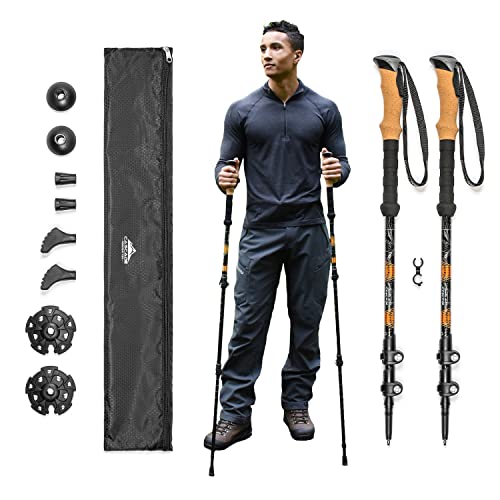
The Hiker Hunger 100% Carbon Fiber Trekking Poles are adjustable three-section telescoping trail poles built for day hikers, section hikers, backpackers, and campers seeking to shed weight without giving up stability. Constructed from 3K carbon fiber, each pole weighs approximately 7.6 ounces, making them an excellent choice for hikers looking to reduce joint impact on rugged trails while keeping their base gear manageable.
In terms of trail adjustment, these poles expand from a compact 24 inches up to a full 55 inches, comfortably serving both shorter and taller hikers across diverse terrain grades. Rather than relying on twist locks that can slip or freeze when exposed to dirt and moisture, Hiker Hunger equips these poles with quick-adjust flip locks built with metal hardware. This provides firm, slip-resistant clamping whether you are lengthening the poles for a steep downhill descent or shortening them for an aggressive ridge climb.
Grip comfort is a primary design focus, featuring ergonomic natural cork handles that actively wick moisture away from your palms while molding to your hand shape over time. Directly beneath the cork handles, secondary nonslip EVA foam extensions provide an immediate choke-down point for short, steep switchbacks, eliminating the need to stop and adjust pole length. Soft neoprene-padded wrist straps further enhance comfort, distributing downward pressure across your wrists without causing chafing during long mileage days.
Transporting and maintaining these poles on the trail is straightforward. When not in use, the shafts collapse down to 24 inches, allowing them to nest securely into side water bottle pockets, slide behind backpack compression straps, or strap onto front trekking-pole attachment loops. Maintenance involves basic trail hygiene: simply wipe away grit and moisture after wet outings and periodically check the thumbscrew tension on the metal flip locks to preserve optimal clamping force.
While carbon fiber provides exceptional weight savings and natural vibration damping, it behaves differently than aluminum under severe lateral stress. If a carbon pole becomes trapped between roots or granite boulders and is subjected to heavy sideways leverage, it is susceptible to cracking or snapping rather than bending. Additionally, hikers using compact daypacks under 20 liters should note that the 24-inch collapsed height will protrude somewhat above the pack rim when lashed to external straps.
For day hikers, multi-day backpackers, and travelers seeking an agile pair of poles with natural cork ergonomics and durable metal locking mechanisms, the Hiker Hunger Carbon Fiber Trekking Poles represent strong trail value. Backed by a 1-year warranty and a USA-based company, they provide dependable knee-saving support and steady balance across varied backcountry trails.
The Hiker Hunger trekking poles feature a telescoping three-section shaft that adjusts smoothly between 24 inches and 55 inches. This expansive range accommodates men, women, and younger hikers across flat paths, steep alpine ascents, and knee-jarring descents.
Length adjustments are secured using external flip locks equipped with metal levers. Unlike plastic components that can warp or weaken over time, the metal locking mechanism maintains consistent clamping pressure against the carbon fiber sections to help prevent unexpected slippage while hiking under load.
Constructed entirely from 100% 3K carbon fiber, these poles offer high tensile strength and natural vibration absorption while weighing only 7.6 ounces per pole. This lightweight profile substantially lowers the energy required per arm swing over long trail days.
The upper handle combines natural moisture-wicking cork with dense EVA foam for the lower grip extension, providing comfortable handholds in both warm and cold weather. To maintain the structural integrity of carbon fiber, hikers should avoid using the poles as pry bars and keep the locking collars clean of trail debris.
With a collapsed length of 24 inches, these poles integrate easily with standard hiking daypacks and multi-day backpacking packs. They can be threaded through dedicated lower trekking-pole loops, secured via upper bungee cords, or held fast by side compression straps.
For travel or public transit to the trailhead, the 24-inch collapsed size allows the pair to fit inside standard checked luggage or across larger duffel bags, keeping your trail gear neatly consolidated between outings.
The Biomechanical, Practical, and Safety Reasons Hikers Rely on Poles
Hikers use trekking poles to redistribute physical impact, maintain balance across hazardous terrain, and boost propulsion on demanding elevation gains. While walking sticks were historically simple wooden staffs used for steadying steps, modern trekking poles are engineered instruments that optimize movement efficiency. Integrating poles into your backcountry routine activates upper-body musculature while protecting the skeletal structures of the lower body. Understanding these mechanics reveals why backpackers and trail walkers consider them essential equipment.
Biomechanical Joint Relief: Protecting Knees, Hips, and Ankles
Downhill hiking generates severe shock concentrating directly on knees, hips, and ankles. Every descent forces quadriceps into continuous eccentric contractions to brake against gravity while absorbing heavy impact forces. Over miles of descent, this repetitive braking causes acute patellofemoral pain and leg fatigue. Trekking poles intercept a significant fraction of that downward force, channeling impact energy safely into the upper torso and arms.
Planting poles ahead of the body creates a mechanical braking buffer during step-downs and rocky drop-offs. The arms and shoulders absorb part of the deceleration load, dampening impact spikes that jolt knee cartilage. This load transfer preserves joint structures and reduces deep muscular micro-tears in the legs. Hikers managing past knee injuries experience immediate relief when using synchronized poles on steep gradients.
The protective benefit multiplies when navigating technical terrain under a heavy multiday load. Carrying extensive backcountry supplies inside a framed hiking backpack elevates your center of gravity, intensifying joint torque on uneven descents. Dual trekking poles counteract that elevated mass by distributing braking force across four dynamic contact points. This distributed load structure prevents awkward lateral joint torquing on loose gravel.
Uphill Propulsion and Cadence: Engaging the Upper Body
Steep ascents demand substantial cardiovascular stamina and heavy energy output from calves, hamstrings, and glutes. Without poles, the lower body bears the entire workload of lifting body mass and gear upward against gravity. Trekking poles transform uphill hiking into a four-limbed movement by actively recruiting lats, pectorals, and triceps. Pushing downward through the poles allows the arms to supply steady upward propulsion, sharing the metabolic workload.
This upper-body engagement establishes a rhythmic walking cadence that maintains forward momentum on prolonged climbs. Establishing an alternating planting rhythm synchronizes footsteps with natural breathing patterns, preventing erratic pacing that leads to premature exhaustion. Hikers maintain an upright torso posture when driving through pole grips, which expands chest volume and improves lung capacity. Opening the chest cavity allows for deeper oxygen intake during grueling ascents.
Conserving lower-body muscular stamina on morning ascents pays massive dividends later in the day. Because arms absorb a portion of the climbing workload, leg muscles experience less acute fatigue and glycogen depletion. Hikers can sustain steady trail speeds over longer daily distances without hitting physical walls. The combined propulsion and rhythm make high-mileage mountain days feel substantially more manageable.
Balance, Traction, and Multi-Point Stability on Technical Terrain
Navigating rough backcountry environments constantly challenges human equilibrium through loose rock, slippery roots, and shifting soils. A single slip on a narrow ridgeline or slick switchback can lead to severe falls. Trekking poles establish a wide base of support by providing two extra points of ground contact. This expanded four-point base dramatically stabilizes the torso against sudden slips and balance disruptions.
Stream crossings and river fords present dangerous footing conditions on remote trails. Submerged boulders coated in slick algae combine with swift currents to destabilize sure-footed backpackers. Planting poles firmly upstream forms a rigid triangular brace against moving water, allowing hikers to test submerged rocks before committing body weight. Maintaining two poles planted while moving one foot at a time ensures solid anchors against the riverbed.
Poles also function as diagnostic sensory probes when encountering obscured or uncertain trail surfaces. Hikers use pole tips to probe snowpack depth, check the stability of rotting log bridges, and detect hidden mud bogs. Tungsten carbide flex tips bite aggressively into hard granite slabs, frozen dirt, and slick timber where boot lugs might slide. Swapping small mud baskets for broad powder snow baskets prevents poles from sinking into deep snow.
Shaft Materials and Structural Dynamics: Carbon Fiber Versus Aluminum
Selecting the appropriate shaft material dictates how trekking poles perform under high stress and repetitive trail vibrations. Carbon fiber poles, such as models constructed from 3k carbon fiber composite, offer remarkable strength-to-weight ratios and natural vibration damping. Each carbon pole can weigh as little as 7.6 ounces, substantially lowering swing weight and preventing arm fatigue. Carbon fiber dissipates high-frequency vibrations before they travel up the shaft into arm joints.
The primary tradeoff between carbon fiber and aluminum lies in how each material responds to extreme physical forces. Carbon fiber handles immense axial downward loads with virtually zero flex, making it exceptionally reliable for steady vertical weight bearing. However, carbon composite has low tolerance for lateral shear stress and can fracture if wedged tightly between boulders while forward momentum torques the shaft. Hikers traversing rocky talus must avoid levering carbon shafts sideways against rigid obstacles.
Aluminum shafts, typically crafted from 7075-T6 or 6061 alloy, provide superior ductility and impact resistance against rock strikes. When subjected to excessive lateral bending forces, aluminum tends to bend rather than snap catastrophically, sometimes allowing for gentle field straightening. Aluminum poles weigh slightly more than carbon equivalents and transmit more trail vibration directly to user hands. Backpackers must balance the ultralight vibration damping of carbon fiber against the rugged bending resilience of aluminum.
Locking Mechanisms and Clamp Reliability: Flip Locks Versus Twist Locks
A trekking pole is only as dependable as the mechanism holding its telescoping sections together under downward pressure. Internal twist locks rely on expanding plastic wedges that friction-lock against the interior walls of tubing. Unfortunately, internal expander plugs can slip suddenly when exposed to fine trail silt, internal condensation, or sub-freezing temperatures. A sudden lock collapse during a high-impact descent can cause an immediate loss of balance and result in injury.
External lever flip locks solve these reliability problems by clamping down around the shaft collar using mechanical cam leverage. Modern designs utilizing metal clamp levers offer superior clamping force compared to plastic hardware, preventing slippage under heavy body weight. External locks provide immediate visual confirmation that the clamp is securely closed and locked. Hikers can easily inspect and operate these external levers even while wearing thick winter gloves.
Proper field maintenance of flip locks requires routine calibration of the external tension thumbscrew. Temperature fluctuations cause shaft materials and clamp collars to expand or contract, which can slightly alter holding tension. If a section begins to slide under firm downward hand pressure, opening the cam lever and tightening the thumbscrew a quarter-turn restores secure locking grip. Keeping shaft tubes free from accumulated mud and grit ensures smooth telescoping adjustment and preserves clamp longevity.
Grip Materials and Ergonomics: Cork, EVA Foam, and Proper Strap Loading
The contact interface between hand and pole determines comfort, blister resistance, and overall energy transmission over long days. Natural cork grips represent the benchmark for warm-weather hiking due to their moisture-wicking properties and natural breathability. Over time, natural cork compresses slightly to conform to the unique anatomical shape of the user hand, minimizing pressure points. Cork remains tactile and slip-resistant even when hands sweat heavily in humid summer environments.
High-density EVA foam serves as another excellent grip material, offering lightweight softness, shock absorption, and durability. Many designs incorporate an extended nonslip EVA foam choke sleeve directly beneath the primary cork handle. This lower foam extension allows hikers to temporarily lower their hand grip when navigating steep switchbacks or sidehill traverses. Choking down on the lower sleeve eliminates the need to constantly stop and adjust mechanical shaft lengths.
Mastering correct wrist strap technique is essential for unlocking the full biomechanical utility of trekking poles. Hikers should insert their hands upward from underneath the strap loop, then bring the palm down to grasp the grip over the webbing. This upward configuration distributes downward body weight directly across the broad strap webbing and the skeletal structure of the wrist. Proper strap loading eliminates the need to death-grip the handles, preventing forearm cramping, palmar blisters, and finger fatigue.
Sizing Fundamentals: The 90-Degree Rule and Terrain Adjustments
Adjusting trekking poles to the correct height is critical for maintaining ergonomic efficiency and preventing shoulder strain. On flat ground, the baseline sizing benchmark requires setting pole length so your elbows rest at a precise 90-degree angle when tips touch the soil. Your forearms should sit parallel to the ground while your shoulders remain relaxed and neutral. Setting poles too high causes shoulder elevation and neck stiffness, while poles adjusted too short force an inefficient forward hunch.
Terrain gradients demand deliberate height adjustments to preserve proper posture and leverage. When tackling sustained uphill climbs, shortening both pole sections by 5 to 10 centimeters brings grips closer to your center of mass. This shortened configuration prevents shoulders from over-reaching and allows arms to generate maximum downward drive. Wearing non-restrictive lightweight trail pants complements this adjusted stride by allowing full hip flexion and unrestricted knee drive.
Conversely, steep mountain descents require lengthening both poles by 5 to 10 centimeters beyond baseline flat-ground height. Extending shafts allows tips to reach ground contact earlier on downward steps without forcing you to lean forward over your knees. You can plant poles ahead to brake and absorb deceleration forces while keeping your spine upright and balanced. Three-section telescoping poles retracting from 24 inches to 55 inches accommodate these dynamic height adjustments across varied terrain.
Multifunctionality in Camp: Pitching Ultralight Shelters
Modern ultralight backpackers rely on trekking poles not only as walking aids but as primary structural components of shelter systems. Non-freestanding trekking-pole tents and modular tarps replace heavy dedicated tent poles with poles already carried in hand. This dual-purpose gear integration eliminates substantial dead weight from a backpacker base gear load. The structural rigidity of carbon fiber or aluminum shafts provides exceptional stability against high backcountry winds.
Pitching a trekking-pole shelter requires setting poles to exact manufacturer pitch heights, typically between 115 and 130 centimeters. Telescoping poles with clear centimeter markings and metal flip locks make dialing in pitch geometry fast and repeatable. Depending on shelter design, poles are positioned handle-up into reinforced fabric apex cups or tip-up into metal grommets. Verifying that flip lock tension is securely tightened prevents the shelter apex from sagging under overnight rain.
Using poles for camp shelters requires careful campsite management. Because poles are committed to holding up your living quarters for the evening, evening camp strolls or water runs must be done without them. Backpackers should ensure rubber tip protectors are installed if pitching on delicate tent fabric or rocky ledges to prevent puncture damage. This multi-use versatility represents one of the strongest practical justifications for carrying poles on long-distance wilderness journeys.
Backcountry Safety Protocols, Scrambling, and Travel Logistics
While trekking poles dramatically improve safety on walking trails, knowing when to stow them is vital for backcountry safety. When terrain transitions into Class 3 or Class 4 rock scrambling, holding poles becomes a dangerous liability that restricts hands from grabbing solid rock holds. Attempting to scramble with poles dangling from wrists risks snagging shafts in rock fissures and trapping your hands during a slip. On exposed scrambling terrain, collapse poles fully and lash them securely to your backpack to keep hands free.
Hikers must also observe strict wrist strap discipline when navigating high-exposure ledges or steep scree fields. If a fall occurs while hands are looped tightly through straps, the pole shaft can lever backward and cause severe wrist fractures or thumb sprains. Removing hands from straps on treacherous, exposed sections allows you to cast poles aside instantly if you lose footing. You can then use open palms to arrest momentum against the hillside without snagging gear.
Travel logistics present another practical hurdle before heading toward distant trailheads. Transportation Security Administration regulations strictly prohibit trekking poles with sharp metal or carbide tips from carry-on luggage on commercial aircraft. Carrying poles in your cabin bag almost inevitably leads to confiscation at security checkpoints. Telescoping poles must be collapsed down to their minimum packed length, padded securely, and packed inside checked baggage for air transit.
Practical Trail Takeaways: Integrating Poles into Your System
Integrating trekking poles into your gear setup transforms endurance, joint longevity, and trail security across all seasons. From offloading punishing knee impact on steep descents to boosting uphill cadence and providing stability over treacherous river crossings, poles solve fundamental movement challenges. Selecting lightweight carbon fiber shafts with metal flip locks and ergonomic cork grips provides optimal balance between swing weight, holding strength, and blister-free hand comfort. With proper upward strap technique and proactive height adjustments, trekking poles become an indispensable extension of your body on mountain adventures.






Write Your Review
No reviews yet. Be the first to share your experience!