


Powering through steep mountain ascents and technical ridge lines demands rapid power transfer without carrying dead weight in your hands. Trail runners often turn to dedicated running poles to offload leg fatigue, stabilize footing across loose gravel, and maintain forward momentum over long ultramarathon distances. Determining which leki poles for trail running match your specific goals depends on whether you prioritize featherweight race-day agility, rugged aluminum durability, or adjustable versatility for rolling elevation profiles. The brand offers several distinct shaft architectures, ranging from one-piece uphill sprint designs to compact folding models that tuck into a running vest quiver.
Shaft materials like high-modulus carbon fiber dampen harsh ground vibrations while keeping swing weight to a bare minimum. Choosing between fixed-length folding poles and telescoping models also impacts how quickly you can deploy gear when technical climbs begin. For runners organizing a gear checklist for extended backcountry trips or mountain ultramarathons, understanding grip ergonomics and strap release systems is equally vital. Evaluating the differences across the LEKI lineup ensures you select a setup that survives rugged scree fields without slowing your trail pace.


Matching LEKI Pole Architecture to Your Trail Running Demands
Selecting the ideal pole setup requires balancing weight, packability, and structural rigidity against the specific demands of your trail terrain. Runners racing short vertical kilometers have vastly different mechanical needs than ultramarathoners traversing mixed alpine trails over twenty hours. By analyzing LEKI shaft architectures, locking mechanisms, tip hardware, and grip interfaces, you can identify exactly which model supports your running goals.
Understanding the LEKI Shark Grip and Mesh Frame Strap
The defining feature across the LEKI trail running lineup is the proprietary Shark system. Unlike traditional loose webbing wrist loops found on standard trekking poles, the Trail Shark and Shark 2.0 setups utilize a form-fitting mesh glove strap. This strap wraps securely around the palm and base of the thumb, anchoring your hand directly to the pole grip via a small, high-strength loop. When pushing upward on steep gradients, force transfers directly through the biomechanical skeleton of the hand rather than relying on grip strength alone.
Efficiency on the trail relies heavily on quick transitions at aid stations and flat running sections. The quick-release push button positioned at the top of the grip allows you to detach from the pole in a single thumb motion without unfastening the velcro strap. This design enables runners to grab hydration bottles, consume energy gels, or check navigation devices without fumbling with awkward straps. Once you clear the flat stretch, clicking back into the grip takes less than a second, letting you regain your climbing rhythm instantly.
Fixed-Length Folding Poles: The Ultratrail FX.One Lineup
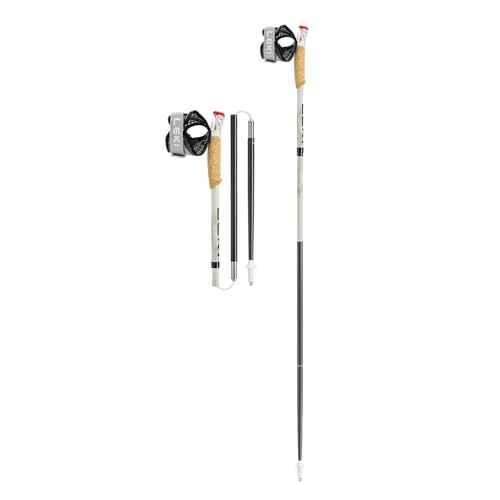
For dedicated race courses and undulating terrain, the LEKI Ultratrail FX.One series represents the benchmark in compact mountain performance. Models like the LEKI Ultratrail FX.One Superlite Trekking and the LEKI Ultratrail FX.One Superlite Trekking utilize an intuitive three-section push-button folding design. These poles collapse down to a remarkably compact pack size between 13.8 and 14.1 inches. Internal tension cords connect the sections, snapping rigid shafts into place within seconds when pulling the top section downward.
Minimizing swing weight is crucial when running for hours, and the Superlite variants excel by weighing as little as 4.8 to 4.9 ounces per pole. This featherweight feel comes from high-grade HRC Max carbon construction, which keeps the shaft slender yet stiff under vertical loading. For runners who want slightly more material mass for rugged training days, the standard LEKI Ultratrail FX.One Trekking Poles – Red and the LEKI Ultratrail FX.One Trekking Poles-Bright provide reliable carbon durability at 5.9 to 6.7 ounces. These folding poles eliminate external adjustment levers entirely, removing external catch points and shaving crucial grams.
Durable Aluminum Construction: The Evotrail FX.One TA
Carbon fiber provides unmatched weight savings, but rocky technical terrain presents unique hazards for composite materials. The LEKI Evotrail FX.One TA Trekking Poles-Black-Dark solves this challenge by utilizing heat-treated HTS 6.5 aluminum tubing. Aluminum possesses ductile properties, meaning it tends to bend slightly under extreme lateral stress rather than snapping catastrophically when wedged between boulders. This makes the Evotrail an exceptional choice for runners tackling aggressive scree fields, talus descents, or rugged backcountry scrambles where unexpected slips occur.
The aluminum build results in a slightly higher weight of 7.58 ounces per pole, but it delivers exceptional torsional rigidity and impact tolerance. It features a four-section folding layout that collapses to an easy-to-stow 15 inches. Paired with the cork Shark 2.0 grip and durable carbide flex tip, this model functions as a reliable workhorse for everyday trail runs where gear longevity takes priority over marginal weight savings. The sturdier alloy walls also provide peace of mind when crossing fast-moving mountain streams where you must probe rocky creek beds under full body weight.
Adjustable Versatility: The Cross Trail FX Superlite
While fixed-length poles dominate racing circles, fastpackers and mountain runners tackling extreme gradient changes often require variable pole lengths. The LEKI Cross Trail FX Superlite Trekking and the LEKI Cross Trail FX Superlite Trekking combine folding packability with the Speed Lock 2 Plus external lever clamp. This hybrid configuration allows on-the-fly height adjustment between 110 and 130 centimeters, while collapsing down to 16.5 inches via the Core Locking Device system. The external cam lever allows quick tension adjustments even when wearing light running gloves in brisk morning weather.
Lengthening your poles provides crucial downhill braking support, while shortening them improves climbing cadence on steep headwalls. The Cross Shark grip on these models features an extended foam lower sleeve, allowing runners to choke down on the handle during brief technical ascents without adjusting the lever lock. Weighing approximately 6.56 to 7.16 ounces, these carbon poles bridge the gap between fast trail running and ultralight mountain trekking. When planning multi-hour mountain adventures with variable gear, reviewing daypack capacity guidelines can help you balance pole storage with essential layers and hydration.
Single-Piece Rigidity for Vertical Kilometers: The Vertical K
Pure uphill races and vertical kilometer challenges present an entirely different set of athletic demands. In these events, runners never stow their poles, making folding mechanisms, internal cords, and external clamps redundant. The LEKI Vertical K Trekking Poles – Red – Yellow and the LEKI Vertical K Trekking Poles – Red – Yellow feature a continuous, single-piece carbon shaft measuring 14 millimeters in diameter. Removing all folding joints yields an astonishingly low weight of approximately 3.8 ounces per pole.
Single-piece shafts deliver zero joint play, zero internal cord rattle, and direct power transfer with every pole plant. Every ounce of energy pushed through the cork Trail Shark grip drives you directly up the slope. The specialized Speed tip provides aggressive bite on hard-packed dirt and loose rock, preventing slippage when driving forward on steep pitches. However, the fixed non-folding shaft means these poles cannot be collapsed for storage in a running vest, limiting their utility strictly to continuous uphill events and dedicated training climbs.
Dialing In Proper Pole Sizing for Running Cadence
Sizing fixed-length trail running poles differs slightly from setting up traditional hiking sticks. In standard hiking, poles are sized so your elbow forms a ninety-degree angle when the tip rests on level ground. Many trail runners prefer a slightly shorter length, approximately five centimeters less than their hiking baseline, to maintain a rapid arm turnover and clear low trail obstacles. A pole that is too long can force your shoulders upward, accelerating upper-body fatigue and throwing off your forward running lean.
If your running terrain consists primarily of steep technical climbs, matching the ninety-degree elbow angle ensures maximum pushing leverage. Most LEKI fixed-length models are sold in five-centimeter increments from 105 centimeters up to 135 centimeters. Stand upright in your standard trail running shoes and measure from your elbow to the floor to find your baseline. If you fall directly between sizes, choose the shorter option if your focus is quick turnover on rolling trails, or the longer size if you power-hike steep mountain ascents.
Packability, Quiver Integration, and Trail Maneuvering
How you transport your poles during flat and downhill sections directly influences trail safety and running efficiency. When moving across overgrown singletrack where vegetation catches on gear, wearing protective trail pants helps shield your legs from scrapes while you maneuver your gear. Folding Z-poles like the Ultratrail FX.One Superlite compress to under 14 inches, sliding seamlessly into running vest quivers or elastic waist belt loops. This compact folded length prevents the pole ends from snagging on low tree branches or kicking against your calves while running downhill.
Deploying folding poles requires simple mechanics: hold the top handle, let the lower segments drop, and pull the upper shaft until the spring-loaded brass pin clicks securely into place. Collapsing the pole is just as rapid, requiring only a firm press on the push-button mechanism to release internal cord tension. Practice this movement while walking during training sessions so you can stow and deploy poles smoothly without breaking stride during a competitive event. Stowing your poles quickly keeps your hands free on flat sections, allowing you to run with natural biomechanics and conserve upper-body energy.
Grip Ergonomics: Natural Cork versus Molded EVA Foam
Hand comfort over dozens of miles depends significantly on the grip material you select. LEKI equips models like the Ultratrail FX.One Superlite and the Evotrail FX.One TA with natural cork Trail Shark handles. Cork naturally wicks moisture away from sweaty palms, conforms gradually to your individual grip shape, and resists slippery hotspots during hot summer races. It also provides a warm, comfortable texture when trail temperatures drop in alpine environments.
Alternatively, models such as the LEKI Ultratrail FX.One Trekking Poles-Bright and the LEKI Ultratrail FX.One Superlite Trekking utilize lightweight EVA foam grips. Molded foam does not absorb water, cleans easily after muddy trail days, and offers a slightly softer cushioning feel under heavy downward pressure. Foam grips also allow for extended choke-up zones, as seen on the Cross Trail series, which gives you multiple hand placement options on steep sidehill traverses. Both materials perform admirably, so your choice should center on whether you favor natural sweat-wicking cork or low-maintenance foam cushioning.
Trail Maintenance, Shaft Inspection, and Wear Prevention
Keeping your trail running poles in peak condition requires routine care after every muddy or rain-soaked outing. Always separate folding sections completely and wipe away accumulated trail grit, fine silt, and moisture using a dry microfiber cloth. Allowing water or dirt to remain inside the hollow shaft sections can lead to jammed push-button mechanisms or internal cord degradation. Never apply petroleum-based lubricants or grease inside the shafts, as lubricants attract dirt and can cause internal locking pins to slip under load.
Inspect the carbon fiber shafts regularly for hairline fractures, deep gouges, or delamination, particularly after navigating rocky talus fields where tips can get trapped between stones. Carbide tips should be checked for excessive rounding or loose seating before technical mountain races. When using adjustable models like the Cross Trail series, test the external lever clamp before your run by applying firm downward body weight to confirm the shaft does not slip. Simple preventative maintenance protects your gear investment and ensures your poles remain dependable on remote mountain terrain.
Selecting the ideal LEKI pole comes down to aligning shaft mechanics with your specific trail running ambitions. Elite racers prioritizing minimal swing weight will find the Ultratrail FX.One Superlite indispensable, while vertical climb specialists gain unmatched stiffness from the single-piece Vertical K. If rocky ruggedness or terrain flexibility matters most, the aluminum Evotrail FX.One TA and adjustable Cross Trail FX Superlite provide dependable, versatile support. Choose the design that matches your mountain goals, dial in your sizing, and enjoy confident stability on every technical trail.






Write Your Review
No reviews yet. Be the first to share your experience!