


Powering up steep mountain switchbacks demands efficient energy transfer and dependable rhythm from your upper body. When deciding what length running poles match your stride, finding the right balance between propulsion on climbs and stability on technical descents is crucial. Choosing the wrong dimension often leads to premature shoulder fatigue, awkward posture, or compromised balance across rocky singletrack. Lightweight shafts made from carbon fiber or resilient aluminum alloys only provide their full biomechanical advantages when properly sized to your anatomical build.
Trail runners frequently transition between aggressive ascents and fast descents, making pole geometry a critical component of their mountain kit. Just as selecting the right gear for a backcountry gear checklist requires careful attention to detail, dialing in your running stick dimensions prevents excessive joint stress on long alpine routes. Modern fixed-length folding designs and micro-adjustable telescoping shafts offer different advantages for runners navigating mixed gradients. Understanding how elbow angles, footwear stack heights, and mountain inclines interact will help you select the ideal equipment for your next ultra marathon or wilderness run.





Determining Your Ideal Running Pole Length
When establishing what length running poles you require, your primary baseline should always position your elbow at a clean 90-degree angle when holding the grip vertically on level ground. Most trail runners select fixed-length folding poles between 105 and 135 centimeters based on their body height and typical course profile. Selecting an improper length compromises uphill propulsion, forces inefficient posture, and increases strain on your upper extremities. Dialing in the correct sizing ensures every plant delivers maximum forward momentum while keeping your joints protected on steep descents.
The Standard 90-Degree Biomechanical Baseline
Finding your neutral baseline starts with standing upright in your standard trail running shoes on a level surface. Hold the pole handle as you normally would on the trail, with your shoulders relaxed and your upper arms resting naturally against your torso. Your elbow should form an exact right angle, keeping your forearm completely parallel to the ground. If your forearm slopes upward toward your chest, the pole is too long and will strain your shoulders during sustained ascents. If your hand drops below your elbow level, the pole is too short and will force an unnatural forward lean.
Remember to account for footwear midsole thickness when testing this neutral elbow angle. Trail running shoes typically feature stack heights between 20 and 35 millimeters, which elevates your stance compared to barefoot standing. Performing a sizing check in bare feet or thin socks can lead you to buy a shaft that sits slightly too short on actual singletrack. Placing the carbide tips on a thin protective mat while wearing your trail shoes ensures an accurate measurement. This simple check establishes a dependable starting point before you adjust for specific mountain gradients.
Mathematical Sizing Formulas and Height Multipliers
A widely trusted method for calculating running pole length relies on multiplying your standing height in centimeters by 0.68. For example, a runner standing 175 centimeters tall would multiply 175 by 0.68 to arrive at approximately 119 centimeters, pointing directly to a 120-centimeter fixed model. If your calculation lands directly between two standard manufacturing sizes, your choice should depend on your typical terrain and running style. Choosing the shorter option favors steep climbing where a lower plant angle reduces shoulder strain, while the longer size provides extra reach for technical descents.
Runners who primarily tackle steep vertical kilometer events often lean toward a conservative multiplier of 0.66 to avoid lifting their arms excessively high. Conversely, ultra runners facing long alpine descents may favor a 0.70 multiplier to provide early contact with the ground when dropping down loose switchbacks. Sizing tables from major manufacturers reflect these mechanical principles across their fixed increments. Generally, runners under 5 feet 4 inches match with 105 or 110 centimeter shafts, while athletes measuring between 5 feet 8 inches and 6 feet gravitate toward 120 or 125 centimeter poles. Taller athletes exceeding 6 feet 2 inches typically require 130 or 135 centimeter options.
Fixed-Length Versus Adjustable Running Poles
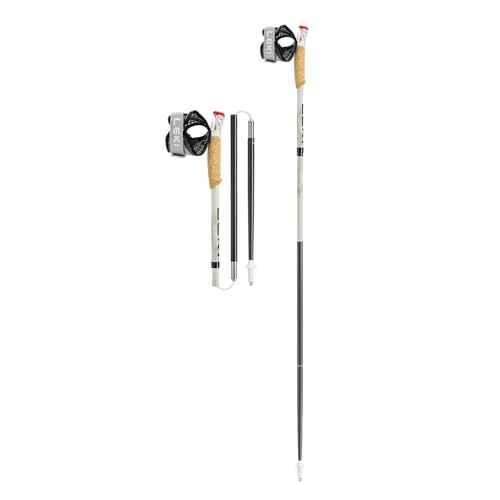
Fixed-length folding poles represent the preferred configuration for dedicated trail racers seeking minimal weight. Models like the LEKI Ultratrail FX.One Trekking Poles- Grey Light and the BLACK DIAMOND Distance Z Poles, Aluminum eliminate external locking hardware to shed ounces and maximize shaft rigidity. Without mechanical lever clamps or telescoping joints, fixed poles deliver a crisp, immediate swing weight that allows rapid cadence on undulating trails. Because you cannot lengthen the shaft for descents or shorten it for vertical climbs, you must select your exact size correctly before purchasing.
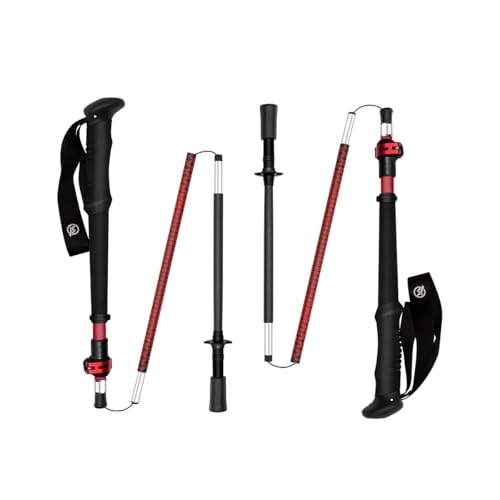
Adjustable folding poles utilize external lever locks on the upper section to provide several inches of variable extension. The ALPIN LOACKER Collapsible Trekking Poles provide an adjustment range from 39 to 47 inches, while the WindQuester Strider Z Ultralight Carbon Fiber extends between 43.3 and 51.1 inches. This versatility proves valuable on diverse mountain routes where long ascents give way to prolonged technical descents. However, the extra clamp collars and telescoping sleeves add weight and slightly increase rotational inertia during each forward swing.
Packability remains another vital design difference when stowing gear inside running vests or waist belts. Fixed four-section poles like the Ultralight Carbon Fiber Trekking Poles collapse down to roughly 14.7 inches, while the AONIJIE Collapsible Trekking Poles 2-Pack Walking pack down to 15 inches. These compact folded dimensions slide easily into external quiver systems or elastic loops without bouncing against your thighs. If you are comparing gear dimensions for your kit, reviewing our fastpacking pack volume guide can help you evaluate how folding hardware fits alongside hydration bladders and mandatory layers. Compact folding architecture ensures that your poles stay securely out of the way on runnable flats.
How Mountain Gradient Dictates Pole Mechanics
Mountain terrain rarely stays flat, which alters how your body interacts with your pole length. As you ascend a steep slope, the rising ground effectively makes a standard pole feel several centimeters longer than it felt on level ground. If your shaft is too long, your wrists bend backward and your elbows flair outward, creating excessive tension across your neck and shoulders. Many athletes manage this gradient shift on fixed poles by grasping the shaft below the main handle. Models equipped with extended lower foam sleeves allow you to choke down effortlessly without breaking your climbing cadence.
Descending steep gradients reverses these biomechanical demands. When dropping down rocky drops, the ground falls away below your feet, making a standard pole feel noticeably shorter. A pole that lacks adequate length forces you to hunch forward at the waist to make solid ground contact, compromising your balance. Lengthening an adjustable pole by 5 to 10 centimeters allows your torso to remain upright while transferring downward braking forces to your arms. This upper-body engagement significantly offloads stress from your quadriceps and knee joints on technical descents.
Grip Architecture and Strap Systems
The connection between your hand and the pole handle directly influences how effectively you transfer energy into the ground. Traditional designs utilize an adjustable nylon or mesh loop that wraps around the wrist to distribute pushing forces across the heel of your hand. Ergonomic EVA foam handles, such as those on the CONTOOSE 100% Carbon Fiber Hiking Pole Collapsible, absorb sweat effectively while providing a non-slip textured hold during hot mountain outings. Closed-cell EVA foam also insulates against cold morning air without becoming slick when soaked with rain or condensation.
Specialized trail running systems take hand attachment a step further with integrated glove-mesh harnesses. The LEKI Evotrail FX.One TA Trekking Poles-Black-Dark uses the Trigger Shark 2.0 cork grip system, which clicks a fitted hand harness directly into the pole head. This mechanism provides optimal power transfer by allowing you to push forcefully against the pole without tightly gripping the shaft. A quick-release push button frees your hand instantly at aid stations or when accessing hydration flasks. Regardless of strap style, proper strap adjustment prevents hand cramping and ensures you do not waste muscular energy clutching the handle.
Shaft Materials and Swing Weight Dynamics
Shaft composition fundamentally shapes how a running pole feels across high-mileage mountain efforts. High-modulus carbon fiber construction delivers an exceptional strength-to-weight ratio, allowing models like the LEKI Ultratrail FX.One Trekking Poles-Bright to weigh under 6 ounces per pole. Carbon fiber excels at dampening high-frequency trail vibrations, preventing metallic buzzing from traveling into your wrists over rocky paths. However, carbon shafts exhibit brittle failure modes when subjected to severe lateral shear forces, such as when a tip becomes wedged between boulders while your body moves forward.
Aircraft-grade aluminum alloys, such as 7075 aluminum or LEKI’s HTS 6.5 alloy, provide superior ductile resistance to bending and impact. If an aluminum shaft strikes a sharp granite boulder during a technical descent, it tends to scratch or bend slightly rather than shattering instantly. The trade-off is a slight increase in swing weight, which refers to the rotational inertia required to flick the pole tip forward with every stride. While the weight difference appears minor on paper, thousands of pole plants over a long trail race can accumulate noticeable forearm fatigue. Your choice should balance your demand for absolute lightness against the ruggedness of your regular mountain trails.
Trail Obstacle Gear Contrasts and Specialization
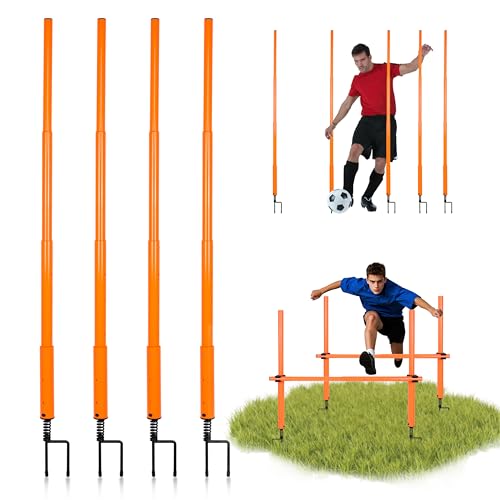
When shopping for running poles, buyers occasionally encounter multi-sport training equipment that serves an entirely different purpose. For example, the Hikeen Adjustable Length Soccer Agility Training poles feature segmented shafts and metal ground spikes designed strictly for turf agility drills and football obstacle courses. While useful for footwork drills in an athletic field setting, agility equipment lacks the ergonomic handles, tungsten carbide tips, and lightweight folding architecture required for wilderness trails. Distinguishing between dedicated trail running poles and turf agility equipment ensures you select gear that protects your joints in alpine terrain.
True mountain running gear must withstand sudden downward loads and unpredictable rocky surfaces. When navigating overgrown brush or scree-covered ridges, matching your hardware with suitable apparel is just as essential as proper pole sizing. Consulting our guide on wearing long trail pants provides valuable insights into shielding your legs from trail debris, thorns, and abrasive rocks. Pairing protective trail apparel with properly sized running sticks creates a balanced system that keeps you moving safely across rugged backcountry routes.
Common Sizing Mistakes and Biomechanical Consequences
One of the most frequent mistakes trail runners make is selecting poles based strictly on catalog generalities without verifying their personal limb proportions. Runners with longer torsos and shorter arms often require slightly longer shafts than standard height charts suggest, while runners with long arms need shorter shafts. If your poles are sized too long, you will instinctively plant them too far forward, creating a braking effect that slows your forward momentum. This faulty angle also places unnecessary compressive stress on your shoulder joints during repetitive climbing strides.
Conversely, using poles that are too short forces you into an exaggerated thoracic hunch during sustained climbs. Leaning excessively forward compresses your diaphragm, reducing lung capacity and hindering optimal oxygen intake during high-exertion efforts. Short poles also force you to over-reach on downhill terrain, compromising stability and increasing the likelihood of knee hyperextension on steep steps. Taking the time to test your elbow angle on realistic terrain prevents these repetitive strain issues and optimizes your running economy.
Pre-Run Verification and Trail Maintenance
Before heading out on technical singletrack, always perform a thorough physical inspection of your folding mechanism and shaft joints. For push-button folding poles, pull the shaft firmly until the locking pin clicks securely into place, verifying that the internal tension cord holds all sections flush. Give each joint a gentle wiggle to ensure there is no excessive lateral play or loose fit between the carbon or aluminum sleeves. Applying full upper-body downward force on both poles while standing still confirms that the locking mechanism will not slip unexpectedly during a rapid descent.
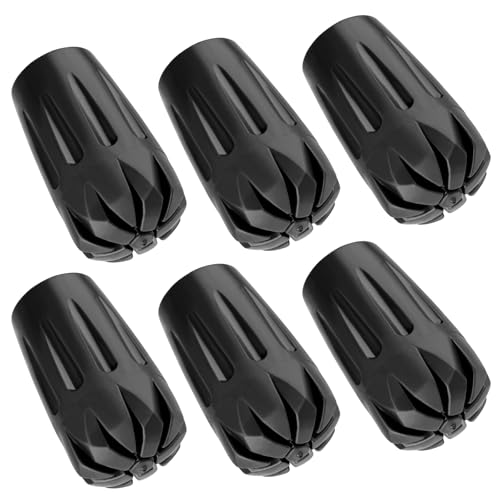
Trail maintenance also extends to inspecting your carbide flex tips and interchangeable baskets. Tungsten carbide tips provide aggressive bite on slick granite, frozen dirt, and loose scree, but rounded tips can slide out unexpectedly under load. Remove trail dust and grit from collapsible joints after wet runs to prevent internal abrasion or jammed push-button pins. Storing your poles fully dry in an open room prevents corrosion and ensures the folding mechanisms operate smoothly for your next mountain training block.
Determining the right running pole length ultimately balances your anatomical height, your preferred terrain gradient, and your choice between fixed and adjustable designs. By establishing a neutral 90-degree elbow bend, applying the standard 0.68 height formula, and considering lower choke-up grip extensions, you can tailor your setup to your exact mountain running goals. Reliable poles provide the stability and propulsion needed to conquer challenging vertical terrain with confidence. Take the time to verify your fit before race day so you can enjoy fluid, efficient movement across every mountain mile.






Write Your Review
No reviews yet. Be the first to share your experience!