


Active adults facing mild joint stiffness or balance hesitation often search for dependable ways to stay mobile without worsening discomfort. Understanding what is nordic walking training reveals an effective fitness discipline that transforms ordinary walking into a rhythmic, total-body workout. Originating as dry-land training for cross-country skiers, this activity utilizes specialized poles to propel the body forward, engaging upper-body musculature while distributing ground impact forces away from vulnerable joints.
Using dual poles encourages an upright posture, steady cadence, and symmetric stride length across outdoor paths. Pairing consistent walking sessions with supportive outdoor walking apparel can further enhance trail mobility and comfort as you build lower-limb endurance. While dynamic fitness poles provide balance confidence, they differ fundamentally from medical mobility aids designed for orthopedic offloading, making professional gait guidance valuable when managing chronic mobility limitations.
Pros
- Lightweight build at only 9.92 oz per pole reduces arm fatigue on long day hikes and backpacking trips
- Internal anti-shock springs help absorb repeated trail impacts on rocky or downhill terrain
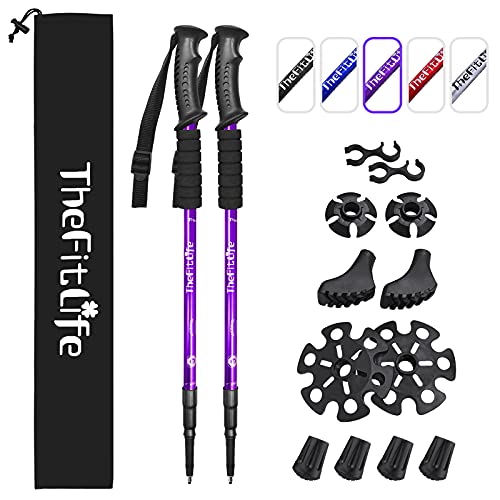
- Includes full set of mud baskets, snow baskets, walking caps, and rubber tips for varied trail surfaces
- Disassembles down to 21.46 inches for practical packing inside standard 22-inch travel luggage
Cons
- Internal twist locks require firm manual tightening compared to external flick-lock levers
- Collapsed length of 25.6 inches may protrude above compact daypacks when lashed to external straps
- Rubber grips offer dependable traction but may feel less breathable on hot, sweaty summer hikes than natural cork
TheFitLife Telescopic Trekking Poles are adjustable three-section aluminum hiking sticks designed for day hikers, weekend backpackers, fitness walkers, and travelers who need reliable balance assistance on the trail. Weighing just 9.92 ounces (282 grams) per pole, this set adds minimal weight when strapped to a backpack while offering structural stability for ascending steep inclines and navigating uneven terrain.
Built to accommodate a broad range of user heights, each pole extends from 25.6 inches (65 cm) up to 51.2 inches (130 cm). The internal anti-shock spring system is engineered to dampen trail vibrations each time the pole plants on hard rock or packed dirt. This subtle cushioning effect is particularly helpful during long descents where repetitive shock transfers directly into the wrists, elbows, and knees.
The shafts are constructed from high-strength aluminum alloy, balancing impact resistance with fatigue durability on rocky paths. Rather than using external clamp levers that can catch on underbrush or gear webbing, TheFitLife utilizes a refined internal twist-lock system. It tightens securely with a simple twist, maintaining a streamlined profile that is easy to operate even while wearing trail gloves. Ergonomic non-slip rubber grips provide a firm and comfortable hold throughout changing weather.
Packing and trail transport are straightforward. Outdoor hikers can secure the poles externally using backpack gear loops and compression straps at their collapsed length of 25.6 inches. For travelers packing for distant trailheads, the poles separate completely into three sections measuring 21.46 inches (54.5 cm), allowing them to fit diagonally inside most standard 22-inch or larger travel suitcases. The package also includes mud baskets, snow baskets, protective rubber tips, and walking caps to handle mud, scree, snow, or paved paths.
A realistic consideration is the twist-lock design itself. While it eliminates bulky external hardware, twist mechanisms require deliberate tightening to prevent slipping under heavy vertical pressure, which can be harder to gauge in freezing weather compared to quick-cam levers. Additionally, hikers using small daypacks under 20 liters may find the 25.6-inch collapsed length slightly tall when mounted to smaller exterior pack pockets.
For recreational day hikers, entry-level backpackers, and fitness walkers seeking reliable trail support at a budget-conscious price point, TheFitLife Telescopic Trekking Poles offer strong value. Their combination of joint-cushioning anti-shock springs, solid aluminum durability, and comprehensive seasonal attachments makes them a versatile companion for trails across the country.
TheFitLife Trekking Poles offer a versatile length adjustment range spanning from 25.6 inches (65 cm) to 51.2 inches (130 cm). This broad range allows men, women, teenagers, and seniors to set an optimal pole height that maintains an efficient 90-degree elbow bend on flat terrain.
Height adjustments are controlled by twisting the telescoping sections. Hikers can shorten the shafts during steep uphill climbs to maintain forward momentum or lengthen them on descents to improve balance and stability across rough trail sections.
When hiking with a daypack or backpacking pack, these poles can be secured externally to trekking-pole loops, daisy chains, or side compression straps. Their collapsed profile of 25.6 inches sits comfortably alongside standard 30 to 65-liter backpacks without excessive overhang.
For air travel or off-season storage, the three aluminum sections can be separated entirely. In this disassembled state, the longest section measures 21.46 inches (54.5 cm), making the set compact enough to fit diagonally within most 22-inch or larger luggage bags.
TheFitLife provides a multi-terrain accessory kit with every pair. Included are rubber tips for hard rock surfaces, walking caps designed for paved surfaces and fitness walking, mud baskets to prevent poles from sinking into soft soil, and broader snow baskets for winter trail use.
All included attachments screw on and off quickly in the field without tools. This modular system allows hikers to adapt the poles seamlessly whether navigating muddy spring switchbacks or paved park trails.

Pros
- Lightweight 9.92 oz aluminum build delivers sturdy trail balance without unnecessary swing weight
- Three-section breakdown fits diagonally in 22-inch suitcases or straps cleanly to hiking daypack loops
- Internal anti-shock spring cushions downward pressure during steep, sustained mountain descents
- Comes complete with four versatile tip and basket attachments suited for year-round trail conditions
Cons
- Twist-lock mechanisms require firm manual tightening and lack the visual verification of external lever flick-locks
- Rubber grips do not wick perspiration as naturally as cork handles during hot summer hikes
- Full 25.6-inch collapsed length may extend beyond the top of compact daypacks unless disassembled
TheFitLife Telescopic Trekking Poles are three-section aluminum hiking sticks designed for day hikers, weekend backpackers, and travel-oriented walkers seeking joint support and trail balance. Featuring an integrated anti-shock spring and an internal twist-lock system, this pole pair caters to budget-conscious outdoor enthusiasts, beginners, and fitness walkers. Because they collapse and disassemble into three compact segments, they serve hikers who regularly transport their gear via 22-inch travel luggage or external backpack attachment loops.
On the trail, weight management and proper height adjustment remain critical for maintaining a steady rhythm. Each pole weighs 9.92 ounces (282 grams), resulting in an aggregate weight of just over 1.5 pounds for the pair. The telescopic aluminum shafts adjust across a usable range of 25.6 inches (65 cm) up to 51.2 inches (130 cm), accommodating men, women, teens, and seniors. When navigating steep descents, the internal anti-shock mechanism activates under downward pressure to absorb trail vibration, while the ergonomic rubber grips deliver steady hand placement across varied walking paces.
The shafts are fabricated from high-strength aluminum alloy, engineered to offer dependable impact resistance against roots, scree, and rocky paths without premature fatigue. TheFitLife utilizes an internal twist-lock mechanism rather than external cam levers, creating a streamlined, low-profile outer diameter that will not catch on dense brush or snag against backpack compression webbing. While the rubber grips lack the moisture-wicking properties of natural cork, their textured surface provides a non-slip grasp in damp conditions, paired with an adjustable wrist strap to help secure your grip.
Transporting these poles alongside your hiking pack or travel baggage is straightforward. When fully collapsed, the poles measure 25.6 inches, making them ideal for securing directly against backpack trekking-pole loops and upper compression straps. For air travel or compact gear totes, each pole disassembles into three independent sections measuring 21.46 inches (54.5 cm), allowing them to slip diagonally into most 22-inch or larger suitcases. Swapping the included rubber tips, flat walking caps, mud baskets, and snow baskets is tool-free, enabling quick configuration changes before heading onto muddy switchbacks or hard pavement.
While practical and versatile, this design presents a few real-world limitations. The internal twist locks require careful hand tightening to avoid accidental slippage under heavy body loads, and they lack the visual security checks provided by external lever locks. In addition, the 25.6-inch collapsed length can extend noticeably above smaller hydration packs or 15-liter daypacks if you do not disassemble them completely. Hikers who prefer ultralight carbon fiber construction or naturally cooling cork handles will also notice the denser feel and moisture retention of the rubber grip material on warm afternoon treks.
For hikers, campers, and travelers searching for an affordable, full-featured trekking pole set that integrates smoothly with backpack lash loops and standard luggage, TheFitLife Telescopic Trekking Poles offer balanced utility. Their aluminum strength, internal anti-shock cushioning, and comprehensive basket kit make them a practical gear choice for everyday trail walks and weekend mountain outings alike.
When preparing for trail outings or flights, gear packability is essential. TheFitLife Telescopic Trekking Poles adjust from a minimum collapsed height of 25.6 inches (65 cm) to a maximum deployed length of 51.2 inches (130 cm). For routine day hiking, the collapsed poles slide easily through lower trekking-pole gear loops on standard daypacks and secure firmly under side compression straps.
For travelers flying to trail destinations, the three aluminum segments can be pulled apart completely. Disassembled, the longest pole section measures 21.46 inches (54.5 cm), allowing the set to lay diagonally inside standard 22-inch or larger hard-shell and soft-sided suitcases. Hikers should verify their pack dimensions and luggage interior measurements before departure to ensure compliant packing.
TheFitLife provides a multi-season accessory kit that expands the poles' versatility across various terrain types. The package includes standard rubber tips for road walking and pavement, wide walking caps for improved asphalt traction, mud baskets to prevent pole sinkage on soft soil, and wide snow baskets for winter trail excursions.
All accessories thread and press securely onto the pole ends without specialized tools. Hikers should inspect the wear on rubber tips and check basket tightness prior to hitting rocky backcountry routes, storing unused attachments in an organizer pouch inside their backpack until needed.
Understanding Nordic Walking Training and Pole Mechanics
Nordic walking training is an active aerobic exercise and gait-conditioning method that incorporates two specialized poles to propel the walker forward with every step. Unlike passive walking where poles merely brush the dirt, this method uses an active planting and backward push phase to engage the upper torso, core, and arms. The movement redistributes weight away from overworked knees and hips while increasing cardiovascular effort naturally. For seniors seeking balance stability and active adults targeting low-impact conditioning, this training provides a structured pathway toward improved mobility.
The Core Principles of Nordic Walking Training
The foundation of this walking discipline relies on a natural diagonal stride that mirrors standard human walking patterns. As your left leg steps forward, your right arm swings forward to plant the pole tip at an angle behind the body. Backward propulsion through the hand strap drives the torso smoothly over the forward foot without jarring the spine. This continuous push-off sequence increases oxygen consumption and caloric expenditure without amplifying the perceived physical exertion of the walker.
Postural alignment remains central throughout each session. Walkers maintain an elongated spine with relaxed shoulders, an open chest, and an engaged core that prevents compensatory leaning. Active shoulder extension and flexion replace passive arm hanging, encouraging gentle thoracic rotation that loosens tight spinal segments. Over time, regular practice reinforces a stable, rhythmic walking cadence that translates into greater stride symmetry during everyday walking.
Biomechanical Joint Offloading and Upper-Body Engagement
Lower-extremity joint preservation is one of the most compelling advantages of incorporating poles into regular fitness routines. Planting the pole tip and pushing backward transfers ground reaction forces through the arms, shoulders, and chest wall. This mechanical offloading spares the tibiofemoral cartilage in the knees, the acetabular labrum in the hips, and the lumbar vertebrae from harsh repetitive shock. Individuals managing mild osteoarthritis often discover that pole propulsion allows them to cover longer distances before experiencing localized joint discomfort.
Simultaneously, the backward thrust activates key postural muscle groups that often remain dormant during standard walking. The latissimus dorsi, triceps brachii, posterior deltoids, and deep abdominal stabilizers work synchronously with each stride. Standard walking engages approximately seventy percent of the body’s skeletal muscle mass, whereas active pole walking recruits up to ninety percent. The resulting full-body muscular activation boosts cardiovascular endurance while strengthening core stabilizers that protect lower back health.
Nordic Walking Sticks Versus Medical Walking Canes
Active adults must distinguish between fitness walking poles and prescribed medical mobility aids. A standard single-point cane or quad cane is engineered specifically for vertical weight offloading, transferring fifteen to twenty-five percent of body weight away from a recovering limb during slow, deliberate steps. Medical canes feature wide, flat non-slip rubber tips and rigid vertical shafts that support downward loads directly beneath the hand. Nordic poles, in contrast, feature slender, lightweight shafts designed for dynamic diagonal pushing rather than static vertical support.
Substituting dynamic fitness sticks for a clinical cane during acute orthopedic recovery creates substantial fall risks. Angled rubber paws or pointed trail tips can slip abruptly on polished linoleum, slick bathroom tile, or smooth hardwood when subjected to full downward body weight. Furthermore, users recovering from hip replacement surgery or suffering from severe balance ataxia lack the bilateral coordination needed to handle dual swinging poles. Anyone managing moderate to severe balance deficits or non-weight-bearing restrictions should rely on medical canes or walkers recommended by a physician.
Proper Pole Sizing and Anatomical Height Adjustment
Accurate pole height ensures proper mechanical leverage while guarding against neck and shoulder tension. When standing upright with the pole tip resting beside your foot, your elbow should form an approximate ninety-degree angle as you grip the handle. A practical sizing guideline calculates target pole length by multiplying your standing height in centimeters by 0.68. If poles are adjusted too tall, your shoulders hike upward involuntarily, causing upper trapezius stiffness and cervical spine discomfort.
Poles set too low compromise biomechanical efficiency by forcing the user to hunch forward during forward propulsion. Most telescoping aluminum models include printed numerical markings along the shaft to streamline precise adjustments. Always measure and adjust your poles while wearing your preferred walking shoes, since varying outsole thickness alters your floor-to-hand distance. Telescopic designs extending from 25.6 inches to 51.2 inches provide the versatility needed to accommodate men, women, teens, and seniors across diverse heights.
Shaft Construction, Twist Locks, and Anti-Shock Springs
Shaft engineering determines how securely walking sticks support repetitive thrusting forces along outdoor trails. High-strength aluminum alloys provide dependable impact resistance and fatigue durability while keeping overall weight around ten ounces per pole. Telescoping sections utilize internal twist-lock mechanisms that expand firmly against the inner tube walls when rotated clockwise. This internal locking layout eliminates external levers and protruding clamps that could snag on trail brush or loose clothing.
Internal anti-shock springs housed within the shaft sections supply supplementary dampening against hard ground strikes. When the pole impacts asphalt, packed gravel, or rocky terrain, the spring compresses momentarily to dissipate vibration before it reaches the wrist, elbow, and shoulder joints. This dampening mechanism benefits walkers with mild wrist osteoarthritis or repetitive strain sensitivities. Conducting a quick pre-walk check to confirm that every twist-lock joint is firmly tightened prevents unexpected shaft slippage during vigorous training.
Ergonomic Grip Shapes, Wrist Straps, and Hand Mechanics
Grip geometry and strap integration dictate how effectively pushing forces transfer from the upper body into the ground. Ergonomic rubber grips are contoured to cradle the natural arch of the palm, dispersing pressure evenly across the thenar eminence. Unlike traditional hiking sticks that depend entirely on finger clamping, Nordic training sticks rely on specialized wrist straps. These straps wrap securely around the wrist and palm, allowing the body to push the pole backward without maintaining a continuous tight grip.
Adjusting the strap tension correctly enables the walker to open the fingers slightly as the hand passes the hip line at the end of each stride. The strap supports the palm directly, transferring backward momentum seamlessly while giving the forearm muscles a momentary rest. This rhythmic grip-and-release mechanic prevents hand cramping, reduces palm numbness, and alleviates carpal tunnel pressure. A secure, comfortable strap system ensures efficient energy transfer while keeping the poles aligned with the forearm axis.
All-Terrain Tip Selection: Rubber Paws to Trail Baskets
Adapting your pole tips to specific walking surfaces is essential for maintaining dependable grip and smooth propulsion. For paved roads, concrete sidewalks, and neighborhood pathways, angled rubber walking caps, frequently called asphalt paws, provide quiet traction. The rubber compound dampens surface shock while preventing the hard internal metal tip from skidding on smooth stone. Always position the angled bevel of the rubber paw facing backward so it grips firmly as the pole pushes against the pavement.
Venturing onto unpaved dirt trails, gravel paths, or grass requires removing the rubber caps to expose durable carbide or steel tips. These pointed metal tips bite securely into soft earth, giving the walker dependable traction on uneven outdoor terrain. Attachable mud baskets or snow baskets prevent the slender shafts from sinking deeply into soft ground or seasonal slush. Regularly inspecting rubber caps for tread wear ensures that you replace worn components before the inner metal core punches through the rubber surface.
Step-by-Step Technique for the Reciprocal Diagonal Stride
Developing an efficient diagonal stride starts by letting the poles drag loosely behind you while walking naturally on level ground. Allow your arms to swing freely in opposition to your legs, keeping your gaze forward and your shoulders completely relaxed. Once your reciprocal arm swing feels natural and rhythmic, gently grasp the handles and begin planting the tips backward. The pole should strike the ground at an angle, aligning roughly between your front heel and your rear foot.
Push firmly through the wrist strap as your body glides forward past the planted pole. As your hand reaches your hip line, release your grip slightly and let the strap complete the backward thrust. Swing the opposite arm forward in a smooth arc to initiate the next plant, maintaining a steady, flowing cadence. Practicing this fluid rhythm on flat turf or quiet park paths builds motor memory before you advance to rolling terrain or brisk fitness paces.
Troubleshooting Posture Mistakes and Overreaching Errors
Novice walkers frequently make mechanical errors that compromise the conditioning benefits of Nordic walking training. The most common error is planting the pole tip too far forward in front of the body, creating an unintended braking force. Overreaching jars the shoulder girdle, halts forward momentum, and forces the lower back into hyperextension. Focus on keeping the pole plant behind your center of gravity so every push propels you forward rather than slowing you down.
Another frequent misstep is maintaining a continuous white-knuckle squeeze on the rubber handles throughout the walking cycle. Squeezing constantly causes rapid forearm fatigue, wrist joint soreness, and stiff elbows that absorb unnecessary shock. Learn to trust the wrist strap to carry the propulsion load, relaxing your fingers during the swing and release phases. If you notice neck tension or shoulder tightness after a session, check your pole height to ensure the telescoping sections have not slipped out of alignment.
Travel Packability and Twist-Lock Maintenance
Portability makes telescopic walking sticks practical companions for travelers, commuters, and fitness enthusiasts on the go. High-grade three-section poles collapse down to approximately 25.6 inches and can even disassemble into individual sections measuring roughly 21.46 inches. When separated into individual segments, they stow diagonally inside standard 22-inch suitcases, satisfying typical airline carry on luggage guidelines for travelers. Outdoor hikers can also strap the collapsed poles securely to external backpack loops between trailheads.
Proper maintenance protects internal twist-lock mechanisms and ensures dependable locking strength over years of outdoor use. After walking in damp or dusty environments, pull the shaft sections apart and wipe each aluminum tube with a dry microfiber cloth. Never apply oil, WD-40, or grease to the internal expanding plugs, as chemical lubricants cause the locking expanders to slip under vertical pressure. Storing poles completely dry in an uncompressed state prevents internal corrosion and maintains smooth telescoping adjustments.
Clinical Safety and Consulting Mobility Specialists
Nordic walking training offers impressive functional conditioning, but participants must possess adequate baseline balance and motor coordination. Physical therapists frequently introduce pole walking to individuals managing early Parkinson’s disease or mild gait hesitation to widen stride length and reduce freezing episodes. However, training should proceed only after a qualified clinician evaluates fall risk, postural stability, and bilateral upper-extremity strength. Professional supervision guarantees that participants master safe planting mechanics without compromising balance.
If you experience sharp joint pain, sudden dizziness, or loss of balance while using walking poles, pause training and seek professional medical guidance. Walkers dealing with acute vestibular disorders, significant lower-limb weakness, or strict non-weight-bearing restrictions require medical walking canes, rollators, or bilateral walkers rather than dynamic fitness sticks. A physical therapist can perform a formal gait analysis, verify proper equipment sizing, and determine whether fitness sticks or prescribed mobility aids best suit your personal rehabilitation goals.
Incorporating regular Nordic walking sessions into your weekly fitness routine provides a rewarding method to enhance cardiovascular stamina, activate upper-body muscle groups, and relieve joint strain. By mastering the diagonal stride, dialing in proper pole height, and using appropriate rubber tips, walkers of all ages can pursue active outdoor mobility with greater confidence. Remember that fitness poles are designed for dynamic forward propulsion rather than static medical offloading, so stay attuned to your body and consult mobility professionals whenever specialized balance guidance is required.




Write Your Review
No reviews yet. Be the first to share your experience!