


Hikers preparing for rugged backcountry trips often wonder whether their winter ski gear can pull double duty on summer trails. You might ask yourself are ski poles and trekking poles the same when trying to optimize gear expenses before embarking on a challenging mountain trek. While both tools provide upper body balance points, their underlying engineering serves completely different athletic movements. Alpine ski poles prioritize fixed lateral rigidity for snow turns, whereas dedicated trekking poles feature telescoping height adjustments, vibration dampening shafts, and all-terrain traction tips. Using the wrong equipment on rocky ascents or steep drops can lead to wrist fatigue, poor ergonomics, and unnecessary joint strain.
Trekking poles actively reduce repetitive strain on lower body joints, offloading impact from knees and ankles during long downhill miles. Hikers managing chronic knee discomfort often pair adjustable poles with protective apparel like tendon knee hiking pants to keep joints aligned on steep descents. Modern hiking poles also feature modular components like interchangeable mud discs, carbide tips, and moisture wicking cork or foam handles that standard alpine ski poles lack. In addition, packability remains a major distinction because collapsible shafts easily fit into luggage alongside an iron frame hiking backpack for remote trail travel. Understanding how these mechanical differences affect trail safety and efficiency helps you make the right gear selection for your next outdoor journey.


Pros
- Folds down to 15 inches, making it significantly easier to pack inside travel luggage or strap to compact daypacks than standard telescoping poles
- Moisture-wicking natural cork handles keep palms dry and comfortable across humid hiking conditions
- Sturdy metal flip locks and reinforced joint caps provide solid structural support without slippage when properly tensioned
- Lower EVA foam grips allow instant trail adjustment for steep uphill climbing
Cons
- At 11.5 ounces per pole, they carry more weight than specialized ultralight carbon fiber poles
- The 110 cm minimum height setting may feel slightly too long for hikers under 5 feet 2 inches
- Per TSA regulations, trekking poles with metal tips must be packed in checked luggage rather than carried on flights
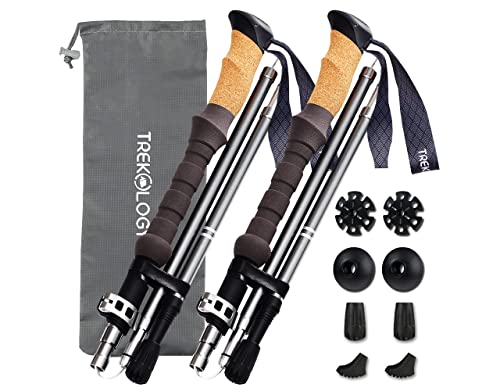
The Trekology Trek-Z Cork Grip Trekking Poles are folding, multi-section hiking sticks designed for hikers, backpackers, and travelers who require sturdy trail stability without the awkward bulk of traditional telescoping poles. Sold as a pair with an included carry bag, these poles suit day hikers tackling uneven paths, weekend backpackers managing load transfer on descents, and outdoor enthusiasts who need compact gear that fits inside travel luggage or standard daypack side sleeves.
Trail packability is one of the standout characteristics of this design. Utilizing a retractable tri-fold cable system, each pole breaks down to just 15 inches (38 cm) in overall length. This short folded dimension lets you slip the pair directly into the main compartment of an overnight pack, tuck them into side stretch-mesh water bottle pockets, or strap them beneath external compression straps without snagging overhead brush. For length adjustment, an upper aluminum section provides a 20 cm sliding range from 110 cm to 130 cm, catering to user heights between 5 feet 2 inches and 6 feet 5 inches.
Component construction focuses on long-term trail durability. Trekology builds the Trek-Z poles from aircraft-grade aluminum alloy, which provides higher impact resistance and flex tolerance against rocky crevices compared to brittle carbon fiber. The folding shaft joints feature protective metal caps to resist wear at stress points during repeated assembly. Up top, the natural cork grip wicks moisture away from sweaty palms during steep ascents, while a secondary EVA foam grip sleeve allows you to lower your hand placement instantly on steep trail grades without adjusting the shaft length.
Deploying and adjusting the poles requires a straightforward two-step setup. After letting the lower segments drop into place, you pull the upper shaft section until an internal metal locking button pops outward with a firm click. A durable metal external flip lock then secures the upper telescoping section at your desired height marker. Proper setup is essential; if the lower shaft feels loose or disconnected, the metal lock button must be firmly pulled until fully seated in its designated catch hole. Maintenance is simple, requiring only an occasional wipe-down with a dry cloth after muddy hikes before packing into the included storage sleeve.
While practical and durable, the Trek-Z design carries a few realistic limitations. Each pole weighs 11.5 ounces (330 grams), resulting in a combined pair weight around 23 ounces, which may deter dedicated ultralight thru-hikers who prefer minimal swing weight. Additionally, the minimum length of 110 cm means youth hikers or adults under 5 feet 2 inches might find the grip positioning too elevated on flat terrain. Travelers should also remember that TSA guidelines require trekking poles with rigid tips to travel inside checked baggage rather than carry-on packs.
For hikers seeking an affordable, compact, and robust set of walking poles, the Trekology Trek-Z Cork Grip poles deliver excellent overall value. They provide dependable joint support, sweat-wicking cork comfort, and pack-friendly folding convenience that fits easily into standard hiking backpacks and travel duffels.
The Trekology Trek-Z poles feature an adjustable working range between 110 cm and 130 cm, making them compatible with users measuring between 5 feet 2 inches and 6 feet 5 inches in height. Sizing adjustments are controlled via a durable metal flip-lock clamp positioned on the upper shaft section, marked with clear centimeter increments for quick alignment.
Hikers can lengthen the poles slightly for steep downhill sections to maintain an upright posture, or shorten them for prolonged uphill climbs. For fast grade transitions where stopping to loosen the clamp is impractical, the extended EVA foam grip below the primary cork handle allows instant choke-down positioning.
Thanks to a three-section folding architecture linked by an internal tension cable, the Trek-Z poles collapse down to an ultra-compact 15 inches (38 cm). This compact footprint allows them to slide vertically inside most 20-liter to 65-liter hiking backpacks, eliminating the tip-heavy snagging hazards common with longer two-piece or three-piece telescoping poles.
A matching carry bag is included to keep trail mud and dust away from sleeping bags, pack liners, and clothing when stored internally. When flying to destination trailheads, note that airline security guidelines require trekking poles to be packed within checked baggage rather than carry-on luggage.
The shafts are manufactured from aircraft-grade aluminum alloy, delivering high tensile strength and resilience against bending forces when supporting heavy backpack loads on rocky trails. The connection joints between segments are reinforced with metal caps to resist cracking and wall deformation under load.
The upper handle utilizes natural cork material that absorbs hand moisture, resisting slick spots during warm summer outings. The handle is engineered with a slight rotational flex that acts as an anti-torque buffer, reducing jarring impacts transmitted through the hands and wrists across prolonged trail miles.
Pros
- Lightweight build at only 9.92 oz per pole reduces arm fatigue on long day hikes and backpacking trips
- Internal anti-shock springs help absorb repeated trail impacts on rocky or downhill terrain
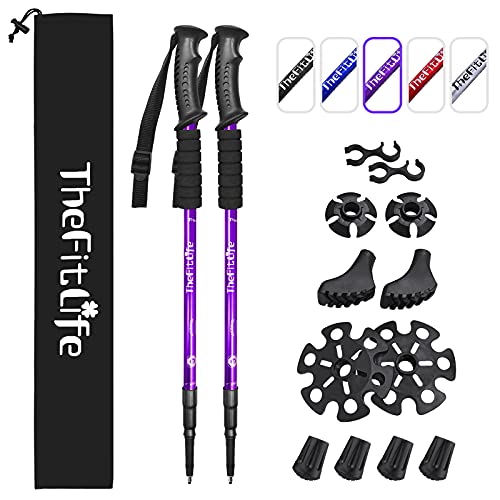
- Includes full set of mud baskets, snow baskets, walking caps, and rubber tips for varied trail surfaces
- Disassembles down to 21.46 inches for practical packing inside standard 22-inch travel luggage
Cons
- Internal twist locks require firm manual tightening compared to external flick-lock levers
- Collapsed length of 25.6 inches may protrude above compact daypacks when lashed to external straps
- Rubber grips offer dependable traction but may feel less breathable on hot, sweaty summer hikes than natural cork
TheFitLife Telescopic Trekking Poles are adjustable three-section aluminum hiking sticks designed for day hikers, weekend backpackers, fitness walkers, and travelers who need reliable balance assistance on the trail. Weighing just 9.92 ounces (282 grams) per pole, this set adds minimal weight when strapped to a backpack while offering structural stability for ascending steep inclines and navigating uneven terrain.
Built to accommodate a broad range of user heights, each pole extends from 25.6 inches (65 cm) up to 51.2 inches (130 cm). The internal anti-shock spring system is engineered to dampen trail vibrations each time the pole plants on hard rock or packed dirt. This subtle cushioning effect is particularly helpful during long descents where repetitive shock transfers directly into the wrists, elbows, and knees.
The shafts are constructed from high-strength aluminum alloy, balancing impact resistance with fatigue durability on rocky paths. Rather than using external clamp levers that can catch on underbrush or gear webbing, TheFitLife utilizes a refined internal twist-lock system. It tightens securely with a simple twist, maintaining a streamlined profile that is easy to operate even while wearing trail gloves. Ergonomic non-slip rubber grips provide a firm and comfortable hold throughout changing weather.
Packing and trail transport are straightforward. Outdoor hikers can secure the poles externally using backpack gear loops and compression straps at their collapsed length of 25.6 inches. For travelers packing for distant trailheads, the poles separate completely into three sections measuring 21.46 inches (54.5 cm), allowing them to fit diagonally inside most standard 22-inch or larger travel suitcases. The package also includes mud baskets, snow baskets, protective rubber tips, and walking caps to handle mud, scree, snow, or paved paths.
A realistic consideration is the twist-lock design itself. While it eliminates bulky external hardware, twist mechanisms require deliberate tightening to prevent slipping under heavy vertical pressure, which can be harder to gauge in freezing weather compared to quick-cam levers. Additionally, hikers using small daypacks under 20 liters may find the 25.6-inch collapsed length slightly tall when mounted to smaller exterior pack pockets.
For recreational day hikers, entry-level backpackers, and fitness walkers seeking reliable trail support at a budget-conscious price point, TheFitLife Telescopic Trekking Poles offer strong value. Their combination of joint-cushioning anti-shock springs, solid aluminum durability, and comprehensive seasonal attachments makes them a versatile companion for trails across the country.
TheFitLife Trekking Poles offer a versatile length adjustment range spanning from 25.6 inches (65 cm) to 51.2 inches (130 cm). This broad range allows men, women, teenagers, and seniors to set an optimal pole height that maintains an efficient 90-degree elbow bend on flat terrain.
Height adjustments are controlled by twisting the telescoping sections. Hikers can shorten the shafts during steep uphill climbs to maintain forward momentum or lengthen them on descents to improve balance and stability across rough trail sections.
When hiking with a daypack or backpacking pack, these poles can be secured externally to trekking-pole loops, daisy chains, or side compression straps. Their collapsed profile of 25.6 inches sits comfortably alongside standard 30 to 65-liter backpacks without excessive overhang.
For air travel or off-season storage, the three aluminum sections can be separated entirely. In this disassembled state, the longest section measures 21.46 inches (54.5 cm), making the set compact enough to fit diagonally within most 22-inch or larger luggage bags.
TheFitLife provides a multi-terrain accessory kit with every pair. Included are rubber tips for hard rock surfaces, walking caps designed for paved surfaces and fitness walking, mud baskets to prevent poles from sinking into soft soil, and broader snow baskets for winter trail use.
All included attachments screw on and off quickly in the field without tools. This modular system allows hikers to adapt the poles seamlessly whether navigating muddy spring switchbacks or paved park trails.

Pros
- Lightweight 3K carbon fiber construction reduces carried and swinging weight to 7.6 ounces per pole
- Metal flip locks offer secure, slip-resistant tension compared to traditional twist-lock mechanisms
- Ergonomic cork handles paired with secondary EVA foam grips provide versatile hand positioning on varying trail grades
- Wide 24-inch to 55-inch adjustment span suits a diverse range of user heights and terrain angles
Cons
- Carbon fiber shafts can fracture if wedged between rocks and subjected to severe lateral bending forces
- Collapsed length of 24 inches may extend beyond the top or bottom of ultra-compact daypacks when mounted externally
- Metal flip lock levers require occasional thumb-screw tension checks to prevent slippage over extended mileage
The Hiker Hunger 100% Carbon Fiber Trekking Poles are adjustable three-section telescoping trail poles built for day hikers, section hikers, backpackers, and campers seeking to shed weight without giving up stability. Constructed from 3K carbon fiber, each pole weighs approximately 7.6 ounces, making them an excellent choice for hikers looking to reduce joint impact on rugged trails while keeping their base gear manageable.
In terms of trail adjustment, these poles expand from a compact 24 inches up to a full 55 inches, comfortably serving both shorter and taller hikers across diverse terrain grades. Rather than relying on twist locks that can slip or freeze when exposed to dirt and moisture, Hiker Hunger equips these poles with quick-adjust flip locks built with metal hardware. This provides firm, slip-resistant clamping whether you are lengthening the poles for a steep downhill descent or shortening them for an aggressive ridge climb.
Grip comfort is a primary design focus, featuring ergonomic natural cork handles that actively wick moisture away from your palms while molding to your hand shape over time. Directly beneath the cork handles, secondary nonslip EVA foam extensions provide an immediate choke-down point for short, steep switchbacks, eliminating the need to stop and adjust pole length. Soft neoprene-padded wrist straps further enhance comfort, distributing downward pressure across your wrists without causing chafing during long mileage days.
Transporting and maintaining these poles on the trail is straightforward. When not in use, the shafts collapse down to 24 inches, allowing them to nest securely into side water bottle pockets, slide behind backpack compression straps, or strap onto front trekking-pole attachment loops. Maintenance involves basic trail hygiene: simply wipe away grit and moisture after wet outings and periodically check the thumbscrew tension on the metal flip locks to preserve optimal clamping force.
While carbon fiber provides exceptional weight savings and natural vibration damping, it behaves differently than aluminum under severe lateral stress. If a carbon pole becomes trapped between roots or granite boulders and is subjected to heavy sideways leverage, it is susceptible to cracking or snapping rather than bending. Additionally, hikers using compact daypacks under 20 liters should note that the 24-inch collapsed height will protrude somewhat above the pack rim when lashed to external straps.
For day hikers, multi-day backpackers, and travelers seeking an agile pair of poles with natural cork ergonomics and durable metal locking mechanisms, the Hiker Hunger Carbon Fiber Trekking Poles represent strong trail value. Backed by a 1-year warranty and a USA-based company, they provide dependable knee-saving support and steady balance across varied backcountry trails.
The Hiker Hunger trekking poles feature a telescoping three-section shaft that adjusts smoothly between 24 inches and 55 inches. This expansive range accommodates men, women, and younger hikers across flat paths, steep alpine ascents, and knee-jarring descents.
Length adjustments are secured using external flip locks equipped with metal levers. Unlike plastic components that can warp or weaken over time, the metal locking mechanism maintains consistent clamping pressure against the carbon fiber sections to help prevent unexpected slippage while hiking under load.
Constructed entirely from 100% 3K carbon fiber, these poles offer high tensile strength and natural vibration absorption while weighing only 7.6 ounces per pole. This lightweight profile substantially lowers the energy required per arm swing over long trail days.
The upper handle combines natural moisture-wicking cork with dense EVA foam for the lower grip extension, providing comfortable handholds in both warm and cold weather. To maintain the structural integrity of carbon fiber, hikers should avoid using the poles as pry bars and keep the locking collars clean of trail debris.
With a collapsed length of 24 inches, these poles integrate easily with standard hiking daypacks and multi-day backpacking packs. They can be threaded through dedicated lower trekking-pole loops, secured via upper bungee cords, or held fast by side compression straps.
For travel or public transit to the trailhead, the 24-inch collapsed size allows the pair to fit inside standard checked luggage or across larger duffel bags, keeping your trail gear neatly consolidated between outings.

Pros
- Collapses down to a compact 15-inch profile that fits inside most hiking daypacks and travel bags.
- Aircraft-grade aluminum shafts and metal flip locks resist trail impacts better than fragile plastic clamps.
- Natural cork grips offer comfortable, sweat-resistant hand placement with lower EVA foam extensions for switchbacks.
- Listed at 9.95 ounces per pole, keeping carried base weight and trail fatigue low.
Cons
- The 100-120 cm adjustment range is strictly limited to hikers 5 feet 9 inches and under.
- Folding cord design requires manual joint alignment during deployment compared to standard twist or slide poles.
- Aluminum construction is slightly heavier than ultralight carbon fiber alternatives.
The Hiker Hunger Foldable Aluminum Trekking Poles are compact, packable hiking sticks designed for trail balance, stability, and joint relief during day hikes or backpacking excursions. With an adjustable range spanning 100 to 120 centimeters, this specific short variant is built specifically for hikers standing 5 feet 9 inches and under. For hikers who prefer to stow their poles inside or alongside a pack when scrambling rocky sections, boarding planes, or commuting to trailheads, the folding configuration provides a distinct packability advantage over standard full-length telescoping options.
On the trail, the main benefit of this system is the compact 15-inch collapsed length combined with a manageable listed weight of 9.95 ounces. The multi-section folding shafts slide smoothly into side water-bottle pockets, slip behind exterior pack compression straps, or stow entirely within internal gear compartments. This makes them especially useful for technical trail segments where hands-free movement is required, as well as for minimalist backpackers who value clean external pack lines without protruding gear.
Construction quality centers around aircraft-grade aluminum tubing connected by reinforced joints and secured with external metal flip locks. Metal locking levers provide reliable holding strength against vertical slippage on steep descents and resist impact damage better than brittle molded plastic alternatives. Hand comfort is supported by genuine cork main grips that shape to the palms and absorb sweat, while lower EVA foam grip extensions allow hikers to choke down during sudden steep switchbacks without pausing to unlock and shorten the poles.
Deploying and adjusting the poles is straightforward once familiar with folding-shaft mechanics. The lower segments lock into place via an internal tension cable, while the uppermost section provides 20 centimeters of fine height adjustment secured by the metal cam lever. Basic maintenance involves wiping away trail mud, letting the shafts and inner cable dry thoroughly before long-term storage, and checking the flip-lock tension screw occasionally to maintain firm clamping force.
Realistic limitations must be noted before purchase. Because this model reaches a maximum length of 120 centimeters, hikers taller than 5 feet 9 inches will lack sufficient extension for a proper 90-degree arm angle, particularly on steep downhill sections. Furthermore, while aluminum bends rather than snaps abruptly under extreme lateral loads, it carries a small weight penalty over premium carbon fiber alternatives. The folding joints also require routine visual checks to ensure trail grit does not interfere with proper joint seating.
For day hikers, section hikers, and adventure travelers who fit within the recommended height parameters, these Hiker Hunger poles represent a well-constructed, travel-friendly trail tool. Their 15-inch packed profile, durable metal hardware, and ergonomic cork handles make them a dependable asset for any hiker seeking reliable stability without taking up unnecessary pack volume.
This model features an adjustable usable length between 100 and 120 centimeters, designed to fit hikers who are 5 feet 9 inches tall and shorter. Proper ergonomic trekking pole fit requires that your elbow forms approximately a 90-degree bend when holding the grip with the pole tip resting on level ground.
Hikers near the upper limit of 5 feet 9 inches who frequently tackle steep mountain descents may find themselves near the pole maximum extension. Hikers taller than 5 feet 9 inches should look toward the longer 115 to 135 centimeter variant to ensure adequate downhill reach and optimal joint support.
Collapsing down to just 15 inches, these folding poles pack considerably smaller than standard two-section or three-section telescoping poles that typically collapse to 24 inches or more. This compact profile allows them to slide entirely inside daypacks, luggage, or trunk storage compartments without sticking out.
When stowing poles on your backpack exterior, the 15-inch length minimizes snagging hazards when hiking through dense brush or off-trail terrain. To maintain the internal tension cord and prevent corrosion, ensure all sections are completely dry before packing them away for extended off-season storage.
Core Mechanical Differences Between Ski Poles and Trekking Poles
Ski poles and trekking poles are not the same, despite sharing a basic pole silhouette and providing upper body contact points. Downhill ski poles are engineered specifically for snow sports where the user pushes across flat snow or initiates downhill turns. Trekking poles serve as dynamic walking aids built to absorb continuous vertical shock across variable dirt, mud, scree, and granite. While an alpine ski pole relies on a rigid, single-piece tube, a trekking pole provides multi-stage length adjustability, modular trail tips, and ergonomic grips tailored for walking strides.
Primary Functional Intent and Load-Bearing Dynamics
Alpine ski poles are primarily designed to assist with timing, rhythm, and balance during dynamic downhill turns. Because the primary braking force in skiing comes from ski edges engaging snow, ski poles rarely sustain direct, continuous vertical body weight. In contrast, trekking poles are engineered to handle repetitive vertical load transfer with every single footstep on rugged hiking trails. This fundamental difference in biomechanical purpose shapes every engineering choice, from shaft diameter and tube wall thickness to internal stress tolerances.
When hiking down a steep mountain pass with a heavy backpack, each pole plant offloads significant impact from your knees and ankles. Ski poles lack the built-in mechanical dampening or precise height calibration needed to maintain an efficient walking posture across uneven trail gradients. Using fixed downhill ski poles on a rocky trail sends sharp impact shock directly into your elbows and shoulders. Trekking poles disperse those ground impact forces through flexible composite weaves, mechanical springs, or engineered shaft flex.
Shaft Adjustability: Fixed Length vs Telescoping and Folding Systems
The most obvious physical distinction between the two gear categories lies in shaft construction and adjustability. Traditional ski poles feature a single, continuous tube of fixed length, which matches a skier standing upright in alpine boots. Trekking poles, however, use multi-section telescoping tubes or folding segments that adjust across a wide height spectrum. For instance, the TrailBuddy 3K Carbon Fiber Hiking Poles adjust between 24 and 54 inches to accommodate hikers of varying heights and changing trail gradients.
Adjustability is essential because your optimal pole length shifts constantly as trail angles change throughout the day. Hikers typically shorten their poles by several inches when tackling steep climbs to maintain an efficient 90-degree elbow angle without straining their shoulders. On technical descents, lengthening the shafts lets you plant the tips further ahead to stabilize your footing without leaning forward awkwardly. A fixed ski pole forces you into unnatural body positions on anything other than flat ground, accelerating fatigue over long trail days.
Packability also separates walking sticks from winter gear when traveling to and from trailheads. Modern folding models like the Trekology Trek-Z Cork Grip Collapsible Lightweight utilize a tri-fold system that breaks down to just 15 inches for easy storage. Fixed ski poles measure around 45 to 52 inches permanently, making them impossible to stash inside standard daypacks or gear duffels. If you are packing for an extended flight or multi-modal transit, knowing what litre backpack for carry travel accommodates your gear helps you organize bulky equipment efficiently.
Shaft Metallurgy and Materials: Aircraft Aluminum vs 3K Carbon Fiber
Material composition reflects the distinct performance requirements of snow sports versus backcountry hiking. Alpine ski poles are predominantly constructed from heavy-gauge aluminum alloys designed to withstand cold temperatures and minor bending without snapping during a fall. In the trekking world, manufacturers prioritize high strength-to-weight ratios to reduce swing weight over thousands of consecutive forward swings. Ultralight composite shafts, such as those found on the 100% Carbon Fiber Trekking Poles by USA Brand, weigh only 7.6 ounces per pole while offering exceptional rigidity.
Carbon fiber excels at naturally absorbing micro-vibrations before trail chatter reaches the user’s wrists and forearms. However, composite poles exhibit distinct failure modes compared to metal alternatives when subjected to lateral shear stress. If a carbon pole slips into a deep boulder crevice and your forward momentum levers against it, the shaft can snap abruptly under side loads. High-grade aircraft aluminum, such as the alloy used in the Premium Foldable Hiking Poles by USA Brand, provides higher ductile tolerance, meaning it tends to bend rather than shatter under heavy lateral force.
Understanding these material properties helps backpackers choose between fatigue-reducing lightness and rugged trail durability. Aluminum remains a dependable choice for technical scrambling, talus hopping, and heavy pack hauling where accidental rock wedging is likely. Carbon fiber represents the ideal build for high-mileage thru-hikers who value minimal arm fatigue on well-graded trails. Ski pole tubing tends to be thicker and heavier because swing weight is far less critical during downhill skiing than on a twenty-mile mountain hike.
Locking Mechanisms and Slip Resistance
Because ski poles are fixed in length, they require no locking mechanisms, joints, or adjustment collars. Trekking poles rely on robust locking systems to support vertical body weight without slipping unexpectedly under load. The most popular mechanism is the external lever flip lock, featured on both the TrailBuddy and Hiker Hunger models. These metal or reinforced composite levers compress an outer collar around the inner shaft section, creating strong frictional resistance against downward force.
External lever locks are especially practical because hikers can easily calibrate clamp tension on the trail using an integrated thumbscrew. If an adjustment section begins to slip during a descent, tightening the thumbscrew restores firm clamping pressure without requiring specialized tools. Furthermore, flip locks remain easy to operate while wearing gloves in cold mountain weather, making them versatile across multiple seasons. A secure lock is a vital safety feature, as sudden shaft slippage on a rocky drop can lead to serious falls.
Other designs use internal expander twist locks or push-button tension pins to secure the shaft sections. The Telescopic Trekking Poles for Hiking from TheFitLife features a streamlined twist-lock system that hides hardware inside the pole to avoid snagging on brush. Tri-fold poles like the Trekology Trek-Z employ a spring-loaded metal pop-up button to lock internal cable tension, combined with an upper flip lock for fine height tuning. These multi-stage systems provide secure vertical stability while maintaining rapid collapsibility for transport.
Grip Ergonomics, Moisture Management, and Wrist Straps
Grip design represents another crucial operational difference between ski poles and hiking poles. Downhill ski poles feature firm rubber or hard plastic handles with aggressive finger notches designed for gripping with insulated winter ski gloves. Trekking pole grips, on the other hand, are contoured for bare hands and continuous skin contact over hours of warm-weather hiking. Ergonomic handles prioritize sweat absorption, friction management, and the prevention of hot spots and blisters.
Natural cork is a favored grip material among long-distance trekkers because it wicks palm perspiration and molds to hand anatomy over time. The Trekology Trek-Z pairs a natural cork main handle with a slight rotational flex feature designed to reduce torque on the wrist during repetitive plants. Closed-cell EVA foam, used on the TrailBuddy poles, provides a soft, cushioned feel that resists moisture saturation and maintains traction when hands are wet. Many trekking poles also add an extended EVA foam sleeve beneath the primary grip, allowing hikers to choke down briefly on steep ascents without adjusting pole length.
Wrist strap geometry also diverges significantly between the two sports. Ski pole straps are simple nylon loops intended to prevent pole loss during a downhill fall. Trekking pole straps feature wide, padded webbing designed to bear downward wrist load directly, allowing hikers to push forward without death-gripping the handles. Properly threading your hand up through the bottom of the strap transfers energy through the skeletal structure of your arm, drastically reducing forearm fatigue over long distances.
Trail Hardware: Carbide Flex Tips, Rubber Boots, and Modular Baskets
The bottom hardware of a pole interacts directly with the ground, making tip and basket design essential for stability. Ski poles feature blunt steel tips surrounded by large, non-removable or semi-permanent snow discs meant to prevent sinking into deep powder. Trekking poles utilize hard tungsten carbide tips that bite into bare granite, loose dirt, wet logs, and slick gravel. Carbide possesses exceptional hardness, resisting rapid abrasion on gritty surfaces where softer steel tips would quickly dull.
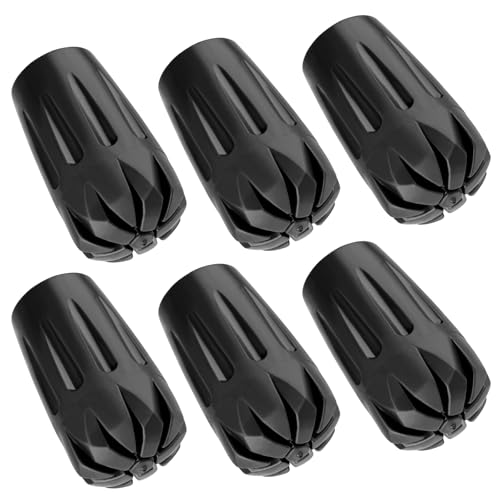
Versatile hiking poles come equipped with interchangeable accessory kits to match diverse trail surfaces throughout the year. TheFitLife poles include press-on rubber tips for pavement, rock-walking caps, small mud baskets, and broad winter snow baskets. Rubber tips slip over the carbide points to provide grip on asphalt or protect sensitive alpine rock from scarring, while also dampening metallic clicking sounds. Mud baskets prevent the pole tip from penetrating too deeply into boggy ground or getting wedged between narrow root gaps.
Attempting to use a standard alpine ski pole on a summer dirt trail creates several practical issues. The wide ski basket catches constantly on trailside roots, brush, and rocks, disrupting your natural walking cadence. Furthermore, the smooth or rounded tip of a ski pole tends to skid off hard-packed dirt and slick rock slabs, creating a slip hazard where you need firm support. Modular trekking hardware allows you to swap baskets in seconds, adapting to changing seasonal conditions effortlessly.
Packability, Travel Regulations, and Swing Weight Realities
Transporting poles to distant hiking destinations requires careful planning around size and security regulations. Because ski poles are rigid and measure over four feet long, they require dedicated ski bags and must always be checked as oversized baggage. Trekking poles collapse down to manageable dimensions, with three-section telescoping designs shrinking to around 24 inches. Foldable Z-poles like the Hiker Hunger Premium Foldable collapse to a compact 15 inches, slipping easily into standard luggage or duffel bags.
However, air travelers must be aware of security restrictions regarding sharp walking hardware. Because trekking poles feature sharp carbide tips, the Transportation Security Administration (TSA) and most international aviation authorities require them to be placed in checked luggage rather than carry-on bags. Trekology explicitly notes that their collapsible poles must be checked per airline security guidelines to avoid confiscation at security checkpoints. Planning your gear configuration around these travel rules prevents frustrating delays at the airport.
Swing weight is another critical factor that impacts endurance during long backcountry journeys. Because you lift and plant each pole thousands of times each day, heavy poles accelerate shoulder and tricep fatigue. Pairing ultralight composite trekking poles with comfortable trail apparel like hiking pants men lightweight creates an efficient system that conserves energy over high-mileage routes. Ski poles carry far higher swing inertia, making them exhausting to swing forward repeatedly across dry trails.
Trail Biomechanics and Ultralight Shelter Compatibility
The biomechanical benefits of dedicated trekking poles extend well beyond basic balance. When descending steep mountain slopes, consistent pole planting redistributes ground reaction forces away from the lower extremities. Consistent pole planting offloads impact during steep descents, supporting better control and comfort on downhill sections. Ski poles cannot replicate these biomechanical benefits because their fixed length forces the hiker to overextend their arms or lean forward awkwardly on uneven gradients.
Trekking poles also serve dual functions in ultralight backpacking setups that ski poles simply cannot match. Many modern backpacking tents and tarps eliminate heavy dedicated tent poles, relying instead on trekking poles as structural ridge supports. These shelters typically require precise apex heights between 115 and 135 centimeters to achieve proper canopy tension and shed wind effectively. Telescoping poles allow hikers to dial in exact height measurements, creating a taut pitch that keeps shelters stable in stormy mountain weather.
A fixed ski pole cannot adjust to meet these precise structural shelter specifications, leaving your tarp sagging or overstretched. Furthermore, the wide grips and sharp points of ski poles do not seat cleanly into reinforced shelter apex cones or grommets. Dedicated hiking poles feature flat or gently rounded grip tops designed to cradle shelter canopies without puncturing delicate fabrics. This versatility makes adjustable trekking poles an indispensable multi-purpose asset for wilderness travelers.
Practical Guidance for Trail Safety and Gear Selection
Choosing the right tool for the trail ultimately comes down to understanding your specific environment and safety needs. While ski poles remain the premier choice for resort skiing and deep winter descents, they lack the modularity, ergonomic refinement, and packability required for walking trails. Dedicated trekking poles provide the adjustability, vibration dampening, and reliable traction necessary to protect your joints and maintain balance across rough terrain. Investing in purpose-built hiking poles ensures that you stay comfortable, supported, and confident on every mile of your journey.




Write Your Review
No reviews yet. Be the first to share your experience!