


Navigating snowbound mountain trails places intense mechanical demands on your body, where every step on unstable powder challenges your balance and forces your stabilizer muscles into overdrive. Hikers frequently ask do you need trekking poles for snowshoeing when preparing for cold-weather adventures, especially when trying to balance winter pack weight and mobility. While casual walks across flat, groomed resort loops might feel manageable with free hands, breaking trail through uneven drifts or navigating rolling hills quickly exposes how difficult it is to stay upright without additional stability points. Using reliable poles transfers weight away from overworked quadriceps, which works well alongside supportive trail pants for joint relief during cold, strenuous ascents.
Adding a pair of dedicated poles transforms winter travel by establishing four solid points of contact across slick crust, hidden ice, and deep powder pockets. They provide essential braking power on steep descents, prevent awkward twisting falls, and allow you to probe concealed hollows around buried rocks or logs. Premium setups featuring external metal flip locks and resilient aluminum shafts withstand frigid temperatures where plastic clips and twist locks might freeze or slip under sudden vertical loads. Choosing the right configuration ensures that your winter outings remain safe, controlled, and far less taxing on your knees and lower back.

Pros
- Collapses down to a compact 15-inch profile that fits inside most hiking daypacks and travel bags.
- Aircraft-grade aluminum shafts and metal flip locks resist trail impacts better than fragile plastic clamps.
- Natural cork grips offer comfortable, sweat-resistant hand placement with lower EVA foam extensions for switchbacks.
- Listed at 9.95 ounces per pole, keeping carried base weight and trail fatigue low.
Cons
- The 100-120 cm adjustment range is strictly limited to hikers 5 feet 9 inches and under.
- Folding cord design requires manual joint alignment during deployment compared to standard twist or slide poles.
- Aluminum construction is slightly heavier than ultralight carbon fiber alternatives.
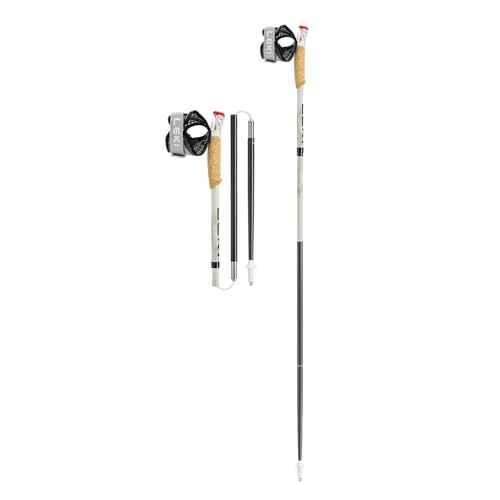
The Hiker Hunger Foldable Aluminum Trekking Poles are compact, packable hiking sticks designed for trail balance, stability, and joint relief during day hikes or backpacking excursions. With an adjustable range spanning 100 to 120 centimeters, this specific short variant is built specifically for hikers standing 5 feet 9 inches and under. For hikers who prefer to stow their poles inside or alongside a pack when scrambling rocky sections, boarding planes, or commuting to trailheads, the folding configuration provides a distinct packability advantage over standard full-length telescoping options.
On the trail, the main benefit of this system is the compact 15-inch collapsed length combined with a manageable listed weight of 9.95 ounces. The multi-section folding shafts slide smoothly into side water-bottle pockets, slip behind exterior pack compression straps, or stow entirely within internal gear compartments. This makes them especially useful for technical trail segments where hands-free movement is required, as well as for minimalist backpackers who value clean external pack lines without protruding gear.
Construction quality centers around aircraft-grade aluminum tubing connected by reinforced joints and secured with external metal flip locks. Metal locking levers provide reliable holding strength against vertical slippage on steep descents and resist impact damage better than brittle molded plastic alternatives. Hand comfort is supported by genuine cork main grips that shape to the palms and absorb sweat, while lower EVA foam grip extensions allow hikers to choke down during sudden steep switchbacks without pausing to unlock and shorten the poles.
Deploying and adjusting the poles is straightforward once familiar with folding-shaft mechanics. The lower segments lock into place via an internal tension cable, while the uppermost section provides 20 centimeters of fine height adjustment secured by the metal cam lever. Basic maintenance involves wiping away trail mud, letting the shafts and inner cable dry thoroughly before long-term storage, and checking the flip-lock tension screw occasionally to maintain firm clamping force.
Realistic limitations must be noted before purchase. Because this model reaches a maximum length of 120 centimeters, hikers taller than 5 feet 9 inches will lack sufficient extension for a proper 90-degree arm angle, particularly on steep downhill sections. Furthermore, while aluminum bends rather than snaps abruptly under extreme lateral loads, it carries a small weight penalty over premium carbon fiber alternatives. The folding joints also require routine visual checks to ensure trail grit does not interfere with proper joint seating.
For day hikers, section hikers, and adventure travelers who fit within the recommended height parameters, these Hiker Hunger poles represent a well-constructed, travel-friendly trail tool. Their 15-inch packed profile, durable metal hardware, and ergonomic cork handles make them a dependable asset for any hiker seeking reliable stability without taking up unnecessary pack volume.
This model features an adjustable usable length between 100 and 120 centimeters, designed to fit hikers who are 5 feet 9 inches tall and shorter. Proper ergonomic trekking pole fit requires that your elbow forms approximately a 90-degree bend when holding the grip with the pole tip resting on level ground.
Hikers near the upper limit of 5 feet 9 inches who frequently tackle steep mountain descents may find themselves near the pole maximum extension. Hikers taller than 5 feet 9 inches should look toward the longer 115 to 135 centimeter variant to ensure adequate downhill reach and optimal joint support.
Collapsing down to just 15 inches, these folding poles pack considerably smaller than standard two-section or three-section telescoping poles that typically collapse to 24 inches or more. This compact profile allows them to slide entirely inside daypacks, luggage, or trunk storage compartments without sticking out.
When stowing poles on your backpack exterior, the 15-inch length minimizes snagging hazards when hiking through dense brush or off-trail terrain. To maintain the internal tension cord and prevent corrosion, ensure all sections are completely dry before packing them away for extended off-season storage.
The Essential Role of Trekking Poles in Winter Snowshoeing
Stepping into deep winter snow without upper-body support quickly reveals how demanding snowshoeing is compared to summer hiking. While strapping snowshoes to your boots provides flotation, your feet still shift, sink, and slide across unpredictable powder and hidden crust. Understanding whether you truly need poles comes down to examining how four contact points protect your joints, keep you upright, and drastically improve safety in remote winter environments.
Stability and Balance Across Unstable Winter Surfaces
Snowshoes widen your natural stance, forcing you to walk with a broader gait that can easily disrupt your center of gravity. Walking in deep powder or across wind-scoured crust creates micro-slips with nearly every stride, forcing your core and hip stabilizers to work harder to maintain balance. Trekking poles provide an immediate lateral base of support that catches you before an unexpected slip turns into an awkward fall. Having two reliable handholds planted in the snow allows you to recover your footing instantly whenever an edge catches on a buried drift.
Recovering from a fall in deep, uncompacted snow is remarkably difficult without poles to push against. When you tumble into deep powder without hand support, your arms sink past your elbows, leaving you struggling to find leverage against the soft snowpack. Crossing your poles into an X shape or laying them flat across the surface creates a makeshift platform that supports your upper body as you stand back up. That simple technique turns an exhausting struggle in freezing conditions into a quick, controlled recovery.
Joint Relief and Upper-Body Energy Distribution
Snowshoeing requires an exaggerated stepping motion where you must lift the extra weight of the bindings and decking on every stride. This repetitive upward drive places heavy strain on the hip flexors, quadriceps, and patellar tendons, especially during long mountain ascents. Engaging your trekking poles recruits the powerful muscle groups of your chest, shoulders, and upper back to share the workload. Offloading that cumulative force allows you to travel farther without hitting the wall of leg exhaustion that cuts winter outings short.
On downhill descents, the braking force generated by each snowshoe impact sends jarring shockwaves directly into your knees and lower back. Planting your poles firmly ahead of each step absorbs a meaningful percentage of that vertical impact before your front foot takes your full weight. This braking assistance keeps your descent controlled, preventing runaway momentum on slick, packed slopes. For snowshoers managing chronic joint stiffness, using dual poles often makes the difference between an enjoyable outing and debilitating soreness.
Mastering Steep Ascents, Technical Descents, and Sidehilling
Climbing steep snowbanks demands deliberate pole adjustments to maintain proper posture and traction. Shortening your poles by five to ten centimeters lets you plant the tips ahead of you without hiking your shoulders uncomfortably high. This shorter lever arm allows you to push straight down through the grips, boosting your climbing power as your snowshoe heel lifters engage. Keeping your chest upright prevents you from pitching forward, which helps your snowshoe crampons bite firmly into the frozen slope.
Technical descents require the opposite adjustment, where lengthening your shafts by five to ten centimeters provides secure forward reaches down the slope. Traversing a steep sidehill presents an even greater technical challenge because the uphill pole needs to be substantially shorter than the downhill pole. Models equipped with extended EVA foam choke-up sleeves, such as the Premium Foldable Hiking Poles by USA Brand, let you simply slide your uphill hand lower down the shaft. That immediate hand repositioning eliminates the need to stop and adjust mechanical lock collars while balancing on an icy traverse.
Why Snow Baskets Are Vital for Powder Flotation
Using summer hiking poles in winter snow without swapping your baskets leads to immediate frustration on the trail. Standard summer mud baskets measure only around two inches across, offering virtually zero surface resistance against uncompressed snowpack. Without a wider disc, the pole tip plunges directly toward the ground on every stroke, burying the lower shaft and pulling your shoulders off balance. You waste an incredible amount of energy repeatedly pulling deeply buried shafts out of the snow on every step.
Dedicated powder snow baskets feature a wide diameter, typically between three and four inches, designed specifically to float on top of fresh powder. These larger discs disperse downward pressure across a broad snow surface, stopping shaft penetration at a predictable depth. Many winter baskets incorporate flexible outer ribs that articulate across crusty angles without levering the carbide tip out of its purchase. Verifying that your pole shafts accept secure, threaded or snap-locking snow baskets is a primary prerequisite for any winter trail excursion.
Shaft Metallurgy in Sub-Zero Cold: Aluminum Versus Carbon Fiber
Winter conditions drastically alter how materials respond to sudden mechanical impacts and heavy vertical loads. Carbon fiber shafts offer exceptional stiffness and low swing weight, but composite resin matrices become significantly more brittle when temperatures drop below freezing. If a carbon pole slips into a concealed rock crevice beneath the snow and receives sudden lateral force from a fall, it can shatter without warning. That catastrophic failure mode leaves you stranded miles from the trailhead without upper-body support.
High-grade aluminum alloys, particularly aircraft-grade aluminum, perform far more reliably across freezing mountain environments. Aluminum maintains ductile strength in freezing conditions, meaning it will typically bend under severe stress rather than snapping into sharp fragments. A bent aluminum shaft can often be gently straightened in the field or at least remain functional enough to help you return safely to your vehicle. For demanding snowshoe outings where you must trust your gear under full pack weight, aluminum provides an exceptional balance of structural resilience and peace of mind.
Locking Hardware Performance: Metal Flip Locks Versus Twist Mechanisms
Internal twist locks rely on expanding plastic internal plugs that press outward against the inner walls of the shaft tubes. In freezing weather, melting snow easily seeps into the telescoping joints, where it refreezes into a slick glaze of internal ice. Once iced over, twist mechanisms spin freely without catching, causing telescoping sections to collapse unexpectedly under downward body weight. Trying to grip frozen, slippery bare shafts with thick winter gloves to break loose a jammed twist expander is nearly impossible.
External lever clamps, especially durable metal flip locks, deliver far superior reliability in sub-zero snow conditions. A sturdy metal lever clamps an external collar directly around the shaft, generating robust friction that resists slipping even when the pole surface is wet or icy. Furthermore, external lever locks feature external thumbscrews that you can quickly dial tighter in the field without special tools if temperatures drop and the metal shrinks slightly. Best of all, large cam levers can be easily snapped open and closed while wearing heavy ski gloves or mittens.
Packability and Transporting Poles with Winter Gear
Snowshoeing frequently requires transitioning between cleared trailheads, packed access roads, and deep backcountry powder. During the initial miles of a trip, you might strap your snowshoes to an internal frame hiking backpack and use your poles for light balance on icy dirt. Conversely, if you hit a flat, hard-packed road, you may prefer to collapse your poles and stow them securely while striding briskly with free hands. Traditional three-section telescoping poles remain quite long even when collapsed, often sticking out awkwardly past pack sides.
Folding Z-style designs solve this transport dilemma by breaking down into compact segments connected by an internal tension cord. Collapsing down to just 15 inches allows these poles to slide completely inside a gear duffel or attach cleanly to pack daisy chains without snagging low-hanging pine branches. If you plan winter travel that involves flying to mountain destinations, checking a carry-on backpack capacity guide helps clarify how to pack your folding poles and winter layers efficiently. Just remember that sharp carbide tips must always be placed in checked luggage according to standard airline security rules.
Grip Ergonomics, Moisture Management, and Thermal Insulation
Grip materials play a surprising role in winter hand warmth and overall fatigue during freezing snowshoe treks. Basic rubber handles conduct cold directly into your palms, causing your fingers to chill rapidly even through insulated gloves. Natural cork grips offer better thermal resistance while gradually shaping themselves to the contours of your hands over time. High-density EVA foam provides another fantastic winter option because closed-cell foam acts as a thermal barrier that prevents freezing temperatures from sapping warmth from your hands.
Wrist strap adjustment also requires careful attention when navigating deep snowbanks and steep terrain. Slipping your gloved hands up from beneath the strap loop allows the webbing to support your wrist structure cleanly without requiring a continuous death-grip on the handle. However, when descending steep slopes through thick timber where pole tips might wedge beneath buried roots, consider slipping your hands out of the straps entirely. That precaution ensures that if a pole gets wedged while you are moving downhill, your wrist will not be trapped and twisted by the sudden stop.
Pre-Trail Checks and Winter Field Maintenance
Taking a few moments to inspect your gear at home before loading up your vehicle prevents frustrating failures at the winter trailhead. Start by checking that your wide snow baskets are threaded completely past their locking detents so they do not spin off in heavy drifts. Next, extend the shafts to your expected height, close the cam levers, and lean your full upper-body weight directly onto the handles. If either shaft section slips even a fraction of an inch, open the lever and tighten the knurled adjustment dial by half a turn until the clamp holds completely firm under vertical pressure.
Post-hike care is equally critical for preserving your trekking poles across a long winter season. When you return from the trail, never store your poles collapsed and wet inside a dark trunk or gear closet. Moisture trapped between aluminum shaft sections can cause oxidation, white chalky galvanic corrosion, and seized joints. Disassemble the sections completely, shake out any lingering water droplets, and let the components dry thoroughly at room temperature before storing them away for your next cold-weather excursion.
Ultimately, while you can technically shuffle across flat resort paths without gear, trekking poles are an indispensable asset for real-world snowshoeing adventures. Equipping yourself with sturdy aluminum shafts, glove-friendly metal lever locks, wide powder baskets, and comfortable thermal grips gives you the control and joint protection needed to conquer deep powder with total confidence. Taking the time to dial in your gear before heading into the snow ensures a safer, warmer, and far more rewarding winter journey.






Write Your Review
No reviews yet. Be the first to share your experience!