


Steady mobility and joint confidence often depend on proper equipment setup rather than brute strength. Using a walking aid that rests at the wrong level can force an unnatural hitch in your stride, straining the shoulder or causing uncomfortable lower back fatigue. Many individuals ask how long should a walking cane be for my height when recovering from lower-limb injuries or managing balance hesitation during daily outings. Establishing the correct measurement ensures the cane offloads up to twenty-five percent of body weight while promoting upright posture and smooth walking mechanics.
An accurate sizing measurement aligns the cane grip with the anatomical crease of your wrist while standing in standard footwear, allowing a comfortable elbow bend between fifteen and twenty degrees. Compact folding models and lightweight aluminum shafts make it easy to pack an aid alongside carry on travel bags when heading out on trips. Matching your personal stature to the cane adjustment range also prevents unnatural wrist flexion and keeps the non-slip rubber ferrule planted squarely on the floor.


Determining Cane Length for Your Stature: Sizing, Biomechanics, and Fit Verification
Finding the proper cane height requires aligning the device with your natural posture rather than relying on a rough estimate based on total body height alone. Body proportions vary significantly, so two individuals of identical stature may require noticeably different cane lengths depending on arm reach and torso dimensions. A properly sized mobility aid allows you to walk with balanced shoulders and natural arm mechanics while relieving stress on painful lower joints. Establishing this measurement correctly provides the foundation for stable, safe movement across indoor and outdoor environments.
The Anatomical Landmark Rule: Measuring from Floor to Wrist Crease
Accurate cane measurement begins with standing fully upright on a flat, even surface while wearing your everyday walking shoes. Let your arms hang loosely at your sides with your shoulders relaxed and level. A second person should measure the vertical distance from the floor up to the prominent interior crease of your wrist. This specific anatomical landmark corresponds closely with the greater trochanter of your hip and marks where the top of the cane handle should rest.
Measuring while barefoot or wearing slippers will result in a cane that sits too low once you step outdoors in standard sneakers or dress shoes. Sole thickness and heel elevation directly alter the distance between your palm and the walking surface. If you must measure without assistance, stand against a wall and place a light pencil mark level with your wrist crease, then measure down to the baseboard with a firm tape measure. Setting the handle directly to this wrist-crease height ensures that your arm will not be forced into an awkward angle during walking strides.
Elbow Flexion Angles: Why Fifteen to Twenty Degrees Is Essential
When your hand grasps the cane handle, your elbow should maintain a natural bend between fifteen and twenty degrees. This slight angle acts as a shock-absorbing joint mechanism, allowing your arm muscles to assist in weight transfer without locking your elbow straight. Biomechanical studies indicate that a cane held at this precise angle can safely offload fifteen to twenty-five percent of lower-extremity body weight away from a painful hip, knee, or ankle. Maintaining this flexion prevents excessive jarring from traveling directly through your forearm into the shoulder joint.
Operating a cane that is adjusted too high forces the shoulder to hike upward unnaturally during every single step. This compensatory posture quickly leads to upper back tension, neck stiffness, and triceps exhaustion. A cane that sits too low causes you to stoop forward and lean your trunk sideways toward the device, which degrades spinal alignment and increases fall risk. Correcting the height restores an upright gaze, keeps your center of gravity balanced, and preserves stamina during extended walks. When rehabilitating a joint injury, pairing a properly aligned cane with supportive knee apparel can help maintain leg comfort throughout daily routines.
Adjusting Telescoping Aluminum Canes with Push-Button Pins
Modern adjustable canes utilize spring-loaded brass detent pins that lock into pre-drilled holes along an anodized aluminum shaft. To adjust the height, loosen the threaded anti-rattle silencing collar located near the adjustment holes before depressing the push button. Slide the lower telescoping section up or down until the brass pin clicks securely and fully into the hole that aligns with your wrist crease. Once the pin is firmly seated, tighten the anti-rattle collar by hand to eliminate mechanical clicks and wobbling during floor contact.
Telescoping models offer distinct adjustment spans that suit specific user heights. The LIXIANG Folding Walking Cane provides a five-level height adjustment ranging from 32.5 inches to 36.5 inches, creating a stable fit for many average-height users. In comparison, the supregear Folding Cane, 5-Level Adjustable Height spans from 33 inches to 37 inches, while the Carex Health Brands Soft Grip Walking Cane extends up to 40 inches for taller individuals. Always check that the locking pin is visibly centered in the hole before putting any downward weight onto the handle.
Sizing and Trimming Traditional Solid Hardwood Walking Sticks
Solid wooden walking sticks offer timeless appearance and exceptional structural rigidity, but they lack telescoping adjustment buttons. Models such as the Walking Cane – Men’s crook handle from King Of Canes come in a fixed 36-inch length made of genuine natural chestnut wood. To size a hardwood stick, you must measure your required floor-to-wrist length and custom-trim the bottom of the wooden shaft. Trimming requires patience, a stable workspace, and precise measurements to prevent cutting the shaft too short.
Begin by gently twisting and pulling off the original rubber tip ferrule from the bottom of the wood shaft. Measure upward from the bottom tip by the exact amount you need to remove, remembering to account for the thickness of the rubber tip base. Mark the cutting line with painter’s tape around the entire circumference to prevent the wood grain from splintering during the cut. Use a fine-toothed hand saw to make a clean, flat cut perpendicular to the shaft, smooth the edge with sandpaper, and firmly push the rubber ferrule back into place.
Contralateral Hand Placement: Carrying the Cane on the Strong Side
A common instinct among new mobility aid users is to hold the cane on the same side as the weak, painful, or recovering leg. Clinical gait principles dictate the exact opposite: the cane must always be held in the hand opposite the affected limb. Holding the device contralaterally preserves the body’s natural reciprocal arm swing, where the opposite arm swings forward with each stepping leg. This placement creates a wide, balanced tripod base of support between your sound limb, your recovering leg, and the cane tip.
When you take a step with your injured or painful leg, move the cane forward simultaneously so both contact the ground together. Body weight shifts partially through your arm onto the cane handle, taking immediate load off the recovering joint. The unaffected leg then steps through to complete a smooth, rhythmic walking stride. Holding the cane on the wrong side forces an awkward waddle, overloads the injured limb, and drastically increases the likelihood of tripping.
Stair Navigation Mechanics: Up with the Good, Down with the Bad
Negotiating stairs requires a deliberate movement pattern to maintain stability and prevent sudden loss of balance. Physical therapy instruction relies on a simple mnemonic rule: up with the good, down with the bad. When ascending a staircase, always step up onto the first riser using your stronger, unaffected leg first. Once your strong foot is flat on the step, push downward to lift your body weight, then bring the cane and your weaker leg up to the same step.
Descending a staircase reverses this sequence to protect the vulnerable limb from sudden drop impacts. Place your cane down onto the lower step first, followed immediately by your weaker or recovering leg. After both the cane and affected foot are firmly planted, step down with your stronger leg to meet them. If a sturdy handrail is available, hold the handrail with one hand, carry the cane in the other hand, and follow the same step-by-step sequencing for maximum safety.
Handle Geometry and Wrist Ergonomics for Sustained Comfort
Handle shape directly influences how downward forces distribute across the palms, fingers, and carpal tunnel. Traditional crook handles, while easy to hook over an arm, concentrate pressure across a narrow strip of the palm that can cause numbness or bruising over long walks. Derby and Fritz handles feature a broader horizontal surface that supports the thenar eminence of your palm more evenly. Offset handles curve the upper shaft forward, aligning your downward body weight directly over the center line of the cane tip for optimal balance.
Grip material also plays a critical role in joint comfort for individuals managing hand osteoarthritis or rheumatoid conditions. The Carex Health Brands Soft Grip Walking Cane features an ergonomic derby handle with soft, latex-free cushioning designed to absorb surface shock and reduce hand fatigue. Similarly, the supregear Folding Cane, 5-Level Adjustable Height and supregear Folding Cane, 5-Level Adjustable Height use contoured T-handles designed to decrease wrist pressure. Choosing a comfortable grip surface prevents hand cramping and allows you to use your cane for longer outings without discomfort.
Base Stability Dynamics: Single-Point Ferrules Versus Pivoting Multi-Tip Bases
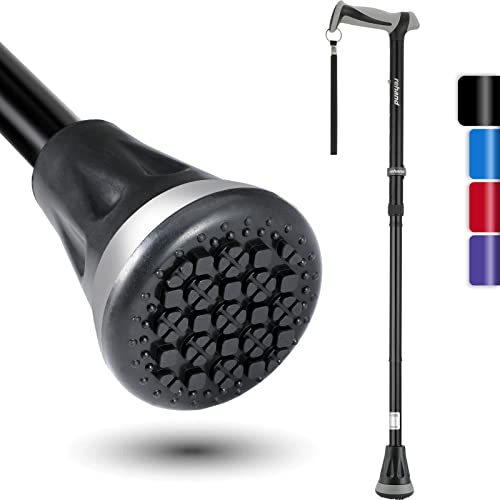
Single-point rubber tips provide agile maneuverability, making them ideal for brisk indoor walking and navigating crowded spaces. These tips feature circular rubber ferrules with molded tread patterns that grip smooth surfaces like tile and hardwood. The Merry Sticks Foldable Walking Cane for Women utilizes a textured rubber ferrule with a 5/8-inch inner diameter to provide reliable traction on diverse floor types. Regularly inspecting these rubber tips is essential, as worn treads or exposed interior washers can slip unexpectedly on wet pavement.
Articulating and multi-tip bases offer an alternative configuration for individuals who require enhanced ground contact. The HONEYBULL Walking Cane for Men & Women includes an extra-wide, four-inch three-pronged pivoting base that conforms to angled surfaces and stands upright independently. Freestanding bases eliminate the frustration of canes constantly sliding to the floor when set against tables, sparing users from painful bending to retrieve them. However, users should take care when using wide bases on narrow stair treads, ensuring the base fits fully onto the step without hanging over the edge.
Weight Capacity and Structural Integrity Across Frame Materials
Every walking cane comes with an engineer-tested weight capacity that must never be exceeded during daily use. Standard-duty models typically support between two hundred and three hundred pounds, providing sufficient strength for partial weight offloading. For instance, the Merry Sticks folding model supports up to 253 pounds, while the LIXIANG folding cane offers a robust 330-pound capacity constructed from durable anodized aluminum. Checking that your selected aid meets your weight support requirements guarantees the shaft will not bow or buckle under downward pressure.
Collapsible travel designs provide exceptional convenience for active users while maintaining reliable frame strength. Both the supregear folding models collapse into four compact sections measuring just ten inches in length, making them easy to slide into a bag or car compartment. Reinforced joint sleeves and internal elastic shock cords keep the folding segments aligned without excessive play or creaking during steps. Selecting high-grade aluminum ensures that the device remains featherlight in your hand while delivering dependable joint support on every journey.
Clinical Indicators for Transitioning from a Cane to Bilateral Support
A single-point or quad cane is designed strictly for unilateral, partial balance and weight support. If you experience progressive neurological decline, severe vestibular dizziness, or bilateral leg weakness, a cane may no longer provide adequate fall prevention. Signs that you need greater assistance include frequent stumbling, lateral tipping when stepping, or clutching furniture while walking through your home. When you feel unstable despite proper cane sizing, it is time to discuss two-handed mobility options with your healthcare provider.
Transitioning to a rolling walker or four-wheeled rollator provides bilateral support that can bear a much higher percentage of body weight. Walkers offer a wide, enclosed base of stability that helps prevent backward and sideways falls while resting tired legs on an integrated seat. Always consult a licensed physical therapist or physician for a comprehensive gait evaluation before changing mobility devices. A professional assessment guarantees that your equipment matches your specific rehabilitation stage and physical strength.
Matching your cane length to your wrist crease and maintaining a slight elbow bend transforms a simple stick into an effective mobility tool. Regular pre-walk checks of your rubber tip tread, push-button pin engagement, and handle grip ensure continuous safety across all walking surfaces. Practicing correct contralateral hand positioning and deliberate stair mechanics will keep your strides smooth and confident. Investing a few minutes in proper sizing protects your joints, prevents unnecessary fatigue, and restores independence to your daily routine.




Write Your Review
No reviews yet. Be the first to share your experience!