


Steep alpine descents frequently expose poor footwear choices through painful toe impact and persistent heel slippage. Understanding how to choose the best hiking boots requires looking past aesthetic styling and evaluating how a boot stabilizes your foot across variable trail surfaces. Whether you are navigating slick granite, damp root networks, or loose scree, the correct footwear balances protective upper materials with underfoot chassis support. Pairing reliable footwear with flexible lightweight hiking pants creates a mobile foundation that prevents premature lower-leg fatigue during extended backcountry days.
Every hiker carries a unique anatomical profile, which means volume requirements, arch height, and forefoot width dictate the ideal model far more than standard numeric sizing. Modern designs range from flexible mid-cut synthetic boots intended for quick day outings to rugged leather boots engineered for sustained load-bearing expeditions. Making an informed decision helps prevent common trail issues such as subungual hematomas, calcaneus friction hot spots, and early fatigue caused by insufficient underfoot stiffness. Exploring construction details such as midsole foam composition, waterproof membranes, and lug geometry ensures your selection matches your intended wilderness objectives.

Pros
- Pre-drilled corner holes make hanging fast on walls, pegboards, shelves, or doors
- Firm aluminum sheet resists bending during regular handling while remaining lightweight at 0.24 pounds
- Compact 8 x 12-inch profile fits neatly into gear staging areas, cabins, or garage workstations
- Retro outdoor footwear design brings personality to hiking gear storage rooms
Cons
- Decorative wall plaque that does not offer hands-on trail utility
- Thin 0.1-inch metal profile can bend or dent if dropped or subjected to heavy impacts
- Manufacturer specifies covered patio areas for exterior use, meaning direct outdoor weather exposure should be avoided
The LKZBGV How to Choose Hiking Shoes Vintage Aluminum Metal Sign is a decorative wall plaque created for hikers, backpackers, campers, and outdoor enthusiasts who want to personalize their gear staging rooms or living spaces. Measuring roughly 8 x 12 inches (listed at 12.1 x 8.1 x 0.1 inches), this compact aluminum sign features an informative vintage graphic focusing on trail footwear selection, making it a fitting decorative accent for gear closets, home offices, cabins, or garages.
In a hiker's home setup, organization and gear preparation often take center stage in mudrooms, basements, or gear staging corners. While this product is not a piece of wearable trail gear, its trail-oriented visual guide complements spaces where hikers sort packs, boots, and trekking poles before heading outdoors. At a listed weight of roughly 0.24 pounds, it adds visual character to gear displays without demanding heavy-duty wall anchors or complex mounting hardware.
The sign is manufactured from a firm aluminum panel designed to maintain a sturdy feel while resisting easy bending during regular handling and mounting. Its multicolor print presents vintage-styled outdoor footwear guidance in a clean, legible format across the 8 x 12-inch surface. The 0.1-inch slim profile keeps the sign flush against vertical surfaces, minimizing snagging risks in narrow entryways or compact utility rooms.
Display setup is simple thanks to four pre-punched holes positioned in the corners of the panel. These mounting points accommodate small nails, wood screws, adhesive wall hooks, string, wire, or ribbon, allowing easy attachment to drywall, pegboards, wooden cabin walls, or shelving units. Keeping the sign maintained is straightforward, as the aluminum surface can be quickly wiped clean with a dry cloth or damp rag to remove dust from garage or workshop environments.
Buyers should note that this item is strictly decorative and educational wall art rather than a technical piece of hiking gear. With a thin 0.1-inch aluminum sheet, the sign can be dented or creased if dropped or subjected to heavy force during storage or moving. Furthermore, while the manufacturer notes suitability for covered patios, it is not intended for unshielded, direct outdoor weather exposure where prolonged rain and intense UV exposure could degrade the finish.
For backpackers, day hikers, or gift shoppers looking to enhance a gear closet, cabin wall, or outdoor-themed office, the LKZBGV Vintage Hiking Shoes Metal Sign offers an affordable and charming touch. Its lightweight aluminum build and flexible four-corner mounting options make it an effortless decorative upgrade for anyone who enjoys the hiking lifestyle.
The sign includes four corner holes that simplify display across different wall surfaces. You can mount it using small drywall nails, screws, hooks, or decorative string without needing specialized hardware. Its slim 0.1-inch depth ensures it hangs nearly flush against gear lockers, garage walls, or cabin wood panels.
With a compact footprint of 12.1 x 8.1 inches, it fits into tight spaces where larger posters would feel crowded. It works well on pegboards above a gear workstation or beside boot storage racks in an entryway.
Constructed from printed aluminum sheet, the sign balances low weight with moderate structural rigidity. At just 0.24 pounds, it puts minimal strain on mounting points while resisting simple bending during standard indoor placement.
The metal surface resists moisture better than traditional paper posters, making it suitable for indoor humid areas like mudrooms or covered outdoor spaces like screen porches. However, keeping it sheltered from direct outdoor rain is advised to preserve the print quality over time.

Pros
- Ultralight 0.26-pound weight adds almost no noticeable load to a daypack or kids' hiking pack
- Slim 6 x 0.18 x 9-inch profile slips smoothly into backpack organizer sleeves and exterior pockets
- Features 15-plus interactive games, quizzes, and illustrations that make navigation skills accessible for youth
- Offers a screen-free educational activity for rest stops, campsites, and family trail walks
Cons
- Standard paperback construction lacks water resistance and requires a dry bag or pack liner in rainy weather
- Does not include a physical compass, which must be purchased separately for hands-on navigation practice
- Content is tailored specifically for children and beginners rather than advanced wilderness navigators
The Kids' Compass Guide by Majosta is an introductory navigation paperback designed for young hikers, outdoor-focused families, and youth groups looking to build foundational trail skills. Rather than serving as an advanced topographical orienteering manual, this book focuses on teaching essential direction-finding and spatial awareness through colorful illustrations, structured quizzes, and over 15 interactive games. For parents packing a hiking daypack for a weekend outing or introducing children to trail navigation, it serves as a lightweight educational companion.
Regarding packability and trail transport, the guide measures 6 x 0.18 x 9 inches and weighs approximately 0.26 pounds (roughly 4.2 ounces). These slim dimensions allow it to slip easily into a daypack front stash pocket, an internal hydration sleeve, a zippered lid pocket, or a side bottle sleeve without taking up valuable gear volume. Hikers monitoring their carried base weight will appreciate that it adds minimal load to a family daypack or a child's starter hiking backpack.
The guide features standard paperback binding and printed pages suitable for handling at campsite tables, trailhead benches, or dry trail rest stops. However, standard paper offers no built-in resistance to rain or leaking water bottles. Hikers venturing out in damp weather or carrying filled hydration reservoirs should store the book inside a lightweight dry bag, zip-top pouch, or pack liner to protect the pages from moisture damage.
On the trail, the book is organized to support short learning sessions during rest stops or evening campsite routines. The interactive games and quizzes turn abstract navigation concepts into engaging outdoor challenges that encourage young hikers to pay closer attention to terrain and landmarks. Because an actual physical compass is not included with the book, families will want to pair it with a basic baseplate compass to make full use of the exercises.
Buyers should keep realistic expectations regarding the guide's scope and physical format. It is intentionally written for children and beginner explorers, meaning it does not replace technical topographic map-reading resources or adult wilderness navigation guides. Additionally, the lack of weatherproofing means it requires thoughtful handling around wet gear and unexpected rain showers.
For parents, scout leaders, and family hikers who want to blend outdoor recreation with practical navigation basics, The Kids' Compass Guide by Majosta offers clear utility. Its minimal weight, compact footprint, and engaging visual presentation make it an easy addition to any family hiking pack or youth trail kit.
At 6 x 0.18 x 9 inches and just 0.26 pounds, The Kids' Compass Guide adds virtually no bulk to a hiking daypack, family travel bag, or youth backpack. It fits cleanly into flat compartments such as front stretch pockets, zippered top lids, and internal document dividers.
Because the publication is a standard paperback without water-resistant lamination, keeping it inside a sealed plastic pouch or dry bag is recommended when hiking in wet weather or carrying it alongside a full hydration reservoir.

Pros
- Waterproof leather and mesh bootie construction reliably shields feet from mud, puddles, and damp brush.
- Omni-Grip rubber outsole with dual-zone tread offers dependable grip across varied terrain including wet rock, snow, and dirt.
- Lightweight midsole cushioning absorbs trail impact without feeling overly heavy or clunky underfoot.
- Lace-up closure provides easy, customizable tension control for stable ankle and heel support.
Cons
- Listed specifically in men's size 10 in Elk/Black, requiring buyers to verify their personal sizing and sock thickness before purchase.
- Full-grain leather and waterproof membrane construction offers less warm-weather breathability than non-waterproof mesh trail shoes.
- Leather uppers require periodic cleaning, drying, and conditioning to preserve long-term suppleness and water resistance.
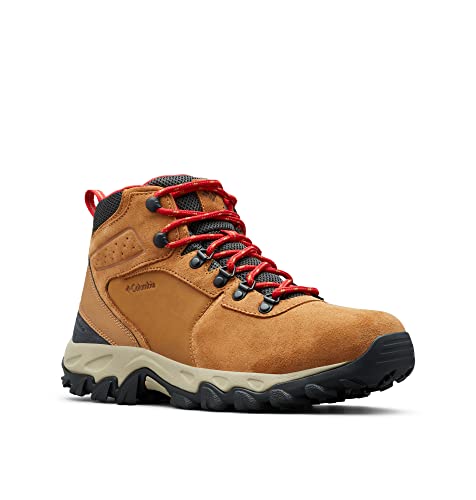
The Columbia Men's Newton Ridge Plus II Waterproof Hiking Boot in Elk/Black (Size 10) is a dedicated trail boot designed for day hikers, weekend backpackers, and outdoor enthusiasts who prioritize foot support and moisture defense. Footwear serves as the critical foundation for any hike, especially when navigating rocky paths, uneven switchbacks, or carrying gear weight in a daypack or backpacking pack. This boot bridges the gap between classic full-grain leather protection and modern lightweight athletic cushioning.
Trail performance centers around the combination of Columbia's lightweight midsole and Omni-Grip rubber outsole. The midsole is formulated for superior cushioning and high energy return, which helps reduce foot fatigue when logging sustained miles over packed dirt, roots, and loose stones. Beneath that, the Omni-Grip multi-terrain traction system incorporates specialized rubber compounds and a dual-zone winter tread pattern engineered to maintain slip-free footing across unpredictable ground, including damp rocks, mud, snow, and ice.
Upper construction blends waterproof full-grain leather with durable mesh bootie integration. This hybrid build provides the structural durability and abrasion resistance of natural hide alongside the targeted flexibility of technical textiles. The tongue features durable mesh to aid in breathability, helping internal moisture vapor escape during strenuous uphill climbs while the outer barrier prevents exterior water from soaking through on rain-soaked trails.
Fitting and trail adjustment are handled through a classic lace-up closure system. Hikers can easily customize pressure across the forefoot and tighten the upper eyelets to secure the ankle against lateral rolling on technical terrain. Maintenance is straightforward: after muddy excursions, the boots can be brushed clean of grit, wiped down with a damp cloth, and air-dried at room temperature away from direct heat to preserve the leather and seam construction.
Realistic limitations should be considered prior to hitting the trail. Because this boot uses a waterproof membrane alongside full-grain leather, it will naturally run warmer during peak summer heat than non-waterproof trail runners or open-mesh shoes. Additionally, natural leather footwear benefits from a short break-in period around town or on light walks to ensure optimal flex and comfort before embarking on demanding multi-day backpacking routes.
For hikers, campers, and trail travelers seeking a dependable waterproof boot that delivers balanced traction, ankle stability, and lightweight cushioning under $100, the Columbia Men's Newton Ridge Plus II represents an exceptional value. It provides the traction and weather shielding needed to tackle unpredictable American trails with confidence.
The Columbia Newton Ridge Plus II utilizes an Omni-Grip multi-terrain traction system designed to provide confident footing on varied outdoor surfaces. The outsole matches specially formulated rubber compounds to aggressive lug patterns, helping hikers maintain traction over gravel, mud, wet tree roots, and steep granite slabs.
A notable feature of this outsole is the dual-zone winter tread design, which ensures solid footing when encountering cold-weather trail conditions such as packed snow and light ice. Paired with the lightweight, high-energy-return midsole, this platform offers dependable shock absorption and ground feel whether you are out on a brief morning day hike or carrying a loaded pack into camp.
Constructed with waterproof full-grain leather, synthetic overlays, and a seam-sealed internal mesh bootie, the Newton Ridge Plus II is built to resist moisture and trail abrasions. The mesh tongue improves overall comfort and flexibility over the instep, preventing pressure points from tight lacing.
To maintain the water resistance and longevity of the leather, remove heavy mud and trail dust using a soft brush and cool water after use. Allow the boots to air-dry completely in a well-ventilated space, and avoid placing them near campfires, heaters, or direct radiator heat, which can prematurely dry out leather and compromise adhesive bonds.
Evaluating Footwear Mechanics, Trail Demands, and Anatomical Fit
Choosing the right trail footwear requires analyzing how foot mechanics interact with pack weight, trail gradient, and ground surfaces. Rather than searching for a universal boot that suits every terrain, smart footwear selection involves matching specific design attributes to your personal hiking habits. A boot that excels on maintained dirt pathways may buckle under the lateral strain of off-trail scree or heavy multi-day loads. By dissecting upper construction, midsole stiffness, outsole grip, and volume adjustments, you can pinpoint footwear that provides reliable security across every mile.
Matching Footwear Architecture to Terrain Severity and Pack Load
The weight you carry on your back fundamentally alters the mechanical demands placed on your feet and ankles. Day hikers carrying minimal supplies often prioritize flexible midsoles that promote a natural, rolling foot strike and rapid forward turnover. In contrast, carrying expedition gear shifts your center of gravity and increases the downward force transmitted through your arches on every step. Under heavy loads, a flexible sole bends excessively over rocky contours, forcing foot muscles to work overtime to stabilize the footbed.
When you haul significant supply weight using structured gear like frame hiking backpacks, footwear with high torsional rigidity becomes indispensable. Stiff internal shanks and dense midsole platforms resist twisting along the longitudinal axis of the foot. This structural resistance prevents the ankle joint from constantly compensating for uneven rocks, talus, and exposed roots. A rigid platform acts as a secure step, allowing you to edge on narrow granite shelves without fatiguing your plantar fascia.
Collar height also plays a distinct functional role depending on the environment you plan to explore. Low-cut shoes favor maximum ankle articulation and ventilation on well-graded singletrack paths. Mid-cut and high-cut uppers wrap the ankle joint, providing debris protection against loose pebbles, mud, and trail grit. While high collars offer sensory awareness that helps remind hikers of ankle alignment, true rollover protection comes from chassis stiffness rather than padded collar fabric alone.
Anatomical Sizing Protocol and Volume Profiling
Standard footwear sizing rarely translates directly to the trail because human feet expand considerably during sustained exercise. Over the course of a strenuous trek, blood flow increases and gravitational pooling causes feet to swell by up to half a full shoe size. Fitting boots early in the morning often leads to purchasing footwear that becomes painfully restrictive by mid-afternoon. Trying on boots late in the day with your intended trail socks provides a far more accurate representation of trail volume.
The unlaced finger-width test offers a reliable baseline for checking internal length before you tie the laces. Slide your foot forward until your longest toe gently touches the front of the toe box while standing upright. You should be able to slide your index finger smoothly behind your heel into the back of the boot cup. If your finger cannot fit comfortably behind your calcaneus, the boot lacks the forward clearance necessary to prevent downhill toe impact.
Testing footwear on an inclined ramp or staircase confirms whether your foot remains locked in place during descent. Stand facing downhill on a steep incline and stomp your forward foot firmly against the surface. Your toes should never make contact with the hard internal front bumper of the toe box. When toes repeatedly collide with the front wall, subungual hematomas and damaged toenails inevitably follow over extended descents.
Internal volume encompasses midfoot instep height and forefoot width, which vary dramatically across different manufacturer lasts. A boot that provides adequate length may still fail if the toe box constricts your metatarsal bones during weight-bearing splay. Hikers with broad forefeet require a wider toe box that allows toes to spread naturally to maintain balance. Conversely, hikers with narrow heels must ensure the rear pocket cups the calcaneus securely to eliminate vertical heel lifting.
Upper Material Dynamics: Full-Grain Leather Versus Modern Synthetics
Upper construction directly dictates a boot’s abrasion resistance, water repellency, breathability, and required break-in commitment. Full-grain leather uppers represent the traditional standard for rugged off-trail backpacking and harsh scree fields. Dense animal hide resists punctures from sharp granite flakes, brush, and shale far better than lightweight textiles. Models like the Columbia Mens Newton Ridge Plus II Waterproof utilize waterproof full-grain leather paired with mesh panels to balance structural durability against trail agility.
Synthetic uppers built from Cordura nylon, polyester mesh, and split-suede overlays offer distinct advantages for casual outings and fast-paced trekking. Synthetic materials absorb less moisture than untreated leather, dry out more quickly when thoroughly soaked, and require virtually no conditioning. They also conform to the foot almost immediately, dramatically reducing the prolonged break-in period required by heavy all-leather boots. However, lightweight synthetic textiles generally exhibit a shorter lifespan when subjected to abrasive talus fields.
Maintaining upper materials ensures your investment continues to protect your feet across multiple seasons. Leather uppers require periodic cleaning with technical footwear gels followed by water-based conditioning agents to prevent drying and fiber cracking. Applying excessive oil-based grease should be avoided because it softens leather excessively, compromising the lateral support built into the boot. Synthetic fabrics benefit from regular brushing to remove microscopic grit that wears down stitching seams over time.
Climate Suitability: Waterproof Liners Versus Non-Waterproof Mesh
Waterproof-breathable bootie membranes have become standard across many outdoor footwear models, yet they involve definite performance trade-offs. These internal membranes rely on microscopic pores that are small enough to block liquid water droplets while permitting vapor molecules to escape. In damp climates, muddy environments, and shoulder-season snow flurries, a waterproof bootie keeps feet comfortable and dry. The Columbia Mens Newton Ridge Plus II Waterproof boot, for example, integrates a seam-sealed bootie construction specifically designed to resist wet weather on treacherous trails.
In hot, arid climates or during sustained summer heat waves, waterproof membranes can trap excessive internal perspiration. When ambient temperatures are high, the humidity gradient between the inside of the boot and the outside air diminishes, slowing vapor transmission. Feet can become soaked from accumulated sweat, which softens the skin and rapidly increases the risk of friction blisters. For desert treks or trails involving frequent deep water crossings, unlined non-waterproof mesh boots dry exponentially faster than membrane-lined alternatives.
Bellows tongue gusset height determines the true practical limit of any waterproof boot’s protection. A boot is only waterproof up to the lowest point where the tongue connects to the upper collar. Stepping into water that exceeds this gusset line allows water to pour directly into the interior cavity over the ankle. Once flooded, waterproof boots act like rubber buckets, trapping liquid inside and requiring extended drying time away from direct trail conditions.
Underfoot Chassis Engineering: Midsoles, Shanks, and Torsional Rigidity
The midsole represents the heart of underfoot shock absorption, energy management, and walking comfort. Most modern trail boots feature either compression-molded ethylene vinyl acetate, commonly known as EVA, or poured polyurethane. EVA delivers lightweight cushioning, immediate step-in softness, and noticeable rebound, which helps absorb initial heel strike shock on hard-packed trails. Manufacturers frequently formulate lightweight EVA midsoles to provide high energy return across day hikes and moderate trail routes.
Polyurethane midsoles are significantly denser and heavier than EVA, making them the preferred material for multi-day expeditions. While polyurethane feels firmer underfoot straight from the box, it resists compression compaction over hundreds of miles under heavy pack loads. EVA foams gradually pack out, losing their cushioning properties and leaving your feet feeling flat and vulnerable to stone bruising. Inspecting the sides of your midsole for permanent compression creases indicates that the cushioning foam has reached its mechanical fatigue threshold.
Internal shanks sandwiched between the midsole and outsole supply critical longitudinal and torsional rigidity. Constructed from molded thermoplastic polyurethane, composite fiberglass, or spring steel, shanks protect the arch from hyperextension over pointed rocks. You can test a boot’s torsional stiffness by grasping the heel in one hand and the forefoot in the other, then twisting them in opposite directions. Minimal twist indicates strong torsional resistance, which keeps your foot stable when side-hilling across steep dirt slopes.
Outsole Traction Dynamics and Tread Lug Geometry
Outsole traction depends on an interplay between specialized rubber compounds and geometric tread patterns. Softer, sticky rubber compounds conform to microscopic irregularities on slick granite and wet river stones, maximizing friction. Harder rubber compounds offer superior longevity and resist chunking when dragged across sharp scree and rough volcanic rock. The Columbia Mens Newton Ridge Plus II Waterproof features an Omni-Grip multi-terrain traction system that employs dual-zone winter tread patterns engineered to secure footing across ice, snow, and loose dirt.
Lug depth and spacing dictate how effectively an outsole bites into soft earth and sheds accumulating mud. Lugs measuring between four and six millimeters in depth provide deep penetration on muddy inclines and slippery grass slopes. Broad channels between the perimeter lugs encourage sticky mud to release naturally with every step rather than packing into a slick surface. Tightly spaced, shallow lugs are better suited for dry slickrock where maximum rubber surface contact is required.
Directional heel braking lugs are essential for maintaining control during steep, loose descents. An undercut heel breast with sharp, forward-facing right-angle edges bites into dirt when you lean back to check your momentum. Without distinct heel braking geometry, stepping onto dry scree or damp soil can lead to uncontrolled forward slippage. Verifying that an outsole includes pronounced braking lugs ensures confident footing when traversing technical downhill sections.
Precision Adjustments Through Advanced Lacing Techniques
Customizing your lacing setup allows you to resolve minor fit discrepancies without altering the boot’s underlying structure. Hikers who experience persistent heel lift on uphill climbs often benefit from incorporating a surgeon’s knot into their lacing sequence. By wrapping the laces twice around each other at the transition between the forefoot and ankle, you lock tension into the lower zone. This independent lower tension keeps the midfoot secure while allowing you to tie the upper collar looser for comfortable calf movement.
Window lacing, also known as box lacing, provides targeted relief for hikers with high insteps or painful dorsal bone spurs. If you experience localized pinching or numbness across the top of your foot, identify the exact eyelets causing pressure. Instead of crossing the laces over that sensitive zone, thread each lace vertically to the next eyelet, creating an open window. This simple adjustment eliminates downward compression over dorsal nerves without compromising overall lateral stability.
Combining customized lacing with well-fitted apparel such as trail hiking pants creates a comfortable system that minimizes knee and leg fatigue over rugged miles. Factory boot footbeds are typically flat and provide minimal anatomical arch contouring. Replacing stock liners with structured aftermarket insoles can support the plantar arch, align the heel, and eliminate excess internal volume. Ensuring proper arch support stabilizes the entire kinetic chain, reducing unnatural pronation and joint strain on challenging backcountry routes.
Longevity Indicators, Maintenance, and Replacement Timelines
Recognizing when hiking footwear has reached the end of its safe operational life prevents unnecessary foot injuries on trail. While upper leather and stitched seams can remain intact for years, internal cushioning foams degrade steadily with cumulative mileage. Compression-molded EVA midsoles typically pack out between three hundred and five hundred miles of trail use, depending on user body weight and pack load. Once the foam collapses, shock absorption decreases significantly, resulting in joint aches and arch fatigue after routine hikes.
Outsole inspection provides another clear indicator of functional footwear wear. Rounded, worn-down lugs can no longer bite into loose soil, dramatically increasing slip hazards on wet mud and slick inclines. Inspect the high-friction zones under the ball of the foot and the heel brake for significant tread loss. Delamination along the rubber rand or separating cementing glue around the flex points signals that outsole adhesion is beginning to fail.
Ultimately, selecting the right hiking footwear comes down to prioritizing proper fit, matching chassis support to your pack weight, and choosing materials that reflect your trail climate. Take the time to measure your feet late in the day, test for downhill toe clearance, and dial in lacing tension before heading into remote terrain. Investing in footwear that truly complements your foot anatomy guarantees comfortable footing and confident stability across every outdoor adventure.



Write Your Review
No reviews yet. Be the first to share your experience!