


Experiencing sudden balance hesitation, joint discomfort, or post-surgical instability often turns routine daily walking into a stressful task. Learning how to select a walking cane helps restore your steady, rhythmic stride while redistributing up to twenty-five percent of lower-limb body weight away from recovering joints. A properly fitted mobility aid offers immediate physical reassurance whether you are navigating slick indoor hardwood or outdoor sidewalk curbs. Maintaining proper joint alignment often pairs well with supportive gear like knee support activewear to enhance overall lower-body stability during recovery.
Matching your body mechanics to the correct cane style prevents common walking faults such as wrist soreness, awkward posture, and shoulder elevation. Modern designs from brands like rehand, Medline, and PELEGON feature ergonomic contoured grips, adjustable telescoping aluminum shafts, and pivoting traction bases built for diverse lifestyles. Understanding core factors like exact handle height, load capacity, and base configurations ensures you choose a cane that truly supports your daily independence. You should always consult a licensed physical therapist or physician for personalized gait assessments and medical recommendations.


Essential Criteria for Selecting the Right Walking Cane
Selecting the ideal mobility aid requires balancing physical support needs with daily lifestyle demands. A proper cane improves stability, prevents tripping accidents, and relieves joint strain without compromising your natural gait. Reviewing your specific stability requirements before choosing a style ensures you gain dependable confidence with every step.
Measuring for Proper Cane Height and Wrist Crease Alignment
Accurate height adjustment represents the most critical factor when selecting a walking cane. To measure properly, put on your typical everyday walking shoes and stand upright with your arms hanging naturally at your sides. The top curve or grip of the cane handle should align directly with the primary crease of your wrist. This measurement ensures that when you grasp the handle, your elbow bends at a comfortable fifteen to twenty degree angle.
An improper cane height quickly leads to poor walking posture, wrist pain, and shoulder elevation. When a cane is set too high, your shoulder hikes upward and strains the upper back muscles with every forward stride. Conversely, a cane adjusted too low forces you to hunch forward, placing excessive stress on your lumbar spine. Modern telescoping models like the Medline Aluminum Offset Walking Cane adjust from 29 to 38 inches, allowing users to fine-tune height using secure push-button pins.
Taller adults or individuals with unique physical proportions need extended height settings to avoid stooping. For instance, the REHAND Adjustable Walking Cane provides ten height settings ranging from 40 to 49 inches, accommodating taller individuals who struggle with standard sizing. Always check that the brass push-button snaps completely through the adjustment hole before putting weight on the shaft. Many quality canes also include an anti-rattle threaded collar that locks the telescoping sections tightly to eliminate distracting clicking noises.
Contralateral Placement and Biomechanical Weight Offloading
Understanding which hand holds the cane is vital for maximizing balance and joint relief. Unless specifically directed otherwise by a physical therapist, you should always hold the cane in the hand opposite your injured, weaker, or painful leg. This contralateral placement mirrors natural human biomechanics, where your opposite arm swings forward in coordination with your advancing foot. Holding the cane on the unaffected side creates a wide, balanced base of support that stabilizes your pelvis during movement.
A standard single-point or offset walking cane transfers approximately fifteen to twenty-five percent of your body weight away from the affected lower limb. As you step forward with your weak or recovering leg, you advance the cane simultaneously to share the ground impact forces. This coordinated movement reduces the painful peak contact pressure on arthritic hips, degenerated knees, or healing ankles. Trying to hold the cane on the injured side disrupts your cadence, creates an awkward limp, and increases joint stress.
Evaluating Handle Ergonomics and Grip Geometries
Handle geometry plays a massive role in hand comfort, grip fatigue, and wrist joint preservation. Traditional crook handles force the wrist into an extended angle and concentrate pressure on a narrow strip of the palm. In contrast, offset handles curve the upper shaft forward to place your downward weight directly over the vertical center line of the cane. Models like the Medline Aluminum-Bronze Offset Walking Cane utilize this balanced geometry alongside soft-foam padding to reduce strain on sensitive wrists.
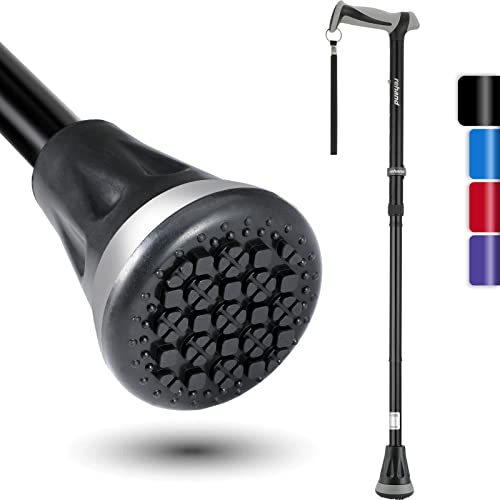
Users managing osteoarthritis, rheumatoid arthritis, or carpal tunnel syndrome often benefit from widened ergonomic palm grips. Brand designs like the REHAND Walking Cane feature an enlarged handle crafted with soft TPR rubber layered over rigid polypropylene. This broader surface area distributes downward pressure evenly across the thenar eminence of your palm, avoiding painful focal pressure points during extended walks. The textured, slip-resistant surface also helps seniors with diminished hand strength maintain a secure hold without clenching their fingers tightly.
Choosing Between Single-Point, Quad, and Pivot Traction Bases
The contact base at the bottom of the cane determines how securely the device grips the ground across different surfaces. Standard single-point rubber tips provide exceptional agility, swift swing speeds, and minimal tripping risk for users who only require mild balance assistance. These compact rubber ferrules work well for brisk outdoor walks and smooth indoor floors where maneuverability is the primary priority. However, standard single-point tips will fall over immediately if you let go of the handle.
Self-standing pivoting bases offer a compelling hybrid solution that blends multi-surface traction with freestanding convenience. Options like the REHAND Foldable Pivot Walking Cane utilize a rotating, four-pronged base with flexible shock-absorbing joints that mimic natural ankle motion. This articulating design keeps the rubber pads flat against the ground even when the shaft angles forward during a normal walking stride. Furthermore, a self-standing base remains upright on level floors, eliminating the painful bending required to pick up dropped canes from the floor.
Traditional quad canes feature either a small or large metal base with four distinct rubber-tipped feet. While quad bases deliver exceptional static balance for stroke recovery or severe balance deficits, their wider footprint requires careful spatial awareness. Users must keep the flat side of the quad base facing toward their body to avoid catching their trailing foot on an outer peg. Quad canes are also cumbersome on tight thresholds and can pose serious safety hazards on standard staircase steps.
Shaft Materials, Weight Ratings, and Frame Durability
Walking cane shafts must deliver reliable structural rigidity without feeling heavy or cumbersome during prolonged daily use. Anodized aircraft-grade aluminum represents the most popular choice because it resists corrosion while maintaining an exceptionally light swing weight. For example, the PELEGON Folding Cane weighs only 0.83 pounds, allowing users to lift and swing the aid effortlessly throughout the day. Selecting lightweight materials prevents shoulder and forearm fatigue during extended community outings.
Verifying certified weight capacities is essential to ensure structural safety under dynamic walking forces. Standard aluminum canes, including designs from Medline and PELEGON, typically support up to 300 pounds of static downward force. Heavy-duty options such as the REHAND Adjustable Cane feature reinforced tubing rated to support up to 350 pounds for greater peace of mind. Never exceed the manufacturer weight rating, as dynamic impact spikes during an accidental slip can bend or buckle an overloaded shaft.
Folding Mechanisms and Portability for Travel
Active individuals and frequent travelers often prefer folding canes that collapse into compact dimensions when not in use. Multi-segment collapsible canes utilize an internal heavy-duty elastic cord that pulls machined aluminum joints tightly together during assembly. The PELEGON Folding Cane collapses down to just 10.5 by 5.1 inches, fitting smoothly inside tote bags, vehicle glove compartments, or airline carry-on luggage. Having a folding cane makes dining out, riding transit, and entering vehicles significantly more convenient.
When traveling with collapsible mobility aids, packing efficiency matters just as much as walking stability. Pairing a compact folding cane with an organized carry-on luggage capacity guide helps you navigate airport terminals without exceeding baggage space restrictions. Travelers can also wear lightweight flexible mobility clothing to maintain full freedom of movement during long transit days. Always inspect the joint sleeves of your folding cane before each outing to ensure the segments seat completely without side-to-side wobble.
Safety Accessories and Stand-Assist Features
Innovative modern canes frequently integrate built-in convenience and safety features tailored to seniors living independently. The TIRAROME Walking Cane for Men & Women incorporates a secondary fold-down handle that provides biomechanical leverage when rising from low armchairs or sofas. This dual-handle system allows users to push upward with both hands, significantly reducing strain on weak knees, hips, and lower back muscles. Once standing, the secondary lever folds neatly out of the way against the primary shaft.
Illumination and emergency alert functions provide an extra layer of personal security during evening walks or unexpected power outages. The TIRAROME model features an adjustable 45-degree LED headlight that casts a clear beam onto uneven pavement, steps, and curb cuts. It also includes an integrated high-decibel SOS alarm button to summon help quickly if a fall or medical emergency occurs. Simple accessories like durable nylon wrist lanyards also keep the cane tethered to your arm while opening doors or paying at counters.
Navigating Stairs and Uneven Indoor Surfaces
Negotiating steps safely requires disciplined footwork and an understanding of your cane limitations. The fundamental rule for stair climbing is simple: lead up with your stronger leg, and step down with your affected leg and cane together. When ascending, place your unaffected foot onto the higher step first, push upward through that strong leg, and then bring your weaker leg and cane up onto the same step. Always grip a sturdy wall handrail with your free hand whenever one is available.
Descending stairs reverses this mechanical progression to protect your recovering joints from sudden drop forces. Place your walking cane down onto the lower step first, followed immediately by your weaker or injured leg. Once your weight stabilizes across the cane and lower foot, step your stronger leg down onto the same tread. Avoid using wide quad canes on narrow stair treads, as the outer feet can overhang the step edge and trigger an accidental slip.
Recognizing When to Transition from a Cane to a Walker
A single walking cane is intended for mild to moderate unilateral support and minor balance hesitation. When an individual experiences progressive neurological deficits, severe bilateral knee arthritis, or frequent unexplained loss of balance, a cane may no longer provide sufficient security. Canes cannot support more than twenty-five percent of body weight and do not offer a surrounding base of support. If you find yourself leaning heavily on walls, shuffling your feet, or feeling constantly anxious while walking, a mobility upgrade is necessary.
Transitioning to a two-wheeled walker or four-wheeled rollator provides bilateral arm support and a wide, stable perimeter that drastically reduces fall risks. A clinical evaluation with a physical therapist can accurately measure your gait velocity, balance scores, and weight-bearing thresholds. Physical therapy specialists can verify whether your current cane remains safe or if a structured rollator prescription will better protect your daily mobility. Regularly reassessing your physical needs ensures that your mobility equipment evolves alongside your health.
Selecting the right walking cane empowers you to maintain personal independence, protect vulnerable joints, and step forward with restored confidence. Take the time to measure your handle height accurately, choose an ergonomic grip that cushions your palm, and match your base traction to your primary walking environment. With the appropriate support in hand, you can continue enjoying daily strolls, errands, and social activities with reliable stability.




Write Your Review
No reviews yet. Be the first to share your experience!