


Navigating steep mountain switchbacks with a loaded multi-day pack places relentless stress on knees, ankles, and leg muscles. Knowing how to use black diamond trekking poles transforms that downward punishment into balanced, controlled movement across rocky talus and loose dirt. By establishing stable contact points on the ground, dual poles absorb jarring impact and offload significant lower-body strain onto your shoulders and core. Hikers often pair dependable poles with specialized clothing, such as hiking pants engineered for knee comfort, to protect vulnerable joints during long backcountry descents.
Dialing in the correct mechanics also prevents annoying trail mishaps like slipping shaft sections, arm fatigue, and painful palm blisters. Features like external lever clamps and extended foam grips work best when you calibrate clamp tension properly and practice efficient wrist strap loading. Adjusting pole length to match shifting slope angles keeps your torso upright and conserves energy over high-mileage days. This practical walkthrough covers everything from basic sizing and grip technique to FlickLock maintenance and all-weather trail handling.

Pros
- Sturdy aluminum shafts provide resilient support and resist bending under heavy pack loads
- FlickLock cam levers offer easy, non-slip adjustments even while wearing gloves or moving on trail
- Extended dual-density foam grip allows quick choke-up changes on short, steep switchbacks
- Includes carbide tips and low-profile trekking baskets for varied four-season trail conditions
- Manageable 1.07-pound weight per pair keeps swing weight comfortable on long-distance treks
Cons
- Collapsed length of roughly 27.2 inches requires external backpack attachment rather than internal packing
- Rubber tip protectors for pavement or slickrock are sold separately
- Heavier than specialized ultralight carbon fiber poles for hikers prioritizing minimal base weight
The Black Diamond Trail Trekking Poles are adjustable three-section aluminum hiking poles engineered for day hikers, weekend backpackers, and multi-day trekkers who need dependable stability across uneven ground. Equipped with an adjustment range of 100 to 140 cm, these poles suit a broad spectrum of hiker heights and trail angles. For backpackers carrying loaded packs, trekking poles serve as essential balance accessories that help distribute weight, reduce strain on knees and ankles during steep descents, and provide reliable anchor points on stream crossings or loose scree.
Trail performance centers on the rugged aluminum shaft construction and Black Diamond's proven FlickLock mechanism. Unlike internal twist-lock mechanisms that can freeze, slip, or seize when exposed to trail grit, the external FlickLock cam levers clamp down securely to prevent unwanted collapsing under full body weight. Making quick adjustments is straightforward, whether lengthening the shafts for a long technical descent or shortening them for an aggressive ridgeline climb. At approximately 1.07 pounds for the pair, the poles deliver a reassuring, solid feel without adding excessive swing weight to your stride.
Comfort and grip ergonomics are well-suited for high-mileage days. The upper handles feature dual-density foam that absorbs trail vibrations while preventing hot spots and hand fatigue in warmer weather. Directly beneath the primary handle, an extended foam choke-up sleeve gives hikers immediate alternative hand placements when tackling sudden steep switchbacks or traversing side-slopes, eliminating the need to stop and adjust pole length. Durable carbide Tech Tips provide aggressive bite on loose gravel, hardpack dirt, and wet granite, while the included trekking baskets prevent the poles from punching deep into soft mud or firm snowpack.
Integrating these poles with your hiking backpack is simple thanks to standard external attachment systems. When fully collapsed to roughly 27.2 inches, the poles slide easily into lower trekking-pole loops, side stretch bottle pockets, or side compression straps found on most daypacks and multi-day backpacking packs. Maintaining the poles between outings is low-maintenance: separating the three aluminum sections after wet or muddy hikes allows moisture to evaporate, preventing internal corrosion and ensuring the FlickLock clamps maintain consistent holding power season after season.
While the Black Diamond Trail poles deliver exceptional durability and stability, there are a few practical tradeoffs to note. With a collapsed length just over 27 inches, they do not pack down as compactly as folding Z-style poles, making them unsuitable for stowing inside small commuter daypacks or carry-on luggage. Furthermore, hikers looking for whisper-quiet grip on asphalt or delicate slickrock will need to purchase optional rubber tech tips separately, as only the carbide tips come standard in the package. Ultralight backpackers seeking the absolute lightest setup may also find aluminum shafts heavier than premium carbon-fiber alternatives.
For hikers and backpackers seeking a reliable, workhorse pair of poles that excel across rocky trails, seasonal weather, and demanding multi-day terrain, the Black Diamond Trail Trekking Poles represent a dependable, trail-tested investment. Their robust aluminum build, secure FlickLock adjustment, and comfortable choke-up foam grips provide practical, all-season trail confidence without the fragile handling concerns of ultralight composite materials.
The Black Diamond Trail Trekking Poles feature an adjustable length range spanning from 100 cm to 140 cm, easily accommodating a wide variety of adult hiker heights. To achieve proper ergonomics on level terrain, adjust the poles so that your elbow rests at a natural 90-degree angle when holding the grip. The external FlickLock cam levers allow each section to extend or collapse quickly with one hand, providing positive locking tension that holds firm under load.
On steep ascents, shortening each pole by 5 to 10 cm helps maintain forward momentum without hyper-extending your shoulders. Conversely, lengthening the poles by 5 to 10 cm on long downhill sections allows you to plant the tips ahead of your stride for controlled braking and knee relief. The built-in measurement markings on the shafts ensure you can reset your preferred trail lengths accurately in seconds.
With a collapsed length of approximately 27.2 inches, the Black Diamond Trail Trekking Poles are designed for external stowage on daypacks, overnight packs, and multi-day expedition backpacks. Most modern hiking packs feature lower trekking-pole tool loops paired with upper elastic bungee ties or side compression straps. Stowing the poles tips-down with the baskets secured in the lower loops keeps the carbide points safely oriented away from your body and gear.
When not in use on flatter stretches of trail, both poles can be collapsed together and secured on one side of your pack. Running the side compression straps through the wrist straps or around the foam choke-up sections prevents the poles from shifting or rattling against other gear. For packs lacking dedicated pole loops, sliding the collapsed shafts into a side water bottle pocket and cinching the upper side compression strap provides an equally secure carry solution.
Constructed from high-strength aluminum, the shaft sections of the Black Diamond Trail poles offer reliable resistance against trail impacts, shearing forces, and bending moments. Unlike carbon fiber, which can fracture unexpectedly when wedged between jagged rocks under heavy lateral loads, aluminum provides forgiving structural resilience that holds up under demanding backcountry use.
The dual-density foam grips resist breakdown from hand sweat and trail dirt, maintaining a non-slip texture throughout humid summer outings. The interchangeable carbide Tech Tips are built to withstand high abrasion from granite and gravel. To extend the working lifespan of your poles, periodically wipe the aluminum tubes clean of grit and inspect the FlickLock screws to maintain firm clamping pressure.
Mastering Black Diamond Trekking Poles on the Trail
Using trekking poles effectively involves far more than simply planting two sticks in front of your boots as you hike. Black Diamond designs its poles with distinct mechanical features, including external cam clamps, dual-density handles, and durable aluminum shafts, that reward proper handling. Mastering these components allows you to offload joint pressure, boost climbing power, and maintain secure footing across challenging backcountry terrain. Learning the correct adjustments before you step onto the dirt ensures your poles work as a reliable extension of your body.
Anatomical Sizing and the Baseline 90-Degree Elbow Angle
Establishing the correct pole height starts by standing on flat ground in your normal hiking footwear. Hold the pole grip naturally with your elbow tucked against your ribcage. Your forearm should rest parallel to the ground, forming a clean 90-degree angle at the elbow joint. This baseline position gives you maximum mechanical leverage while preventing premature fatigue in your shoulders, wrists, and upper back.
Most three-section Black Diamond models feature printed measurement markings along the middle and lower shaft sections. Distribute the overall length evenly between both telescoping sections rather than extending one fully and leaving the other collapsed. Balancing the extension keeps the shaft rigid and prevents unnecessary vibration along the lower tubing. Check that both poles mirror each other in length before hiking along level trail sections.
Safety on the trail requires paying close attention to the printed stop indicators on each shaft section. Never extend any segment past the marked stop line or maximum limit boundary. Pulling tubing beyond this safety mark leaves too little overlapping material inside the clamping collar, which can cause the pole to bend under body weight. Keeping plenty of shaft overlap inside each joint preserves the structural integrity of the high-strength aluminum.
Operating and Calibrating the FlickLock Cam System
External lever clamps provide a fast, secure way to change pole length compared to older internal twist expanders. Black Diamond equips its poles with the FlickLock adjustment system, which uses an external cam lever to compress the outer sleeve around the inner shaft. Opening the lever releases friction so the shaft slides smoothly, while flipping the lever closed locks tubing firmly in place. You can easily operate this low-profile lever with cold fingers or while wearing thick winter gloves.
Every cam lock requires proper tension calibration to ensure sections do not slip when you place your weight on the grips. Open the lever completely and locate the knurled adjustment thumb screw on the opposite side of the clamp. Turn the thumb screw clockwise in small quarter-turn increments to increase clamping pressure, then close the lever. You should feel firm resistance during the final snap of the lever without having to force it so hard that hardware strains.
Always verify lock holding power before trusting poles on steep terrain or rocky descents. Place the tips on the ground, hold the grips firmly, and lean downward with your upper body weight to test vertical resistance. If either shaft section creeps upward into the sleeve, open the lever and tighten the tension screw another half turn. Proper calibration prevents dangerous sudden collapses that could lead to falls on the trail.
Proper Wrist Strap Loading and Grip Ergonomics
Many hikers make the mistake of slipping their hands downward through the top of the wrist strap loop. The correct technique requires bringing your hand up through the bottom of the loop before wrapping your fingers around the grip. When you pull down against the webbing, the strap rests flat across the back of your hand and cradles your wrist. This orientation allows you to push downward through the strap fabric rather than clenching the handle with white-knuckled effort.
Dual-density foam grips provide a secure, comfortable hold that absorbs perspiration and minimizes hand fatigue over long distances. Relying on properly adjusted wrist straps lets you loosen your finger grip, which keeps your hands relaxed and prevents painful blisters during humid treks. The strap bears your downward weight on each step, while your fingers merely guide the pole angle. Adjust the strap buckle so the loop feels snug against your wrist without pinching.
Uneven terrain often calls for fast hand repositioning without changing the actual mechanical pole length. Models built with an extended foam choke-up section allow you to slide your hand several inches down the upper shaft. This extended grip surface is ideal when crossing short, steep rises or negotiating off-camber hillside contours. Sliding your grip downward provides immediate downhill leverage without forcing you to stop and fiddle with the FlickLock levers.
Adjusting Pole Length for Uphill Grinds and Steep Descents
Sustained mountain climbs change your biomechanical geometry because the trail rises steeply directly in front of your feet. Shorten both poles by roughly 5 to 10 centimeters when you face a long ascent. Shorter poles prevent you from reaching awkwardly upward, which spares your shoulders from excessive strain and keeps your center of gravity balanced. Plant the poles slightly behind or beside your feet to drive yourself upward using your chest and arm muscles.
Descending steep mountain switchbacks reverses the physical demand and shifts heavy impact onto your quadriceps and patellofemoral knee joints. Lengthen each pole by 5 to 10 centimeters before starting a technical downhill section. Longer poles reach the slope ahead of your lead foot, letting you control descent speed and cushion the shock of each downhill step. This adjustment keeps your torso upright and stops you from pitching forward over loose gravel.
Traversing long hillside switchbacks often creates an asymmetrical slope where the uphill side sits higher than the downhill side. You can adjust the uphill pole shorter and the downhill pole longer to match the lateral slope angle. Alternatively, keep both poles at baseline length and simply grip the extended foam sleeve on the uphill pole. Coordinating pole plants with your opposite foot strike maintains a smooth, natural hiking cadence across changing grades.
Trail Hardware: Carbide Tech Tips and Seasonal Baskets
Trekking poles contact the earth through specialized hardware designed to provide positive traction across diverse surfaces. Black Diamond uses interchangeable carbide Tech Tips that bite aggressively into hard-packed dirt, weathered granite, mud, and trail ice. The concave carbide tip point prevents the pole from slipping out laterally when planted on slick roots or angled rocks. Inspect the carbide points periodically to ensure they have not worn down flat or sustained damage from wedging into rock fissures.
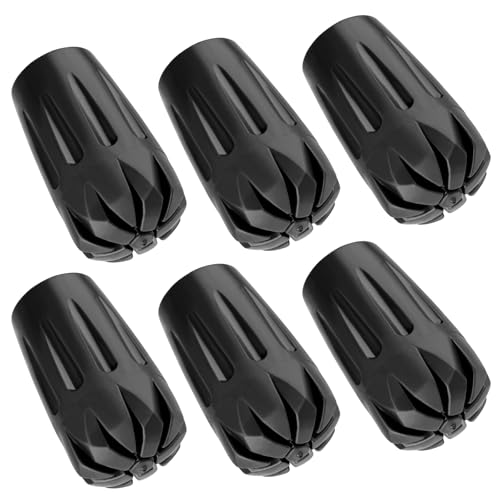
Hikers navigating paved road walks, wooden footbridges, or sensitive slickrock terrain should consider using removable rubber tip protectors. While carbide tips excel on wilderness soil, they can skid loudly across smooth pavement and leave scratches on delicate sandstone. Rubber tips slip securely over the carbide ends to provide quiet traction and dampen vibration on hard surfaces. Stash rubber tips in an accessible hip-belt pocket so you can slide them on whenever trails transition to asphalt.
Integrated trekking baskets prevent your pole shafts from sinking excessively into soft trail substrate. Standard low-profile mud baskets work well for summer backpacking, keeping tips from wedging between roots or plunging deep into marshy bogs. In late autumn and winter, swap out the small baskets for wider powder snow baskets. Wider baskets provide the flotation required to keep poles functional when snowshoeing across deep drifts or crossing spring snowpack.
Technical Terrain Tactics: Boulder Scree, Talus, and River Crossings
Navigating loose boulder fields and jagged talus requires a critical modification to your usual wrist strap habits. Remove your hands from the wrist straps completely when moving across high-consequence rocky terrain. If a pole tip slips into a deep crevice between boulders and you lose your footing, strapped wrists can trap your hands and cause severe sprains. Holding the grips without straps lets you drop the poles instantly if you need to catch yourself during a slip.
Rock crevices also pose a serious mechanical danger to aluminum and carbon pole shafts alike. When a carbide tip gets wedged between boulders while your body momentum carries you forward, the shaft experiences massive lateral shear force. High-strength aluminum offers great durability, but excessive sideways leverage can bend any metal shaft beyond repair. Train your trail vision to place tips on flat boulder faces rather than plunging them into narrow gaps between rocks.
River crossings highlight another practical scenario where poles become indispensable balance tools. Unbuckle your pack waist belt, keep your hands free from pole straps, and face slightly upstream against the current. Move only one point of contact at a time, keeping two poles and one foot firmly planted while advancing your other foot. Never rely on trekking poles as emergency fall-arrest tools on steep snow slopes, where a dedicated mountaineering ice axe remains essential for safety.
Transport, Airline Baggage, and Backcountry Storage
Stowing your poles efficiently makes transitions through trailheads, public transit, and airport terminals hassle-free. Open the FlickLock levers, collapse all three sections down to their minimum length, and lock the levers shut to keep the bundle tidy. You can slide the collapsed shafts into the side water bottle pockets of your pack and secure them using the upper compression straps. Point the sharp carbide tips downward or cover them with rubber caps to prevent tearing backpack fabric or scratching nearby gear.
Flying to distant hiking destinations requires careful planning around airport security regulations. Airport security agencies typically prohibit sharp metal trekking pole tips inside commercial aircraft passenger cabins, requiring you to place poles in checked baggage. If you are packing lightweight luggage for long journeys, our practical carry-on backpack sizing guide explains how pack volume and gear stowage impact travel efficiency. Checking your poles inside a sturdy duffel ensures you arrive at your trail destination without having valuable gear confiscated at security checkpoints.
Backcountry storage after wet or muddy trips demands simple preventative care to avoid stuck joints. Never collapse wet poles and leave them stored inside a damp gear closet for weeks at a time. Moisture trapped inside aluminum tubing can cause mineral oxidation and surface pitting, which makes the telescoping sections bind and stick. Disassembling the sections after every stormy hike takes only seconds and keeps the hardware operating smoothly for years of dependable trail service.
Routine Maintenance, Cleaning, and Field Repairs
Routine cleaning is the most effective way to preserve the smooth operation of external lever locks. Pull the middle and lower shaft sections completely out of their upper sleeves after returning from dusty desert treks or muddy wilderness routes. Wipe down each aluminum section with a dry microfiber cloth to remove gritty dirt, trail silt, and dried mud. Clean the inside of the clamping collars with a soft brush to prevent fine particles from abrading the anodized aluminum finish.
A crucial rule of trekking pole maintenance is to avoid using spray lubricants, grease, or oils on the shaft sections. External cam mechanisms rely entirely on dry surface friction between the aluminum tubing and the plastic clamp collar to hold your body weight. Adding lubricants to the poles destroys that friction and causes severe, uncontrollable slippage under load. Keep all shaft surfaces clean, bare, and completely dry to maintain reliable vertical holding power.
Carry a small multitool or pocket screwdriver in your backcountry repair kit so you can adjust cam lock tension screws in camp if needed. Inspect the plastic levers, hinge pins, and strap webbing periodically for signs of excessive wear or impact damage. Practicing proper sizing, mindful strap usage, and regular cleaning ensures your Black Diamond trekking poles deliver dependable stability on every adventure.






Write Your Review
No reviews yet. Be the first to share your experience!