


Maintaining active joint mobility while managing balance hesitation often leads walkers to explore low-impact training methods. Many active adults ask what is nordic walking exercise when searching for ways to reduce lower body stress without sacrificing cardiovascular conditioning. Originating as an off-season training regimen for cross-country skiers, this total-body movement style combines natural walking strides with rhythmic, backward pole thrusts that activate the upper torso. Incorporating specialized poles offloads repetitive impact from sensitive knee and hip joints while promoting an upright, confident posture across paved paths and packed park trails.
Unlike standard walking, using dual poles distributes weight evenly between the limbs and engages the latissimus, triceps, and abdominal muscles. Pairing this upright routine with supportive knee trail apparel helps cushion movements while protecting delicate joints during outdoor training sessions. While Nordic walking builds functional endurance, it relies on rhythmic propulsion rather than the unilateral weight offloading of clinical canes. Understanding proper technique, pole sizing, and hardware features ensures you get the conditioning benefits while maintaining dependable stability on every outing.
Pros
- Lightweight build at only 9.92 oz per pole reduces arm fatigue on long day hikes and backpacking trips
- Internal anti-shock springs help absorb repeated trail impacts on rocky or downhill terrain
- Includes full set of mud baskets, snow baskets, walking caps, and rubber tips for varied trail surfaces
- Disassembles down to 21.46 inches for practical packing inside standard 22-inch travel luggage
Cons
- Internal twist locks require firm manual tightening compared to external flick-lock levers
- Collapsed length of 25.6 inches may protrude above compact daypacks when lashed to external straps
- Rubber grips offer dependable traction but may feel less breathable on hot, sweaty summer hikes than natural cork
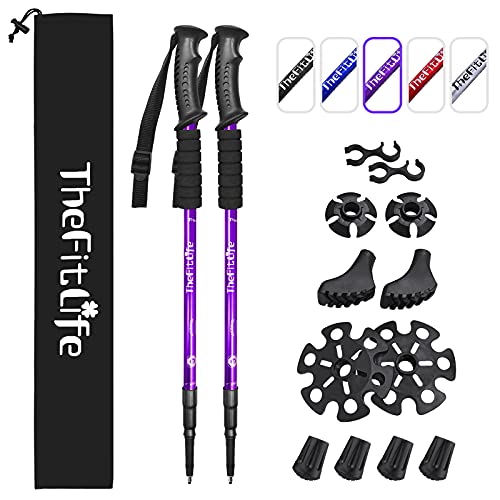
TheFitLife Telescopic Trekking Poles are adjustable three-section aluminum hiking sticks designed for day hikers, weekend backpackers, fitness walkers, and travelers who need reliable balance assistance on the trail. Weighing just 9.92 ounces (282 grams) per pole, this set adds minimal weight when strapped to a backpack while offering structural stability for ascending steep inclines and navigating uneven terrain.
Built to accommodate a broad range of user heights, each pole extends from 25.6 inches (65 cm) up to 51.2 inches (130 cm). The internal anti-shock spring system is engineered to dampen trail vibrations each time the pole plants on hard rock or packed dirt. This subtle cushioning effect is particularly helpful during long descents where repetitive shock transfers directly into the wrists, elbows, and knees.
The shafts are constructed from high-strength aluminum alloy, balancing impact resistance with fatigue durability on rocky paths. Rather than using external clamp levers that can catch on underbrush or gear webbing, TheFitLife utilizes a refined internal twist-lock system. It tightens securely with a simple twist, maintaining a streamlined profile that is easy to operate even while wearing trail gloves. Ergonomic non-slip rubber grips provide a firm and comfortable hold throughout changing weather.
Packing and trail transport are straightforward. Outdoor hikers can secure the poles externally using backpack gear loops and compression straps at their collapsed length of 25.6 inches. For travelers packing for distant trailheads, the poles separate completely into three sections measuring 21.46 inches (54.5 cm), allowing them to fit diagonally inside most standard 22-inch or larger travel suitcases. The package also includes mud baskets, snow baskets, protective rubber tips, and walking caps to handle mud, scree, snow, or paved paths.
A realistic consideration is the twist-lock design itself. While it eliminates bulky external hardware, twist mechanisms require deliberate tightening to prevent slipping under heavy vertical pressure, which can be harder to gauge in freezing weather compared to quick-cam levers. Additionally, hikers using small daypacks under 20 liters may find the 25.6-inch collapsed length slightly tall when mounted to smaller exterior pack pockets.
For recreational day hikers, entry-level backpackers, and fitness walkers seeking reliable trail support at a budget-conscious price point, TheFitLife Telescopic Trekking Poles offer strong value. Their combination of joint-cushioning anti-shock springs, solid aluminum durability, and comprehensive seasonal attachments makes them a versatile companion for trails across the country.
TheFitLife Trekking Poles offer a versatile length adjustment range spanning from 25.6 inches (65 cm) to 51.2 inches (130 cm). This broad range allows men, women, teenagers, and seniors to set an optimal pole height that maintains an efficient 90-degree elbow bend on flat terrain.
Height adjustments are controlled by twisting the telescoping sections. Hikers can shorten the shafts during steep uphill climbs to maintain forward momentum or lengthen them on descents to improve balance and stability across rough trail sections.
When hiking with a daypack or backpacking pack, these poles can be secured externally to trekking-pole loops, daisy chains, or side compression straps. Their collapsed profile of 25.6 inches sits comfortably alongside standard 30 to 65-liter backpacks without excessive overhang.
For air travel or off-season storage, the three aluminum sections can be separated entirely. In this disassembled state, the longest section measures 21.46 inches (54.5 cm), making the set compact enough to fit diagonally within most 22-inch or larger luggage bags.
TheFitLife provides a multi-terrain accessory kit with every pair. Included are rubber tips for hard rock surfaces, walking caps designed for paved surfaces and fitness walking, mud baskets to prevent poles from sinking into soft soil, and broader snow baskets for winter trail use.
All included attachments screw on and off quickly in the field without tools. This modular system allows hikers to adapt the poles seamlessly whether navigating muddy spring switchbacks or paved park trails.

Pros
- Lightweight 9.92 oz aluminum build delivers sturdy trail balance without unnecessary swing weight
- Three-section breakdown fits diagonally in 22-inch suitcases or straps cleanly to hiking daypack loops
- Internal anti-shock spring cushions downward pressure during steep, sustained mountain descents
- Comes complete with four versatile tip and basket attachments suited for year-round trail conditions
Cons
- Twist-lock mechanisms require firm manual tightening and lack the visual verification of external lever flick-locks
- Rubber grips do not wick perspiration as naturally as cork handles during hot summer hikes
- Full 25.6-inch collapsed length may extend beyond the top of compact daypacks unless disassembled
TheFitLife Telescopic Trekking Poles are three-section aluminum hiking sticks designed for day hikers, weekend backpackers, and travel-oriented walkers seeking joint support and trail balance. Featuring an integrated anti-shock spring and an internal twist-lock system, this pole pair caters to budget-conscious outdoor enthusiasts, beginners, and fitness walkers. Because they collapse and disassemble into three compact segments, they serve hikers who regularly transport their gear via 22-inch travel luggage or external backpack attachment loops.
On the trail, weight management and proper height adjustment remain critical for maintaining a steady rhythm. Each pole weighs 9.92 ounces (282 grams), resulting in an aggregate weight of just over 1.5 pounds for the pair. The telescopic aluminum shafts adjust across a usable range of 25.6 inches (65 cm) up to 51.2 inches (130 cm), accommodating men, women, teens, and seniors. When navigating steep descents, the internal anti-shock mechanism activates under downward pressure to absorb trail vibration, while the ergonomic rubber grips deliver steady hand placement across varied walking paces.
The shafts are fabricated from high-strength aluminum alloy, engineered to offer dependable impact resistance against roots, scree, and rocky paths without premature fatigue. TheFitLife utilizes an internal twist-lock mechanism rather than external cam levers, creating a streamlined, low-profile outer diameter that will not catch on dense brush or snag against backpack compression webbing. While the rubber grips lack the moisture-wicking properties of natural cork, their textured surface provides a non-slip grasp in damp conditions, paired with an adjustable wrist strap to help secure your grip.
Transporting these poles alongside your hiking pack or travel baggage is straightforward. When fully collapsed, the poles measure 25.6 inches, making them ideal for securing directly against backpack trekking-pole loops and upper compression straps. For air travel or compact gear totes, each pole disassembles into three independent sections measuring 21.46 inches (54.5 cm), allowing them to slip diagonally into most 22-inch or larger suitcases. Swapping the included rubber tips, flat walking caps, mud baskets, and snow baskets is tool-free, enabling quick configuration changes before heading onto muddy switchbacks or hard pavement.
While practical and versatile, this design presents a few real-world limitations. The internal twist locks require careful hand tightening to avoid accidental slippage under heavy body loads, and they lack the visual security checks provided by external lever locks. In addition, the 25.6-inch collapsed length can extend noticeably above smaller hydration packs or 15-liter daypacks if you do not disassemble them completely. Hikers who prefer ultralight carbon fiber construction or naturally cooling cork handles will also notice the denser feel and moisture retention of the rubber grip material on warm afternoon treks.
For hikers, campers, and travelers searching for an affordable, full-featured trekking pole set that integrates smoothly with backpack lash loops and standard luggage, TheFitLife Telescopic Trekking Poles offer balanced utility. Their aluminum strength, internal anti-shock cushioning, and comprehensive basket kit make them a practical gear choice for everyday trail walks and weekend mountain outings alike.
When preparing for trail outings or flights, gear packability is essential. TheFitLife Telescopic Trekking Poles adjust from a minimum collapsed height of 25.6 inches (65 cm) to a maximum deployed length of 51.2 inches (130 cm). For routine day hiking, the collapsed poles slide easily through lower trekking-pole gear loops on standard daypacks and secure firmly under side compression straps.
For travelers flying to trail destinations, the three aluminum segments can be pulled apart completely. Disassembled, the longest pole section measures 21.46 inches (54.5 cm), allowing the set to lay diagonally inside standard 22-inch or larger hard-shell and soft-sided suitcases. Hikers should verify their pack dimensions and luggage interior measurements before departure to ensure compliant packing.
TheFitLife provides a multi-season accessory kit that expands the poles' versatility across various terrain types. The package includes standard rubber tips for road walking and pavement, wide walking caps for improved asphalt traction, mud baskets to prevent pole sinkage on soft soil, and wide snow baskets for winter trail excursions.
All accessories thread and press securely onto the pole ends without specialized tools. Hikers should inspect the wear on rubber tips and check basket tightness prior to hitting rocky backcountry routes, storing unused attachments in an organizer pouch inside their backpack until needed.
Understanding Nordic Walking Exercise, Biomechanics, and Pole Support
Nordic walking transforms a standard neighborhood stroll into an efficient, full-body cardiovascular workout that actively protects your weight-bearing joints. By pairing a natural forward stride with intentional backward pole plants, this discipline engages your core and shoulder girdle while stabilizing your cadence. Grasping the physics behind the pole push, alongside proper equipment selection, empowers you to improve your fitness without overloading vulnerable hips and knees.
The Core Mechanics and Ski-Training Heritage of Nordic Walking
Nordic walking originated in Finland during the early twentieth century as an off-season conditioning routine for elite cross-country skiers. Athletes needed a practical way to preserve upper-body muscular endurance and aerobic capacity during snow-free summer months. By replicating the rhythmic push-off motion of cross-country skiing across dry ground, they discovered that walking with poles sustained high fitness levels with minimal orthopedic strain. Over subsequent decades, health researchers and outdoor enthusiasts adapted this routine into a mainstream fitness activity suitable for walkers of all fitness backgrounds.
The movement pattern relies on the continuous coordination of opposing limbs known as the diagonal stride. As your left foot steps forward, your right arm swings forward to plant the pole tip into the ground slightly behind you. Pushing through the pole shaft propels your body forward into the next step, where the opposite arm and leg take over. This continuous rhythm creates a balanced, fluid momentum that prevents erratic steps and encourages steady breathing on both flat pavement and gradual inclines.
Biomechanical Joint Offloading and Upper-Body Propulsion
One primary appeal of Nordic walking is its ability to disperse impact forces away from the lower extremities. During standard walking, each heel strike sends a ground reaction force straight through the ankle, knee, hip, and lower lumbar vertebrae. When you plant a pole and apply downward pressure through the hand grip, a meaningful portion of your body weight transfers through the upper extremities. This mechanical redistribution cushions the shock experienced by cartilage surfaces, making longer walks far more comfortable for individuals managing mild joint stiffness.
Upper-body muscular activation increases significantly compared to conventional hands-free walking. Propelling your weight forward requires continuous work from the triceps, posterior deltoids, latissimus dorsi, and abdominal stabilizers. The natural torso rotation that occurs during opposite arm and leg swings also activates the oblique musculature. Because so many major muscle groups participate in every forward stride, you build upper-body muscular endurance without lifting heavy weights or subjecting joints to abrupt ballistic stress.
Cardiovascular Demands, Caloric Expenditure, and Postural Alignment
Engaging large muscle groups across both the upper and lower body substantially raises the aerobic demand of your daily walk. Because the heart must pump oxygenated blood to your chest, arms, and back in addition to your legs, your cardiovascular system works harder at any given walking speed. Many fitness enthusiasts find that their breathing rate and heart rate rise comfortably into moderate aerobic zones without needing to jog or run. This elevated metabolic output leads to greater caloric expenditure while preserving a sustainable, conversational walking tempo.
Postural benefits emerge quickly once you establish a consistent Nordic walking rhythm. Leaning on poles inappropriately can create poor habits, but executing the proper technique naturally draws your spine into an erect, balanced vertical alignment. Pushing backward through the poles prevents rounded shoulders, opens the rib cage for deeper lung expansion, and minimizes the forward head posture common in sedentary lifestyles. Walkers frequently report less tension across the mid-back and neck after adopting the upright mechanics encouraged by pole support.
Nordic Walking Poles Versus Medical Canes and Trekking Poles
Distinguishing Nordic walking sticks from standard mobility aids is critical for your personal safety. Single-point walking canes and quad canes are designed specifically for clinical gait assistance, providing asymmetric weight offloading of 15% to 25% for recovering limbs. In clinical settings, holding a medical cane on the unaffected side opposite the weaker or injured leg preserves a natural reciprocal cadence while protecting joint structures. Nordic poles, in contrast, are bilateral fitness tools meant to enhance forward propulsion and bilateral stability during active exercise. They are not engineered to bear sudden, concentrated downward loads during acute orthopedic rehabilitation or severe balance episodes.
Nordic poles also differ from traditional backcountry trekking poles in their intended motion and tip geometry. Trekking poles are typically used to brake descents and support heavy backpacks over steep, technical mountain terrain, often featuring angled, forward-facing plants. Nordic walking poles utilize an angled backward plant that drives forward momentum across smooth paths, park tracks, and mild rolling hills. Recognizing these design objectives ensures you select the correct tool for your physical goals rather than compromising your stability with an mismatched aid.
Determining Accurate Pole Height and Elbow Flexion Angles
Setting your poles to the correct height is fundamental to avoiding shoulder strain and maximizing walking efficiency. A standard calculation for Nordic pole sizing involves multiplying your overall height in centimeters by 0.68, which establishes a baseline pole length. When standing upright with relaxed shoulders and holding the grip upright, your elbow should form an approximate 90-degree angle. This right-angle position contrasts with medical walking canes, which require a gentle 15- to 20-degree elbow bend aligned with the wrist crease.
If a pole is adjusted too tall, your shoulder must hike upward with each swing, causing unnecessary fatigue across the trapezius and neck. Conversely, poles set too short force your torso into an exaggerated forward lean that compromises spinal alignment and diminishes upper-body pushing power. Telescopic models that adjust smoothly across a generous range allow you to fine-tune your fit based on shoe sole thickness and personal arm length. Checking your elbow angle in a mirror before starting ensures your mechanics remain natural and sustainable.
Executing the Rhythmic Diagonal Stride and Plant Technique
Mastering the proper Nordic walking motion begins by letting your arms swing naturally at your sides without gripping the poles tightly. Once you establish a steady walking cadence, begin swinging the pole forward as your opposite foot steps ahead. The pole tip should contact the ground at an approximate 45-degree angle behind your forward foot, roughly parallel to your trailing leg. Avoid planting the pole out in front of your body, as planting forward acts as a brake rather than a forward propellant.
As the pole tip bites into the surface, press downward and backward through the grip to push your body forward past the pole. During this push phase, your arm extends backward behind your hip to complete the full range of motion. Release grip pressure slightly at the end of the backward thrust to allow the pole to swing cleanly forward on the next cycle. Maintaining a relaxed, rhythmic hand motion prevents hand cramping and ensures smooth transition between propulsion and recovery phases.
Shaft Engineering, Telescoping Adjustments, and Anti-Shock Springs
Durable pole construction ensures that every backward thrust delivers rigid, dependable propulsion across changing outdoor terrain. Lightweight aluminum alloy shafts provide an exceptional balance of impact resistance, torsional stiffness, and minimal swing weight. For instance, poles weighing under ten ounces per stick minimize shoulder and wrist fatigue during prolonged workouts. High-grade aluminum also absorbs trail vibrations effectively, preventing repetitive micro-shocks from traveling up into the elbow and wrist joints over miles of use.
Telescoping adjustment systems make storing and transporting exercise poles straightforward. Multi-section poles featuring smooth twist-lock mechanisms allow rapid height adjustments without external levers that can snag on clothing or trail brush. When collapsed to approximately 25.6 inches, or separated into sections measuring under 22 inches, poles stow easily into vehicle trunks or travel luggage. If you frequently pack your mobility gear for flights or weekend getaways, consulting our carry on travel pack guide can help you verify interior suitcase dimensions to comply with airline rules. Built-in internal anti-shock springs further cushion firm pavement strikes, enhancing joint comfort for users navigating hard surfaces.
Traction Feet, Rubber Walking Caps, and Multi-Terrain Accessories
The interface between your pole and the ground dictates both your traction and your propulsion efficiency. Bare carbide or tungsten tips provide aggressive bite on loose dirt, gravel, and unpaved park paths. However, metal tips can slip unpredictably and vibrate harshly on concrete sidewalks or asphalt roadways. To address paved surfaces, Nordic poles utilize specialized angled rubber walking caps, often called fitness paws or boots, that provide dependable friction and sound-dampening traction. These durable rubber ferrules provide a broad, shock-absorbing footprint that grips textured pavement, reducing repetitive impact while dampening vibration through the shaft.
Treaded rubber caps must be positioned with their angled foot facing backward to grip the pavement during the propulsive push. In addition to pavement caps, modular accessories like mud baskets and wider snow baskets prevent pole tips from sinking into soft turf, sand, or winter slush. Inspecting rubber caps regularly for tread wear is vital, as worn rubber can expose the underlying metal tip and compromise your grip on wet sidewalks. Replacing smooth or cracked rubber boots preserves joint cushioning and ensures dependable ground contact year-round.
Common Walking Faults, Overstriding, and Joint Strain Mitigation
Beginners often commit several biomechanical errors that reduce exercise efficiency and increase joint discomfort. The most frequent mistake is overstriding, which occurs when a walker attempts to increase speed by throwing the forward leg too far ahead of the body. Overstriding causes an aggressive heel strike that jars the knee joint and acts as a braking force against forward momentum. Instead, maintain a normal, natural stride length and increase your walking speed by pushing more dynamically through the trailing pole.
Another common error involves planting the poles too far in front of the torso with vertical shafts. This habit transforms the exercise into a halting, defensive walk rather than an active, propulsive workout. Keep the pole shafts angled backward at all times, trusting the downward and rearward thrust to carry your weight forward. Additionally, avoid gripping the handles with excessive force, as tight clenching strains the forearm flexors and can irritate the carpal tunnel. A light, rhythmic hold that engages during the push and relaxes during the recovery preserves wrist comfort throughout your walk.
Clinical Boundaries and Transitioning to Prescribed Mobility Aids
While Nordic walking is an outstanding fitness activity, it is not a substitute for prescribed medical mobility equipment. Individuals recovering from major orthopedic surgery, those with acute vestibular balance deficits, or patients under strict partial weight-bearing orders must not rely on fitness poles for basic mobility. Fitness poles lack the broad, stable base of quad canes and the reinforced vertical weight tolerance of medical crutches or standard walking canes. Attempting to use fitness poles as primary weight-bearing aids during unsteady rehabilitation can result in dangerous falls.
If you notice progressive balance degradation, frequent near-falls, or bilateral leg weakness, you should transition from fitness poles to certified clinical aids. Standard single-point canes, wide-base quad canes, and four-wheeled rollators provide dedicated unilateral or bilateral support tailored for stability rather than athletic exercise. Always consult a licensed physical therapist or physician for a comprehensive gait evaluation before starting a new walking program, especially if you manage chronic joint disorders or neurological instability. Professional guidance ensures you choose the appropriate equipment to stay active safely while honoring your body’s functional boundaries.




Write Your Review
No reviews yet. Be the first to share your experience!