


Navigating steep mountain descents with a loaded pack places heavy repetitive shock on the patellofemoral joints and lower back. Many hikers wonder what is the point of trekking poles when their legs already carry their body weight across backcountry miles. Engaging a pair of trekking poles redistributes descending force into the latissimus dorsi, shoulders, and chest, significantly lessening patellar impact. Hikers managing chronic knee discomfort often pair these supports with supportive knee hiking pants to maintain endurance over long descents. This deliberate transfer of energy transforms steep downhill sections from knee-jarring drops into controlled, sustainable steps.
Beyond basic physical relief, poles establish two additional points of ground contact that dramatically stabilize movement over slick roots, loose talus, and river boulders. Rather than reacting defensively to sudden slips, walkers gain steady balance and rhythmic momentum across varying trail conditions. Modern shaft alloys and composite builds also minimize hand fatigue while maintaining high structural rigidity under full body weight. Deciding whether to carry hiking sticks comes down to recognizing how extra stability and reduced joint fatigue protect longevity on trail.

Pros
- Durable 7075 aluminum shaft construction resists bending on rocky and uneven trail surfaces
- Moisture-wicking cork handles mold to hand shape for a comfortable grip during warm-weather treks
- Convenient lever locks allow quick, secure height adjustments even while wearing gloves
- Disassembles down to 21 inches for straightforward packing inside carry-ons or external pack attachments
Cons
- At 24.5 inches collapsed and 21 inches disassembled, they pack down longer than folding Z-style trekking poles
- Lever locks require periodic screw tightening to maintain firm clamping pressure over extended trail use
- At 9.7 ounces per pole, aluminum construction is slightly heavier than premium carbon-fiber options
The TrailBuddy Trekking Poles are three-section telescoping hiking sticks engineered for day hikers, backpackers, travelers, and outdoor enthusiasts needing balance assistance. Made with aircraft-grade 7075 aluminum shafts and natural cork grips, these poles serve trail walkers tackling rocky switchbacks, seniors wanting extra stability, and backpackers looking to distribute pack weight off their knees.
Each pole weighs 9.7 ounces, keeping swing weight manageable over high-mileage day hikes and multi-day routes. Height adjusts from a fully collapsed 24.5 inches up to 54 inches, accommodating tall adults down to youth hikers. Quick-release lever locks allow one-handed height changes on trail, making it simple to shorten poles for steep ascents or extend them when descending steep switchbacks.
Aircraft-grade 7075 aluminum provides greater impact resistance and tensile strength than standard aluminum tubing, bending under extreme stress rather than snapping abruptly. Moisture-wicking cork handles mold to the user's palms over time, reducing sweat buildup and friction during humid hikes. Padded wrist straps relieve downward hand strain, while threaded tips prevent mud and snow accessories from twisting off in deep substrate.
Operating these poles requires flipping open the lever locks, sliding the sections to the marked height indicators, and clamping the levers shut. For transport, collapsing the shafts down to 24.5 inches allows them to mount securely onto backpack trekking-pole loops or compression straps. For suitcase packing or compact backpack side pockets, the shafts can be disassembled completely down to 21 inches. Routine maintenance involves wiping off trail grit and inspecting lever tension screws between outings.
While 7075 aluminum offers reliable resilience, each pole weighs 9.7 ounces, which is slightly heavier than ultralight carbon-fiber poles. The telescoping design also has a longer packed profile than compact folding Z-poles, meaning they might protrude higher when lashed to smaller daypacks. Additionally, the manual lever-lock screws must be checked periodically to prevent slippage on steep descents.
For hikers, backpackers, and travelers seeking dependable trail balance at an approachable value, the TrailBuddy 7075 Aluminum Trekking Poles offer a practical mix of rugged construction, ergonomic cork grips, and simple lever adjustments. They are well suited for anyone needing a sturdy, travel-ready walking stick without paying premium carbon-fiber prices.
The TrailBuddy trekking poles feature an adjustable length range spanning from 24.5 inches when fully collapsed up to 54 inches at full extension. This wide vertical adjustment allows users of varied heights, including kids aged seven and up through tall adults, to set proper ninety-degree elbow angles for efficient uphill pushing and downhill braking.
Height adjustments rely on quick-cam lever locks that can be flipped open and closed with one hand. Unlike internal twist mechanisms that can seize up from trail dust or freeze in sub-freezing temperatures, the exterior lever clamps offer visible locking status and easy field tightening via standard adjustment screws.
When preparing for travel or stowing gear at camp, these poles collapse to 24.5 inches, making them compatible with most external backpack gear loops, bungee tie-offs, and side compression straps. For airline luggage or smaller pack interiors, completely separating the three telescoping segments reduces overall length to 21 inches.
This disassembled 21-inch profile allows hikers to slide the shafts into luggage or secure them inside travel-hiking daypacks. The threaded tip design also ensures that baskets and protective rubber covers stay attached during transit rather than falling off inside gear bags.
Crafted from aircraft-grade 7075 aluminum, the shafts provide dependable bending resistance under heavy pack loads and rocky impacts. Aluminum offers a distinct safety benefit over carbon fiber on rugged trails, as it tends to bend rather than splinter under lateral shock.
Ergonomics are handled by genuine cork grips that naturally wick moisture and absorb vibration on hard-packed trails. Over repeated miles, cork contours to individual hand profiles to minimize pressure points, while the padded wrist straps transfer load directly from the forearm to the pole.
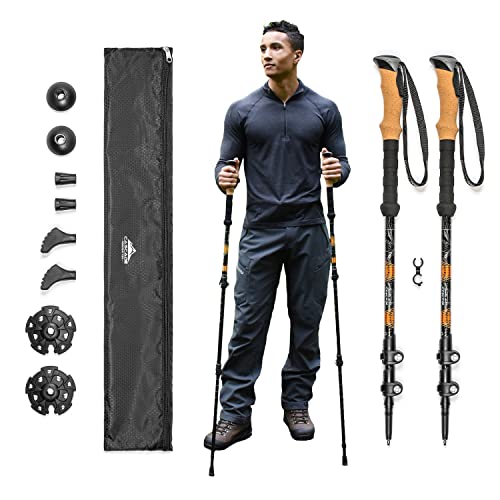
Pros
- Sturdy 6061 aluminum shafts resist bending under load across rocky trails and uneven terrain
- Ergonomic cork handles combined with EVA lower grips provide comfortable, versatile hand positions
- Lever-style quick locks allow fast, tool-free length adjustments between 26 and 54 inches
- Generous accessory bundle includes mud baskets, snow baskets, rubber boots, tip covers, and a carry bag
Cons
- Collapsed length of 26 inches may extend above the top collar of smaller 15L to 20L daypacks
- At 10 ounces per pole, aluminum construction is heavier than ultralight carbon fiber designs
- Quick-lock cam tensioners require occasional thumb-screw checks to maintain firm holding pressure over time
The Cascade Mountain Tech 6061 Aluminum Trekking Poles serve as a dependable, budget-conscious trail accessory designed for day hikers, weekend backpackers, and outdoor walkers seeking upper-body engagement and knee relief. Built to pair with standard hiking daypacks and larger backpacking packs, these two-section adjustable poles provide steady points of contact across varied outdoor surfaces.
On the trail, the quick-lock lever mechanism allows smooth height adjustments spanning from 26 inches up to 54 inches to accommodate various hiker heights and changing slope angles. Weighing approximately 10 ounces per pole, the shafts offer solid balance without excessive swing weight. When you reach a flat trail section or scramble where free hands are required, the poles collapse to a manageable 26-inch profile that fits neatly onto external backpack gear loops, side compression straps, or inside the included travel bag.
Material construction centers on aircraft-grade 6061 aluminum, which provides dependable bend resistance when navigating rocky terrain, boulder fields, or stream crossings. The ergonomic handles combine genuine cork tops with extended EVA down grips. The cork sections help dampen ground vibrations and wick moisture away during warm summer hikes, while the lower foam sections let hikers quickly lower their hand positions during steep switchbacks without pausing to readjust pole length.
Dialing in the poles for specific trails is straightforward thanks to the included accessory bundle. The core shafts feature tungsten carbide tips that bite into hard-packed dirt and slick rock surfaces. For paved greenways or sensitive rock paths, push-on rubber boots and tip covers provide traction and prevent surface scarring. When transitioning to wet spring trails or winter routes, the interchangeable mud and snow baskets screw on easily to prevent the poles from sinking deeply into soft ground.
While these poles provide dependable trail stability, prospective buyers should recognize a few practical design tradeoffs. The three-section telescoping design collapses to 26 inches, which is longer than folding Z-style poles and may extend beyond the top of compact 15-liter to 20-liter daypacks. At roughly 10 ounces per pole, aluminum construction also carries a modest weight penalty compared to premium carbon fiber poles. In addition, the quick-lock cam tensioners may require occasional finger-tightening of the thumbscrews to maintain positive locking force over miles of continuous vibration.
For beginner hikers, weekend backpackers, and budget-conscious outdoor enthusiasts looking for reliable trekking poles with comprehensive multi-season accessories, the Cascade Mountain Tech 6061 Aluminum Trekking Poles offer balanced durability and practical trail support.
When not in use, each pole collapses down to a compact 26 inches, allowing hikers to stow them easily along the exterior of most hiking backpacks. Hikers can thread the tungsten carbide tips through standard lower trekking-pole attachment loops and secure the upper shafts using side compression straps or elastic bungi cords.
For travel or vehicle storage, the set includes a lightweight zippered travel bag that prevents dirt, mud, and trail debris on the baskets and tips from contacting the interior fabric of your backpack or luggage. At 10 ounces per pole, carrying them on your pack adds minimal base weight during trail approaches.
The poles arrive with an extensive accessory package configured for year-round hiking versatility. Hard tungsten carbide tips serve as the baseline contact point for dirt singletrack, loose scree, and rugged mountain paths where maximum purchase is necessary.
For asphalt trails, slick boardwalks, or indoor transit, the included rubber boots and tip covers slip over the metal ends to dampen noise and enhance surface grip. The kit also includes wide rubber snow baskets and medium mud baskets, which prevent the poles from sinking into deep drifts, boggy soil, or loose river gravel.
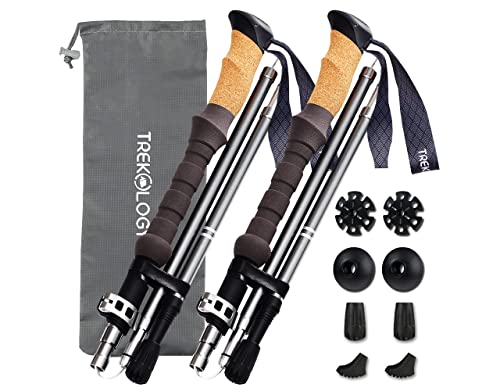
Pros
- Collapses down to a compact 15 inches, fitting easily inside backpacks or carry luggage bags
- Natural cork handles absorb hand perspiration effectively during strenuous hikes
- Sturdy aircraft-grade aluminum construction with protective metal caps at the folding joints
- Simple height adjustment between 110 cm and 130 cm via a sturdy metal flip lock lever
Cons
- TSA regulations require trekking poles to be packed in checked luggage rather than carry-on bags
- Users must verify the push-button lock is fully popped out to ensure shaft stability before hiking
- At 11.5 oz per pole, aluminum construction is heavier than ultralight carbon-fiber alternatives
The Trekology Trek-Z Cork Grip Collapsible Trekking Poles are three-section folding hiking sticks designed for day hikers, backpackers, and adventure travelers who require portable stability on uneven trails. Rather than using traditional telescoping designs that remain long when collapsed, these poles utilize a tri-fold folding cable system that stows down to a compact 15 inches. This makes them a strong match for hikers who prefer storing their poles directly inside a daypack or securing them flat against external pack compression straps without poles protruding past the top lid.
On trail, these poles offer an adjustable length range of 110 cm to 130 cm, covering a stated user height range between 5'2" and 6'5". Each pole weighs 11.5 oz (330 g), delivering a solid feel that helps distribute carried weight and stabilize joint impact on steep descents. The main handle is shaped from natural cork, which naturally absorbs hand moisture and sweat during warm trail outings. Trekology notes that the cork grips incorporate a slight rotational flex as an anti-torque ergonomic feature. Below the cork, secondary EVA foam grips allow hikers to quickly choke down on the poles when negotiating short, steep step-ups without adjusting overall pole length.
Build quality centers on aircraft-grade aluminum alloy shafts, chosen to withstand lateral loads and rocky terrain where brittle materials might crack. To reinforce high-stress connection points, Trekology adds metal caps around the folding joints, reducing play once the poles are deployed. Extension and length adjustments are secured using a durable metal flip lock at the upper section, ensuring reliable clamping power once clamped to the hiker's preferred height marker.
Deploying the poles requires extending the folding sections until the internal tension cable pulls tight and an internal metal lock button pops through the shaft hole. Ensuring this button is fully seated is essential for complete structural rigidity before latching the upper flip lock. For transport, collapsing the poles takes seconds, allowing both poles to slip neatly into the included storage bag. When traveling by commercial air to hiking destinations, keep in mind that TSA and airline policies classify trekking poles as checked luggage, meaning they must be stowed inside checked duffels or backpacks rather than overhead carry-on bags.
While the folding mechanism provides impressive packability, the design does present a few practical limitations. The total adjustment range is 20 cm (110 to 130 cm), which may not suit hikers under 5'2" who require a shorter pole setup. Additionally, at 11.5 oz per pole, weight-conscious thru-hikers aiming for sub-pound base weights might find aluminum folding poles heavier than fixed-length carbon options. The locking button also requires careful initial alignment during assembly to ensure the segments seat properly without wobbling.
For hikers, backpackers, and travelers seeking dependable trail support without spending top-tier outdoor brand prices, the Trekology Trek-Z Cork poles offer exceptional value. The combination of sweat-wicking cork handles, reinforced aluminum joints, and an ultra-packable 15-inch folded size makes them a versatile accessory for everything from local forest walks to rugged mountain backpacking trips.
The Trekology Trek-Z poles adjust between 110 cm and 130 cm in length, accommodating hikers measuring roughly 5'2" to 6'5" (159 to 195 cm) in height. Length adjustments are managed via a metal flip lock clamp on the top shaft section, allowing users to fine-tune height based on trail slope or individual arm ergonomics.
Hikers shorter than 5'2" may find the minimum 110 cm setting too tall for standard 90-degree elbow positioning on level terrain. Always confirm that your forearm rests parallel to the ground when holding the cork grip before clamping the metal flip lock.
Thanks to a three-piece folding design, the Trek-Z poles collapse down to just 15 inches (38 cm) in length. This compact size allows them to fit horizontally or vertically inside most standard daypacks, carry duffels, or luggage cases without hanging loosely off external attachment points.
The poles come with a dedicated carry bag to keep trail mud and dust away from clean gear inside your backpack. Hikers traveling by air should remember that TSA guidelines prohibit trekking poles in carry-on baggage, requiring these poles to travel inside checked luggage.
The pole shafts are manufactured from aircraft-grade aluminum alloy, delivering reliable strength-to-weight performance and high resistance to bending stresses on demanding rocky routes. The connection joints are strengthened with metal caps to guard against joint wear and slippage over time.
The handles feature genuine cork, which helps manage perspiration and adapts comfortably to hand pressure over long miles. A secondary EVA foam grip sits directly beneath the cork for quick hand repositioning on steep gradients without stopping to change shaft length.
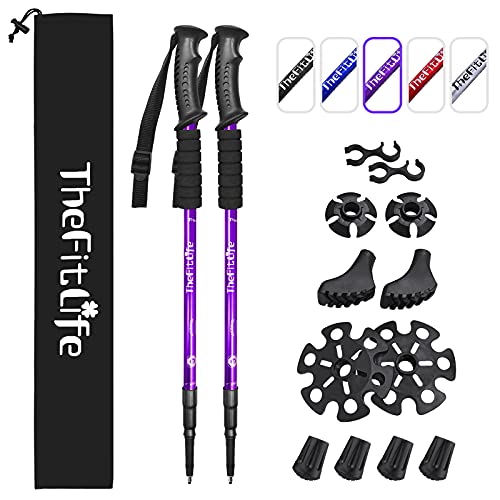
Pros
- Lightweight build at only 9.92 oz per pole reduces arm fatigue on long day hikes and backpacking trips
- Internal anti-shock springs help absorb repeated trail impacts on rocky or downhill terrain
- Includes full set of mud baskets, snow baskets, walking caps, and rubber tips for varied trail surfaces
- Disassembles down to 21.46 inches for practical packing inside standard 22-inch travel luggage
Cons
- Internal twist locks require firm manual tightening compared to external flick-lock levers
- Collapsed length of 25.6 inches may protrude above compact daypacks when lashed to external straps
- Rubber grips offer dependable traction but may feel less breathable on hot, sweaty summer hikes than natural cork
TheFitLife Telescopic Trekking Poles are adjustable three-section aluminum hiking sticks designed for day hikers, weekend backpackers, fitness walkers, and travelers who need reliable balance assistance on the trail. Weighing just 9.92 ounces (282 grams) per pole, this set adds minimal weight when strapped to a backpack while offering structural stability for ascending steep inclines and navigating uneven terrain.
Built to accommodate a broad range of user heights, each pole extends from 25.6 inches (65 cm) up to 51.2 inches (130 cm). The internal anti-shock spring system is engineered to dampen trail vibrations each time the pole plants on hard rock or packed dirt. This subtle cushioning effect is particularly helpful during long descents where repetitive shock transfers directly into the wrists, elbows, and knees.
The shafts are constructed from high-strength aluminum alloy, balancing impact resistance with fatigue durability on rocky paths. Rather than using external clamp levers that can catch on underbrush or gear webbing, TheFitLife utilizes a refined internal twist-lock system. It tightens securely with a simple twist, maintaining a streamlined profile that is easy to operate even while wearing trail gloves. Ergonomic non-slip rubber grips provide a firm and comfortable hold throughout changing weather.
Packing and trail transport are straightforward. Outdoor hikers can secure the poles externally using backpack gear loops and compression straps at their collapsed length of 25.6 inches. For travelers packing for distant trailheads, the poles separate completely into three sections measuring 21.46 inches (54.5 cm), allowing them to fit diagonally inside most standard 22-inch or larger travel suitcases. The package also includes mud baskets, snow baskets, protective rubber tips, and walking caps to handle mud, scree, snow, or paved paths.
A realistic consideration is the twist-lock design itself. While it eliminates bulky external hardware, twist mechanisms require deliberate tightening to prevent slipping under heavy vertical pressure, which can be harder to gauge in freezing weather compared to quick-cam levers. Additionally, hikers using small daypacks under 20 liters may find the 25.6-inch collapsed length slightly tall when mounted to smaller exterior pack pockets.
For recreational day hikers, entry-level backpackers, and fitness walkers seeking reliable trail support at a budget-conscious price point, TheFitLife Telescopic Trekking Poles offer strong value. Their combination of joint-cushioning anti-shock springs, solid aluminum durability, and comprehensive seasonal attachments makes them a versatile companion for trails across the country.
TheFitLife Trekking Poles offer a versatile length adjustment range spanning from 25.6 inches (65 cm) to 51.2 inches (130 cm). This broad range allows men, women, teenagers, and seniors to set an optimal pole height that maintains an efficient 90-degree elbow bend on flat terrain.
Height adjustments are controlled by twisting the telescoping sections. Hikers can shorten the shafts during steep uphill climbs to maintain forward momentum or lengthen them on descents to improve balance and stability across rough trail sections.
When hiking with a daypack or backpacking pack, these poles can be secured externally to trekking-pole loops, daisy chains, or side compression straps. Their collapsed profile of 25.6 inches sits comfortably alongside standard 30 to 65-liter backpacks without excessive overhang.
For air travel or off-season storage, the three aluminum sections can be separated entirely. In this disassembled state, the longest section measures 21.46 inches (54.5 cm), making the set compact enough to fit diagonally within most 22-inch or larger luggage bags.
TheFitLife provides a multi-terrain accessory kit with every pair. Included are rubber tips for hard rock surfaces, walking caps designed for paved surfaces and fitness walking, mud baskets to prevent poles from sinking into soft soil, and broader snow baskets for winter trail use.
All included attachments screw on and off quickly in the field without tools. This modular system allows hikers to adapt the poles seamlessly whether navigating muddy spring switchbacks or paved park trails.

Pros
- Lightweight 3K carbon fiber construction reduces carried and swinging weight to 7.6 ounces per pole
- Metal flip locks offer secure, slip-resistant tension compared to traditional twist-lock mechanisms
- Ergonomic cork handles paired with secondary EVA foam grips provide versatile hand positioning on varying trail grades
- Wide 24-inch to 55-inch adjustment span suits a diverse range of user heights and terrain angles
Cons
- Carbon fiber shafts can fracture if wedged between rocks and subjected to severe lateral bending forces
- Collapsed length of 24 inches may extend beyond the top or bottom of ultra-compact daypacks when mounted externally
- Metal flip lock levers require occasional thumb-screw tension checks to prevent slippage over extended mileage
The Hiker Hunger 100% Carbon Fiber Trekking Poles are adjustable three-section telescoping trail poles built for day hikers, section hikers, backpackers, and campers seeking to shed weight without giving up stability. Constructed from 3K carbon fiber, each pole weighs approximately 7.6 ounces, making them an excellent choice for hikers looking to reduce joint impact on rugged trails while keeping their base gear manageable.
In terms of trail adjustment, these poles expand from a compact 24 inches up to a full 55 inches, comfortably serving both shorter and taller hikers across diverse terrain grades. Rather than relying on twist locks that can slip or freeze when exposed to dirt and moisture, Hiker Hunger equips these poles with quick-adjust flip locks built with metal hardware. This provides firm, slip-resistant clamping whether you are lengthening the poles for a steep downhill descent or shortening them for an aggressive ridge climb.
Grip comfort is a primary design focus, featuring ergonomic natural cork handles that actively wick moisture away from your palms while molding to your hand shape over time. Directly beneath the cork handles, secondary nonslip EVA foam extensions provide an immediate choke-down point for short, steep switchbacks, eliminating the need to stop and adjust pole length. Soft neoprene-padded wrist straps further enhance comfort, distributing downward pressure across your wrists without causing chafing during long mileage days.
Transporting and maintaining these poles on the trail is straightforward. When not in use, the shafts collapse down to 24 inches, allowing them to nest securely into side water bottle pockets, slide behind backpack compression straps, or strap onto front trekking-pole attachment loops. Maintenance involves basic trail hygiene: simply wipe away grit and moisture after wet outings and periodically check the thumbscrew tension on the metal flip locks to preserve optimal clamping force.
While carbon fiber provides exceptional weight savings and natural vibration damping, it behaves differently than aluminum under severe lateral stress. If a carbon pole becomes trapped between roots or granite boulders and is subjected to heavy sideways leverage, it is susceptible to cracking or snapping rather than bending. Additionally, hikers using compact daypacks under 20 liters should note that the 24-inch collapsed height will protrude somewhat above the pack rim when lashed to external straps.
For day hikers, multi-day backpackers, and travelers seeking an agile pair of poles with natural cork ergonomics and durable metal locking mechanisms, the Hiker Hunger Carbon Fiber Trekking Poles represent strong trail value. Backed by a 1-year warranty and a USA-based company, they provide dependable knee-saving support and steady balance across varied backcountry trails.
The Hiker Hunger trekking poles feature a telescoping three-section shaft that adjusts smoothly between 24 inches and 55 inches. This expansive range accommodates men, women, and younger hikers across flat paths, steep alpine ascents, and knee-jarring descents.
Length adjustments are secured using external flip locks equipped with metal levers. Unlike plastic components that can warp or weaken over time, the metal locking mechanism maintains consistent clamping pressure against the carbon fiber sections to help prevent unexpected slippage while hiking under load.
Constructed entirely from 100% 3K carbon fiber, these poles offer high tensile strength and natural vibration absorption while weighing only 7.6 ounces per pole. This lightweight profile substantially lowers the energy required per arm swing over long trail days.
The upper handle combines natural moisture-wicking cork with dense EVA foam for the lower grip extension, providing comfortable handholds in both warm and cold weather. To maintain the structural integrity of carbon fiber, hikers should avoid using the poles as pry bars and keep the locking collars clean of trail debris.
With a collapsed length of 24 inches, these poles integrate easily with standard hiking daypacks and multi-day backpacking packs. They can be threaded through dedicated lower trekking-pole loops, secured via upper bungee cords, or held fast by side compression straps.
For travel or public transit to the trailhead, the 24-inch collapsed size allows the pair to fit inside standard checked luggage or across larger duffel bags, keeping your trail gear neatly consolidated between outings.
The Biomechanical and Practical Purpose of Trekking Poles
Clarifying what is the point of trekking poles begins with recognizing that human bipedal walking becomes considerably less efficient once uneven ground and pack weight enter the equation. Trekking poles serve as functional upper-body extensions that convert human locomotion from a two-point system into a dynamic four-point gait. This mechanical transformation reduces physical wear on the knees, improves center-of-gravity balance, and provides reliable propulsion across strenuous ascents. Instead of relying entirely on leg muscles to absorb braking forces and initiate vertical steps, poles actively distribute kinetic effort throughout the entire skeletal frame.
Biomechanical Load Offloading and Lower-Body Joint Relief
Downhill hiking generates massive eccentric loading on the quadriceps femoris, forcing the knees and ankles to act as mechanical brakes with every descending stride. When hikers plant poles ahead of downhill steps, upper-body muscle groups absorb a measurable portion of that gravitational impact before the feet strike the rock. This deceleration support relieves repetitive pressure on delicate knee cartilage, patellar tendons, and hip sockets during long descents. Over a multi-day trip with thousands of feet of elevation loss, this sustained shock dispersion helps prevent severe overuse inflammation.
Hikers carrying heavy multi-day gear combinations, such as an internal frame hiking backpack packed with camp supplies, place compounding downward force on lower-body joints. Trekking poles mitigate this load by establishing early deceleration contact on steep steps, distributing downward velocity through the arms. For hikers with pre-existing meniscus wear or ankle instability, this upper-body brake system frequently makes the difference between finishing a route comfortably and nursing painful joint flare-ups.
Dynamic Balance and Four-Point Trail Stability
Bipedal balance requires constant micro-adjustments from the stabilizing muscles surrounding the ankles, calves, and core. Slippery mud, wet logs, shifting scree, and submerged river stones constantly threaten to displace a hiker’s center of mass. By providing two auxiliary contact points, hiking sticks expand the hiker’s physical base of support, dramatically reducing the probability of trail falls. When one foot slips on loose shale, the planted pole provides immediate reactionary support before a slip turns into an uncontrolled tumble.
River crossings and muddy bogs present classic balance dilemmas where judging depth and bottom firmness remains difficult with footwear alone. Probing river beds with carbide tips allows hikers to test submerged rocks for algae slickness and check drop-offs before committing full body weight. In winter conditions or high alpine snowfields, poles prevent post-holing slips and provide lateral stability across icy sidehills. This tactile feedback loop gives hikers continuous spatial confidence on challenging, technical surfaces.
Uphill Propulsion and Cadence Rhythm Efficiency
Ascending steep switchbacks demands high cardiovascular output and sustained concentric contractions from glutes, calves, and quads. Trekking poles recruit the pectorals, deltoids, and latissimus dorsi to actively push downward and backward against the terrain. This synchronized upper-body involvement shares the climbing workload, helping legs maintain a continuous pace without burning out prematurely. Instead of experiencing high localized leg fatigue, the body distributes energy output across several large muscle groups.
Maintaining an even walking cadence also conserves critical endurance reserves during high-mileage backcountry days. The rhythmic pole-plant cycle promotes consistent stride frequency and upright posture, opening the rib cage for improved diaphragmatic breathing. Hikers who lean excessively forward on steep climbs restrict lung volume, accelerating exhaustion and muscle cramping. Using poles encourages an athletic forward lean from the ankles rather than collapsing at the waist, maximizing oxygen exchange and forward drive.
Shaft Materials and Impact Dynamics: Carbon Fiber Versus Aluminum
The choice of shaft material directly shapes how a trekking pole behaves under load, absorbs ground shock, and handles mechanical stress. Carbon fiber shafts, featured on models like the 100% Carbon Fiber Trekking Poles by USA Brand, deliver exceptional stiffness alongside ultra-low swing weight at 7.6 ounces per pole. Carbon composites exhibit natural vibration-dampening properties that mute the sharp metallic buzz felt when striking solid granite. The key structural tradeoff lies in shear resistance, as carbon can snap under sudden lateral shear force if wedged tightly between boulders.
Aluminum alloys, such as 7075 and 6061, offer ductile toughness and superior resistance to catastrophic fracture under heavy vertical loads. The TrailBuddy Trekking Poles utilize 7075 aircraft-grade aluminum, weighing 9.7 ounces each, which provides higher tensile strength than standard alloys and can often bend rather than abruptly break under extreme stress. In contrast, 6061 aluminum options, like the 10-ounce Cascade Mountain Tech Trekking Poles, offer reliable everyday durability for varied trail terrain at a modest weight penalty. Choosing between carbon and aluminum comes down to whether a hiker prioritizes minimal swing weight or maximum impact durability in rocky environments.
Locking Mechanisms: Holding Strength and Field Reliability
Telescoping and folding trekking poles require dependable locking hardware to maintain set lengths without collapsing under downward pressure. External lever locks, often called cam or flip locks, clamp directly around the outer circumference of overlapping shaft sections. The 100% Carbon Fiber Trekking Poles by USA Brand incorporate metal lever locks that allow hikers to adjust tension easily without complex internal mechanisms. External levers operate smoothly with gloved hands in sub-freezing temperatures and allow quick visual inspection of clamp security before steep descents.
Internal twist locks rely on expanding plastic plugs inside the hollow shaft sections that friction-lock against the interior aluminum walls. The Telescopic Trekking Poles for Hiking utilize a glove-friendly internal twist-lock system that creates a snag-free shaft profile free of external protrusions. However, twist locks can sometimes slip if trail dust, water, or internal frost coats the expander wedge, requiring occasional disassembly and cleaning. Cam locks remain the standard choice for heavy backpacking due to their straightforward external thumbscrew tension calibration and visible locking state.
Grip Ergonomics and Upper-Body Fatigue Management
The interface between hand and pole dictates long-term comfort, blister prevention, and overall control across extended miles. Natural cork handles, featured on the TrailBuddy Trekking Poles and Trekology Trek-Z Cork Grip Collapsible Lightweight, conform gradually to the user’s hand shape while actively wicking palm sweat. Keeping skin dry prevents hot spots and friction blisters during warm-weather hikes, making cork highly desirable for long treks. Cork also provides moderate vibration dampening, reducing repetitive stress transfer to wrists and elbows.
Dual-density EVA foam and textured rubber offer alternate grip characteristics tailored to specific climates and trail conditions. The Cascade Mountain Tech Trekking Poles pair ergonomic cork grips with an extended EVA down grip, allowing hikers to choke down on the shaft during steep climbs without pausing to adjust pole length. Rubber grips, found on the Telescopic Trekking Poles for Hiking, provide durable non-slip traction and thermal insulation in wet, cold environments, though rubber does not absorb sweat in hot weather. Adjustable padded wrist straps ensure hikers can bear downward load through the strap loops rather than death-gripping the handles, reducing forearm fatigue.
Mechanical Anti-Shock Springs Versus Rigid Shaft Feel
Hikers navigating hard-packed surfaces or asphalt approaches often debate whether mechanical shock absorption provides noticeable ergonomic advantages. Spring-loaded mechanisms, integrated into designs like the Telescopic Trekking Poles for Hiking, compress slightly upon ground contact to absorb harsh initial impacts. This mechanical dampening can soften jarring sensations for hikers managing wrist tendonitis or arthritic elbow joints. The internal spring smooths out the sudden deceleration shock caused by repetitive strikes against solid rock.
Conversely, many thru-hikers and mountain trekkers prefer rigid shafts that deliver direct, unfiltered trail feedback with zero mechanical give. Rigid shafts provide absolute precision when testing uncertain footing or wedging tips for stability on exposed ridgelines. Mechanical springs also introduce internal moving parts that can accumulate dirt or freeze in sub-zero alpine conditions. Choosing an anti-shock system depends on whether a hiker prioritizes maximum joint cushioning on hard trails or firm, unyielding pole placement on technical terrain.
Packed Dimensions, Folding Systems, and Travel Practicalities
Transporting trekking poles to trailheads involves navigating pack space constraints, external lash points, and commercial airline regulations. The Trekology Trek-Z Cork Grip Collapsible Lightweight utilizes a tri-fold Z-pole system that collapses down to 15 inches, fitting neatly inside standard luggage cases or daypacks. This compact folding architecture relies on internal tension cords and metal joint caps that lock into place with a push-button mechanism. Tri-fold poles deploy in seconds, making them popular among fastpackers and travelers with limited gear space.
Standard three-section telescoping poles collapse down to around 24 to 26 inches, requiring external pack attachment straps when not in active use. Hikers organizing gear for flights should consult a practical carry-on backpack size guide to understand transit packing rules, as airline security guidelines generally mandate checking poles with sharp carbide tips in checked baggage. The TrailBuddy Trekking Poles can be disassembled down to 21 inches by separating the individual sections, simplifying packing into larger duffels. Verifying packed dimensions prevents gear damage and travel delays before reaching the trailhead.
Secondary Backcountry Utility: Shelter Pitching and Terrain Probing
Beyond walking assistance, trekking poles perform vital secondary duties that reduce total pack weight for ultralight backpackers. Many modern backcountry shelters, tarp tents, and A-frame tarps eliminate heavy dedicated tent poles by using trekking poles as primary structural supports. The telescoping height adjustability of poles like the Cascade Mountain Tech Trekking Poles, expanding from 26 inches to 54 inches, allows campers to set precise shelter peak heights between 110 and 130 centimeters. This dual-use functionality saves pounds of pack weight by repurposing daytime hiking tools into nighttime shelter frames.
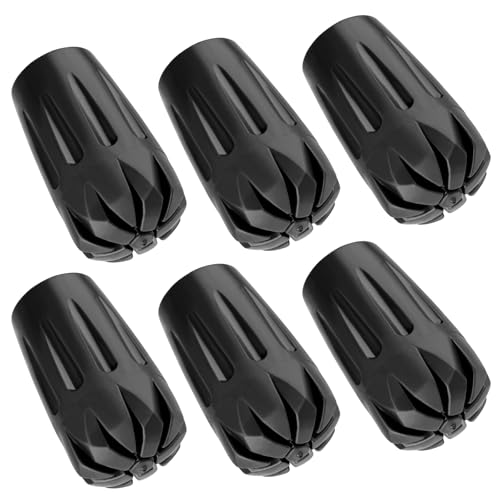
Poles also act as essential safety instruments when encountering overgrown brush, deep mud, or potential wildlife hazards. Hikers can push aside stinging nettles, thorny brambles, and spiderwebs across narrow trails without exposing bare skin. When crossing snowfields, poles fitted with wide snow baskets measure snowpack crust depth and check for hidden hollows over buried rocks. The modular tip accessories included with models like the TrailBuddy Trekking Poles, including mud baskets and rubber boot covers, allow immediate adaptation to changing environmental demands.
Essential Dial-In: Proper Length Calibration and Trail Technique
Maximizing the functional benefits of trekking poles requires proper length adjustment matched to personal height and terrain slope. On level ground, a hiker’s elbow should form a clean 90-degree angle when the hand rests naturally on the grip and the tip touches the ground. Setting poles too high strains the shoulders and traps, while setting them too low forces an inefficient downward slouch. Sizing ranges, such as the 110 to 130 centimeter span on the Trekology Trek-Z Cork Grip Collapsible Lightweight, accommodate hikers between 5 feet 2 inches and 6 feet 5 inches.
Adjusting pole length dynamically as the trail gradient changes prevents posture breakdown and optimizes power transfer. Shortening each pole by 5 to 10 centimeters on sustained ascents keeps the hands below shoulder level, preventing arm fatigue and encouraging forward drive. Conversely, lengthening poles by 5 to 10 centimeters on steep descents allows early ground planting without bending forward at the waist. Hikers should always verify that telescoping sections remain below marked stop lines and confirm cam clamp tension before applying full body weight on exposed trails.
Ultimately, what is the point of trekking poles comes down to enhancing physical longevity, trail safety, and overall efficiency across demanding wilderness terrain. Integrating poles converts strenuous hikes into a balanced, full-body exercise that protects lower-body joints from premature wear. Whether selecting ultralight carbon fiber for high-mileage speed or resilient aluminum alloys for rugged rocky trails, the added stability transforms backcountry travel. By dialing in correct pole length, selecting ergonomic grip materials, and leveraging dual-purpose backcountry utility, hikers can tackle steep terrain with renewed confidence and sustained comfort.




Write Your Review
No reviews yet. Be the first to share your experience!