


Negotiating steep descents with a loaded pack places punishing compressive stress on knees, hips, and ankles. Many hikers wonder what are the benefits of hiking poles when assessing whether carrying extra gear justifies the effort on moderate or rugged trails. In practice, utilizing a synchronized pair of trekking poles redistributes braking forces away from the lower limbs and activates the upper body. When paired with supportive trail pants designed for joint mobility, trekking poles transform technical downhill sections from jarring impacts into controlled, rhythmic steps.
Beyond joint relief, trekking poles serve as dynamic stabilizers that establish critical third and fourth points of contact across unstable terrain. Whether crossing slick riverbeds, traversing loose granite scree, or maintaining rhythm during sustained ascents, poles dramatically improve balance and pacing efficiency. Modern designs built from durable aluminum alloys or vibration-damping carbon fiber ensure that added upper-body support does not come at the cost of excessive swing weight. Understanding how these mechanical aids function helps hikers protect their joints, maintain endurance, and navigate challenging backcountry routes with greater confidence.
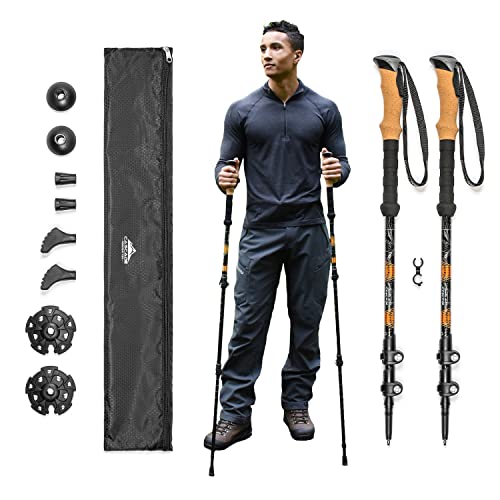
Pros
- Sturdy 6061 aluminum shafts resist bending under load across rocky trails and uneven terrain
- Ergonomic cork handles combined with EVA lower grips provide comfortable, versatile hand positions
- Lever-style quick locks allow fast, tool-free length adjustments between 26 and 54 inches
- Generous accessory bundle includes mud baskets, snow baskets, rubber boots, tip covers, and a carry bag
Cons
- Collapsed length of 26 inches may extend above the top collar of smaller 15L to 20L daypacks
- At 10 ounces per pole, aluminum construction is heavier than ultralight carbon fiber designs
- Quick-lock cam tensioners require occasional thumb-screw checks to maintain firm holding pressure over time
The Cascade Mountain Tech 6061 Aluminum Trekking Poles serve as a dependable, budget-conscious trail accessory designed for day hikers, weekend backpackers, and outdoor walkers seeking upper-body engagement and knee relief. Built to pair with standard hiking daypacks and larger backpacking packs, these two-section adjustable poles provide steady points of contact across varied outdoor surfaces.
On the trail, the quick-lock lever mechanism allows smooth height adjustments spanning from 26 inches up to 54 inches to accommodate various hiker heights and changing slope angles. Weighing approximately 10 ounces per pole, the shafts offer solid balance without excessive swing weight. When you reach a flat trail section or scramble where free hands are required, the poles collapse to a manageable 26-inch profile that fits neatly onto external backpack gear loops, side compression straps, or inside the included travel bag.
Material construction centers on aircraft-grade 6061 aluminum, which provides dependable bend resistance when navigating rocky terrain, boulder fields, or stream crossings. The ergonomic handles combine genuine cork tops with extended EVA down grips. The cork sections help dampen ground vibrations and wick moisture away during warm summer hikes, while the lower foam sections let hikers quickly lower their hand positions during steep switchbacks without pausing to readjust pole length.
Dialing in the poles for specific trails is straightforward thanks to the included accessory bundle. The core shafts feature tungsten carbide tips that bite into hard-packed dirt and slick rock surfaces. For paved greenways or sensitive rock paths, push-on rubber boots and tip covers provide traction and prevent surface scarring. When transitioning to wet spring trails or winter routes, the interchangeable mud and snow baskets screw on easily to prevent the poles from sinking deeply into soft ground.
While these poles provide dependable trail stability, prospective buyers should recognize a few practical design tradeoffs. The three-section telescoping design collapses to 26 inches, which is longer than folding Z-style poles and may extend beyond the top of compact 15-liter to 20-liter daypacks. At roughly 10 ounces per pole, aluminum construction also carries a modest weight penalty compared to premium carbon fiber poles. In addition, the quick-lock cam tensioners may require occasional finger-tightening of the thumbscrews to maintain positive locking force over miles of continuous vibration.
For beginner hikers, weekend backpackers, and budget-conscious outdoor enthusiasts looking for reliable trekking poles with comprehensive multi-season accessories, the Cascade Mountain Tech 6061 Aluminum Trekking Poles offer balanced durability and practical trail support.
When not in use, each pole collapses down to a compact 26 inches, allowing hikers to stow them easily along the exterior of most hiking backpacks. Hikers can thread the tungsten carbide tips through standard lower trekking-pole attachment loops and secure the upper shafts using side compression straps or elastic bungi cords.
For travel or vehicle storage, the set includes a lightweight zippered travel bag that prevents dirt, mud, and trail debris on the baskets and tips from contacting the interior fabric of your backpack or luggage. At 10 ounces per pole, carrying them on your pack adds minimal base weight during trail approaches.
The poles arrive with an extensive accessory package configured for year-round hiking versatility. Hard tungsten carbide tips serve as the baseline contact point for dirt singletrack, loose scree, and rugged mountain paths where maximum purchase is necessary.
For asphalt trails, slick boardwalks, or indoor transit, the included rubber boots and tip covers slip over the metal ends to dampen noise and enhance surface grip. The kit also includes wide rubber snow baskets and medium mud baskets, which prevent the poles from sinking into deep drifts, boggy soil, or loose river gravel.
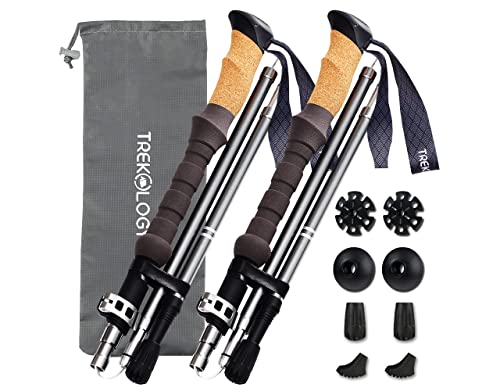
Pros
- Collapses down to a compact 15 inches, fitting easily inside backpacks or carry luggage bags
- Natural cork handles absorb hand perspiration effectively during strenuous hikes
- Sturdy aircraft-grade aluminum construction with protective metal caps at the folding joints
- Simple height adjustment between 110 cm and 130 cm via a sturdy metal flip lock lever
Cons
- TSA regulations require trekking poles to be packed in checked luggage rather than carry-on bags
- Users must verify the push-button lock is fully popped out to ensure shaft stability before hiking
- At 11.5 oz per pole, aluminum construction is heavier than ultralight carbon-fiber alternatives
The Trekology Trek-Z Cork Grip Collapsible Trekking Poles are three-section folding hiking sticks designed for day hikers, backpackers, and adventure travelers who require portable stability on uneven trails. Rather than using traditional telescoping designs that remain long when collapsed, these poles utilize a tri-fold folding cable system that stows down to a compact 15 inches. This makes them a strong match for hikers who prefer storing their poles directly inside a daypack or securing them flat against external pack compression straps without poles protruding past the top lid.
On trail, these poles offer an adjustable length range of 110 cm to 130 cm, covering a stated user height range between 5'2" and 6'5". Each pole weighs 11.5 oz (330 g), delivering a solid feel that helps distribute carried weight and stabilize joint impact on steep descents. The main handle is shaped from natural cork, which naturally absorbs hand moisture and sweat during warm trail outings. Trekology notes that the cork grips incorporate a slight rotational flex as an anti-torque ergonomic feature. Below the cork, secondary EVA foam grips allow hikers to quickly choke down on the poles when negotiating short, steep step-ups without adjusting overall pole length.
Build quality centers on aircraft-grade aluminum alloy shafts, chosen to withstand lateral loads and rocky terrain where brittle materials might crack. To reinforce high-stress connection points, Trekology adds metal caps around the folding joints, reducing play once the poles are deployed. Extension and length adjustments are secured using a durable metal flip lock at the upper section, ensuring reliable clamping power once clamped to the hiker's preferred height marker.
Deploying the poles requires extending the folding sections until the internal tension cable pulls tight and an internal metal lock button pops through the shaft hole. Ensuring this button is fully seated is essential for complete structural rigidity before latching the upper flip lock. For transport, collapsing the poles takes seconds, allowing both poles to slip neatly into the included storage bag. When traveling by commercial air to hiking destinations, keep in mind that TSA and airline policies classify trekking poles as checked luggage, meaning they must be stowed inside checked duffels or backpacks rather than overhead carry-on bags.
While the folding mechanism provides impressive packability, the design does present a few practical limitations. The total adjustment range is 20 cm (110 to 130 cm), which may not suit hikers under 5'2" who require a shorter pole setup. Additionally, at 11.5 oz per pole, weight-conscious thru-hikers aiming for sub-pound base weights might find aluminum folding poles heavier than fixed-length carbon options. The locking button also requires careful initial alignment during assembly to ensure the segments seat properly without wobbling.
For hikers, backpackers, and travelers seeking dependable trail support without spending top-tier outdoor brand prices, the Trekology Trek-Z Cork poles offer exceptional value. The combination of sweat-wicking cork handles, reinforced aluminum joints, and an ultra-packable 15-inch folded size makes them a versatile accessory for everything from local forest walks to rugged mountain backpacking trips.
The Trekology Trek-Z poles adjust between 110 cm and 130 cm in length, accommodating hikers measuring roughly 5'2" to 6'5" (159 to 195 cm) in height. Length adjustments are managed via a metal flip lock clamp on the top shaft section, allowing users to fine-tune height based on trail slope or individual arm ergonomics.
Hikers shorter than 5'2" may find the minimum 110 cm setting too tall for standard 90-degree elbow positioning on level terrain. Always confirm that your forearm rests parallel to the ground when holding the cork grip before clamping the metal flip lock.
Thanks to a three-piece folding design, the Trek-Z poles collapse down to just 15 inches (38 cm) in length. This compact size allows them to fit horizontally or vertically inside most standard daypacks, carry duffels, or luggage cases without hanging loosely off external attachment points.
The poles come with a dedicated carry bag to keep trail mud and dust away from clean gear inside your backpack. Hikers traveling by air should remember that TSA guidelines prohibit trekking poles in carry-on baggage, requiring these poles to travel inside checked luggage.
The pole shafts are manufactured from aircraft-grade aluminum alloy, delivering reliable strength-to-weight performance and high resistance to bending stresses on demanding rocky routes. The connection joints are strengthened with metal caps to guard against joint wear and slippage over time.
The handles feature genuine cork, which helps manage perspiration and adapts comfortably to hand pressure over long miles. A secondary EVA foam grip sits directly beneath the cork for quick hand repositioning on steep gradients without stopping to change shaft length.

Pros
- Folds down to 15 inches, making it significantly easier to pack inside travel luggage or strap to compact daypacks than standard telescoping poles
- Moisture-wicking natural cork handles keep palms dry and comfortable across humid hiking conditions
- Sturdy metal flip locks and reinforced joint caps provide solid structural support without slippage when properly tensioned
- Lower EVA foam grips allow instant trail adjustment for steep uphill climbing
Cons
- At 11.5 ounces per pole, they carry more weight than specialized ultralight carbon fiber poles
- The 110 cm minimum height setting may feel slightly too long for hikers under 5 feet 2 inches
- Per TSA regulations, trekking poles with metal tips must be packed in checked luggage rather than carried on flights
The Trekology Trek-Z Cork Grip Trekking Poles are folding, multi-section hiking sticks designed for hikers, backpackers, and travelers who require sturdy trail stability without the awkward bulk of traditional telescoping poles. Sold as a pair with an included carry bag, these poles suit day hikers tackling uneven paths, weekend backpackers managing load transfer on descents, and outdoor enthusiasts who need compact gear that fits inside travel luggage or standard daypack side sleeves.
Trail packability is one of the standout characteristics of this design. Utilizing a retractable tri-fold cable system, each pole breaks down to just 15 inches (38 cm) in overall length. This short folded dimension lets you slip the pair directly into the main compartment of an overnight pack, tuck them into side stretch-mesh water bottle pockets, or strap them beneath external compression straps without snagging overhead brush. For length adjustment, an upper aluminum section provides a 20 cm sliding range from 110 cm to 130 cm, catering to user heights between 5 feet 2 inches and 6 feet 5 inches.
Component construction focuses on long-term trail durability. Trekology builds the Trek-Z poles from aircraft-grade aluminum alloy, which provides higher impact resistance and flex tolerance against rocky crevices compared to brittle carbon fiber. The folding shaft joints feature protective metal caps to resist wear at stress points during repeated assembly. Up top, the natural cork grip wicks moisture away from sweaty palms during steep ascents, while a secondary EVA foam grip sleeve allows you to lower your hand placement instantly on steep trail grades without adjusting the shaft length.
Deploying and adjusting the poles requires a straightforward two-step setup. After letting the lower segments drop into place, you pull the upper shaft section until an internal metal locking button pops outward with a firm click. A durable metal external flip lock then secures the upper telescoping section at your desired height marker. Proper setup is essential; if the lower shaft feels loose or disconnected, the metal lock button must be firmly pulled until fully seated in its designated catch hole. Maintenance is simple, requiring only an occasional wipe-down with a dry cloth after muddy hikes before packing into the included storage sleeve.
While practical and durable, the Trek-Z design carries a few realistic limitations. Each pole weighs 11.5 ounces (330 grams), resulting in a combined pair weight around 23 ounces, which may deter dedicated ultralight thru-hikers who prefer minimal swing weight. Additionally, the minimum length of 110 cm means youth hikers or adults under 5 feet 2 inches might find the grip positioning too elevated on flat terrain. Travelers should also remember that TSA guidelines require trekking poles with rigid tips to travel inside checked baggage rather than carry-on packs.
For hikers seeking an affordable, compact, and robust set of walking poles, the Trekology Trek-Z Cork Grip poles deliver excellent overall value. They provide dependable joint support, sweat-wicking cork comfort, and pack-friendly folding convenience that fits easily into standard hiking backpacks and travel duffels.
The Trekology Trek-Z poles feature an adjustable working range between 110 cm and 130 cm, making them compatible with users measuring between 5 feet 2 inches and 6 feet 5 inches in height. Sizing adjustments are controlled via a durable metal flip-lock clamp positioned on the upper shaft section, marked with clear centimeter increments for quick alignment.
Hikers can lengthen the poles slightly for steep downhill sections to maintain an upright posture, or shorten them for prolonged uphill climbs. For fast grade transitions where stopping to loosen the clamp is impractical, the extended EVA foam grip below the primary cork handle allows instant choke-down positioning.
Thanks to a three-section folding architecture linked by an internal tension cable, the Trek-Z poles collapse down to an ultra-compact 15 inches (38 cm). This compact footprint allows them to slide vertically inside most 20-liter to 65-liter hiking backpacks, eliminating the tip-heavy snagging hazards common with longer two-piece or three-piece telescoping poles.
A matching carry bag is included to keep trail mud and dust away from sleeping bags, pack liners, and clothing when stored internally. When flying to destination trailheads, note that airline security guidelines require trekking poles to be packed within checked baggage rather than carry-on luggage.
The shafts are manufactured from aircraft-grade aluminum alloy, delivering high tensile strength and resilience against bending forces when supporting heavy backpack loads on rocky trails. The connection joints between segments are reinforced with metal caps to resist cracking and wall deformation under load.
The upper handle utilizes natural cork material that absorbs hand moisture, resisting slick spots during warm summer outings. The handle is engineered with a slight rotational flex that acts as an anti-torque buffer, reducing jarring impacts transmitted through the hands and wrists across prolonged trail miles.

Pros
- Lightweight 3K carbon fiber construction reduces carried and swinging weight to 7.6 ounces per pole
- Metal flip locks offer secure, slip-resistant tension compared to traditional twist-lock mechanisms
- Ergonomic cork handles paired with secondary EVA foam grips provide versatile hand positioning on varying trail grades
- Wide 24-inch to 55-inch adjustment span suits a diverse range of user heights and terrain angles
Cons
- Carbon fiber shafts can fracture if wedged between rocks and subjected to severe lateral bending forces
- Collapsed length of 24 inches may extend beyond the top or bottom of ultra-compact daypacks when mounted externally
- Metal flip lock levers require occasional thumb-screw tension checks to prevent slippage over extended mileage
The Hiker Hunger 100% Carbon Fiber Trekking Poles are adjustable three-section telescoping trail poles built for day hikers, section hikers, backpackers, and campers seeking to shed weight without giving up stability. Constructed from 3K carbon fiber, each pole weighs approximately 7.6 ounces, making them an excellent choice for hikers looking to reduce joint impact on rugged trails while keeping their base gear manageable.
In terms of trail adjustment, these poles expand from a compact 24 inches up to a full 55 inches, comfortably serving both shorter and taller hikers across diverse terrain grades. Rather than relying on twist locks that can slip or freeze when exposed to dirt and moisture, Hiker Hunger equips these poles with quick-adjust flip locks built with metal hardware. This provides firm, slip-resistant clamping whether you are lengthening the poles for a steep downhill descent or shortening them for an aggressive ridge climb.
Grip comfort is a primary design focus, featuring ergonomic natural cork handles that actively wick moisture away from your palms while molding to your hand shape over time. Directly beneath the cork handles, secondary nonslip EVA foam extensions provide an immediate choke-down point for short, steep switchbacks, eliminating the need to stop and adjust pole length. Soft neoprene-padded wrist straps further enhance comfort, distributing downward pressure across your wrists without causing chafing during long mileage days.
Transporting and maintaining these poles on the trail is straightforward. When not in use, the shafts collapse down to 24 inches, allowing them to nest securely into side water bottle pockets, slide behind backpack compression straps, or strap onto front trekking-pole attachment loops. Maintenance involves basic trail hygiene: simply wipe away grit and moisture after wet outings and periodically check the thumbscrew tension on the metal flip locks to preserve optimal clamping force.
While carbon fiber provides exceptional weight savings and natural vibration damping, it behaves differently than aluminum under severe lateral stress. If a carbon pole becomes trapped between roots or granite boulders and is subjected to heavy sideways leverage, it is susceptible to cracking or snapping rather than bending. Additionally, hikers using compact daypacks under 20 liters should note that the 24-inch collapsed height will protrude somewhat above the pack rim when lashed to external straps.
For day hikers, multi-day backpackers, and travelers seeking an agile pair of poles with natural cork ergonomics and durable metal locking mechanisms, the Hiker Hunger Carbon Fiber Trekking Poles represent strong trail value. Backed by a 1-year warranty and a USA-based company, they provide dependable knee-saving support and steady balance across varied backcountry trails.
The Hiker Hunger trekking poles feature a telescoping three-section shaft that adjusts smoothly between 24 inches and 55 inches. This expansive range accommodates men, women, and younger hikers across flat paths, steep alpine ascents, and knee-jarring descents.
Length adjustments are secured using external flip locks equipped with metal levers. Unlike plastic components that can warp or weaken over time, the metal locking mechanism maintains consistent clamping pressure against the carbon fiber sections to help prevent unexpected slippage while hiking under load.
Constructed entirely from 100% 3K carbon fiber, these poles offer high tensile strength and natural vibration absorption while weighing only 7.6 ounces per pole. This lightweight profile substantially lowers the energy required per arm swing over long trail days.
The upper handle combines natural moisture-wicking cork with dense EVA foam for the lower grip extension, providing comfortable handholds in both warm and cold weather. To maintain the structural integrity of carbon fiber, hikers should avoid using the poles as pry bars and keep the locking collars clean of trail debris.
With a collapsed length of 24 inches, these poles integrate easily with standard hiking daypacks and multi-day backpacking packs. They can be threaded through dedicated lower trekking-pole loops, secured via upper bungee cords, or held fast by side compression straps.
For travel or public transit to the trailhead, the 24-inch collapsed size allows the pair to fit inside standard checked luggage or across larger duffel bags, keeping your trail gear neatly consolidated between outings.

Pros
- Collapses down to a compact 15-inch profile that fits inside most hiking daypacks and travel bags.
- Aircraft-grade aluminum shafts and metal flip locks resist trail impacts better than fragile plastic clamps.
- Natural cork grips offer comfortable, sweat-resistant hand placement with lower EVA foam extensions for switchbacks.
- Listed at 9.95 ounces per pole, keeping carried base weight and trail fatigue low.
Cons
- The 100-120 cm adjustment range is strictly limited to hikers 5 feet 9 inches and under.
- Folding cord design requires manual joint alignment during deployment compared to standard twist or slide poles.
- Aluminum construction is slightly heavier than ultralight carbon fiber alternatives.
The Hiker Hunger Foldable Aluminum Trekking Poles are compact, packable hiking sticks designed for trail balance, stability, and joint relief during day hikes or backpacking excursions. With an adjustable range spanning 100 to 120 centimeters, this specific short variant is built specifically for hikers standing 5 feet 9 inches and under. For hikers who prefer to stow their poles inside or alongside a pack when scrambling rocky sections, boarding planes, or commuting to trailheads, the folding configuration provides a distinct packability advantage over standard full-length telescoping options.
On the trail, the main benefit of this system is the compact 15-inch collapsed length combined with a manageable listed weight of 9.95 ounces. The multi-section folding shafts slide smoothly into side water-bottle pockets, slip behind exterior pack compression straps, or stow entirely within internal gear compartments. This makes them especially useful for technical trail segments where hands-free movement is required, as well as for minimalist backpackers who value clean external pack lines without protruding gear.
Construction quality centers around aircraft-grade aluminum tubing connected by reinforced joints and secured with external metal flip locks. Metal locking levers provide reliable holding strength against vertical slippage on steep descents and resist impact damage better than brittle molded plastic alternatives. Hand comfort is supported by genuine cork main grips that shape to the palms and absorb sweat, while lower EVA foam grip extensions allow hikers to choke down during sudden steep switchbacks without pausing to unlock and shorten the poles.
Deploying and adjusting the poles is straightforward once familiar with folding-shaft mechanics. The lower segments lock into place via an internal tension cable, while the uppermost section provides 20 centimeters of fine height adjustment secured by the metal cam lever. Basic maintenance involves wiping away trail mud, letting the shafts and inner cable dry thoroughly before long-term storage, and checking the flip-lock tension screw occasionally to maintain firm clamping force.
Realistic limitations must be noted before purchase. Because this model reaches a maximum length of 120 centimeters, hikers taller than 5 feet 9 inches will lack sufficient extension for a proper 90-degree arm angle, particularly on steep downhill sections. Furthermore, while aluminum bends rather than snaps abruptly under extreme lateral loads, it carries a small weight penalty over premium carbon fiber alternatives. The folding joints also require routine visual checks to ensure trail grit does not interfere with proper joint seating.
For day hikers, section hikers, and adventure travelers who fit within the recommended height parameters, these Hiker Hunger poles represent a well-constructed, travel-friendly trail tool. Their 15-inch packed profile, durable metal hardware, and ergonomic cork handles make them a dependable asset for any hiker seeking reliable stability without taking up unnecessary pack volume.
This model features an adjustable usable length between 100 and 120 centimeters, designed to fit hikers who are 5 feet 9 inches tall and shorter. Proper ergonomic trekking pole fit requires that your elbow forms approximately a 90-degree bend when holding the grip with the pole tip resting on level ground.
Hikers near the upper limit of 5 feet 9 inches who frequently tackle steep mountain descents may find themselves near the pole maximum extension. Hikers taller than 5 feet 9 inches should look toward the longer 115 to 135 centimeter variant to ensure adequate downhill reach and optimal joint support.
Collapsing down to just 15 inches, these folding poles pack considerably smaller than standard two-section or three-section telescoping poles that typically collapse to 24 inches or more. This compact profile allows them to slide entirely inside daypacks, luggage, or trunk storage compartments without sticking out.
When stowing poles on your backpack exterior, the 15-inch length minimizes snagging hazards when hiking through dense brush or off-trail terrain. To maintain the internal tension cord and prevent corrosion, ensure all sections are completely dry before packing them away for extended off-season storage.
Biomechanical and Practical Advantages of Using Trekking Poles
Trekking poles serve as essential biomechanical tools that alter how human anatomy interacts with gravity, trail obstacles, and shifting gradients. Rather than merely acting as walking sticks, modern pole systems function as an extension of the skeletal frame that actively redistributes body weight and kinetic forces. Exploring what are the benefits of hiking poles reveals significant physiological advantages, ranging from immediate joint preservation to long-term endurance enhancement. By transferring a portion of each downward step onto the shoulder girdle and core, hikers can sustain higher mileage with reduced physical trauma.
Joint Impact Mitigation and Lower Body Relief on Steep Descents
Descents place tremendous eccentric strain on the quadriceps and exert multi-fold compressive forces across the patella and meniscus with every step. When stepping down off tall rock ledges or steep log water bars, the leading knee absorbs several times the hiker’s total body weight. Planting poles ahead of the body creates a supportive braking tripod that catches downward momentum before the foot contacts the ground. This physical deceleration offloads substantial cumulative pressure from the knees, ankles, and lumbar spine over miles of sustained downhill hiking.
Hikers carrying multi-day packs experience magnified lower-body stress, making external structural support vital on prolonged mountain descents. Combining poles with heavy load-bearing internal frame backpacks helps stabilize the center of mass, preventing the jarring spinal compression that often accompanies steep descents. By allowing the arms, shoulders, and chest to share the deceleration workload, poles prevent early quad burnout and trembling knees. Over high-mileage descents, this mechanical offloading significantly reduces post-hike joint inflammation and connective tissue soreness.
Uphill Cadence, Muscular Redistribution, and Caloric Economy
Sustained mountain ascents demand immense cardiovascular output and rapid muscular exhaustion of the calves, hamstrings, and glutes. Trekking poles convert dormant upper-body musculature into active propulsion engines by engaging the latissimus dorsi, triceps, and anterior deltoids. As the pole tip bites into the trail surface, a firm downward and backward push through the wrist straps provides direct forward thrust. This kinetic contribution relieves the lower legs from bearing the entire burden of vertical elevation gain, smoothing out the physical effort.
Using poles on steep climbs also encourages an upright, efficient posture that keeps the chest open and maximizes lung capacity. Hikers without poles often hunch forward under heavy loads, compressing the diaphragm and restricting tidal breathing volume during intense climbs. Poles naturally keep the torso balanced over the hips, facilitating rhythmic breathing and a steady marching cadence. Wearing flexible, lightweight trail hiking pants alongside a steady pole rhythm enables unrestricted hip flexion and fluid strides on technical mountain ascents.
Dynamic Balance and Fall Prevention on Uneven Backcountry Terrain
Maintaining balance on rough wilderness tracks requires continuous micro-adjustments that fatigue the stabilizing muscles of the ankles and feet. Trekking poles instantly transform a bipedal gait into a four-point suspension system, dramatically widening the user’s base of support. When stepping across wet river boulders, muddy bogs, or loose talus slopes, having two additional ground contact points prevents slips from escalating into catastrophic falls. The poles act as instant outriggers that catch off-balance stumbles before the center of gravity moves past the base of support.
Sidehill traversing along exposed ridgelines presents unique stability challenges where the uphill foot operates on a different plane than the downhill foot. Telescoping poles, such as the Cascade Mountain Tech Trekking Poles with their adjustable range from 26 inches to 54 inches, allow hikers to shorten the uphill pole and lengthen the downhill pole to maintain an upright stance. This lateral stabilization reduces ankle torque and prevents hikers from leaning precariously into the slope. On treacherous stream crossings, poles provide tactile verification of water depth and submerged rock stability before committing full body weight to a step.
Ergonomics, Grip Materials, and Wrist Strap Skeletal Loading
Hand comfort and proper grip mechanics directly determine how efficiently energy transfers from the body into the pole shaft. Natural cork grips, featured on models like the Trekology Trek-Z Cork Grip Collapsible Lightweight, absorb hand moisture and gradually conform to the user’s hand shape over time. Cork maintains a firm, slip-resistant surface during hot summer treks, preventing the palmar blisters commonly caused by non-breathable rubber handles. Some cork grips even incorporate engineered rotational flex to absorb anti-torque forces on uneven terrain without transferring torsional wrist strain to the hiker.
Secondary grip sleeves made from high-density EVA foam provide crucial choke-up positions directly beneath the main handle for steep climbs. Products such as the 100% Carbon Fiber Trekking Poles by USA Brand incorporate extended EVA foam collars so hikers can instantly choke up on the shaft without pausing to adjust mechanical locks. Also, utilizing proper wrist strap technique by threading the hand upward through the bottom of the loop ensures that downward body weight rests on the wide webbing rather than requiring a fatiguing death grip on the handle. Padded neoprene straps prevent chafing across the ulnar border of the wrist during high-mileage backcountry days.
Structural Metallurgy: Aluminum Bend Ductility Versus Carbon Fiber Vibration Damping
Shaft material selection represents a fundamental trade-off between ductile impact resistance and ultralight vibration damping. Aircraft-grade 6061 aluminum, utilized in Cascade Mountain Tech Trekking Poles, provides reliable structural resilience by yielding and bending under excessive lateral force rather than shattering instantly. When a pole gets wedged between granite boulders or root lattices during an off-balance fall, aluminum shafts often bend, allowing the hiker to gently bend them back to finish the trek. This bending ductility makes aluminum a trusted choice for rugged backcountry excursions and hikers supporting heavier pack weights.
Conversely, multi-directional 3k carbon fiber shafts offer exceptional weight reduction and superior high-frequency trail vibration absorption. The 100% Carbon Fiber Trekking Poles by USA Brand weigh only 7.6 ounces per pole, substantially reducing swing weight and preventing shoulder fatigue over long-distance treks. Carbon fiber transmits less repetitive ground buzz into the wrists and elbows, making it highly desirable for hikers managing joint sensitivity. However, carbon fiber shafts possess lower tolerance for lateral shear stress and can fracture if subjected to severe twisting while jammed tightly in rock crevices.
Locking Assemblies and Secure Deployment Under Axial Body Weight
A trekking pole’s ability to protect the hiker depends entirely on the mechanical holding force of its locking mechanisms. External cam lever locks, also known as flip locks, have largely replaced older internal twist expanders across the outdoor industry due to their visible reliability and ease of field adjustment. Models like the Premium Foldable Hiking Poles by USA Brand utilize durable metal flip locks that provide firm clamping pressure on shaft sections without slipping under heavy downward body weight. Unlike plastic collars that can become brittle in freezing temperatures, metal clamp hardware resists cracking and maintains consistent clamping friction.
Maintaining proper clamping tension requires periodic adjustment of the external thumbscrew to account for temperature shifts and component wear. If a pole section slides inward when bearing full upper-body weight, opening the cam lever and tightening the tension screw clockwise by a quarter-turn restores secure holding power. Hikers should routinely test both shafts by bearing full downward body weight on level ground before starting a descent. Verifying lock security ensures that the shafts will not unexpectedly collapse during high-consequence step-downs or technical river crossings.
Packability, Folding Geometries, and Travel Realities
Packability dictates how easily trekking poles stow away when trails transition to Class 3 scrambles or when traveling on public transit and airlines. Folding Z-poles, including the Trekology Trek-Z Cork Grip Collapsible Lightweight and Premium Foldable Hiking Poles by USA Brand, collapse down to a compact 15 inches using internal tension cords and metal joint collars. This tiny footprint allows hikers to slip their poles inside daypacks, commuter bags, or luggage rather than lashing long telescoping shafts to the pack exterior. Three-section telescoping poles typically collapse to around 24 to 26 inches, which remains portable but requires external pack attachment loops.
Navigating airline security regulations requires advance planning because airport transit rules strictly govern sharp trekking pole hardware. Transportation Security Administration guidelines and international aviation security rules prohibit hiking poles with metal carbide tips in carry-on baggage. Travelers must pack their collapsible or folding poles inside checked luggage to avoid checkpoint confiscation. Carrying a protective travel bag, which comes standard with many folding pole sets, prevents sharp carbide flex tips and metal joint ferrules from puncturing clothing or duffel fabric during air transit.
Multi-Use Utility: Ultralight Shelters, Trail Probing, and Hazard Defense
Beyond locomotion, trekking poles provide versatile multi-use utility that allows ultralight backpackers to eliminate dedicated tent poles from their base weight. Many modern non-freestanding tarps and ultralight shelters rely on inverted trekking poles as primary vertical structural supports. Sturdy aluminum shafts and rigid carbon fiber poles provide high axial load resistance capable of sustaining taut shelter pitches in heavy backcountry winds and rain. Hikers should confirm that shelter grommets or apex reinforcement cups seat securely against the pole grips or carbide tips without puncturing the canopy.
Trekking poles also act as essential trail probing tools when navigating obscure or treacherous backcountry conditions. Hikers can probe deep mud holes, test the structural integrity of snow bridges, and assess the depth of murky river crossings before committing their footing. In overgrown wilderness corridors, waving poles forward sweeps away thick cobwebs and parts dense briars, stinging nettles, and damp foliage without requiring hand contact. In rare instances, extending poles outward can make a hiker appear larger to deter curious wildlife along remote backcountry routes.
Establishing Proper Sizing, Elbow Angles, and Terrain Calibration
Maximizing the biomechanical benefits of trekking poles requires establishing the correct shaft length relative to the hiker’s height and terrain gradient. Standing upright on flat ground, the pole should be adjusted so the elbow rests at a clean 90-degree angle when the hand grips the handle and the tip touches the floor. Telescoping poles feature graduated centimeter or inch markings along the shaft sections to make replicating this baseline height simple and repeatable. Sizing ranges that span from 100 cm to 135 cm ensure that men, women, and teenagers of varying heights can achieve optimal arm positioning.
Adjusting pole height dynamically throughout a hike optimizes performance across changing trail inclines. On sustained uphill climbs, shortening each pole by 5 to 10 centimeters brings the push point closer to the body, preventing the arms from over-reaching and tiring the shoulders. Conversely, lengthening the shafts by 5 to 10 centimeters for steep descents allows the hiker to plant the tips further downhill while maintaining an upright posture. Hikers must ensure that shaft sections are never pulled past the marked stop indicators, as insufficient segment overlap creates severe structural weakness that can cause the shaft to snap under load.
Investing in a reliable pair of trekking poles transforms overall hiking efficiency, joint longevity, and backcountry safety. Whether choosing ductile aluminum shafts for rugged load-bearing stability or ultralight carbon fiber for fatigue-free swing weight, the biomechanical relief on knees and hips is undeniable. By mastering proper upward strap loading, setting precise clamp tension, and adjusting pole lengths for the gradient ahead, hikers can conquer challenging elevation profiles with lasting comfort. Integrating trekking poles into your regular gear kit ensures that every trail mile feels more balanced, secure, and sustainable.



Write Your Review
No reviews yet. Be the first to share your experience!