


Steep mountain trails and rocky backcountry paths place heavy compressive forces on ankles, knees, and hips, especially when carrying a multiday pack. Learning how to walk with hiking poles transforms your body from a two-legged walker into a four-point stability system, actively distributing impact forces into your shoulders, chest, and arms. Beyond protecting delicate joints on punishing descents, synchronized pole technique establishes a steady walking cadence that conserves cardiovascular energy on long ascents. Hikers managing chronic knee soreness often pair their pole setup with protective knee hiking pants to keep lower-body joints supported through continuous elevation changes.
Mastering the rhythm of trekking poles takes a bit of deliberate practice, but the mechanical advantages quickly feel second nature once your arms sync with your natural stride. Whether you choose ultra-lightweight carbon fiber shafts for rapid trail running or resilient 7075 aluminum poles for rocky off-trail routes, understanding wrist strap alignment, terrain height adjustment, and proper plant angles is essential. Many beginners grip their poles too tightly or plant them awkwardly far forward, inadvertently tiring their forearms and interrupting forward momentum. Dialing in a fluid arm swing and correct plant timing allows your trekking poles to propel you forward on flats, hoist you up climbs, and brake smoothly on slick switchbacks.
Pros
- Collapses down to a compact 15 inches, fitting easily inside backpacks or carry luggage bags
- Natural cork handles absorb hand perspiration effectively during strenuous hikes
- Sturdy aircraft-grade aluminum construction with protective metal caps at the folding joints
- Simple height adjustment between 110 cm and 130 cm via a sturdy metal flip lock lever
Cons
- TSA regulations require trekking poles to be packed in checked luggage rather than carry-on bags
- Users must verify the push-button lock is fully popped out to ensure shaft stability before hiking
- At 11.5 oz per pole, aluminum construction is heavier than ultralight carbon-fiber alternatives
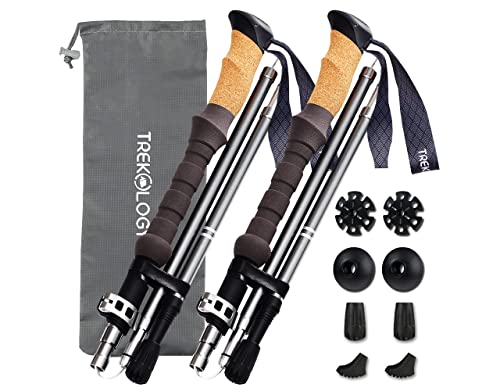
The Trekology Trek-Z Cork Grip Collapsible Trekking Poles are three-section folding hiking sticks designed for day hikers, backpackers, and adventure travelers who require portable stability on uneven trails. Rather than using traditional telescoping designs that remain long when collapsed, these poles utilize a tri-fold folding cable system that stows down to a compact 15 inches. This makes them a strong match for hikers who prefer storing their poles directly inside a daypack or securing them flat against external pack compression straps without poles protruding past the top lid.
On trail, these poles offer an adjustable length range of 110 cm to 130 cm, covering a stated user height range between 5'2" and 6'5". Each pole weighs 11.5 oz (330 g), delivering a solid feel that helps distribute carried weight and stabilize joint impact on steep descents. The main handle is shaped from natural cork, which naturally absorbs hand moisture and sweat during warm trail outings. Trekology notes that the cork grips incorporate a slight rotational flex as an anti-torque ergonomic feature. Below the cork, secondary EVA foam grips allow hikers to quickly choke down on the poles when negotiating short, steep step-ups without adjusting overall pole length.
Build quality centers on aircraft-grade aluminum alloy shafts, chosen to withstand lateral loads and rocky terrain where brittle materials might crack. To reinforce high-stress connection points, Trekology adds metal caps around the folding joints, reducing play once the poles are deployed. Extension and length adjustments are secured using a durable metal flip lock at the upper section, ensuring reliable clamping power once clamped to the hiker's preferred height marker.
Deploying the poles requires extending the folding sections until the internal tension cable pulls tight and an internal metal lock button pops through the shaft hole. Ensuring this button is fully seated is essential for complete structural rigidity before latching the upper flip lock. For transport, collapsing the poles takes seconds, allowing both poles to slip neatly into the included storage bag. When traveling by commercial air to hiking destinations, keep in mind that TSA and airline policies classify trekking poles as checked luggage, meaning they must be stowed inside checked duffels or backpacks rather than overhead carry-on bags.
While the folding mechanism provides impressive packability, the design does present a few practical limitations. The total adjustment range is 20 cm (110 to 130 cm), which may not suit hikers under 5'2" who require a shorter pole setup. Additionally, at 11.5 oz per pole, weight-conscious thru-hikers aiming for sub-pound base weights might find aluminum folding poles heavier than fixed-length carbon options. The locking button also requires careful initial alignment during assembly to ensure the segments seat properly without wobbling.
For hikers, backpackers, and travelers seeking dependable trail support without spending top-tier outdoor brand prices, the Trekology Trek-Z Cork poles offer exceptional value. The combination of sweat-wicking cork handles, reinforced aluminum joints, and an ultra-packable 15-inch folded size makes them a versatile accessory for everything from local forest walks to rugged mountain backpacking trips.
The Trekology Trek-Z poles adjust between 110 cm and 130 cm in length, accommodating hikers measuring roughly 5'2" to 6'5" (159 to 195 cm) in height. Length adjustments are managed via a metal flip lock clamp on the top shaft section, allowing users to fine-tune height based on trail slope or individual arm ergonomics.
Hikers shorter than 5'2" may find the minimum 110 cm setting too tall for standard 90-degree elbow positioning on level terrain. Always confirm that your forearm rests parallel to the ground when holding the cork grip before clamping the metal flip lock.
Thanks to a three-piece folding design, the Trek-Z poles collapse down to just 15 inches (38 cm) in length. This compact size allows them to fit horizontally or vertically inside most standard daypacks, carry duffels, or luggage cases without hanging loosely off external attachment points.
The poles come with a dedicated carry bag to keep trail mud and dust away from clean gear inside your backpack. Hikers traveling by air should remember that TSA guidelines prohibit trekking poles in carry-on baggage, requiring these poles to travel inside checked luggage.
The pole shafts are manufactured from aircraft-grade aluminum alloy, delivering reliable strength-to-weight performance and high resistance to bending stresses on demanding rocky routes. The connection joints are strengthened with metal caps to guard against joint wear and slippage over time.
The handles feature genuine cork, which helps manage perspiration and adapts comfortably to hand pressure over long miles. A secondary EVA foam grip sits directly beneath the cork for quick hand repositioning on steep gradients without stopping to change shaft length.

Pros
- Folds down to 15 inches, making it significantly easier to pack inside travel luggage or strap to compact daypacks than standard telescoping poles
- Moisture-wicking natural cork handles keep palms dry and comfortable across humid hiking conditions
- Sturdy metal flip locks and reinforced joint caps provide solid structural support without slippage when properly tensioned
- Lower EVA foam grips allow instant trail adjustment for steep uphill climbing
Cons
- At 11.5 ounces per pole, they carry more weight than specialized ultralight carbon fiber poles
- The 110 cm minimum height setting may feel slightly too long for hikers under 5 feet 2 inches
- Per TSA regulations, trekking poles with metal tips must be packed in checked luggage rather than carried on flights
The Trekology Trek-Z Cork Grip Trekking Poles are folding, multi-section hiking sticks designed for hikers, backpackers, and travelers who require sturdy trail stability without the awkward bulk of traditional telescoping poles. Sold as a pair with an included carry bag, these poles suit day hikers tackling uneven paths, weekend backpackers managing load transfer on descents, and outdoor enthusiasts who need compact gear that fits inside travel luggage or standard daypack side sleeves.
Trail packability is one of the standout characteristics of this design. Utilizing a retractable tri-fold cable system, each pole breaks down to just 15 inches (38 cm) in overall length. This short folded dimension lets you slip the pair directly into the main compartment of an overnight pack, tuck them into side stretch-mesh water bottle pockets, or strap them beneath external compression straps without snagging overhead brush. For length adjustment, an upper aluminum section provides a 20 cm sliding range from 110 cm to 130 cm, catering to user heights between 5 feet 2 inches and 6 feet 5 inches.
Component construction focuses on long-term trail durability. Trekology builds the Trek-Z poles from aircraft-grade aluminum alloy, which provides higher impact resistance and flex tolerance against rocky crevices compared to brittle carbon fiber. The folding shaft joints feature protective metal caps to resist wear at stress points during repeated assembly. Up top, the natural cork grip wicks moisture away from sweaty palms during steep ascents, while a secondary EVA foam grip sleeve allows you to lower your hand placement instantly on steep trail grades without adjusting the shaft length.
Deploying and adjusting the poles requires a straightforward two-step setup. After letting the lower segments drop into place, you pull the upper shaft section until an internal metal locking button pops outward with a firm click. A durable metal external flip lock then secures the upper telescoping section at your desired height marker. Proper setup is essential; if the lower shaft feels loose or disconnected, the metal lock button must be firmly pulled until fully seated in its designated catch hole. Maintenance is simple, requiring only an occasional wipe-down with a dry cloth after muddy hikes before packing into the included storage sleeve.
While practical and durable, the Trek-Z design carries a few realistic limitations. Each pole weighs 11.5 ounces (330 grams), resulting in a combined pair weight around 23 ounces, which may deter dedicated ultralight thru-hikers who prefer minimal swing weight. Additionally, the minimum length of 110 cm means youth hikers or adults under 5 feet 2 inches might find the grip positioning too elevated on flat terrain. Travelers should also remember that TSA guidelines require trekking poles with rigid tips to travel inside checked baggage rather than carry-on packs.
For hikers seeking an affordable, compact, and robust set of walking poles, the Trekology Trek-Z Cork Grip poles deliver excellent overall value. They provide dependable joint support, sweat-wicking cork comfort, and pack-friendly folding convenience that fits easily into standard hiking backpacks and travel duffels.
The Trekology Trek-Z poles feature an adjustable working range between 110 cm and 130 cm, making them compatible with users measuring between 5 feet 2 inches and 6 feet 5 inches in height. Sizing adjustments are controlled via a durable metal flip-lock clamp positioned on the upper shaft section, marked with clear centimeter increments for quick alignment.
Hikers can lengthen the poles slightly for steep downhill sections to maintain an upright posture, or shorten them for prolonged uphill climbs. For fast grade transitions where stopping to loosen the clamp is impractical, the extended EVA foam grip below the primary cork handle allows instant choke-down positioning.
Thanks to a three-section folding architecture linked by an internal tension cable, the Trek-Z poles collapse down to an ultra-compact 15 inches (38 cm). This compact footprint allows them to slide vertically inside most 20-liter to 65-liter hiking backpacks, eliminating the tip-heavy snagging hazards common with longer two-piece or three-piece telescoping poles.
A matching carry bag is included to keep trail mud and dust away from sleeping bags, pack liners, and clothing when stored internally. When flying to destination trailheads, note that airline security guidelines require trekking poles to be packed within checked baggage rather than carry-on luggage.
The shafts are manufactured from aircraft-grade aluminum alloy, delivering high tensile strength and resilience against bending forces when supporting heavy backpack loads on rocky trails. The connection joints between segments are reinforced with metal caps to resist cracking and wall deformation under load.
The upper handle utilizes natural cork material that absorbs hand moisture, resisting slick spots during warm summer outings. The handle is engineered with a slight rotational flex that acts as an anti-torque buffer, reducing jarring impacts transmitted through the hands and wrists across prolonged trail miles.

Pros
- Compact 13.4-inch folded size packs easily into daypacks, travel luggage, or side bottle sleeves
- Aircraft-grade 7075 aluminum alloy provides reliable strength against bending on rocky trails
- External Quick Lock mechanism allows simple height adjustments from 43.3 to 49.2 inches
- Grooved EVA foam handle absorbs hand sweat while maintaining a comfortable, non-slip grip
- Includes a durable tungsten steel tip with a protective rubber foot for varied surfaces
Cons
- Sold as a single pole (1 PC), meaning hikers who prefer dual-pole stability must purchase two units
- Maximum extended length of 49.2 inches may not suit taller hikers above 6 feet 2 inches
- Fixed adjustment range (43.3 to 49.2 inches) may be too long for individuals under 5 feet 3 inches
The A ALAFEN 7075 Aluminum Collapsible Trekking Pole is a single, folding walking stick designed for day hikers, backpackers, and travelers who require portable stability on the trail. Unlike standard telescoping poles that can remain awkwardly long when strapped to a backpack, this model folds down to a compact 13.4 inches. That manageable profile makes it especially suitable for hikers carrying mid-sized daypacks, overnight packs with external gear attachments, or travel bags where packing volume is limited.
Real-world trail utility centers on how easily the pole stows and deploys. Weighing approximately 0.6875 pounds (about 11 ounces), the pole adds very little base weight to your hiking pack. When assembled, its Quick Lock mechanism allows you to adjust the functional length between 43.3 inches and 49.2 inches. The pole shaft includes a printed measuring scale, which helps you quickly set your preferred height depending on whether you are climbing uphill or descending steep terrain. According to manufacturer specifications, this adjustment range accommodates hikers between 5 feet 3 inches and 6 feet 2 inches.
Construction quality centers on aircraft-grade 7075 aluminum alloy, a material well-regarded in the outdoor gear space for its resilience against bending and impact deformation. At the handle, an EVA foam grip features a skid-resistant grooved surface and sweat-absorbent texture to help maintain control during warm-weather hikes or strenuous ascents. The attached wrist strap adds stability and helps distribute grip pressure. For ground traction, the bottom houses a rugged tungsten steel tip that bites into packed dirt, mud, and scree, while an included rubber footing covers the metal tip for pavement or slick rock slabs.
Packing and trail-side handling are straightforward thanks to the multi-section folding design. When collapsed to 13.4 inches, the pole easily slips inside standard backpack main compartments, fits into tall side water bottle sleeves, or lashes onto external compression straps and trekking pole loops. Deploying the pole involves extending the connected segments until the internal tension cord locks in place, followed by securing the lever-action Quick Lock clamp at your desired height mark. Maintenance requires minimal effort, mainly consisting of wiping away trail grit, rinsing off mud, and allowing the sections to air dry completely before long-term storage.
Potential buyers should consider a few practical limitations before ordering. This listing includes only a single pole (1 PC), so hikers who rely on a dual-pole setup for knee relief or balance will need to purchase a second unit. Additionally, the adjustment range of 43.3 to 49.2 inches limits proper ergonomic fit for hikers under 5 feet 3 inches or taller than 6 feet 2 inches. While 7075 aluminum is durable and impact-resistant, it does weigh slightly more than high-end carbon fiber options, and the folding mechanism requires careful locking to prevent slippage under heavy downward force.
For hikers, campers, and travel enthusiasts seeking a reliable and budget-friendly single walking stick, the A ALAFEN collapsible pole delivers excellent practical value. Its ability to tuck neatly into or onto almost any hiking backpack makes it a hassle-free addition to your gear lineup. If you fall within the supported height range and want dependable trail support without the bulk of traditional full-length poles, this compact aluminum model is a sensible choice.
When fully collapsed, the A ALAFEN trekking pole measures 13.4 inches, making it short enough to fit inside most daypacks or slide into exterior side pockets without protruding excessively. This makes it far more pack-friendly than conventional three-section telescoping poles that typically collapse to 24 inches or more.
The working length adjusts from 43.3 inches (110 cm) to 49.2 inches (125 cm) using an external Quick Lock lever. The manufacturer lists a recommended user height range of 5 feet 3 inches to 6 feet 2 inches (160 cm to 187 cm). If your height falls outside this window, the pole may not provide an optimal 90-degree elbow angle on flat terrain.
The pole shaft is constructed from aircraft-grade 7075 aluminum alloy, offering solid structural resistance to bending forces common on rocky descents. The handle is shaped from grooved EVA foam designed to absorb hand moisture and reduce slippage during humid trail conditions.
The tip features a tungsten steel point engineered for firm penetration into dirt, gravel, and packed forest trails. A removable rubber foot is included to shield the metal tip and provide traction on asphalt, stone walkways, or slick granite slabs.

Pros
- Lightweight 3K carbon fiber construction reduces carried and swinging weight to 7.6 ounces per pole
- Metal flip locks offer secure, slip-resistant tension compared to traditional twist-lock mechanisms
- Ergonomic cork handles paired with secondary EVA foam grips provide versatile hand positioning on varying trail grades
- Wide 24-inch to 55-inch adjustment span suits a diverse range of user heights and terrain angles
Cons
- Carbon fiber shafts can fracture if wedged between rocks and subjected to severe lateral bending forces
- Collapsed length of 24 inches may extend beyond the top or bottom of ultra-compact daypacks when mounted externally
- Metal flip lock levers require occasional thumb-screw tension checks to prevent slippage over extended mileage
The Hiker Hunger 100% Carbon Fiber Trekking Poles are adjustable three-section telescoping trail poles built for day hikers, section hikers, backpackers, and campers seeking to shed weight without giving up stability. Constructed from 3K carbon fiber, each pole weighs approximately 7.6 ounces, making them an excellent choice for hikers looking to reduce joint impact on rugged trails while keeping their base gear manageable.
In terms of trail adjustment, these poles expand from a compact 24 inches up to a full 55 inches, comfortably serving both shorter and taller hikers across diverse terrain grades. Rather than relying on twist locks that can slip or freeze when exposed to dirt and moisture, Hiker Hunger equips these poles with quick-adjust flip locks built with metal hardware. This provides firm, slip-resistant clamping whether you are lengthening the poles for a steep downhill descent or shortening them for an aggressive ridge climb.
Grip comfort is a primary design focus, featuring ergonomic natural cork handles that actively wick moisture away from your palms while molding to your hand shape over time. Directly beneath the cork handles, secondary nonslip EVA foam extensions provide an immediate choke-down point for short, steep switchbacks, eliminating the need to stop and adjust pole length. Soft neoprene-padded wrist straps further enhance comfort, distributing downward pressure across your wrists without causing chafing during long mileage days.
Transporting and maintaining these poles on the trail is straightforward. When not in use, the shafts collapse down to 24 inches, allowing them to nest securely into side water bottle pockets, slide behind backpack compression straps, or strap onto front trekking-pole attachment loops. Maintenance involves basic trail hygiene: simply wipe away grit and moisture after wet outings and periodically check the thumbscrew tension on the metal flip locks to preserve optimal clamping force.
While carbon fiber provides exceptional weight savings and natural vibration damping, it behaves differently than aluminum under severe lateral stress. If a carbon pole becomes trapped between roots or granite boulders and is subjected to heavy sideways leverage, it is susceptible to cracking or snapping rather than bending. Additionally, hikers using compact daypacks under 20 liters should note that the 24-inch collapsed height will protrude somewhat above the pack rim when lashed to external straps.
For day hikers, multi-day backpackers, and travelers seeking an agile pair of poles with natural cork ergonomics and durable metal locking mechanisms, the Hiker Hunger Carbon Fiber Trekking Poles represent strong trail value. Backed by a 1-year warranty and a USA-based company, they provide dependable knee-saving support and steady balance across varied backcountry trails.
The Hiker Hunger trekking poles feature a telescoping three-section shaft that adjusts smoothly between 24 inches and 55 inches. This expansive range accommodates men, women, and younger hikers across flat paths, steep alpine ascents, and knee-jarring descents.
Length adjustments are secured using external flip locks equipped with metal levers. Unlike plastic components that can warp or weaken over time, the metal locking mechanism maintains consistent clamping pressure against the carbon fiber sections to help prevent unexpected slippage while hiking under load.
Constructed entirely from 100% 3K carbon fiber, these poles offer high tensile strength and natural vibration absorption while weighing only 7.6 ounces per pole. This lightweight profile substantially lowers the energy required per arm swing over long trail days.
The upper handle combines natural moisture-wicking cork with dense EVA foam for the lower grip extension, providing comfortable handholds in both warm and cold weather. To maintain the structural integrity of carbon fiber, hikers should avoid using the poles as pry bars and keep the locking collars clean of trail debris.
With a collapsed length of 24 inches, these poles integrate easily with standard hiking daypacks and multi-day backpacking packs. They can be threaded through dedicated lower trekking-pole loops, secured via upper bungee cords, or held fast by side compression straps.
For travel or public transit to the trailhead, the 24-inch collapsed size allows the pair to fit inside standard checked luggage or across larger duffel bags, keeping your trail gear neatly consolidated between outings.

Pros
- Collapses down to a compact 15-inch profile that fits inside most hiking daypacks and travel bags.
- Aircraft-grade aluminum shafts and metal flip locks resist trail impacts better than fragile plastic clamps.
- Natural cork grips offer comfortable, sweat-resistant hand placement with lower EVA foam extensions for switchbacks.
- Listed at 9.95 ounces per pole, keeping carried base weight and trail fatigue low.
Cons
- The 100-120 cm adjustment range is strictly limited to hikers 5 feet 9 inches and under.
- Folding cord design requires manual joint alignment during deployment compared to standard twist or slide poles.
- Aluminum construction is slightly heavier than ultralight carbon fiber alternatives.
The Hiker Hunger Foldable Aluminum Trekking Poles are compact, packable hiking sticks designed for trail balance, stability, and joint relief during day hikes or backpacking excursions. With an adjustable range spanning 100 to 120 centimeters, this specific short variant is built specifically for hikers standing 5 feet 9 inches and under. For hikers who prefer to stow their poles inside or alongside a pack when scrambling rocky sections, boarding planes, or commuting to trailheads, the folding configuration provides a distinct packability advantage over standard full-length telescoping options.
On the trail, the main benefit of this system is the compact 15-inch collapsed length combined with a manageable listed weight of 9.95 ounces. The multi-section folding shafts slide smoothly into side water-bottle pockets, slip behind exterior pack compression straps, or stow entirely within internal gear compartments. This makes them especially useful for technical trail segments where hands-free movement is required, as well as for minimalist backpackers who value clean external pack lines without protruding gear.
Construction quality centers around aircraft-grade aluminum tubing connected by reinforced joints and secured with external metal flip locks. Metal locking levers provide reliable holding strength against vertical slippage on steep descents and resist impact damage better than brittle molded plastic alternatives. Hand comfort is supported by genuine cork main grips that shape to the palms and absorb sweat, while lower EVA foam grip extensions allow hikers to choke down during sudden steep switchbacks without pausing to unlock and shorten the poles.
Deploying and adjusting the poles is straightforward once familiar with folding-shaft mechanics. The lower segments lock into place via an internal tension cable, while the uppermost section provides 20 centimeters of fine height adjustment secured by the metal cam lever. Basic maintenance involves wiping away trail mud, letting the shafts and inner cable dry thoroughly before long-term storage, and checking the flip-lock tension screw occasionally to maintain firm clamping force.
Realistic limitations must be noted before purchase. Because this model reaches a maximum length of 120 centimeters, hikers taller than 5 feet 9 inches will lack sufficient extension for a proper 90-degree arm angle, particularly on steep downhill sections. Furthermore, while aluminum bends rather than snaps abruptly under extreme lateral loads, it carries a small weight penalty over premium carbon fiber alternatives. The folding joints also require routine visual checks to ensure trail grit does not interfere with proper joint seating.
For day hikers, section hikers, and adventure travelers who fit within the recommended height parameters, these Hiker Hunger poles represent a well-constructed, travel-friendly trail tool. Their 15-inch packed profile, durable metal hardware, and ergonomic cork handles make them a dependable asset for any hiker seeking reliable stability without taking up unnecessary pack volume.
This model features an adjustable usable length between 100 and 120 centimeters, designed to fit hikers who are 5 feet 9 inches tall and shorter. Proper ergonomic trekking pole fit requires that your elbow forms approximately a 90-degree bend when holding the grip with the pole tip resting on level ground.
Hikers near the upper limit of 5 feet 9 inches who frequently tackle steep mountain descents may find themselves near the pole maximum extension. Hikers taller than 5 feet 9 inches should look toward the longer 115 to 135 centimeter variant to ensure adequate downhill reach and optimal joint support.
Collapsing down to just 15 inches, these folding poles pack considerably smaller than standard two-section or three-section telescoping poles that typically collapse to 24 inches or more. This compact profile allows them to slide entirely inside daypacks, luggage, or trunk storage compartments without sticking out.
When stowing poles on your backpack exterior, the 15-inch length minimizes snagging hazards when hiking through dense brush or off-trail terrain. To maintain the internal tension cord and prevent corrosion, ensure all sections are completely dry before packing them away for extended off-season storage.
Mastering Trekking Pole Biomechanics, Cadence, and Terrain Technique
Walking with trekking poles is an extension of your natural bipedal locomotion rather than a rigid mechanical exercise. When used with proper rhythm, poles turn your upper body into an active propulsion and braking system that unburdens your legs. Understanding how to integrate pole plants into your natural stride unlocks greater endurance, sharper balance, and dependable joint protection across every type of backcountry terrain.
The Contralateral Walking Gait: Syncing Arm Swing and Stride
The standard movement pattern for trail walking is the contralateral gait, where your opposite arm swings forward with your opposite foot. When your left foot steps forward, your right arm brings the right pole forward to plant beside that foot. This cross-body cadence mirrors the normal arm swing of walking without poles, preventing the awkward hitch that occurs when beginners force unnatural movements. Maintaining a relaxed grip allows the pole to swing like a pendulum, requiring minimal shoulder effort to initiate each forward cycle.
On level ground, pole tips should angle backward at roughly forty-five degrees rather than standing vertically or reaching in front of your toes. Planting the tip behind your lead foot creates an immediate lever that propels your center of mass forward. If you plant the tips too far forward on flats, you create an unintentional braking action that arrests momentum and strains your elbows. Keep your elbows relaxed near your ribcage, allowing your wrists and forearms to generate fluid rearward propulsion with each alternating stride.
Sizing Pole Height and the 90-Degree Elbow Baseline
Achieving proper biomechanical leverage begins by establishing the classic ninety-degree elbow angle on flat ground. Stand upright in your trail footwear, hold the grips comfortably, and adjust the shaft length until your forearms rest parallel to the trail. A ninety-degree bend ensures that your arm muscles operate from their strongest anatomical position without causing shoulder tension. If the poles are set too high, your shoulders remain constantly shrugged, which rapidly leads to upper-back fatigue and neck stiffness on long days.
Telescoping models such as the 100% Carbon Fiber Trekking Poles by USA Brand offer an adjustment range from 24 to 55 inches to accommodate varied user statures. Similarly, folding options like the Trekology Trek-Z Cork Grip Collapsible Lightweight provide twenty centimeters of adjustment between 110 and 130 centimeters via durable metal flip locks. These adjustment scales printed along the shaft segments make it easy to dial in your baseline height. Always distribute length adjustments evenly across telescoping sections on multi-piece poles rather than overextending a single lower segment past its stop line.
Wrist Strap Loading: The Upward Hand Insertion Method
Proper wrist strap technique is the single most overlooked element of efficient trekking pole walking. Use the upward hand insertion method by sliding your hand upward through the bottom opening of the wrist loop, then pulling downward so the strap rests flat across the heel of your palm. Once positioned, close your fingers around the grip with the webbing resting comfortably underneath your hand. This upward entry creates a structural harness that transfers your downward body weight directly through the strap into the shaft without requiring a tight grip.
Inserting your hand downward from above is a common mistake that causes severe hand fatigue and increases fall risks. Entering from the top forces your forearms to maintain an active pinch grip because the strap provides zero skeletal support. If you stumble with your hand trapped inside a top-entered strap, your wrist can twist painfully beneath the handle as you fall. Padded straps, such as the neoprene-lined webbing on quality carbon models, prevent chafing and distribute downward force evenly across your hand.
Uphill Propulsion: Shortening Shafts and Driving Forward Momentum
Ascending steep mountain trails requires a deliberate adjustment in both pole height and body posture. As the trail gradient tilts upward, shorten your poles by five to ten centimeters so your elbows maintain that critical ninety-degree bend without forcing your hands above your chest. Leaving poles at their flat-ground setting forces you to reach high into the air, straining your shoulders and wasting valuable aerobic energy. Planting shortened poles firmly beside your trailing foot allows you to recruit your lats and core muscles to hoist your body upward.
Timing your pole plant with each toe-off generates valuable forward drive on sustained climbs. Push down and back through the wrist straps in a synchronized rhythm, transferring muscular effort from your calves and quads into your upper body. Keep your torso leaned slightly forward from the ankles rather than bending at the waist, which preserves lung volume and breathing. This four-point climbing technique spreads cardiovascular exertion across your entire body, enabling you to maintain a steady climbing pace without exhausting your legs.
Downhill Braking Mechanics: Protecting Knees on Steep Descents
Steep descents deliver heavy shock loads to knee joints, quadriceps, and ankle tendons with every downward step. To counteract these braking forces, lengthen both poles by five to ten centimeters so the tips strike the trail slightly ahead of your descending feet. Planting the poles forward provides early ground contact, absorbing a meaningful portion of your descending kinetic energy before your knees bend to bear the load. Maintain soft, flexed knees and take shorter, controlled strides rather than overreaching with jarring heel strikes.
When stepping down over steep ledges, rock slabs, or tall log water bars, transition from an alternating gait to the double-pole planting technique. Plant both pole tips forward into stable soil simultaneously, rest your palms over the rounded tops of the grips, and lower your trailing foot with controlled muscular support. Hikers managing heavy multiday pack loads frequently combine dual trekking poles with a structured frame hiking backpack to transfer heavy gear weight away from the spine directly onto the hip belt. This cooperative stabilization provides an essential margin of safety when navigating slippery descent routes with tired legs.
Navigating Technical Terrain: Scree, Mud, Rivers, and Boulder Fields
Technical backcountry terrain demands quick adaptations in pole placement and safety awareness. Crossing swift backcountry rivers requires maintaining three points of contact with the riverbed at all times, moving only one pole or foot forward in a methodical sequence. Position pole tips slightly upstream where the rushing water current pushes the pole firmly against the river bottom rather than sweeping it downstream. Always remove your hands from the wrist straps before wading into fast-moving water so you can instantly jettison your poles if you lose your footing.
When navigating loose talus fields, scree slopes, or rock scrambles, taking your hands out of the wrist straps prevents wrist injuries if a pole wedges tightly between boulders. Tungsten carbide flex tips bite aggressively into hard rock, wet timber, and frozen dirt, but slip-on rubber tips should be removed on natural trails because rubber can easily skitter across slick mud and wet stones. Pairing agile pole footwork with breathable lightweight hiking pants helps maintain unrestricted leg mobility while stepping over downed timber, navigating thick trailside brush, and balancing across scree fields.
Sidehilling and Traverse Strategies: Extended Grip Choke-Up Sleeves
Traversing across steep, off-camber hillsides creates an awkward asymmetry where the uphill slope is close to your body while the downhill side drops away sharply. Constantly stopping to readjust mechanical flip locks on switchbacks is inefficient and breaks your hiking cadence. Modern trekking poles solve this challenge by integrating elongated EVA foam lower sleeves beneath the primary grip handle. Models like the Premium Foldable Hiking Poles by USA Brand feature secondary nonslip foam extensions that allow you to choke down with your uphill hand in an instant.
When traversing an angled slope, keep your downhill pole at standard length and grip it normally, but shift your uphill hand down onto the lower foam sleeve. This ergonomic grip adjustment naturally shortens the uphill pole without requiring hardware adjustments, keeping both shoulders level and relaxed. Your downhill pole serves as an outrigger to prevent falls, while the uphill pole provides steady balance against the rising slope. Once the trail levels out or switches direction, you can instantly slide your uphill hand back up to the primary handle and resume your standard stride.
Correcting Common Walking Mistakes and Energy Leaks
One of the most frequent mistakes made by newer pole users is overreaching, which involves throwing the pole tips far out in front on level ground. Reaching excessively forward creates a braking force that halts your momentum, requiring extra muscular energy from your legs to overcome with every step. Another common energy leak is death-gripping the handles, which leads to tight forearms, hand cramps, and early grip fatigue. Trust your wrist straps to support downward forces so your fingers can remain lightly curled around the handles in a relaxed grip.
Dragging pole tips behind your heels is another sign of inefficient walking technique that serves no practical purpose. If your pole tips are lazily skipping across the ground behind you, they provide zero propulsion, stability, or joint protection while unnecessarily wearing down carbide tips. Likewise, planting poles too close to your feet can cause you to trip over your own gear on narrow singletrack trails. Keep pole tips planted slightly wider than your shoulder width, allowing your feet to move unobstructed down the centerline of the trail.
Shaft Materials and Swing Weight: Carbon Fiber Versus Aluminum Dynamics
The material composition of your pole shafts directly impacts walking comfort, vibration feedback, and dynamic swing weight. Multi-layer carbon fiber constructions, such as 3k carbon weaves weighing around 7.6 ounces per pole, offer lightweight agility that minimizes shoulder fatigue across consecutive long trail days. Carbon fiber naturally absorbs and dampens trail vibrations, preventing repetitive mechanical buzzing from traveling through the shafts into your wrists and elbows. However, carbon fiber is vulnerable to lateral shear stress, meaning a shaft can crack if it gets wedged between granite rocks under severe sideways leverage.
Conversely, aircraft-grade 7075 aluminum alloy shafts, featured on durable designs like the A ALAFEN 7075 Aluminum Collapsible Ultralight, offer superior ductile resilience and bend resistance. When subjected to accidental stumbles, heavy pack falls, or rock crevice wedging, aluminum shafts tend to bend slightly rather than fracturing catastrophically. This bending tolerance allows hikers to gently straighten the pole in the field to complete their hike safely. While aluminum poles carry a slightly higher swing weight than carbon fiber, their rugged durability makes them an outstanding choice for demanding off-trail routes, scree-heavy terrain, and rugged wilderness travel.
Locking Mechanism Tensioning and Field Security
Dependable walking technique relies on complete confidence that your pole shafts will not suddenly collapse under downward body weight. An external cam lever lock with metal clamp hardware provides superior holding force compared to older internal twist-lock expander plugs that frequently slip when contaminated by trail grit. The metal flip locks on modern telescoping and folding poles feature knurled thumbscrews that allow you to fine-tune clamping tension without requiring specialized tools. If a shaft section slides under moderate downward pressure, open the lever, tighten the thumbscrew clockwise a quarter turn, and snap the lever firmly closed.
On folding tri-fold trekking poles, proper assembly requires extending the hidden upper shaft until the spring-loaded metal locking button audibly pops out to lock the joint collars in place. If the button fails to engage completely, the lower segments remain loose and can collapse unexpectedly when you lean on them. Always test your poles before starting down a steep trail by placing both tips on the ground and putting your full downward upper-body weight onto the handles. Performing this quick weight test verifies that your clamp tension is secure, preventing hazardous collapses during steep downhill descents.
Travel Logistics, Pack Stowage, and Airline Checked Baggage Rules
Knowing how to pack and transport your trekking poles is just as important as knowing how to walk with them on the trail. Tri-fold collapsible designs collapse down to compact lengths between 13.4 and 15 inches, making them exceptionally easy to stow inside standard daypacks, duffels, and luggage cases. When you encounter technical scrambling sections where both hands are required to climb rock ledges, fold your poles and secure them onto pack attachment loops or side compression straps. Keeping poles stowed properly prevents them from snagging on low-hanging branches or getting caught underfoot during hands-on rock moves.
If your backcountry adventures require commercial airline travel, remember that airport security regulations treat trekking poles very strictly. Transportation Security Administration (TSA) guidelines and international aviation security rules prohibit hiking poles with sharp metal tips from being carried inside airplane passenger cabins. Trekking poles must always be packed securely inside checked luggage to avoid confiscation at security checkpoints. Telescoping poles should be fully collapsed and folding poles broken down into their included carry cases with rubber tip protectors installed to prevent metal tips from puncturing your checked luggage bags.
Practical Trail Takeaways for Long-Term Walking Efficiency
Developing seamless trekking pole habits takes a few trail outings of focused attention before the contralateral cadence becomes completely automatic. Focus on maintaining a relaxed grip, trusting your wrist straps to carry downward loads, and matching pole length to the gradient of the trail ahead. Regularly inspect your locking clamps, clean grit from shaft joints after wet outings, and let your poles become an intuitive extension of your natural walking stride. With sound mechanics and dependable gear under your hands, you will enjoy smoother miles, better balance, and noticeably fresher legs at the end of every backcountry journey.




Write Your Review
No reviews yet. Be the first to share your experience!