


Transitioning between summer mountain trails and winter snow slopes often prompts outdoor enthusiasts to evaluate their gear closets for dual-purpose versatility. Carrying specialized equipment for every sub-discipline of alpine sports can quickly overburden your gear budget and storage space. Many winter travelers naturally wonder whether their standard summer trekking gear can safely pull double duty on snow-covered slopes. The question of whether can you ski with hiking poles regularly surfaces among cross-country tourers, splitboarders, and resort skiers looking to simplify their setups. While both pieces of equipment share a superficially similar silhouette, the mechanical demands of winter snow sports introduce severe forces that standard trail sticks may not be engineered to handle.
Downhill skiing exerts dynamic lateral torque and aggressive impact forces that differ substantially from the gentle vertical loading experienced during typical trail hiking. Hikers navigating steep snowdrifts alongside heavy winter packs might also pair their pole setups with protective hiking pants for knee strain to maintain stability across cold mountain grades. Understanding how shaft metallurgy, locking collar mechanisms, and specialized snow baskets respond to sub-zero temperatures is essential before clipping into ski bindings with summer gear. The equipment you choose must provide reliable stability without catastrophic structural failure when you plant your weight against a frozen snowpack. Evaluating the boundary between safe winter touring and dangerous alpine resort descents will keep you safe in cold backcountry terrain.

Pros
- Durable 7075 aluminum shaft construction resists bending on rocky and uneven trail surfaces
- Moisture-wicking cork handles mold to hand shape for a comfortable grip during warm-weather treks
- Convenient lever locks allow quick, secure height adjustments even while wearing gloves
- Disassembles down to 21 inches for straightforward packing inside carry-ons or external pack attachments
Cons
- At 24.5 inches collapsed and 21 inches disassembled, they pack down longer than folding Z-style trekking poles
- Lever locks require periodic screw tightening to maintain firm clamping pressure over extended trail use
- At 9.7 ounces per pole, aluminum construction is slightly heavier than premium carbon-fiber options
The TrailBuddy Trekking Poles are three-section telescoping hiking sticks engineered for day hikers, backpackers, travelers, and outdoor enthusiasts needing balance assistance. Made with aircraft-grade 7075 aluminum shafts and natural cork grips, these poles serve trail walkers tackling rocky switchbacks, seniors wanting extra stability, and backpackers looking to distribute pack weight off their knees.
Each pole weighs 9.7 ounces, keeping swing weight manageable over high-mileage day hikes and multi-day routes. Height adjusts from a fully collapsed 24.5 inches up to 54 inches, accommodating tall adults down to youth hikers. Quick-release lever locks allow one-handed height changes on trail, making it simple to shorten poles for steep ascents or extend them when descending steep switchbacks.
Aircraft-grade 7075 aluminum provides greater impact resistance and tensile strength than standard aluminum tubing, bending under extreme stress rather than snapping abruptly. Moisture-wicking cork handles mold to the user's palms over time, reducing sweat buildup and friction during humid hikes. Padded wrist straps relieve downward hand strain, while threaded tips prevent mud and snow accessories from twisting off in deep substrate.
Operating these poles requires flipping open the lever locks, sliding the sections to the marked height indicators, and clamping the levers shut. For transport, collapsing the shafts down to 24.5 inches allows them to mount securely onto backpack trekking-pole loops or compression straps. For suitcase packing or compact backpack side pockets, the shafts can be disassembled completely down to 21 inches. Routine maintenance involves wiping off trail grit and inspecting lever tension screws between outings.
While 7075 aluminum offers reliable resilience, each pole weighs 9.7 ounces, which is slightly heavier than ultralight carbon-fiber poles. The telescoping design also has a longer packed profile than compact folding Z-poles, meaning they might protrude higher when lashed to smaller daypacks. Additionally, the manual lever-lock screws must be checked periodically to prevent slippage on steep descents.
For hikers, backpackers, and travelers seeking dependable trail balance at an approachable value, the TrailBuddy 7075 Aluminum Trekking Poles offer a practical mix of rugged construction, ergonomic cork grips, and simple lever adjustments. They are well suited for anyone needing a sturdy, travel-ready walking stick without paying premium carbon-fiber prices.
The TrailBuddy trekking poles feature an adjustable length range spanning from 24.5 inches when fully collapsed up to 54 inches at full extension. This wide vertical adjustment allows users of varied heights, including kids aged seven and up through tall adults, to set proper ninety-degree elbow angles for efficient uphill pushing and downhill braking.
Height adjustments rely on quick-cam lever locks that can be flipped open and closed with one hand. Unlike internal twist mechanisms that can seize up from trail dust or freeze in sub-freezing temperatures, the exterior lever clamps offer visible locking status and easy field tightening via standard adjustment screws.
When preparing for travel or stowing gear at camp, these poles collapse to 24.5 inches, making them compatible with most external backpack gear loops, bungee tie-offs, and side compression straps. For airline luggage or smaller pack interiors, completely separating the three telescoping segments reduces overall length to 21 inches.
This disassembled 21-inch profile allows hikers to slide the shafts into luggage or secure them inside travel-hiking daypacks. The threaded tip design also ensures that baskets and protective rubber covers stay attached during transit rather than falling off inside gear bags.
Crafted from aircraft-grade 7075 aluminum, the shafts provide dependable bending resistance under heavy pack loads and rocky impacts. Aluminum offers a distinct safety benefit over carbon fiber on rugged trails, as it tends to bend rather than splinter under lateral shock.
Ergonomics are handled by genuine cork grips that naturally wick moisture and absorb vibration on hard-packed trails. Over repeated miles, cork contours to individual hand profiles to minimize pressure points, while the padded wrist straps transfer load directly from the forearm to the pole.
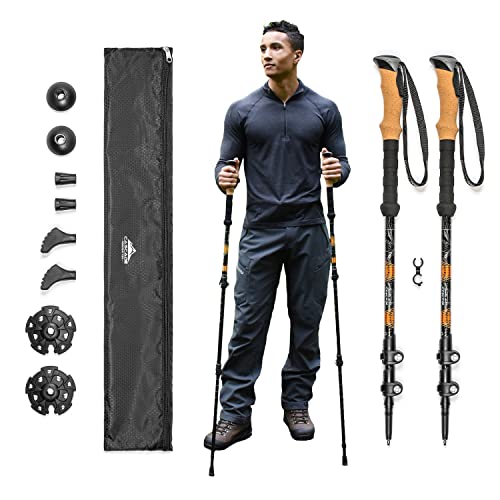
Pros
- Sturdy 6061 aluminum shafts resist bending under load across rocky trails and uneven terrain
- Ergonomic cork handles combined with EVA lower grips provide comfortable, versatile hand positions
- Lever-style quick locks allow fast, tool-free length adjustments between 26 and 54 inches
- Generous accessory bundle includes mud baskets, snow baskets, rubber boots, tip covers, and a carry bag
Cons
- Collapsed length of 26 inches may extend above the top collar of smaller 15L to 20L daypacks
- At 10 ounces per pole, aluminum construction is heavier than ultralight carbon fiber designs
- Quick-lock cam tensioners require occasional thumb-screw checks to maintain firm holding pressure over time
The Cascade Mountain Tech 6061 Aluminum Trekking Poles serve as a dependable, budget-conscious trail accessory designed for day hikers, weekend backpackers, and outdoor walkers seeking upper-body engagement and knee relief. Built to pair with standard hiking daypacks and larger backpacking packs, these two-section adjustable poles provide steady points of contact across varied outdoor surfaces.
On the trail, the quick-lock lever mechanism allows smooth height adjustments spanning from 26 inches up to 54 inches to accommodate various hiker heights and changing slope angles. Weighing approximately 10 ounces per pole, the shafts offer solid balance without excessive swing weight. When you reach a flat trail section or scramble where free hands are required, the poles collapse to a manageable 26-inch profile that fits neatly onto external backpack gear loops, side compression straps, or inside the included travel bag.
Material construction centers on aircraft-grade 6061 aluminum, which provides dependable bend resistance when navigating rocky terrain, boulder fields, or stream crossings. The ergonomic handles combine genuine cork tops with extended EVA down grips. The cork sections help dampen ground vibrations and wick moisture away during warm summer hikes, while the lower foam sections let hikers quickly lower their hand positions during steep switchbacks without pausing to readjust pole length.
Dialing in the poles for specific trails is straightforward thanks to the included accessory bundle. The core shafts feature tungsten carbide tips that bite into hard-packed dirt and slick rock surfaces. For paved greenways or sensitive rock paths, push-on rubber boots and tip covers provide traction and prevent surface scarring. When transitioning to wet spring trails or winter routes, the interchangeable mud and snow baskets screw on easily to prevent the poles from sinking deeply into soft ground.
While these poles provide dependable trail stability, prospective buyers should recognize a few practical design tradeoffs. The three-section telescoping design collapses to 26 inches, which is longer than folding Z-style poles and may extend beyond the top of compact 15-liter to 20-liter daypacks. At roughly 10 ounces per pole, aluminum construction also carries a modest weight penalty compared to premium carbon fiber poles. In addition, the quick-lock cam tensioners may require occasional finger-tightening of the thumbscrews to maintain positive locking force over miles of continuous vibration.
For beginner hikers, weekend backpackers, and budget-conscious outdoor enthusiasts looking for reliable trekking poles with comprehensive multi-season accessories, the Cascade Mountain Tech 6061 Aluminum Trekking Poles offer balanced durability and practical trail support.
When not in use, each pole collapses down to a compact 26 inches, allowing hikers to stow them easily along the exterior of most hiking backpacks. Hikers can thread the tungsten carbide tips through standard lower trekking-pole attachment loops and secure the upper shafts using side compression straps or elastic bungi cords.
For travel or vehicle storage, the set includes a lightweight zippered travel bag that prevents dirt, mud, and trail debris on the baskets and tips from contacting the interior fabric of your backpack or luggage. At 10 ounces per pole, carrying them on your pack adds minimal base weight during trail approaches.
The poles arrive with an extensive accessory package configured for year-round hiking versatility. Hard tungsten carbide tips serve as the baseline contact point for dirt singletrack, loose scree, and rugged mountain paths where maximum purchase is necessary.
For asphalt trails, slick boardwalks, or indoor transit, the included rubber boots and tip covers slip over the metal ends to dampen noise and enhance surface grip. The kit also includes wide rubber snow baskets and medium mud baskets, which prevent the poles from sinking into deep drifts, boggy soil, or loose river gravel.

Pros
- Folds down to 15 inches, making it significantly easier to pack inside travel luggage or strap to compact daypacks than standard telescoping poles
- Moisture-wicking natural cork handles keep palms dry and comfortable across humid hiking conditions
- Sturdy metal flip locks and reinforced joint caps provide solid structural support without slippage when properly tensioned
- Lower EVA foam grips allow instant trail adjustment for steep uphill climbing
Cons
- At 11.5 ounces per pole, they carry more weight than specialized ultralight carbon fiber poles
- The 110 cm minimum height setting may feel slightly too long for hikers under 5 feet 2 inches
- Per TSA regulations, trekking poles with metal tips must be packed in checked luggage rather than carried on flights
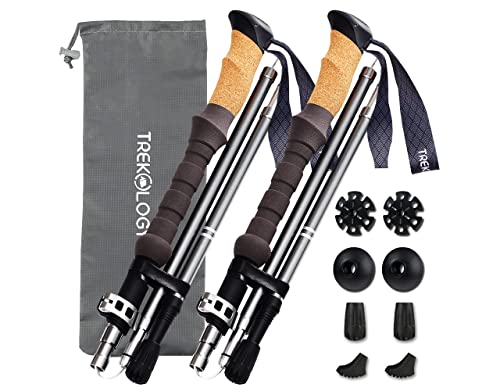
The Trekology Trek-Z Cork Grip Trekking Poles are folding, multi-section hiking sticks designed for hikers, backpackers, and travelers who require sturdy trail stability without the awkward bulk of traditional telescoping poles. Sold as a pair with an included carry bag, these poles suit day hikers tackling uneven paths, weekend backpackers managing load transfer on descents, and outdoor enthusiasts who need compact gear that fits inside travel luggage or standard daypack side sleeves.
Trail packability is one of the standout characteristics of this design. Utilizing a retractable tri-fold cable system, each pole breaks down to just 15 inches (38 cm) in overall length. This short folded dimension lets you slip the pair directly into the main compartment of an overnight pack, tuck them into side stretch-mesh water bottle pockets, or strap them beneath external compression straps without snagging overhead brush. For length adjustment, an upper aluminum section provides a 20 cm sliding range from 110 cm to 130 cm, catering to user heights between 5 feet 2 inches and 6 feet 5 inches.
Component construction focuses on long-term trail durability. Trekology builds the Trek-Z poles from aircraft-grade aluminum alloy, which provides higher impact resistance and flex tolerance against rocky crevices compared to brittle carbon fiber. The folding shaft joints feature protective metal caps to resist wear at stress points during repeated assembly. Up top, the natural cork grip wicks moisture away from sweaty palms during steep ascents, while a secondary EVA foam grip sleeve allows you to lower your hand placement instantly on steep trail grades without adjusting the shaft length.
Deploying and adjusting the poles requires a straightforward two-step setup. After letting the lower segments drop into place, you pull the upper shaft section until an internal metal locking button pops outward with a firm click. A durable metal external flip lock then secures the upper telescoping section at your desired height marker. Proper setup is essential; if the lower shaft feels loose or disconnected, the metal lock button must be firmly pulled until fully seated in its designated catch hole. Maintenance is simple, requiring only an occasional wipe-down with a dry cloth after muddy hikes before packing into the included storage sleeve.
While practical and durable, the Trek-Z design carries a few realistic limitations. Each pole weighs 11.5 ounces (330 grams), resulting in a combined pair weight around 23 ounces, which may deter dedicated ultralight thru-hikers who prefer minimal swing weight. Additionally, the minimum length of 110 cm means youth hikers or adults under 5 feet 2 inches might find the grip positioning too elevated on flat terrain. Travelers should also remember that TSA guidelines require trekking poles with rigid tips to travel inside checked baggage rather than carry-on packs.
For hikers seeking an affordable, compact, and robust set of walking poles, the Trekology Trek-Z Cork Grip poles deliver excellent overall value. They provide dependable joint support, sweat-wicking cork comfort, and pack-friendly folding convenience that fits easily into standard hiking backpacks and travel duffels.
The Trekology Trek-Z poles feature an adjustable working range between 110 cm and 130 cm, making them compatible with users measuring between 5 feet 2 inches and 6 feet 5 inches in height. Sizing adjustments are controlled via a durable metal flip-lock clamp positioned on the upper shaft section, marked with clear centimeter increments for quick alignment.
Hikers can lengthen the poles slightly for steep downhill sections to maintain an upright posture, or shorten them for prolonged uphill climbs. For fast grade transitions where stopping to loosen the clamp is impractical, the extended EVA foam grip below the primary cork handle allows instant choke-down positioning.
Thanks to a three-section folding architecture linked by an internal tension cable, the Trek-Z poles collapse down to an ultra-compact 15 inches (38 cm). This compact footprint allows them to slide vertically inside most 20-liter to 65-liter hiking backpacks, eliminating the tip-heavy snagging hazards common with longer two-piece or three-piece telescoping poles.
A matching carry bag is included to keep trail mud and dust away from sleeping bags, pack liners, and clothing when stored internally. When flying to destination trailheads, note that airline security guidelines require trekking poles to be packed within checked baggage rather than carry-on luggage.
The shafts are manufactured from aircraft-grade aluminum alloy, delivering high tensile strength and resilience against bending forces when supporting heavy backpack loads on rocky trails. The connection joints between segments are reinforced with metal caps to resist cracking and wall deformation under load.
The upper handle utilizes natural cork material that absorbs hand moisture, resisting slick spots during warm summer outings. The handle is engineered with a slight rotational flex that acts as an anti-torque buffer, reducing jarring impacts transmitted through the hands and wrists across prolonged trail miles.

Pros
- Collapses down to a compact 15-inch profile that fits inside most hiking daypacks and travel bags.
- Aircraft-grade aluminum shafts and metal flip locks resist trail impacts better than fragile plastic clamps.
- Natural cork grips offer comfortable, sweat-resistant hand placement with lower EVA foam extensions for switchbacks.
- Listed at 9.95 ounces per pole, keeping carried base weight and trail fatigue low.
Cons
- The 100-120 cm adjustment range is strictly limited to hikers 5 feet 9 inches and under.
- Folding cord design requires manual joint alignment during deployment compared to standard twist or slide poles.
- Aluminum construction is slightly heavier than ultralight carbon fiber alternatives.
The Hiker Hunger Foldable Aluminum Trekking Poles are compact, packable hiking sticks designed for trail balance, stability, and joint relief during day hikes or backpacking excursions. With an adjustable range spanning 100 to 120 centimeters, this specific short variant is built specifically for hikers standing 5 feet 9 inches and under. For hikers who prefer to stow their poles inside or alongside a pack when scrambling rocky sections, boarding planes, or commuting to trailheads, the folding configuration provides a distinct packability advantage over standard full-length telescoping options.
On the trail, the main benefit of this system is the compact 15-inch collapsed length combined with a manageable listed weight of 9.95 ounces. The multi-section folding shafts slide smoothly into side water-bottle pockets, slip behind exterior pack compression straps, or stow entirely within internal gear compartments. This makes them especially useful for technical trail segments where hands-free movement is required, as well as for minimalist backpackers who value clean external pack lines without protruding gear.
Construction quality centers around aircraft-grade aluminum tubing connected by reinforced joints and secured with external metal flip locks. Metal locking levers provide reliable holding strength against vertical slippage on steep descents and resist impact damage better than brittle molded plastic alternatives. Hand comfort is supported by genuine cork main grips that shape to the palms and absorb sweat, while lower EVA foam grip extensions allow hikers to choke down during sudden steep switchbacks without pausing to unlock and shorten the poles.
Deploying and adjusting the poles is straightforward once familiar with folding-shaft mechanics. The lower segments lock into place via an internal tension cable, while the uppermost section provides 20 centimeters of fine height adjustment secured by the metal cam lever. Basic maintenance involves wiping away trail mud, letting the shafts and inner cable dry thoroughly before long-term storage, and checking the flip-lock tension screw occasionally to maintain firm clamping force.
Realistic limitations must be noted before purchase. Because this model reaches a maximum length of 120 centimeters, hikers taller than 5 feet 9 inches will lack sufficient extension for a proper 90-degree arm angle, particularly on steep downhill sections. Furthermore, while aluminum bends rather than snaps abruptly under extreme lateral loads, it carries a small weight penalty over premium carbon fiber alternatives. The folding joints also require routine visual checks to ensure trail grit does not interfere with proper joint seating.
For day hikers, section hikers, and adventure travelers who fit within the recommended height parameters, these Hiker Hunger poles represent a well-constructed, travel-friendly trail tool. Their 15-inch packed profile, durable metal hardware, and ergonomic cork handles make them a dependable asset for any hiker seeking reliable stability without taking up unnecessary pack volume.
This model features an adjustable usable length between 100 and 120 centimeters, designed to fit hikers who are 5 feet 9 inches tall and shorter. Proper ergonomic trekking pole fit requires that your elbow forms approximately a 90-degree bend when holding the grip with the pole tip resting on level ground.
Hikers near the upper limit of 5 feet 9 inches who frequently tackle steep mountain descents may find themselves near the pole maximum extension. Hikers taller than 5 feet 9 inches should look toward the longer 115 to 135 centimeter variant to ensure adequate downhill reach and optimal joint support.
Collapsing down to just 15 inches, these folding poles pack considerably smaller than standard two-section or three-section telescoping poles that typically collapse to 24 inches or more. This compact profile allows them to slide entirely inside daypacks, luggage, or trunk storage compartments without sticking out.
When stowing poles on your backpack exterior, the 15-inch length minimizes snagging hazards when hiking through dense brush or off-trail terrain. To maintain the internal tension cord and prevent corrosion, ensure all sections are completely dry before packing them away for extended off-season storage.
Evaluating Trekking Poles for Downhill and Backcountry Skiing
Skate-skiing across groomed Nordic tracks or touring across rolling meadows allows for reasonable crossover with hiking equipment, but high-speed downhill resort skiing demands specialized gear. You can use hiking poles for low-angle cross-country touring, snowshoeing, and backcountry uphill skinning if you equip them with wide snow baskets. High-speed alpine descents and aggressive resort carving, however, subject equipment to severe lateral impacts that trekking shafts rarely survive. Understanding why these two tools diverge in structural composition helps prevent gear failure and bodily injury when facing hard-packed snow.
Axial Load Capacity Versus Lateral Shear Stress in Snow
Trekking poles are fundamentally engineered to support vertical, downward forces known as axial loads. When you walk downhill with a heavy backpack, your weight drives directly along the longitudinal axis of the shaft, which maximizes the structural strength of thin-walled aluminum or carbon fiber. Downhill skiing completely changes these load dynamics by introducing sudden, violent lateral torque whenever you plant a tip at speed. A ski pole features thick-walled construction designed to flex and rebound under heavy side-impact forces without buckling. If an alpine skier plants a lightweight hiking pole into hard crust during a high-speed turn, the shaft often folds under the unyielding lateral shear stress.
Shaft metallurgy plays a significant role in determining how much bending force a pole can absorb before permanent failure occurs. Models like the TrailBuddy Trekking Poles utilize aircraft-grade 7075 aluminum, which offers superior bend resistance and tensile resilience compared to softer alloys. Other reliable options, such as the Cascade Mountain Tech Trekking Poles, employ 6061 aluminum, providing dependable toughness on varied terrain. Even high-grade aluminum alloys remain vulnerable to creasing when wedged into frozen crust while the skier continues forward momentum. Traditional alpine ski poles avoid telescoping seams entirely, maintaining a continuous cylinder that disperses bending forces uniformly.
Locking Mechanism Behavior in Sub-Freezing Conditions
Adjustable trekking poles rely on mechanical joints that must maintain friction to prevent sudden height collapse during use. External lever cam locks with metal thumb screws represent the gold standard for trail adjustability, offering quick operation even with cold fingers. In sub-freezing winter conditions, however, metal and composite plastics contract at different rates as ambient temperatures plunge. This thermal contraction can loosen the clamping collar enough to allow the telescoping sections to slip inward when you lean heavily onto the grip. Checking and tightening the adjustment thumbscrew before every winter outing prevents unexpected collapses on steep slopes.
Internal expansion-plug twist locks perform far worse than external cam levers in sub-zero alpine environments. Moisture from melting powder frequently enters the interior joints, where it quickly freezes into a slick glaze of ice over the plastic expanding wedges. Once ice forms inside the shaft, internal twist locks lose all frictional purchase and spin freely without engaging. Collapsible designs featuring external metal flip locks, such as the Premium Foldable Hiking Poles by USA Brand, keep tensioning hardware outside the tubing where freezing ice buildup cannot disable the clamp. Securing reliable clamp tension ensures your poles stay extended when stabilizing your balance on uneven snowpack.
Snow Basket Surface Area and Powder Deflection
Attempting to ski with standard summer trail baskets is one of the quickest ways to cause an unexpected forward fall. Small mud baskets measuring roughly two inches in diameter are designed to prevent poles from sinking into forest dirt, not unconsolidated winter powder. When planted into soft snow, a small basket punches straight down toward bedrock, offering zero surface resistance. This sudden lack of resistance causes the skier to lurch forward off balance, often leading to a violent tumble or a snapped shaft. True powder ski baskets feature wide diameters of three to four inches, creating the surface area necessary to float across deep drifts.
Trekking pole manufacturers frequently include cold-weather attachments to extend gear utility into shoulder seasons. Both TrailBuddy and Cascade Mountain Tech include push-on or threaded snow baskets designed to handle packed winter trails and moderate snowfall. These included snow baskets perform well for snowshoeing and firm-crust ski touring, but they remain noticeably smaller than dedicated freeride powder baskets. When carrying heavier winter gear inside a heavy-duty frame pack, ensuring adequate basket surface area prevents exhausting post-holing with every step. Always confirm that your snow baskets screw on securely so they do not unscrew and disappear into deep snowbanks.
Grip Ergonomics, Moisture Absorption, and Winter Gloves
Grip materials behave drastically differently in dry summer conditions compared to freezing winter environments. Natural cork handles are popular among summer hikers because they mold to the hand and wick away perspiration to prevent palm blisters. In winter snow, however, natural cork can absorb ambient moisture or melted snow, which then freezes into an icy, slick surface during sub-zero mornings. Ergonomic grips designed specifically for alpine skiing utilize molded rubber with aggressive finger channels that interface securely with bulky, insulated ski gloves. Rubber also acts as a thermal barrier, preventing cold aluminum from pulling warmth away from your palms.
Extended foam grips beneath the primary handle offer immense versatility during uphill snow ascents and backcountry skinning. The Cascade Mountain Tech Trekking Poles and the Trekology Trek-Z Cork Grip Collapsible Lightweight both feature secondary EVA foam sleeves below the main grip. This extended choke-up surface allows tourers to shift their hand position lower on the pole when traversing steep sidehills without stopping to readjust the mechanical locking levers. Skiers moving across undulating terrain can instantly adapt their leverage between switchbacks by utilizing these lower foam sleeves. If your poles feature natural cork handles, pair them with durable waterproof gloves to keep snow from wetting out the cork material.
Wrist Strap Geometry and Fall Injury Dynamics
Wrist strap design marks one of the most critical safety distinctions between dedicated ski poles and standard hiking walking sticks. Hiking pole straps are constructed as fixed webbing loops designed to support downward skeletal weight when hands enter upward from beneath. During a summer hike, this geometry transfers body weight through the ulnar border of the wrist, reducing grip fatigue over long mileage days. In alpine skiing, however, tethering your wrist tightly to a pole shaft during a high-speed tumble introduces severe injury risks. If the basket catches on frozen crust while you tumble forward, a fixed strap can violently hyper-extend your thumb or fracture your wrist.
Dedicated modern ski poles frequently incorporate emergency breakaway strap systems that detach under severe outward tension. These safety release mechanisms help prevent skier’s thumb, which is a painful ligament sprain caused by the pole grip jamming against the thumb joint during a crash. Trekking poles completely lack breakaway release mechanisms on their wrist webbing. When using hiking poles on snow slopes, seasoned winter backcountry travelers deliberately take their hands out of the straps before beginning any downhill run. Slipping your hands free from the loops ensures that if a pole snags, it drops away cleanly without twisting your shoulder or wrist.
Telescoping Shafts Versus Folding Z-Poles in Alpine Snow
Choosing between traditional three-piece telescoping poles and tri-fold Z-poles depends heavily on your specific winter activity. Telescoping poles utilize concentric aluminum tubes that slide into one another, providing an expansive adjustability range typically between 24 and 54 inches. This extensive adjustment span allows winter hikers to lengthen their poles significantly for descending deep snowdrifts or shorten them for steep boot-packs. Collapsible three-section models also feature thicker tubing in the upper sections, providing decent rigidity when bearing down on firm snow surfaces. The primary drawback on snow is that moisture inside the telescoping collars can freeze, making length adjustments difficult without thawing the locks.
Folding Z-poles, such as the Trekology Trek-Z Cork Grip Collapsible Lightweight and the Premium Foldable Hiking Poles by USA Brand, offer unmatched compact packability by collapsing down to just 15 inches. Splitboarders and snowshoers often favor folding poles because they easily stow inside or lash onto compact daypacks once downhill riding begins. The internal tension cord that binds the folding segments together, however, introduces a winter vulnerability if snow enters the open ferrules during breakdown. Fine powder can pack tightly inside the joint sockets, preventing the sections from snapping into full alignment when reassembled on the mountain. Keeping folding joint sleeves clear of frozen slush is crucial to maintaining structural integrity before loading your weight onto the shafts.
Real-World Use Cases: Where Hiking Poles Work on Snow
Low-angle cross-country skiing represents an ideal scenario where sturdy trekking poles can serve as perfectly adequate substitutes for dedicated Nordic poles. When gliding along mellow, groomed tracks or flat logging roads, lateral impact forces remain minimal while vertical propulsion dominates every stride. Pair your equipment with comfortable, lightweight hiking pants to allow full range of motion during rhythmic kick-and-glide strides across packed snow. The adjustable height on trekking poles allows you to set the grips to armpit height for classic Nordic touring, providing optimal pushing leverage across flat fields. In these low-speed, low-consequence environments, the risk of shattering a lightweight aluminum shaft remains exceedingly low.
Backcountry splitboarders and alpine tourers frequently rely on adjustable trekking poles as primary uphill climbing tools. When skinning up steep alpine ascents, the ability to lengthen or shorten poles to match slope gradients provides substantial biomechanical efficiency. Telescoping poles allow the climber to plant their uphill pole shorter and their downhill pole longer when traversing steep switchbacks. Once the summit is reached and splitboards are reassembled into ride mode, collapsible poles fold down and disappear onto pack lashes. As long as you stow the poles away before descending on your board, trekking poles excel in backcountry approach scenarios.
How to Prepare Hiking Poles for Winter Snow Adventures
Preparing your hiking poles for cold-weather duty requires a few mandatory hardware inspections before stepping out into the snow. Start by removing the summer road rubber feet and small mud discs to inspect the underlying tungsten carbide flex tips. Carbide tips bite securely into hard water ice and frozen crust, providing dependable traction when ascending windswept ridges. Next, thread on broad winter snow baskets, making sure they seat completely past any retention ridges so they do not dislodge in crusty snowpack. Leaving summer tips and small baskets on your poles virtually guarantees that the shafts will plunge helplessly through winter drifts.
Calibrating the tension on all cam lever locks represents the second non-negotiable step before facing sub-zero alpine conditions. Open each lever clamp, rotate the metal thumb screw clockwise by a half turn, and close the lever until you feel firm palm resistance. Test the lock integrity by placing the pole vertically on the floor and leaning your full upper-body weight directly onto the handle. If the telescoping section slips even a millimeter under downward pressure, increase the thumbscrew tension until the shaft remains completely stationary. Performing this test in warm indoor conditions ensures that slight hardware contraction in freezing mountain air will not cause sudden height collapse on the trail.
Final Practical Verdict for Snow Sports Enthusiasts
Using trekking poles for snow activities offers practical convenience as long as you respect the mechanical boundaries of your equipment. For Nordic cross-country touring, snowshoe approaches, splitboard ascents, and casual winter walks, sturdy aluminum trekking poles perform remarkably well. The inclusion of durable snow baskets, dependable external lever locks, and extended foam choke grips makes models from TrailBuddy, Cascade Mountain Tech, Trekology, and Hiker Hunger Outfitters valuable four-season companions. Their compact collapsed length and versatile height adjustment give them distinct advantages over rigid, single-length ski poles on variable terrain.
The boundary ends firmly when transitioning to high-speed alpine downhill skiing, aggressive terrain parks, and lift-served resort runs. The intense lateral impacts, high-speed gate strikes, and aggressive carving forces of downhill skiing will quickly fold or snap collapsible trekking shafts. Furthermore, the absence of breakaway safety wrist straps creates unnecessary risks of severe thumb and wrist injuries during high-speed downhill falls. Investing in dedicated, thick-walled aluminum ski poles for resort skiing ensures your gear withstands high-speed forces while keeping you safe across every descent. Matching the right pole to your specific winter sport guarantees durability, comfort, and peace of mind in the snow.



Write Your Review
No reviews yet. Be the first to share your experience!