


Descending thousands of vertical feet across loose rock places intense mechanical stress on knees, hips, and ankles. Hikers looking to preserve joint health often wonder whether investing in premium trekking equipment provides genuine relief on rugged backcountry trails. When evaluating whether are leki poles worth it, understanding the mechanical advantage of rigid shaft geometry and dependable locking collars becomes essential. Quality poles transfer braking forces away from the lower body to upper muscular groups, creating reliable rhythm and balance on steep mountain grades.
Many hikers pairing supportive trekking gear with hiking pants for knee relief find that dependable hardware transforms multiday trips into sustainable pursuits. The brand has built a prominent reputation around proprietary locking clamps, specialized grip ergonomics, and resilient aluminum and carbon shaft construction. Determining if this engineering justifies the premium investment requires examining how these poles hold up against slippage under heavy downward body weight, swing weight fatigue over long trail miles, and real trail demands across changing seasons.




Evaluating the Engineering, Trail Performance, and Value of LEKI Trekking Poles
Investing in higher-end trail equipment requires looking closely at real mechanical performance, structural durability, and ergonomic design. Hikers asking whether are leki poles worth it generally want to know if proprietary locking levers, advanced grip contours, and refined metallurgy translate into dependable trail stability. While budget alternatives exist across the outdoor market, long-distance hikers and trail runners frequently favor this German brand for consistent backcountry reliability. The following analysis examines how these engineering choices perform across challenging terrain, high pack weights, and demanding mountain environments.
Direct Assessment: What Sets the Brand Apart on the Trail?
The value proposition of high-end trekking poles centers on joint protection, rhythmic balance, and structural reliability under load. Generic poles often suffer from plastic locking levers that slip when wet, non-ergonomic grips that cause palm blisters, or weak shaft alloys that deform under unexpected stumble forces. The manufacturer addresses these vulnerabilities by pairing high-grade aluminum and carbon tubing with precision cam locks and modular hardware. Hikers navigating rugged backcountry routes benefit from equipment that maintains its set length during aggressive downhill steps.
Beyond basic stability, long-term ownership value depends heavily on modularity and replacement component availability. Baskets, carbide flex tips, and rubber road pads will inevitably wear down or become lodged in rocky crevices over hundreds of trail miles. Because the brand uses standardized tip assemblies across many models, replacing worn parts does not require purchasing an entirely new pole system. This modular ecosystem extends overall product lifespan, making the initial investment more economical over multiple hiking seasons.
Shaft Materials Compared: High-Tensile Aluminum versus Carbon Fiber
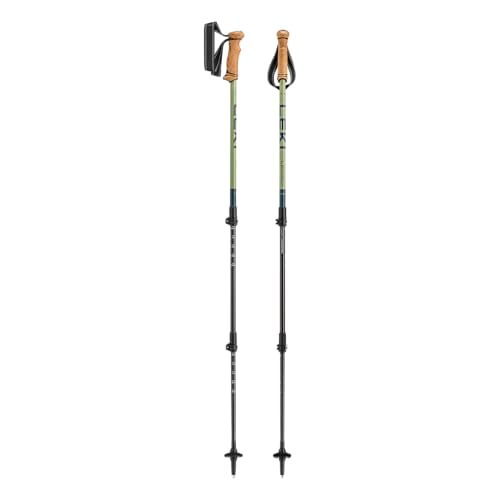
Shaft metallurgy determines how a pole handles downward axial body weight versus sudden lateral shear forces. Aluminum models such as the LEKI Makalu Cork Lite Trekking Poles-Stone Blue and the LEKI Wanderfreund High Fives Trekking Pole use heat-treated HTS 6.5 aluminum tubing. Aluminum provides exceptional ductility, meaning the metal can absorb substantial bending strain before fracturing. Hikers carrying heavy multiday loads through rocky boulder fields often prefer aluminum because a slightly bent shaft can often be gently straightened to complete a trip safely.
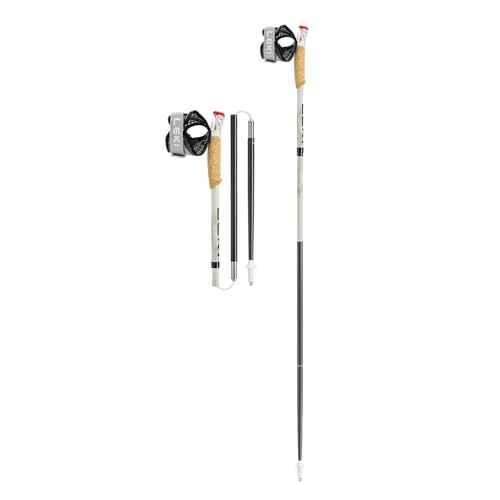
In contrast, carbon fiber models like the LEKI Ultratrail FX.One Trekking Poles-Bright utilize high-modulus carbon construction designed to reduce swing weight to a minimum. At roughly a quarter-pound per pole, these carbon shafts dramatically lower forearm fatigue over marathon distances and continuous trail runs. Carbon fiber also naturally dampens high-frequency trail vibrations that can aggravate wrist and elbow joints on hard-packed surfaces. However, carbon lacks the bending tolerance of aluminum, making it more vulnerable to snapping if wedged between granite boulders under sharp lateral leverage.
Locking System Security: Speed Lock Plus Cam Levers versus Super Lock Twist Expanders
Locking mechanisms represent the single most critical safety component on any adjustable trekking pole. A sudden lock failure on a steep downhill descent can cause an immediate fall and severe joint injury. The brand utilizes external lever systems, notably the Speed Lock Plus found on the LEKI Legacy Lite Trekking Poles – Denimblue and the Makalu Cork Lite. These external cam levers apply consistent clamping force around the outer shaft diameter and feature a tool-free tension dial that allows hikers to increase clamping resistance when temperatures drop.
Conversely, entry models such as the LEKI Voyager Trekking Poles – Blue – White feature the Super Lock internal twist expansion system. Internal expansion plugs create a clean, streamlined shaft profile that prevents snagging on dense brush or alpine shrubbery. However, internal twist locks require rotating the shaft sections to expand an internal wedge, which can be tricky to operate with thick winter gloves or frozen hands. Fine trail silt or moisture trapped inside the shaft can also reduce internal friction, requiring periodic disassembly and dry wiping to prevent slippage.
Grip Architecture: Cork, Cor-Tec, and Trigger Shark Systems
Grip comfort directly impacts hand fatigue, blister formation, and overall control across extended mileage. The Makalu series features the Aergon Air grip with a natural cork surface that wicks sweat effectively during warm summer ascents. Cork conforms gradually to the individual anatomy of the hiker hand, creating a customized interface that resists hot spots. The grip also includes an extended foam sleeve positioned below the main handle, allowing hikers to choke down during steep sidehill traverses without adjusting pole length.
Other models incorporate proprietary grip formulations tailored to specific activities and budgets. The Legacy Lite uses the EVOCON Cor-Tec grip, a composite cork and rubber blend designed for durability and ergonomic comfort across daily trail walks. Meanwhile, the trail-running-focused Ultratrail FX.One uses the Trail Trigger Shark system with lightweight foam and a detachable mesh strap glove. This click-in mechanism maximizes power transfer through the palm during uphill climbs while allowing instant release when grabbing hydration flasks or scrambling over rocks.
Sizing Dynamics and the Biomechanics of Joint Protection
Proper height adjustment is vital to maximizing joint relief and maintaining an efficient walking posture. When standing on level ground, your elbow should rest at an exact ninety-degree angle with the pole tip placed near the heel of your footwear. Dual-locking models like the Makalu Cork Lite and Legacy Lite offer an adjustment range between 100 and 135 centimeters, accommodating a broad spectrum of hiker heights. Shortening the shafts by five to ten centimeters on sustained climbs maintains forward propulsion without forcing excessive shoulder flexion.
Lengthening the poles on descents provides braking stability that substantially unloads the patellofemoral joint and quadriceps. Hikers pairing poles with lightweight hiking pants can move fluidly without fabric restriction during deep downhill lunges. To engage the upper skeletal structure effectively, hands should enter the wrist strap from beneath the loop before gripping the handle. This upward insertion distributes downward force across the strap webbing rather than forcing you to maintain a continuous, fatiguing white-knuckle grip.
Packability and Deployment: Fixed-Length Folding Z-Poles versus Telescoping Shafts
Packability requirements differ dramatically depending on whether you prioritize trail running speed, air travel portability, or technical adjustability. The Ultratrail FX.One employs a three-section folding Z-pole architecture that collapses down to just 14.5 inches at the push of a button. This ultra-compact packed length allows fastpackers and mountain runners to stow poles inside or alongside running vests without awkward shaft protrusions. Because these are fixed-length poles available in sizing increments from 105 to 135 centimeters, buyers must select the precise length matching their height.
In contrast, traditional three-section telescoping designs like the Makalu and Legacy Lite pack down to between 25.6 and 26.4 inches. While noticeably longer when lashed to a pack, telescoping shafts offer continuous length adjustment that proves advantageous on fluctuating alpine gradients. Telescoping sections also nest inside each other, creating a rigid overlapping structure that provides superior downward column strength under heavy expedition loads. Backpackers using internal frame hiking backpacks often appreciate this robust axial support when navigating unstable scree fields.
Single Walking Staffs versus Dual Trekking Pole Systems
While dual poles dominate backcountry trails, single hiking staffs serve specialized balance and support needs for specific outdoor pursuits. The LEKI Wanderfreund High Fives Trekking Pole and the LEKI Legend Black Carbon Trekking Pole are sold as single units featuring cane-style grips. The Wanderfreund incorporates a cork cane handle for ergonomic palm resting, while the Legend Black features an Aergomed foam grip paired with ultralight PRC 1000 carbon shafts. These single poles offer dedicated downward stability for casual walkers, travelers navigating cobblestones, and hikers managing balance concerns.
Choosing between a single staff and a synchronized pair depends on the physical objective and terrain difficulty. A single staff leaves one hand completely free to manage trail maps, guidebooks, leashes, or camera equipment on mellow forest paths. However, a single pole cannot provide the bilateral load distribution required to offload knee joints symmetrically during steep mountain descents. Dual trekking poles establish continuous three-point contact across difficult creek crossings, mud bogs, and loose gravel where bilateral balance is critical.
Trail Hardware and Component Modularity: Tips, Paws, and Baskets
Trail performance is heavily dictated by the interface between the pole tip and the ground surface. Most backcountry models feature the Flex Tip Short equipped with a durable tungsten carbide point. Carbide bites securely into wet logs, slippery granite, and hard-packed dirt, preventing unexpected lateral slip during weight transfers. The flexible plastic housing surrounding the carbide tip allows slight deflection if the point gets caught between stones, reducing the risk of bending the lower aluminum shaft.
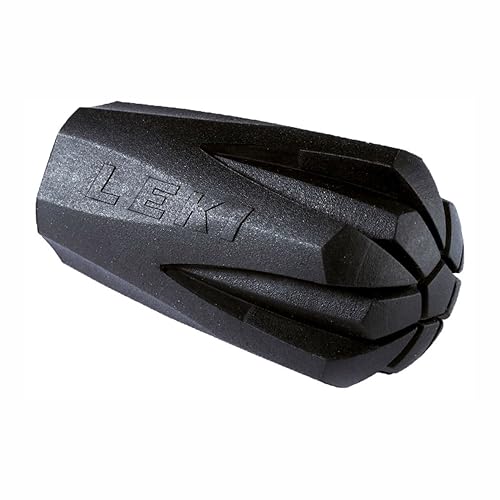
Hard surface walking requires swapping bare carbide for protective rubber boots to prevent skittering and trail degradation. Accessories such as the LEKI Rubber Walking Tip and the vulcanized LEKI Walking Rubber Tip slip firmly over carbide flex tips. These rubber paws absorb shock on asphalt, concrete, and paved walking paths while eliminating the noisy clicking sound of metal on stone. Modularity also extends to baskets, allowing hikers to switch between low-profile trekking baskets for summer trails and wider powder baskets for winter snowshoeing.
Backcountry Shelter Pitching and Transport Logistics
Ultralight backpackers frequently utilize trekking poles as primary vertical uprights for non-freestanding tarps and tents. Telescoping aluminum poles like the Makalu and Legacy Lite excel in this dual-use role due to their rigid column strength and micro-adjustable height. Setting a shelter pitch often requires dialing the pole to exactly 120 or 125 centimeters to achieve proper canopy tension in high backcountry winds. The rounded, ergonomic profile of the Aergon grip seats securely into reinforced shelter apex cups without puncturing delicate silicone-coated fabrics.
Travel logistics present another practical factor that outdoor enthusiasts must plan for carefully. Airport security regulations strictly prohibit trekking poles with metal points in domestic carry-on baggage. Travelers flying to trail destinations must stow their poles inside checked luggage to avoid checkpoint confiscation. Collapsible models like the Ultratrail FX.One pack easily into standard suitcases, while telescoping shafts can be disassembled into their three individual segments to fit diagonally across compact duffel bags.
Long-Term Maintenance and Final Value Considerations
Routine maintenance preserves locking power and prevents premature wear on telescoping and folding poles. After hiking through wet river crossings or gritty desert sand, pull the shaft sections apart completely and wipe them clean with a dry towel. Never apply WD-40, silicone spray, or grease inside telescoping aluminum or carbon tubing, as lubricants eliminate the dry friction necessary for cam clamps to hold. Periodic inspection of external Speed Lock thumbscrews ensures that clamp tension remains dialed before loading full body weight on steep slopes.
Deciding if these premium poles are worth your money ultimately comes down to your hiking frequency and trail objectives. Casual walkers sticking to flat paved paths may find simple budget walking sticks entirely adequate for occasional outings. However, hikers, backpackers, and mountain runners tackling steep vertical gradients, heavy pack loads, and technical terrain gain immense value from the brand superior locking security and ergonomic refinement. When joint longevity, balance reliability, and repairable construction matter on the trail, the investment proves thoroughly justified.






Write Your Review
No reviews yet. Be the first to share your experience!