


Descending rocky switchbacks with heavy pack weight places intense stress on knees and ankles, leading many outdoor enthusiasts to consider repurposing winter gear for warm-weather adventures. When looking at winter equipment stored in your closet, you might wonder whether are ski poles the same as hiking poles or if each tool serves a fundamentally distinct purpose on the trail. While both styles provide balance and upper-body propulsion, their internal engineering, grip materials, and structural flexibility reflect very different outdoor demands. Standard alpine equipment focuses on rigid downhill leverage across frozen snowpacks, whereas dedicated trekking equipment prioritizes joint protection and multi-terrain versatility.
Trekking poles excel at absorbing repetitive trail shock, adjusting to changing slope angles, and collapsing into compact profiles for travel. Pairing reliable poles with comfortable trail gear such as knee support hiking pants can significantly reduce joint fatigue across long backcountry miles. Understanding the exact mechanical differences between fixed alpine shafts, backcountry touring tools, and telescoping trekking poles ensures you stay stable without putting undue stress on your arms. Before grabbing a set of downhill poles for your next summer hike, evaluating how these design features function on dirt and rock will help you make the right choice.


Structural and Functional Distinctions Between Ski Poles and Hiking Poles
The Direct Answer: Why Ski Poles and Hiking Poles Are Not the Same
Hikers asking whether are ski poles the same as hiking poles can be answered with a clear mechanical distinction: downhill ski poles and trekking poles are engineered for entirely different movement patterns and surfaces. Downhill ski poles rely on single-piece, rigid shafts designed to provide lateral leverage, push across flat snow, and initiate carved turns on frozen mountain slopes. Trekking poles utilize multi-section telescoping or folding shafts that absorb vertical impact, adjust to uphill and downhill trail gradients, and pack away when not needed. While both items feature grips, shafts, straps, and baskets, the materials and functional geometries are tailored to completely separate sports.
Alpine ski equipment is built to withstand lateral shear forces and cold winter temperatures without collapsing under sudden sideways loads. On the other hand, hiking poles are designed primarily for downward axial loads to offload weight from the lower body on sustained descents. Using standard ski poles on a rocky summer trail often feels awkward because they lack the ability to adapt to varying terrain heights. Understanding these fundamental mechanical differences helps outdoor enthusiasts avoid unnecessary wrist strain, premature equipment failure, and balance issues on rugged paths.
Certain hybrid designs exist in the outdoor market to bridge the gap between winter snow travel and mountain trekking. Adjustable backcountry touring poles often incorporate features from both worlds, providing telescoping adjustment alongside broad winter baskets and carbide tips. However, dedicated alpine resort poles remain strictly specialized tools that do not translate well to warm-weather trails. Examining each individual hardware component reveals why dedicated trekking poles offer substantial advantages for trail hiking.
Shaft Architecture: Fixed-Length Construction Versus Telescoping Adjustability
The most obvious physical difference between downhill ski poles and trekking poles lies in their shaft construction. Standard alpine ski poles, such as the K2 Power Aluminum Men’s Ski Poles, Blue, 44in or the LEKI Kids’ Rider Ski Poles – Black – Red – 90cm, feature solid, single-piece aluminum shafts that cannot be resized. These continuous tubes maximize torsional stiffness and eliminate failure points during aggressive alpine skiing. However, a fixed shaft length creates major ergonomic problems when navigating variable trail inclines on foot.
Dedicated hiking poles solve this issue through two-piece or three-piece telescoping designs that let users customize overall length. For example, the LEKI Lhasa AS Trekking Poles – Orange utilize an adjustable range between 90 and 125 centimeters secured by Speed Lock Plus clamp levers. This adjustability allows hikers to follow the standard 90-degree elbow rule on flat ground while adapting to terrain changes. Proper technique calls for shortening shafts by 5 to 10 centimeters on steep ascents to maintain forward leverage, and lengthening them on steep descents to plant the tips ahead without bending over.
Fixed-length ski poles cannot offer this biomechanical adaptability, forcing hikers to overreach uphill or crouch unnaturally on descents. Furthermore, single-piece ski poles cannot collapse to fit inside luggage or lash securely against an internal frame hiking backpack when scrambling over rocky boulders. Telescoping hiking poles collapse down to roughly 24 to 26 inches, making them practical for travel and transitions between trail walking and rock scrambling. Transportation rules also favor packable poles, as airport security requires hiking poles with sharp points to travel in checked baggage rather than carry-on compartments.
Grip Materials and Ergonomics: Cold-Weather Insulation Versus Summer Moisture Control
Grip materials and angles reflect the contrasting environments for which ski poles and trekking poles are manufactured. Downhill ski poles almost exclusively use dense, molded rubber or hard plastic handles with fixed finger channels. These heavy rubber grips are shaped to accommodate thick, insulated winter gloves and provide thermal insulation against sub-freezing metal shafts. When used without gloves in warm summer conditions, hard rubber grips often cause clammy palms, hot spots, and painful friction blisters.
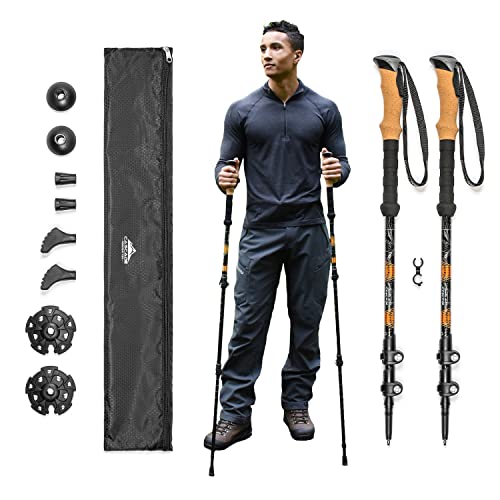
In contrast, quality hiking poles prioritize moisture management, breathability, and natural hand contouring. Many trekking poles utilize natural harvested cork or high-density ethylene vinyl acetate (EVA) foam grips that wick away perspiration and mold to the user’s hand over time. The LEKI Lhasa AS Trekking Poles – Orange incorporate a Cor-tec cork composite grip that keeps hands comfortable during long, humid summer treks. Cork remains cool in direct sunlight, maintains grip friction when wet, and significantly dampens high-frequency trail vibrations.
Specialized backcountry ski poles, such as the Backcountry Access Scepter Aluminum, feature a hybrid scraper grip with a rubber overmold designed for clearing snow from ski tops. These backcountry models frequently include an extended lower foam choke sleeve beneath the main grip. This secondary grip zone allows users to choke up on the shaft when traversing steep sidehills without stopping to adjust clamp locks. Standard resort ski poles lack these extended grip zones entirely, forcing hikers to hold bare metal tubing when navigating off-camber slopes.
Wrist Strap Mechanics: Retention Loops Versus Skeletal Weight Support
Wrist straps on downhill ski poles and trekking poles serve completely different functional objectives. Ski pole straps are primarily simple nylon retention loops designed to keep the pole from sliding down the mountain if dropped during a fall. Alpine skiers typically grip the rubber handle tightly with their fingers, relying on manual grip strength rather than strap tension. This direct hand grip works well for intermittent downhill pole plants, but causes rapid forearm and hand fatigue over a ten-mile mountain hike.
Hiking pole straps are designed as critical load-bearing components that transfer body weight directly into the arm skeleton. Proper hiking technique requires entering the strap loop from underneath, allowing the wide webbing to rest smoothly across the base of the thumb and the ulnar border of the wrist. When the hiker pulls down, their body weight distributes across the strap rather than requiring a white-knuckle squeeze on the grip. This upward insertion method conserves grip strength and protects the carpal tunnel from chronic overuse on long backpacking days.
Releasing hands from straps is also a key safety consideration across technical terrain. Downhill ski straps occasionally feature mechanical safety releases to prevent shoulder dislocation during high-speed crashes. On hiking trails, outdoor enthusiasts should slip their hands completely out of trekking pole straps when crossing fast-moving rivers or scrambling on Class 3 rock. Keeping hands free during a scramble ensures you can catch yourself without getting tangled in dangling pole shafts.
Tip Construction and Traction: Hardened Steel Versus Tungsten Carbide Flex Tips
Ground contact mechanics highlight another significant difference between snow sports equipment and trail hiking gear. Alpine ski poles typically end in blunt, conical steel points designed to puncture frozen crust, groomers, and packed snow. While steel points perform adequately in snow, they dull quickly against abrasive granite and tend to skitter off smooth rock surfaces. Hard steel points can also cause significant trail scarring and erosion when dragged across fragile alpine switchbacks.
Dedicated hiking poles utilize sharp, concave tungsten carbide flex tips that bite securely into loose soil, wet logs, and decomposing granite. The Backcountry Access Scepter Aluminum pairs an adjustable aluminum shaft with a durable carbide tip to ensure solid penetration on both ice and rocky ridgelines. Carbide retains its sharp cutting edge through hundreds of miles of abrasive rock contact without deforming. Flex tip assemblies also provide controlled lateral flex, preventing the lower pole shaft from snapping if the tip becomes momentarily wedged between two stones.
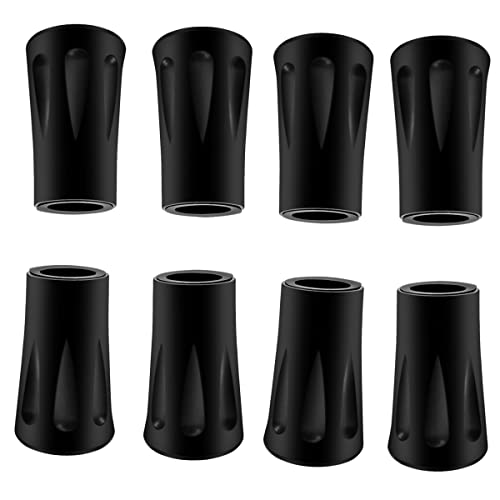
Hiking on paved access roads, asphalt pathways, or smooth rock slabs calls for protective slip-on rubber tips. Accessories such as the 8Pcs Trekking Pole Tips Replacement Protectors and the Trekking Pole Rubber Tips Replacement feature an 11-millimeter internal socket that fits standard pole ends. These rubber boots contain an embedded internal metal washer that stops sharp metal tips from puncturing through the rubber base. Using rubber feet softens trail impact, eliminates harsh clicking sounds, and delivers reliable friction across slick pavement and wet bedrock.
Basket Dimensions and Terrain Interaction: Flotation Versus Snagging Hazards
Pole baskets are designed to regulate how deeply a shaft penetrates into soft ground, but seasonal requirements vary dramatically. Downhill ski poles come equipped with relatively wide snow baskets, ranging from 60 millimeters on groomed all-mountain runs up to 90 millimeters or more for deep powder. The K2 Power Aluminum Men’s Ski Poles, Blue, 44in use standard 60-millimeter baskets, while youth groomer models like the LEKI Kids’ Rider Ski Poles – Black – Red – 90cm use smaller performance discs. These broad surfaces provide crucial surface area to stop poles from plunging into snowpack.
Using wide snow baskets on dry summer hiking trails creates frustrating and potentially hazardous problems. Oversized winter baskets easily catch on exposed tree roots, dense trailside brush, and jagged rock crevices. When a broad basket snags during a forward swing, it can yank your shoulder backward or trip your forward leg, increasing the risk of a stumble. Summer trekking poles therefore feature small, low-profile mud baskets measuring around 35 to 45 millimeters, providing just enough resistance in loose mud without catching on vegetation.
When winter conditions arrive, hikers can easily adapt their trekking poles by attaching aftermarket powder baskets. Modular accessories like the Rubber Ski Pole Baskets Replacement Snow Baskes and the TREKOLOGY Trekking Pole Rubber Tips and Snow kit feature wide 85 to 87-millimeter platforms designed for snowshoeing and winter trekking. These hard plastic baskets thread onto 14-millimeter pole sockets, delivering the flotation needed for deep powder without requiring a separate set of downhill ski poles. Having interchangeable baskets makes a quality pair of adjustable trekking poles versatile across all four seasons.
Impact Absorption and Biomechanical Relief on Descents
One of the primary motivations for using hiking poles is reducing compressive loads on lower body joints during long descents. Stepping down steep trail gradients places intense braking force on knees, patellofemoral cartilage, and lumbar vertebrae. Trekking poles absorb a significant portion of this impact by distributing deceleration forces across the lats, shoulders, and pectoral muscles. Downhill ski poles, built as stiff rigid tubes to transmit instant force into ski edges, lack internal cushioning and transmit ground vibration straight into the hiker’s upper body.
Advanced trekking poles frequently feature built-in suspension mechanisms to dampen repetitive shock on hard trails. The LEKI Lhasa AS Trekking Poles – Orange incorporate an integrated Dynamic Suspension System designed to absorb impact before it reaches the wrists, elbows, and shoulders. This dampening technology protects connective tissues from chronic joint irritation during high-mileage descents on packed dirt and rocky steps. Ski poles provide zero built-in damping, which can lead to wrist fatigue and joint soreness after several hours of pounding on hard summer ground.
Pairing shock-absorbing trekking poles with lightweight trail clothing like lightweight breathable trail pants allows hikers to maintain a relaxed, fluid downhill cadence. The poles act as shock absorbers while flexible pants grant full freedom of movement across high step-downs and water crossings. The combined reduction in joint strain helps preserve cartilage health, especially for hikers carrying heavy multiday backpacks. Attempting to achieve the same joint relief with rigid, unyielding alpine ski poles usually leads to jarring hand vibration and forearm fatigue.
Can You Use Ski Poles for Hiking? Feasible Crossover Situations and Hard Limits
While ski poles and trekking poles are distinct gear categories, there are specific outdoor situations where ski poles can serve as functional substitutes. If you are embarking on a flat winter snowshoe outing or walking on packed snow roads, downhill ski poles work reasonably well. In deep snow, the fixed shaft length is less problematic because pole tips sink several inches into the snowpack, naturally compensating for minor height mismatches. Furthermore, the broad baskets and insulated rubber grips of ski poles are right at home in cold winter conditions.
Backcountry ski touring poles represent the most practical crossover option between winter sports and hiking. Models like the Backcountry Access Scepter Aluminum combine adjustable telescoping sections, carbide tips, and lightweight aluminum alloys. Because backcountry poles feature reliable clamp locks and interchangeable baskets, they transition smoothly from winter ski touring to summer backpacking. If you already own two-piece or three-piece backcountry touring poles, you can often use them for three-season hiking by swapping winter powder baskets for compact mud baskets.
Hard limits arise when using fixed downhill resort ski poles on technical summer terrain. Attempting to hike steep mountain passes, rocky scree fields, or long thru-hikes with single-piece alpine poles quickly becomes cumbersome. The lack of height adjustability strains your lower back, the heavy rubber grips blister bare hands, and the wide baskets constantly snag on underbrush. For dry summer trails and high-mileage adventures, dedicated trekking poles remain far superior in comfort, safety, and versatility.
Shelter Pitching and Ultralight Tent Compatibility
Backpackers frequently rely on trekking poles as structural uprights for non-freestanding ultralight tents, tarps, and pyramid shelters. Modern ultralight backpacking shelters save weight by omitting dedicated aluminum tent poles, using the hiker’s trekking poles instead. These shelters demand precise vertical pole heights, often requiring exact measurements such as 115, 120, or 125 centimeters to achieve proper pitch tension. Achieving this precise geometric tension is only possible when using poles with adjustable telescoping sections and reliable locking collars.
Fixed downhill ski poles cannot adjust to match specific shelter dimensions, rendering them practically useless for pitching non-freestanding tents. A fixed 44-inch ski pole will either over-tension a small shelter canopy or leave an oversized tarp sagging loosely in the wind. In addition, trekking poles feature ergonomic, rounded grip caps designed to nest securely inside reinforced tent apex cones or fabric pockets without puncturing delicate silicone-treated nylon. The sharp edges and protruding strap hardware on alpine ski grips can easily rip through lightweight shelter canopies during strong gusts.
Tip orientation is another critical factor when pitching shelters in windy backcountry environments. Many modern trekking shelters utilize reinforced metal grommets that seat standard carbide flex tips securely at the ground level. Downhill ski poles with wide steel tips or bulky, non-removable baskets cannot seat properly into shelter grommets. If you plan to sleep in an ultralight trekking-pole shelter, carrying dedicated telescoping poles is an absolute structural necessity.
Field Maintenance, Hardware Inspection, and Final Trail Recommendations
Maintaining any set of poles requires regular inspection to ensure dependable performance and prevent unexpected hardware failures on the trail. For adjustable trekking poles and backcountry touring tools, regularly check the tension thumbscrews on external cam levers before stepping onto steep trails. Temperature drops can cause aluminum tubing and composite clamp collars to contract slightly, which may lead to lock slippage under full body weight. Tightening the lever thumbscrew slightly ensures the clamp bites securely and supports downward pressure without creeping downward.
Telescoping aluminum sections also require routine cleaning after hiking through muddy terrain or river crossings. Pull the shaft sections completely apart after wet trips, wipe away internal silt and grit with a dry cloth, and let the components air-dry thoroughly before reassembling. Storing damp aluminum shafts inside a closed closet can cause galvanic oxidation, leading to white powder buildup and seized joints. Avoiding oil-based lubricants inside the shafts is critical, as greases destroy the mechanical friction needed for lever clamps and expander plugs to hold securely.
In summary, while ski poles and hiking poles share a similar silhouette, they are engineered for vastly different biomechanical tasks and trail environments. Downhill ski poles excel at rigid lateral support on snowy ski slopes, but lack the adjustability, grip breathability, and tip versatility needed for hiking. Investing in dedicated telescoping trekking poles ensures proper joint protection, lightweight packability, and multi-season comfort across diverse backcountry terrain. Choosing the right pole for your specific outdoor pursuit will keep you balanced, comfortable, and confident on every step of your journey.






Write Your Review
No reviews yet. Be the first to share your experience!