


Setting the correct shaft length on your trekking poles transforms how your body handles elevation changes, rough trails, and heavy backpacks. When hikers do not know how to set hiking pole height, they often experience excessive shoulder fatigue, wrist stiffness, and unnecessary knee pressure during steep descents. Dialing in the proper ergonomic length creates a stable foundation that offloads joint strain while enhancing natural walking cadence across shifting gravel, mud, and slick granite slabs. Pairing calibrated poles with tendon knee hiking pants provides an effective way to manage repetitive leg impact over high-mileage backcountry days.
Pole length is not a rigid number that stays frozen from trailhead to summit. Terrain gradient, pack weight, and footwear stack height all influence how your arms interact with the ground. Modern designs like the Telescopic Trekking Poles for Hiking and the Trekology Trek-Z Cork Grip Collapsible Lightweight offer different adjustment systems, ranging from internal twist collars to external flip locks. Understanding how to set, calibrate, and fine-tune these shafts ensures dependable stability, whether you are climbing steep switchbacks or navigating rocky downhill descents.

Pros
- Built-in anti-shock spring reduces joint stress when descending rocky trails
- Snag-free twist-lock mechanism keeps pole profile slim against pack straps
- Includes a versatile four-piece tip and basket set for rocks, mud, snow, and pavement
- Disassembles to 21.46 inches for easier transport in luggage or duffels
- High-strength aluminum alloy provides reliable durability at an accessible price point
Cons
- Twist-lock collars require firm hand tightening to prevent accidental collapse under heavy loads
- Collapsed length of 25.6 inches typically requires external backpack attachment rather than internal storage
- Rubber grips lack the sweat absorption of natural cork handles on warm-weather hikes
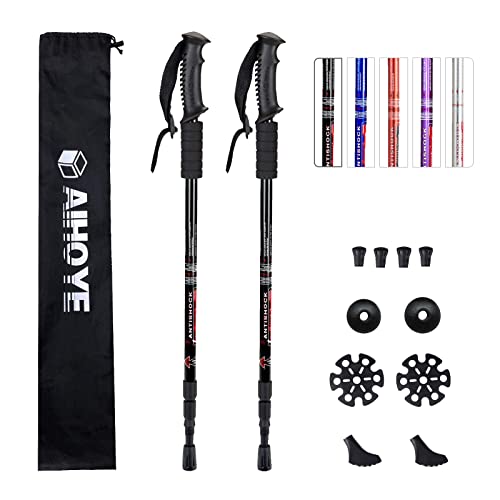
The TheFitLife Telescopic Trekking Poles provide practical stability and joint protection for day hikers, weekend backpackers, and fitness walkers. Designed as an accessible external trail accessory, these poles help balance shifting loads when carrying a daypack or overnight backpack over uneven terrain. Hikers looking to minimize joint strain will appreciate the integrated anti-shock mechanism that softens ground impacts with every stride.
On the trail, adjustability and weight balance are essential. Each pole weighs 9.92 ounces (282 grams), resulting in an agile swing weight that does not prematurely tire your arms. The three-section telescoping shaft expands from a minimum length of 25.6 inches (65 cm) up to 51.2 inches (130 cm). This generous adjustment range allows hikers to set proper pole lengths for steep ascents, descending grades, or flat trail cruising, accommodating a broad spectrum of user heights.
Crafted from durable aluminum alloy, the pole shafts are engineered to withstand rocky paths, root-strewn tracks, and variable temperatures. Instead of external cam levers, TheFitLife uses an internal twist-lock mechanism. This design creates a smooth, snag-free exterior that slides easily into backpack gear loops or under side compression straps without catching on webbing. The molded rubber grip features an ergonomic, non-slip profile suited for all-day trail handling.
For backpackers and travelers, transport flexibility is a notable advantage. The poles collapse to 25.6 inches for trail lashing. When fully separated into three individual sections, the longest piece measures 21.46 inches (54.5 cm), allowing them to fit diagonally inside most 22-inch or larger travel luggage. The package also includes rubber tips, road-walking caps, mud baskets, and snow baskets, giving hikers the correct ground interface across all four seasons.
Potential buyers should consider a few mechanical factors before hitting the trail. Twist-lock mechanisms require deliberate, firm hand tightening to ensure the internal expanders bite securely under full body weight. Additionally, while the 25.6-inch collapsed length attaches well to external pack loops, it is generally too long to fit inside compact daypack main compartments. Hikers who prefer porous cork grips for sweaty summer hikes should note that these feature molded rubber handles.
Overall, TheFitLife Telescopic Trekking Poles deliver dependable build quality, useful anti-shock dampening, and full accessory coverage at an approachable price. They are a smart addition for hikers who want reliable extra balance on rocky trails without spending premium gear prices.
Securing trekking poles properly on your backpack prevents shifting weight and snagging on low branches. TheFitLife poles collapse down to 25.6 inches (65 cm), making them well-suited for side compression straps, tool loops, or dedicated trekking-pole bungees on standard daypacks and multi-day packs. For travelers, the poles can be fully disassembled into three sections measuring 21.46 inches (54.5 cm), which fits diagonally inside checked luggage or travel duffels.
The height adjustment ranges from 25.6 inches to 51.2 inches (130 cm), making it simple to achieve an ergonomic 90-degree elbow bend on level terrain. Markings on the pole sections help you quickly match heights between the left and right poles after packing or adjusting for uphill and downhill sections.
TheFitLife poles come equipped with a comprehensive accessory set designed to adapt to varied trail surfaces. Standard carbide tips provide direct grip on hard-packed dirt, ice, and rock. For paved surfaces or rocky trails where you want to minimize noise and tip wear, push-on rubber tips and curved walking caps provide added grip and cushioning.
For loose or seasonal ground conditions, screw-on mud baskets prevent the poles from sinking deep into wet soil, sand, or scree. Wider snow baskets are also included to distribute weight across soft winter powder or crust, making these poles fully functional for year-round outdoor hiking.

Pros
- Folds down to 15 inches, making it significantly easier to pack inside travel luggage or strap to compact daypacks than standard telescoping poles
- Moisture-wicking natural cork handles keep palms dry and comfortable across humid hiking conditions
- Sturdy metal flip locks and reinforced joint caps provide solid structural support without slippage when properly tensioned
- Lower EVA foam grips allow instant trail adjustment for steep uphill climbing
Cons
- At 11.5 ounces per pole, they carry more weight than specialized ultralight carbon fiber poles
- The 110 cm minimum height setting may feel slightly too long for hikers under 5 feet 2 inches
- Per TSA regulations, trekking poles with metal tips must be packed in checked luggage rather than carried on flights
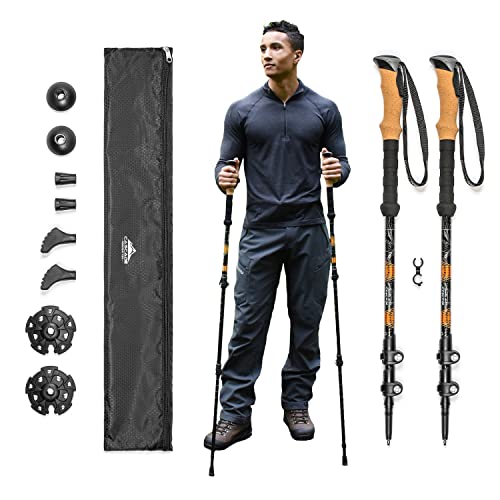
The Trekology Trek-Z Cork Grip Trekking Poles are folding, multi-section hiking sticks designed for hikers, backpackers, and travelers who require sturdy trail stability without the awkward bulk of traditional telescoping poles. Sold as a pair with an included carry bag, these poles suit day hikers tackling uneven paths, weekend backpackers managing load transfer on descents, and outdoor enthusiasts who need compact gear that fits inside travel luggage or standard daypack side sleeves.
Trail packability is one of the standout characteristics of this design. Utilizing a retractable tri-fold cable system, each pole breaks down to just 15 inches (38 cm) in overall length. This short folded dimension lets you slip the pair directly into the main compartment of an overnight pack, tuck them into side stretch-mesh water bottle pockets, or strap them beneath external compression straps without snagging overhead brush. For length adjustment, an upper aluminum section provides a 20 cm sliding range from 110 cm to 130 cm, catering to user heights between 5 feet 2 inches and 6 feet 5 inches.
Component construction focuses on long-term trail durability. Trekology builds the Trek-Z poles from aircraft-grade aluminum alloy, which provides higher impact resistance and flex tolerance against rocky crevices compared to brittle carbon fiber. The folding shaft joints feature protective metal caps to resist wear at stress points during repeated assembly. Up top, the natural cork grip wicks moisture away from sweaty palms during steep ascents, while a secondary EVA foam grip sleeve allows you to lower your hand placement instantly on steep trail grades without adjusting the shaft length.
Deploying and adjusting the poles requires a straightforward two-step setup. After letting the lower segments drop into place, you pull the upper shaft section until an internal metal locking button pops outward with a firm click. A durable metal external flip lock then secures the upper telescoping section at your desired height marker. Proper setup is essential; if the lower shaft feels loose or disconnected, the metal lock button must be firmly pulled until fully seated in its designated catch hole. Maintenance is simple, requiring only an occasional wipe-down with a dry cloth after muddy hikes before packing into the included storage sleeve.
While practical and durable, the Trek-Z design carries a few realistic limitations. Each pole weighs 11.5 ounces (330 grams), resulting in a combined pair weight around 23 ounces, which may deter dedicated ultralight thru-hikers who prefer minimal swing weight. Additionally, the minimum length of 110 cm means youth hikers or adults under 5 feet 2 inches might find the grip positioning too elevated on flat terrain. Travelers should also remember that TSA guidelines require trekking poles with rigid tips to travel inside checked baggage rather than carry-on packs.
For hikers seeking an affordable, compact, and robust set of walking poles, the Trekology Trek-Z Cork Grip poles deliver excellent overall value. They provide dependable joint support, sweat-wicking cork comfort, and pack-friendly folding convenience that fits easily into standard hiking backpacks and travel duffels.
The Trekology Trek-Z poles feature an adjustable working range between 110 cm and 130 cm, making them compatible with users measuring between 5 feet 2 inches and 6 feet 5 inches in height. Sizing adjustments are controlled via a durable metal flip-lock clamp positioned on the upper shaft section, marked with clear centimeter increments for quick alignment.
Hikers can lengthen the poles slightly for steep downhill sections to maintain an upright posture, or shorten them for prolonged uphill climbs. For fast grade transitions where stopping to loosen the clamp is impractical, the extended EVA foam grip below the primary cork handle allows instant choke-down positioning.
Thanks to a three-section folding architecture linked by an internal tension cable, the Trek-Z poles collapse down to an ultra-compact 15 inches (38 cm). This compact footprint allows them to slide vertically inside most 20-liter to 65-liter hiking backpacks, eliminating the tip-heavy snagging hazards common with longer two-piece or three-piece telescoping poles.
A matching carry bag is included to keep trail mud and dust away from sleeping bags, pack liners, and clothing when stored internally. When flying to destination trailheads, note that airline security guidelines require trekking poles to be packed within checked baggage rather than carry-on luggage.
The shafts are manufactured from aircraft-grade aluminum alloy, delivering high tensile strength and resilience against bending forces when supporting heavy backpack loads on rocky trails. The connection joints between segments are reinforced with metal caps to resist cracking and wall deformation under load.
The upper handle utilizes natural cork material that absorbs hand moisture, resisting slick spots during warm summer outings. The handle is engineered with a slight rotational flex that acts as an anti-torque buffer, reducing jarring impacts transmitted through the hands and wrists across prolonged trail miles.
Biomechanics and Practical Execution of Trekking Pole Sizing
Setting your trekking poles to the proper height balances upper body power transfer and lower body joint preservation. When adjusted correctly, the poles absorb significant braking forces on descents and recruit your upper body to propel you uphill. An incorrect height forces your shoulders into awkward shrugs or pulls your posture forward, accelerating muscle fatigue. Achieving the ideal setup requires evaluating your body mechanics on flat ground first, then making tactical adjustments as trail topography shifts.
The 90-Degree Elbow Baseline on Level Terrain
The fundamental starting point for setting hiking pole length is establishing a right angle at your elbow while standing on flat ground. Put on your regular hiking footwear, stand upright with your shoulders relaxed, and place the pole tips vertically on the floor beside your feet. Grip the handles naturally and observe the angle formed between your upper arm and forearm. Your forearm should rest completely parallel to the ground, creating a precise 90-degree bend at the elbow joint.
If your hands reach upward and your elbow angle drops below 90 degrees, the pole is set too long for flat ground. This upward reach places continuous strain on your deltoids and traps, which quickly leads to neck stiffness over long trail miles. Conversely, if your arm angles downward and your elbow opens wider than 90 degrees, the pole is too short. A short pole causes you to stoop forward, compromising spinal alignment and limiting your balance across uneven surfaces.
Footwear stack height plays an underappreciated role in this baseline measurement. Trail running shoes with thin midsoles place your palms closer to the ground than heavy mountaineering boots with thick lugged outsoles. Always verify your flat-ground sizing while wearing the exact socks and footwear you intend to use on the trail. Taking a minute to dial in this neutral 90-degree benchmark before you depart ensures your baseline measurements remain reliable throughout your trip.
Adapting Pole Height for Steep Climbs and High-Angle Ascents
Sustained uphill sections dramatically change the distance between your hands and the ground ahead of you. Because the slope rises in front of your feet, placing a standard flat-ground pole forward forces your hands high above your chest. This awkward arm position reduces your climbing leverage and places unnecessary strain on your rotator cuffs. To maintain efficient biomechanics on steep grades, shorten both trekking poles by roughly 5 to 10 centimeters (2 to 4 inches).
Shortening the shafts allows you to plant the tips without lifting your elbows above your ribcage. This compact arm carriage keeps your center of gravity stable and allows you to push directly downward with your latissimus dorsi and triceps. That downward push propels your body upward onto the next rock or log step without pulling your torso off balance. Your forearms should return to roughly a 90-degree angle relative to the rising slope in front of you.
In rolling terrain where short climbs alternate with flat sections, you can choke down on the handle rather than adjusting the shaft locks repeatedly. Models with extended lower grip sleeves give you the option to slide your hands down temporarily without breaking stride. However, for continuous mountain ascents lasting more than fifteen minutes, stopping to shorten the actual shaft provides far superior comfort and power. The mechanical advantage gained from properly shortened poles easily justifies the brief stop to adjust them.
Lengthening Poles for Steep Descents and Joint Impact Reduction
Downhill hiking delivers the highest mechanical stress to the lower extremities, particularly the patellofemoral joints, quadriceps, and ankles. As you step downward, the trail drops away beneath you, making standard-length poles reach into empty air before contacting the ground. To counter this drop, lengthen both poles by 5 to 10 centimeters (2 to 4 inches) beyond your flat-ground setting. Lengthening the shafts ensures the carbide tips make solid ground contact before your leading foot lands on the trail.
Planting the extended poles ahead of your body allows your arms to share the eccentric braking load that would otherwise fall squarely on your knees. This technique acts like an extra set of shock absorbers, stabilizing your forward momentum on loose scree or steep stone stairs. Hikers carrying heavy loads in an iron frame hiking backpack benefit immensely from this added reach, as it prevents top-heavy pack weight from pitching the body forward. The extended shafts provide continuous third and fourth points of balance during precarious step-downs.
When descending extremely steep drops, you can also rest the palms of your hands directly over the rounded tops of the grips. Cup the pommels with your palms rather than gripping the shafts tightly, and lean into the poles as you lower your weight. This posture keeps your wrists in a neutral position while transferring downward braking forces through the skeletal structure of your arms. Be careful never to commit full body weight to poles until you confirm the tips have achieved solid purchase on the rock.
Navigating Locking Mechanisms: Lever Cam Locks versus Twist Locks
The mechanism that secures your pole height determines how quickly and reliably you can make adjustments on the trail. External lever cam locks utilize an outside clamp tightened by a knurled metal or plastic thumb screw. The Trekology Trek-Z Cork Grip Collapsible Lightweight features a durable metal flip lock system that provides 20 centimeters of rapid adjustment between 110 and 130 centimeters. Flip locks are favored by many hikers because their clamping tension is visibly obvious and easy to manipulate while wearing bulky winter gloves.
Internal twist-lock systems, by contrast, rely on an expanding internal nylon plug that presses outward against the shaft walls when twisted. The Telescopic Trekking Poles for Hiking utilizes a glove-friendly twist-lock mechanism that creates a streamlined profile without external levers that could snag on dense trail brush. Twist locks provide a clean exterior, but they require clean internal surfaces to maintain proper friction. If fine trail grit enters the shaft, the internal expander plug can spin freely without biting against the aluminum wall.
Regardless of your locking mechanism, verifying clamping security before bearing weight is a vital safety habit. After adjusting height, press your full upper body weight downward onto both poles while standing on flat ground. If either shaft slips downward even slightly, increase lock tension immediately before proceeding. For flip locks, tighten the thumb screw a quarter turn; for twist locks, disassemble the sections to wipe away silt and re-tighten firmly.
Adjusting Three-Section Telescoping Poles versus Folding Z-Poles
Telescoping poles and folding Z-poles feature distinct internal architectures that influence how you set and calibrate their length. Traditional telescoping poles consist of nested aluminum or carbon fiber segments that slide inside one another. On three-section poles, both the middle and lower sections feature length markings in centimeters or inches. To maintain structural balance, extend the middle and lower sections equally rather than pulling one segment out to its absolute limit while leaving the other fully collapsed.
Equal extension balances the shaft diameter profile and preserves the pole’s natural resistance to bending forces. Every telescoping segment has a printed stop line that must never be extended past the locking collar. Pulling a shaft section past that line leaves too little overlap inside the joint, creating a weak leverage point that can bend or snap under normal axial pressure. TheFitLife model extends out to 130 centimeters (51.2 inches) across its three aluminum sections, providing versatile sizing for a wide range of hiker heights.
Folding Z-poles operate under a different framework, using tensioned internal cords to snap fixed-length sections into place. The Trekology Trek-Z incorporates a retractable tri-fold design that folds down to a compact 15 inches for effortless packing. Once the lower sections snap together and the metal lock button pops out, the top section provides an integrated flip-lock adjustment zone. This design delivers the ultra-compact packability of a folding pole while still offering 20 centimeters of height adjustability to match changing terrain.
Wrist Strap Loading and Grip Technique for Axial Support
Setting the correct height is only half the battle; how you engage the wrist straps directly dictates how effectively weight transfers to the poles. Many hikers incorrectly slide their hands downward through the top of the strap loop, grabbing both the strap and handle together. This downward grip pinches webbing against the palm and forces a continuous, fatiguing finger grip on the shaft. Over a long mountain traverse, gripping too tightly leads to forearm cramps, blisters, and hand fatigue.
The correct ergonomic method requires inserting your hand upward from underneath the strap loop before grasping the grip. Slide your hand up through the bottom of the loop, open your fingers, and bring your thumb over the top of the strap while gripping the handle. When executed properly, the wide webbing wraps smoothly across the back of your hand and rests along the ulnar border of your wrist. This configuration allows your body weight to rest directly onto the strap fabric, transferring force through your skeletal structure without requiring excessive finger squeeze.
Once your hand is seated, adjust strap tension so it supports your wrist snugly without cutting off circulation. You should be able to relax your grip on flat stretches while the pole remains suspended naturally in your palm. Grip composition also influences comfort; natural cork absorbs hand sweat and molds to your palm, while rubber grips offer durable weather insulation. The Trek-Z cork handles feature engineered rotational flex to accommodate dynamic wrist movement, ensuring comfortable power transfer across varying terrain.
Managing Sidehill Contours with Extended Grips and Choking Up
Traversing a steep mountain slope along a contour line creates an asymmetric challenge for trekking pole height. The uphill side of the slope is much closer to your body, while the downhill drop-off falls steeply away on the opposite side. If you keep both poles set to the exact same length, your uphill arm is forced high into a cramped position while your downhill arm reaches awkwardly downward. This imbalance disrupts your walking rhythm and pulls your torso away from the safety of the hillside.
When traversing an extended sidehill slope that continues for miles, the best solution is to adjust each pole independently. Shorten your uphill pole by 5 to 10 centimeters and lengthen your downhill pole by the same amount to level out your arm carriage. This asymmetric adjustment keeps both elbows at a comfortable 90-degree angle despite the severe tilt of the underlying terrain. Your posture remains vertical, improving foot traction and preventing sudden slips on narrow mountain paths.
If the trail switchbacks repeatedly across the slope, stopping to readjust individual pole shafts at every turn becomes impractical. This is where extended lower grip sleeves made of high-density EVA foam become indispensable. By choking down your uphill hand onto the lower foam sleeve while keeping your downhill hand on the primary grip, you immediately equalize your reach without touching a single lock. This rapid adaptation saves time and energy while keeping your balance secure on exposed hillside switchbacks.
Shelter Pitching, Maintenance, and Travel Logistics
Beyond trail walking, adjustable trekking poles frequently serve as structural uprights for non-freestanding ultralight tents and tarps. Most ultralight shelters require poles set between 115 and 130 centimeters to achieve proper canopy tension and effective rain shedding. Before pitching your shelter, adjust your poles to the manufacturer’s exact recommended height and confirm the locking collars are fully tightened. Because guylines place continuous downward pressure on the shafts throughout the night, loose locks will cause the canopy to sag during a storm.
Maintaining consistent height settings also requires keeping the internal surfaces of your poles clean and free of trail debris. After wet or dusty trips, fully disassemble the pole segments, wipe down the shaft surfaces with a clean dry cloth, and allow them to air dry. Never apply oil, grease, or chemical lubricants to the inside of the shafts or expander plugs, as lubricants eliminate the friction needed for locks to hold your body weight. Clean, dry shafts ensure that your height markings remain clear and your locking collars clamp securely.
Transporting poles to distant trailheads introduces travel rules that hikers should anticipate before arriving at the airport. The Transportation Security Administration (TSA) and international security agencies strictly prohibit hiking poles in carry-on luggage due to sharp carbide tips. You must pack your poles inside checked baggage, whether they fold down to 15 inches like the Trekology Trek-Z or disassemble like TheFitLife models. Checking your gear prevents airport confiscation and protects your equipment for the trail ahead.
Setting your hiking pole height accurately is an essential backcountry skill that protects your knees, stabilizes balance, and boosts endurance. By establishing a solid 90-degree elbow baseline on flat terrain, shortening for climbs, and lengthening for descents, you unlock the full biomechanical benefits of your equipment. Regularly checking lock tension and practicing proper strap technique ensures your poles deliver dependable support on every trail.






Write Your Review
No reviews yet. Be the first to share your experience!