


Stepping onto an uneven mountain path with a loaded pack places immediate compressive stress across your lower joints. Many outdoor enthusiasts naturally wonder whether is one hiking pole enough for their favorite backcountry routes or if carrying a pair is mandatory. Using a solitary hiking staff offers an immediate third contact point to gauge mud depth, push back overgrown brush, and catch sudden footing slips. It also keeps one hand completely free for checking GPS maps, holding a camera, or managing a water bottle while maintaining forward momentum. Casual day hikers often appreciate this balance of light support and physical convenience.
Carrying only one pole fundamentally alters your gait and body alignment compared to using a synchronized dual-pole system. Pairing thoughtful gear choices like supportive pants for knee joint comfort with upper body stability tools helps mitigate descending fatigue on steep gradients. Without balanced upper body propulsion, your dominant side shoulders a heavier braking burden whenever the trail drops sharply. Deciding between a single pole and a full pair depends directly on trail gradient, pack weight, and your personal joint sensitivity. Understanding these tradeoffs allows you to tailor your gear configuration to match the demands of your chosen route.

Pros
- Compact 15-inch folded size fits easily inside daypacks or stows neatly against backpack compression straps
- Aircraft-grade aluminum construction with reinforced metal joint caps offers reliable trail strength
- Moisture-wicking EVA foam grip and extended shaft sleeve provide secure handling during steep climbs
- External flip-lock mechanism allows quick, tool-free height adjustments between 100 and 120 cm
Cons
- Height range of 100 to 120 cm fits users up to 5'10", requiring taller hikers to select the longer pole size
- TSA regulations require folding trekking poles to be packed in checked luggage rather than airline carry-on bags
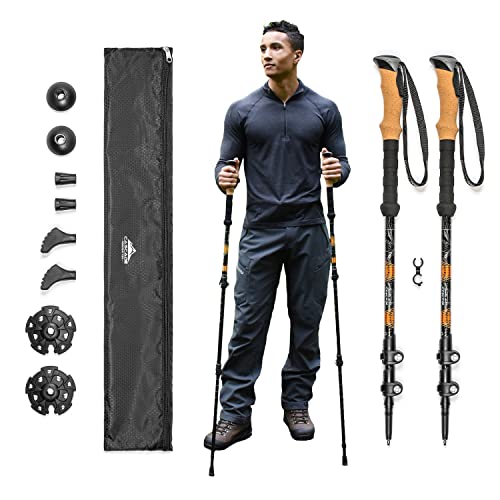
The Trekology Trek-Z Folding Trekking Pole set is a compact, tri-fold aluminum walking stick pair engineered for day hikers, backpackers, and active travelers who need dependable trail balance without taking up excessive pack space. Sized with an adjustment range of 100 to 120 cm, this specific model suits hikers between 4'11" and 5'10" who want an adjustable walking aid that easily stows on or inside a hiking backpack.
Collapsing down to just 15 inches (38 cm), the Trek-Z poles eliminate the awkward overhang common with traditional telescoping poles when strapped to backpack gear loops or slipped into stretch water bottle pockets. Weighing 10.4 oz (294 g) per pole, they offer solid ground support on ascents and descents while adding minimal base weight to your daypack or multi-day backpacking load. The included mud stops help prevent the tips from sinking into soft ground, making them useful across forest tracks, dirt trails, and wet crossings.
Built with aircraft-grade aluminum alloy tubing and reinforced joints fitted with metal lock caps, these poles are crafted to handle rugged trail conditions and repeated folding cycles. The ergonomic handle features moisture-wicking EVA foam that helps keep your hands dry during sweaty summer hikes. An extended EVA foam section down the upper shaft allows hikers to quickly choke up on the grip when climbing steep switchbacks without pausing to readjust pole height.
Deploying the poles involves snapping the folding sections into place and securing the top flip-lock mechanism, which provides 20 cm of micro-adjustment to dial in the correct 90-degree elbow angle. When you reach the trailhead or take a lunch break, unlocking the system allows the poles to quickly fold back down to 15 inches. Trekology includes a custom holder bag to shield the rest of your backpack contents from dirt and sharp tips during transport.
While the tri-fold aluminum design is versatile, buyers should be aware of a few practical constraints. Hikers taller than 5'10" will need the longer 115 to 135 cm version, as this model caps out at 120 cm. Additionally, for travelers heading to destination hikes via commercial airlines, TSA guidelines require trekking poles to be packed in checked baggage rather than carry-on luggage.
For day hikers, weekend campers, and budget-conscious backpackers seeking reliable walking support that packs down small enough for almost any daypack, the Trekology Trek-Z poles deliver practical utility and straightforward adjustment at an accessible price point.
A key advantage of the Trekology Trek-Z poles is their 15-inch (38 cm) collapsed length, making them significantly easier to carry than standard telescoping poles that often measure 24 inches or more when retracted. This short profile allows them to slide vertically inside a typical 20-liter daypack or tuck securely into the side water-bottle pockets of a backpacking pack without snagging low-hanging branches.
The included carry bag provides a clean barrier between trail mud and your gear, keeping the interior of your backpack dry and organized. Hikers who prefer external storage can easily lash the folded poles to standard pack compression straps, ice-axe loops, or trekking-pole attachments without throwing off the balance of their pack.
This 100 to 120 cm Trek-Z model is specifically tailored for hikers with heights between 4'11" and 5'10". Proper trekking-pole sizing generally requires your elbow to rest at a comfortable 90-degree angle when holding the grip with the pole tip resting on flat ground.
Height adjustment is controlled by an intuitive external flip-lock equipped with a metal stopper, offering 20 cm of variable adjustment. Hikers can shorten the poles slightly for steep uphill pushes or lengthen them for descents to maintain balanced posture on uneven terrain.
Constructed from aircraft-grade aluminum alloy, the Trek-Z poles balance structural rigidity with manageable trail weight. Aluminum is well-suited for rugged terrain because it tends to bend under extreme stress rather than snapping abruptly like ultralight carbon fiber.
Trekology reinforces the connecting joints with metal lock caps, reducing play and wobble across the tri-fold joints during heavy downhill impacts. The moisture-wicking EVA foam handles resist sweat buildup and provide soft, all-day hand comfort in varied weather conditions.

Pros
- Collapses down to a compact 15 inches, fitting easily inside backpacks or carry luggage bags
- Natural cork handles absorb hand perspiration effectively during strenuous hikes
- Sturdy aircraft-grade aluminum construction with protective metal caps at the folding joints
- Simple height adjustment between 110 cm and 130 cm via a sturdy metal flip lock lever
Cons
- TSA regulations require trekking poles to be packed in checked luggage rather than carry-on bags
- Users must verify the push-button lock is fully popped out to ensure shaft stability before hiking
- At 11.5 oz per pole, aluminum construction is heavier than ultralight carbon-fiber alternatives
The Trekology Trek-Z Cork Grip Collapsible Trekking Poles are three-section folding hiking sticks designed for day hikers, backpackers, and adventure travelers who require portable stability on uneven trails. Rather than using traditional telescoping designs that remain long when collapsed, these poles utilize a tri-fold folding cable system that stows down to a compact 15 inches. This makes them a strong match for hikers who prefer storing their poles directly inside a daypack or securing them flat against external pack compression straps without poles protruding past the top lid.
On trail, these poles offer an adjustable length range of 110 cm to 130 cm, covering a stated user height range between 5'2" and 6'5". Each pole weighs 11.5 oz (330 g), delivering a solid feel that helps distribute carried weight and stabilize joint impact on steep descents. The main handle is shaped from natural cork, which naturally absorbs hand moisture and sweat during warm trail outings. Trekology notes that the cork grips incorporate a slight rotational flex as an anti-torque ergonomic feature. Below the cork, secondary EVA foam grips allow hikers to quickly choke down on the poles when negotiating short, steep step-ups without adjusting overall pole length.
Build quality centers on aircraft-grade aluminum alloy shafts, chosen to withstand lateral loads and rocky terrain where brittle materials might crack. To reinforce high-stress connection points, Trekology adds metal caps around the folding joints, reducing play once the poles are deployed. Extension and length adjustments are secured using a durable metal flip lock at the upper section, ensuring reliable clamping power once clamped to the hiker's preferred height marker.
Deploying the poles requires extending the folding sections until the internal tension cable pulls tight and an internal metal lock button pops through the shaft hole. Ensuring this button is fully seated is essential for complete structural rigidity before latching the upper flip lock. For transport, collapsing the poles takes seconds, allowing both poles to slip neatly into the included storage bag. When traveling by commercial air to hiking destinations, keep in mind that TSA and airline policies classify trekking poles as checked luggage, meaning they must be stowed inside checked duffels or backpacks rather than overhead carry-on bags.
While the folding mechanism provides impressive packability, the design does present a few practical limitations. The total adjustment range is 20 cm (110 to 130 cm), which may not suit hikers under 5'2" who require a shorter pole setup. Additionally, at 11.5 oz per pole, weight-conscious thru-hikers aiming for sub-pound base weights might find aluminum folding poles heavier than fixed-length carbon options. The locking button also requires careful initial alignment during assembly to ensure the segments seat properly without wobbling.
For hikers, backpackers, and travelers seeking dependable trail support without spending top-tier outdoor brand prices, the Trekology Trek-Z Cork poles offer exceptional value. The combination of sweat-wicking cork handles, reinforced aluminum joints, and an ultra-packable 15-inch folded size makes them a versatile accessory for everything from local forest walks to rugged mountain backpacking trips.
The Trekology Trek-Z poles adjust between 110 cm and 130 cm in length, accommodating hikers measuring roughly 5'2" to 6'5" (159 to 195 cm) in height. Length adjustments are managed via a metal flip lock clamp on the top shaft section, allowing users to fine-tune height based on trail slope or individual arm ergonomics.
Hikers shorter than 5'2" may find the minimum 110 cm setting too tall for standard 90-degree elbow positioning on level terrain. Always confirm that your forearm rests parallel to the ground when holding the cork grip before clamping the metal flip lock.
Thanks to a three-piece folding design, the Trek-Z poles collapse down to just 15 inches (38 cm) in length. This compact size allows them to fit horizontally or vertically inside most standard daypacks, carry duffels, or luggage cases without hanging loosely off external attachment points.
The poles come with a dedicated carry bag to keep trail mud and dust away from clean gear inside your backpack. Hikers traveling by air should remember that TSA guidelines prohibit trekking poles in carry-on baggage, requiring these poles to travel inside checked luggage.
The pole shafts are manufactured from aircraft-grade aluminum alloy, delivering reliable strength-to-weight performance and high resistance to bending stresses on demanding rocky routes. The connection joints are strengthened with metal caps to guard against joint wear and slippage over time.
The handles feature genuine cork, which helps manage perspiration and adapts comfortably to hand pressure over long miles. A secondary EVA foam grip sits directly beneath the cork for quick hand repositioning on steep gradients without stopping to change shaft length.
Evaluating Single Versus Dual Trekking Poles on the Trail
Determining whether a single staff provides adequate stability requires looking closely at trail conditions, hiking biomechanics, and body symmetry. A single pole can be an effective walking aid on moderate paths, but technical mountain routes introduce distinct mechanical challenges. Analyzing how your upper body redistributes force will help you choose the right setup for your next outing.
The Biomechanical Difference Between One Pole and Two
Walking with two poles establishes a rhythmic, four-point gait cycle that distributes physical effort evenly across your arms, shoulders, and core. Alternating dual poles mimics your natural arm swing and activates your upper body musculature in tandem with every stride. This symmetrical rhythm transfers a portion of your downward impact away from your lower extremities with each step.
Using only one pole introduces an asymmetrical loading pattern into your natural walking mechanics. Your dominant side inevitably absorbs more downward braking force while your opposite side functions without any upper body assistance. Over long distances, this one-sided reliance can cause uneven shoulder tension and alter your natural pelvic tilt.
Hikers who carry a single pole often find themselves switching the stick between hands to alleviate localized arm fatigue. While switching hands prevents forearm cramping, it disrupts hiking cadence and leaves you temporarily unprotected during hand swaps. Dual poles eliminate this issue by providing continuous, uninterrupted ground contact on both sides of your body.
Gait Symmetry, Spinal Alignment, and Muscular Fatigue
Maintaining balanced spinal alignment is critical during all-day hikes across uneven terrain. When you plant a single hiking pole on one side of your body, your torso subtly rotates and leans toward that anchor point. This slight lateral flexion might seem inconsequential over a mile or two, but it compounds over ten or fifteen miles into noticeable lumbar strain.
Dual trekking poles encourage an upright, forward-facing posture that opens your chest cavity and promotes deeper breathing. Engaging both latissimus dorsi muscles simultaneously helps stabilize your spine against the swaying momentum of your pack. This balanced posture keeps your center of mass centered between your hips rather than pulled toward one side.
Muscular fatigue also manifests differently depending on whether your arms share the workload. A single pole places the entire burden of braking, vaulting, and balance recovery onto one wrist, elbow, and shoulder. Distributing these forces across two arms reduces localized joint fatigue and preserves endurance for late-day trail challenges.
Scenarios Where a Single Hiking Pole Excels
A single hiking pole remains a favorite choice for casual day hikers tackling well-maintained, rolling paths. When trail gradients remain gentle and technical obstacles are minimal, a single staff offers sufficient balance support without unnecessary complexity. It serves as a dependable probe for checking mud depth, testing loose rocks, or pushing aside overgrown brush.
Keeping one hand completely unobstructed provides distinct practical advantages during relaxed trail walking. You can easily reach into side pockets for snacks, sip from a water bottle on the move, or handle a leash when hiking with pets. Birdwatchers and landscape photographers frequently prefer a single pole because it allows them to operate equipment without stowing their gear.
Collapsible options like the Trekology Trek-Z Hiking Trekking Poles offer the flexibility to deploy just one shaft while keeping the companion pole stowed. These aluminum poles collapse down to 15 inches, meaning a spare pole easily slides into an exterior pack sleeve until terrain demands extra support. This modular approach lets you adapt your gear configuration as trail conditions evolve.
Steep Descents and Downhill Joint Protection
Steep downhill trail sections subject your knees, hips, and ankles to substantial compressive shock forces. Every downward step forces your quadriceps to contract eccentrically to brake your forward motion. Relying on a single pole during steep descents forces one knee to absorb significantly more braking force than the supported side.
Dual trekking poles create a stable braking platform that redistributes downhill forces directly into your chest, shoulders, and triceps. Lengthening both shafts by 5 to 10 centimeters allows you to plant the tips ahead of your descent without bending at the waist. This dual-point forward planting stabilizes your descent and significantly moderates impact shock on both patellofemoral joints.
Hikers managing chronic knee discomfort will rarely find that a single hiking stick provides sufficient downhill relief. The unassisted leg remains vulnerable to sudden hyperflexion, slipping on loose scree, or twisting on off-camber roots. Using a synchronized pair ensures that every step receives mechanical deceleration from your upper body.
Technical Terrain, River Fording, and Balance Demands
Crossing swift backcountry rivers demands maximum ground contact to resist hydraulic pressure. A single pole creates a basic three-point stance when combined with your two feet, which provides modest stability in gentle currents. In swift or waist-deep water, however, a three-point stance leaves you momentarily balanced on only two points every time you lift a foot.
Dual poles establish a secure four-point foundation that allows you to move with three points anchored to the riverbed at all times. This tripod stability ensures that you never lose your footing even if a submerged river stone shifts beneath your boot. Dual points also provide essential lateral bracing against strong side currents that could easily pivot a hiker leaning on a single stick.
Traversing boulder fields and loose talus slopes presents similar balance hazards that overwhelm a single contact point. Stepping onto an unstable rock while holding two poles allows you to brace instantly with both arms, preventing a dangerous fall. A single pole can only stabilize one side, leaving the opposite flank completely unprotected if a rock pivots unexpectedly.
Pack Weight Considerations and Heavy Load Support
Backpack weight fundamentally alters your center of gravity and increases the momentum of every stumble. When you hike with ultralight day gear, your core muscles can easily compensate for minor balance disruptions. Carrying heavy multi-day gear, especially in structured internal frame backpacks, magnifies lateral sway and demands substantial external stabilization.
A single pole struggles to control the high torsional forces generated by a heavy pack on uneven switchbacks. As your upper body leans to plant the stick, the pack weight shifts laterally, placing uneven shear stress on your lumbar spine. Dual poles act as structural outriggers, keeping the load centered directly above your pelvis and minimizing rotational strain.
Heavy backpacking also requires uphill propulsion assistance that a single pole cannot provide symmetrically. Planting two poles behind your stride engages your lats and shoulders to push your pack weight upward against gravity. This dual-arm propulsion conserves valuable quadricep energy during grueling mountain ascents with heavy gear.
Sizing Mechanics, Height Adjustments, and Strap Technique
Achieving proper biomechanical support requires adjusting your pole length to maintain a 90-degree elbow bend on level ground. When standing upright with shoulders relaxed, your forearm should form a right angle relative to your torso when gripping the handle. Both the EVA foam and the Trekology Trek-Z Cork Grip Collapsible Lightweight models feature metal flip-lock systems that provide a 20-centimeter adjustment range to achieve this baseline.
Adjusting pole length for changing trail gradients is essential whether you carry one shaft or two. On sustained climbs, shortening your poles by 5 to 10 centimeters prevents you from overreaching and straining your shoulder joints. On descents, lengthening the shafts keeps your torso upright and ensures your tips contact the ground before your lead foot strikes.
Proper wrist strap loading technique is equally vital for transferring weight effectively without fatiguing your hands. Insert your hand upward through the bottom opening of the strap loop before closing your palm over the grip. This configuration rests your downward body weight across the wide webbing strap rather than forcing your fingers to clench the handle tightly all day.
Shaft Metallurgy and Locking Mechanisms
Trekking pole durability depends on the structural qualities of the shaft material and the security of the locking hardware. Aircraft-grade aluminum alloy provides excellent tensile strength and bends slightly under extreme loads rather than snapping catastrophically like brittle carbon fiber. This bending ductility offers a valuable safety margin when a pole tip becomes wedged between granite boulders.
Folding Z-pole designs utilize reinforced joints with metal stopper caps to maintain rigidity across multiple shaft sections. The Trekology Trek-Z models incorporate durable metal flip locks paired with a push-button locking stopper to prevent unwanted collapse under axial body weight. Inspecting the metal tension stopper before loading your full weight ensures the shaft sections remain locked securely in place.
Locking mechanisms require routine field inspection to prevent gradual slippage caused by temperature swings and trail vibration. If a flip lock feels loose, tightening the metal thumbscrew restores clamping force and maintains shaft integrity on steep step-downs. Keeping shaft joints clean from trail silt prevents internal binding and extends the operational life of the folding hardware.
Grip Materials and Ergonomic Comfort in the Field
Grip material directly influences hand comfort, moisture management, and blister prevention over long distances. Natural cork grips excel in warm, humid climates because cork naturally absorbs hand moisture and molds to your palm contour over time. Cork handles also feature subtle rotational flex, which functions as an ergonomic anti-torque feature to cushion joint stress.
EVA foam grips provide a soft, resilient hold that wicks sweat away from your skin to keep your grip secure in wet weather. High-density EVA foam handles resist breakdown from trail dirt and remain comfortable across wide temperature variations. Extended foam choke sleeves positioned below the primary grip allow you to lower your hand placement during brief uphill scrambles without readjusting the locking mechanism.
Using two poles distributes grip friction across both palms, drastically reducing the formation of hot spots and calluses. When you hike with only one pole, your working hand absorbs constant friction and sweat accumulation for hours. Switching grips or alternating hands helps, but balanced dual grips keep both hands comfortable without localized chafing.
Transport, TSA Regulations, and Packability
Planning trail excursions involving air travel requires strict compliance with airport security guidelines. The Transportation Security Administration prohibits trekking poles with sharp metal carbide tips in carry-on luggage, mandating that they be stowed in checked baggage. Tri-fold poles that collapse down to 15 inches slide neatly into checked duffels or suitcases without occupying excessive space.
Compact packability also proves valuable when transitioning from walking paths to non-technical Class 3 rock scrambles. When both hands are required for three-point contact on rocky ledges, folding your poles and sliding them into pack side pockets prevents awkward snagging. Stowing your poles securely ensures that sharp carbide tips do not puncture your pack or catch on low-hanging branches.
Choosing Your Optimal Trail Configuration
Deciding whether to hike with one pole or a matched pair ultimately comes down to your personal balance needs, route topography, and pack weight. A single pole provides practical assistance on flat nature trails, casual walks, and exploratory scouting hikes where you value a free hand. It offers functional support for pushing back underbrush, testing shallow creek beds, and catching minor trail stumbles.
When heading into steep backcountry mountains, carrying multi-day pack loads, or managing joint sensitivity, dual poles provide indispensable biomechanical protection. Using two poles preserves gait symmetry, distributes descending braking forces evenly across your upper body, and establishes a secure four-point stance across rugged terrain. Investing in a quality pair gives you the versatility to hike with one staff on mellow trails or deploy both poles when the route turns demanding.



Write Your Review
No reviews yet. Be the first to share your experience!