


Steep mountain descents place tremendous compressive force on the knees, hips, and ankles, often turning an otherwise rewarding backcountry trek into an exercise in joint management. Many outdoor enthusiasts eventually ask what are the best hiking poles to mitigate that constant downhill pounding and maintain surefooted stability on loose talus. Trekking poles serve as dynamic stabilizers, transferring downward braking loads away from lower joints and redistributing force into the chest, shoulders, and back. When paired with reliable footwear and supportive hiking pants for knee strain, a proper set of poles can preserve your endurance over grueling high-elevation miles.
Beyond absorbing downward punishment on steep switchbacks, dual poles establish a steady cadence during uphill climbs by engaging the upper body for forward propulsion. They act as essential third and fourth points of contact when traversing slippery stream crossings, muddy bogs, and uneven rock scree. Evaluating shaft composition, locking hardware, and handle ergonomics ensures you select equipment matched to your specific trail goals. Making an informed choice prevents common trail frustrations like slipping lock clamps, heavy swing weight, and hand fatigue on multiday journeys.




Evaluating Trekking Pole Design, Durability, and Field Performance
Determining what are the best hiking poles requires looking past marketing buzzwords and examining how mechanical hardware interacts with trail biomechanics. A reliable pole is not simply the lightest stick available, but rather a cohesive system offering dependable structural integrity, secure locking clamps, and ergonomic comfort over high-mileage days. Hikers navigate diverse environments ranging from sun-baked alpine granite to spongy forest loam, which means the optimal tool depends directly on terrain demands and pack weight. Examining shaft materials, clamping hardware, grip compounds, and sizing geometry provides a clear framework for selecting gear that enhances balance and preserves joint health.
What Defines the Best Hiking Poles for Varied Trail Conditions
The best hiking poles strike a balance between axial load capacity, swing weight, and trail adaptability. Axial load capacity refers to the vertical downward force a pole can support before slipping or buckling when a hiker leans heavily on a steep step-down. Swing weight measures how easily the pole pivots forward with every stride, directly influencing forearm and shoulder fatigue over long backcountry treks. Lower shaft mass makes a noticeable difference in arm comfort during eight-hour trail days.
Trail adaptability means the equipment handles changing weather, steep gradients, and varying surfaces without failing unexpectedly. Hikers must trust that a lock collar will not slip during cold morning descents and that tips will grip wet river stones securely. When choosing equipment, backpackers often match pole strength to the load carried in a framed hiking backpack, where heavier loads demand higher structural bend resistance. Understanding these core engineering demands ensures you select equipment built to handle rigorous backcountry use.
Shaft Materials: Aluminum 7075 Resilience Versus Carbon Fiber Weight Savings
Shaft composition represents the fundamental choice between ductile resilience and featherweight efficiency. Aircraft-grade 7075 aluminum remains the benchmark for rugged durability, offering superior resistance against bending and catastrophic failure. When an aluminum pole gets wedged between granite boulders during a stumble, the metal usually bends slightly rather than snapping cleanly. Models such as the MSR DynaLock Explore 3-Section Alumunium and the York Nordic Hiking & Walking Poles leverage high-strength 7075 aluminum to deliver reliable impact resistance while keeping single-pole weights near eight ounces.
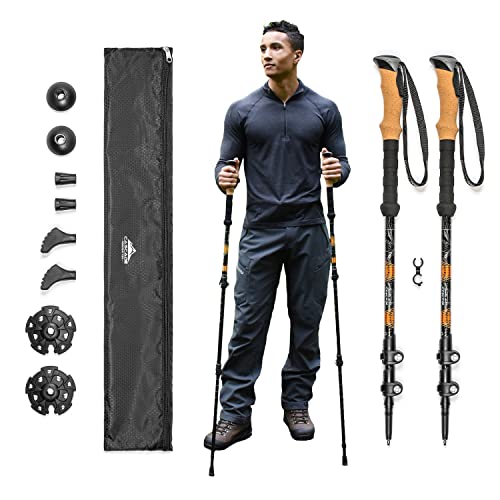
Carbon fiber caters to fastpackers and long-distance hikers seeking minimum weight and superior vibration damping. Multi-layer carbon shafts naturally absorb micro-vibrations before they travel up through the wrist and elbow joints, reducing joint fatigue on hard-packed trails. The Foxelli Carbon Fiber Trekking Poles highlight this advantage, weighing only 7.6 ounces per pole while incorporating reinforced stress zones to resist trail stress. However, carbon fiber exhibits lower tolerance to lateral shear forces, meaning a sharp blow against a rock edge can induce cracks or structural fracture.
Locking Mechanisms: External Cam Lever Locks Versus Internal Twist Expanders
A trekking pole is only as reliable as the mechanism holding its telescoping sections in place. External lever cam locks, also known as flick locks, have largely replaced older internal twist expanders across technical backcountry gear. Cam locks operate via an external clamp lever that compresses an aluminum or composite collar around the inner shaft section. This exterior setup makes it easy to visually confirm whether a clamp is engaged before bearing full weight on an off-camber descent.
External cam systems perform exceptionally well in freezing temperatures and dusty environments because their mechanical parts remain outside the hollow shaft. The DynaLock mechanism on the MSR DynaLock Explore 3-Section Alumunium exemplifies this design, featuring tool-free tension adjustment that allows hikers to calibrate clamp tightness with their fingers in seconds. Temperature drops cause hardware to contract slightly, which can lead to sudden clamp slippage if tension cannot be tightened on trail. By contrast, internal twist locks rely on expanding nylon wedges that frequently jam or slip when exposed to fine silt, making external levers far more dependable.
Grip Ergonomics: Natural Cork, EVA Foam, and Correct Wrist Strap Technique
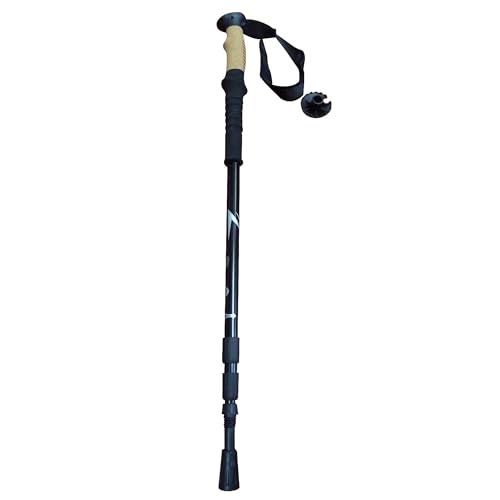
Handle comfort directly dictates whether a long day on the trail ends with comfortable hands or painful friction blisters. Natural cork grips, featured on models like the Yard Tuff Adjustable Walking Sticks for Hiking, offer superior moisture management by absorbing sweat and molding to palm contours over time. For cooler conditions or wet trails, EVA foam grips, such as those on the York Nordic Hiking & Walking Poles, provide soft cushioning and do not hold moisture. Many mountain poles also feature lower foam choke sleeves, allowing hikers to lower hand placement on steep sidehills without stopping to adjust clamp levers.
Proper wrist strap technique is just as crucial as handle material for preventing grip fatigue. Many hikers mistakenly slip their hands downward through the loop, which forces continuous finger clenching on the grip. The correct biomechanical approach involves inserting your hand upward from beneath the loop before resting your palm over the webbing. This upward entry allows downward body weight to rest securely across the wide strap, letting you relax your fingers on the backswing without dropping the pole.
Sizing Precision and Terrain-Specific Length Adjustments
Proper pole sizing forms the cornerstone of effective trail biomechanics and joint protection. On level terrain, the baseline standard is the 90-degree elbow rule, where your elbow forms a right angle when holding the grip with the pole tip resting vertically on the ground. This neutral position keeps your shoulders relaxed, prevents upper trap tension, and aligns the forearm to absorb downward braking force efficiently. Wearing your typical hiking footwear during initial sizing ensures your standing height is accurately represented before setting clamp positions.
Terrain gradients require dynamic length adjustments to maintain this optimal efficiency throughout the day. Shortening poles by five to ten centimeters on steep ascents prevents your hands from rising above heart level, which reduces shoulder strain and improves climbing cadence. Conversely, lengthening poles by five to ten centimeters for descents lets you plant the tips forward without hunching your back. Telescoping models like the Yard Tuff Adjustable Walking Sticks for Hiking and Foxelli Carbon Fiber Trekking Poles adjust easily, but shafts must never be extended past their etched stop lines.
Shock Absorption and Joint Impact Mitigation on Steep Descents
Mitigating compressive force on the lower body is one of the primary reasons hikers invest in quality poles. Descending a steep grade subjects knee joints and patellar tendons to repetitive impact forces several times greater than walking on flat ground. Trekking poles intercept a significant portion of this impact force, routing energy through the arms and torso musculature before it hammers the knees. Hikers wearing lightweight hiking pants who encounter rocky descents can maintain a fluid, low-impact stride by actively loading the poles on each step-down.
Some hikers prefer built-in mechanical suspension to dampen sharp trail strikes on hard-packed ground. The Yard Tuff Adjustable Walking Sticks for Hiking feature an internal anti-shock spring system designed to absorb impact forces and reduce joint strain on rough terrain. Rigid carbon and aluminum poles without springs rely on natural material flex and body mechanics for shock management. Regardless of design, planting both tips ahead of your descent path creates a stable braking tripod that minimizes quadriceps fatigue and reduces slip risk.
Tips, Baskets, and Accessory Modularity for Mixed Surfaces
The interface between your pole and the ground dictates traction across varying backcountry terrain. Standard trekking poles come equipped with hard tungsten carbide tips that bite aggressively into rock slabs, hard-packed dirt, and muddy switchbacks. Carbide tips resist abrasive wear over hundreds of trail miles, ensuring sharp, reliable purchase when traversing slippery riverbeds or loose scree. However, metal tips can skitter loudly and lose traction on smooth asphalt or paved greenways, while also accelerating trail erosion on delicate sandstone paths.
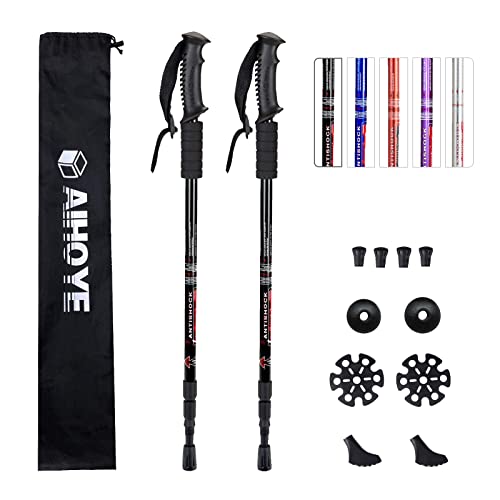
Slip-on rubber ferrules solve this pavement problem by providing non-slip traction on hard surfaces while dampening noise. Accessories such as the 6-Pack Heavy Duty Walking Stick Tips feature textured bottom surfaces that enhance grip on pavement, rocky paths, and indoor floors while protecting metal points. For seasonal adaptability, swapping low-profile mud baskets for wide winter powder baskets, like those included with the MSR DynaLock Explore 3-Section Alumunium, keeps poles floating on deep snow rather than sinking out of reach.
Backcountry Dual-Use, Shelter Pitching, and Transport Regulations
Beyond serving as walking aids, trekking poles play a crucial dual role for ultralight backpackers by supporting non-freestanding shelters. Tarp shelters and trekking-pole tents eliminate heavy dedicated tent poles by utilizing your walking sticks as primary vertical structural uprights. Rigid three-section aluminum poles excel in this role because their robust locking collars withstand high lateral wind loads without slipping downward overnight. When pitching a shelter, placing the handle or rubber-capped tip into the reinforced tent apex pocket prevents sharp carbide tips from puncturing fragile silnylon or DCF canopy fabric.
Transporting trekking poles requires careful planning, especially when traveling to backcountry destinations by commercial airplane. Transportation Security Administration guidelines strictly prohibit hiking poles with pointed metal carbide tips in domestic carry-on baggage, mandating that they travel in checked luggage. Furthermore, packability matters when transitioning to technical Class 3 or Class 4 rock scrambles where hands must remain free. The Foxelli Carbon Fiber Trekking Poles collapse down to 24 inches or disassemble into 21-inch sections, making them easy to lash securely to backpack compression straps.
Routine Maintenance, Silt Removal, and Lock Calibration
Regular field maintenance ensures that your poles remain dependable through years of challenging backcountry adventures. After hiking through rain, river crossings, or dusty talus, pull each telescoping section apart completely and wipe the aluminum or carbon shafts with a dry cloth. Allowing moisture to remain trapped inside aluminum tubes promotes galvanic oxidation and white chalky corrosion that can seize the sections permanently. Never apply WD-40, grease, or petroleum lubricants to the interior of pole shafts, as lubricants eliminate the dry friction required for cam locks to hold securely.
Routine lock calibration prevents unexpected slippage before it happens on demanding mountain switchbacks. Check the tightness of your external lever cam locks periodically by opening the lever and gently turning the tension thumbscrew clockwise by a quarter turn. Close the lever and verify that it requires firm thumb pressure to snap shut, ensuring that the clamp collar grips the inner shaft tightly. Performing a downward body weight check on level ground before starting a descent ensures that your gear is properly dialed in and ready for the trail ahead.
Selecting the ideal hiking poles ultimately depends on aligning your specific trail style with the right materials, locking mechanisms, and ergonomic features. Whether you prioritize the dent-resistant durability of 7075 aluminum, the ultralight vibration damping of carbon fiber, or the joint-cushioning comfort of cork grips, dependable poles provide the stability and joint relief needed for countless miles of exploration. Taking the time to properly size your shafts, calibrate lock tension, and perform routine maintenance guarantees that your equipment will support you faithfully across every backcountry adventure.





Write Your Review
No reviews yet. Be the first to share your experience!