


Navigating rocky singletrack and steep backcountry descents places continuous compressive strain on knees, ankles, and lumbar joints. Many outdoor enthusiasts exploring fitness routines wonder, can you use nordic walking poles for hiking, hoping to adapt equipment they already own for local mountain paths. While fitness walking sticks can technically function on flat, well-maintained gravel walkways, rugged wilderness trails demand fundamentally different biomechanical support than paved neighborhood circuits. Equipping the proper gear, alongside supportive apparel like tendon knee hiking pants, ensures that joint stress stays minimized across unpredictable elevation changes.
Dedicated backcountry trekking equipment focuses on downhill braking stability, vertical load bearing, and sudden balance corrections over slippery roots or loose scree. Fitness walking equipment, on the other hand, emphasizes forward propulsion, high-cadence arm swings, and continuous cardiovascular exertion on uniform ground. Choosing between these systems comes down to analyzing wrist strap designs, tip assemblies, and how much structural weight the shaft must support when you stumble. Understanding these critical design boundaries helps prevent gear failure, hand injuries, and joint fatigue miles away from the trailhead.

Pros
- Compact 15-inch folded size fits easily inside daypacks or stows neatly against backpack compression straps
- Aircraft-grade aluminum construction with reinforced metal joint caps offers reliable trail strength
- Moisture-wicking EVA foam grip and extended shaft sleeve provide secure handling during steep climbs
- External flip-lock mechanism allows quick, tool-free height adjustments between 100 and 120 cm
Cons
- Height range of 100 to 120 cm fits users up to 5'10", requiring taller hikers to select the longer pole size
- TSA regulations require folding trekking poles to be packed in checked luggage rather than airline carry-on bags
The Trekology Trek-Z Folding Trekking Pole set is a compact, tri-fold aluminum walking stick pair engineered for day hikers, backpackers, and active travelers who need dependable trail balance without taking up excessive pack space. Sized with an adjustment range of 100 to 120 cm, this specific model suits hikers between 4'11" and 5'10" who want an adjustable walking aid that easily stows on or inside a hiking backpack.
Collapsing down to just 15 inches (38 cm), the Trek-Z poles eliminate the awkward overhang common with traditional telescoping poles when strapped to backpack gear loops or slipped into stretch water bottle pockets. Weighing 10.4 oz (294 g) per pole, they offer solid ground support on ascents and descents while adding minimal base weight to your daypack or multi-day backpacking load. The included mud stops help prevent the tips from sinking into soft ground, making them useful across forest tracks, dirt trails, and wet crossings.
Built with aircraft-grade aluminum alloy tubing and reinforced joints fitted with metal lock caps, these poles are crafted to handle rugged trail conditions and repeated folding cycles. The ergonomic handle features moisture-wicking EVA foam that helps keep your hands dry during sweaty summer hikes. An extended EVA foam section down the upper shaft allows hikers to quickly choke up on the grip when climbing steep switchbacks without pausing to readjust pole height.
Deploying the poles involves snapping the folding sections into place and securing the top flip-lock mechanism, which provides 20 cm of micro-adjustment to dial in the correct 90-degree elbow angle. When you reach the trailhead or take a lunch break, unlocking the system allows the poles to quickly fold back down to 15 inches. Trekology includes a custom holder bag to shield the rest of your backpack contents from dirt and sharp tips during transport.
While the tri-fold aluminum design is versatile, buyers should be aware of a few practical constraints. Hikers taller than 5'10" will need the longer 115 to 135 cm version, as this model caps out at 120 cm. Additionally, for travelers heading to destination hikes via commercial airlines, TSA guidelines require trekking poles to be packed in checked baggage rather than carry-on luggage.
For day hikers, weekend campers, and budget-conscious backpackers seeking reliable walking support that packs down small enough for almost any daypack, the Trekology Trek-Z poles deliver practical utility and straightforward adjustment at an accessible price point.
A key advantage of the Trekology Trek-Z poles is their 15-inch (38 cm) collapsed length, making them significantly easier to carry than standard telescoping poles that often measure 24 inches or more when retracted. This short profile allows them to slide vertically inside a typical 20-liter daypack or tuck securely into the side water-bottle pockets of a backpacking pack without snagging low-hanging branches.
The included carry bag provides a clean barrier between trail mud and your gear, keeping the interior of your backpack dry and organized. Hikers who prefer external storage can easily lash the folded poles to standard pack compression straps, ice-axe loops, or trekking-pole attachments without throwing off the balance of their pack.
This 100 to 120 cm Trek-Z model is specifically tailored for hikers with heights between 4'11" and 5'10". Proper trekking-pole sizing generally requires your elbow to rest at a comfortable 90-degree angle when holding the grip with the pole tip resting on flat ground.
Height adjustment is controlled by an intuitive external flip-lock equipped with a metal stopper, offering 20 cm of variable adjustment. Hikers can shorten the poles slightly for steep uphill pushes or lengthen them for descents to maintain balanced posture on uneven terrain.
Constructed from aircraft-grade aluminum alloy, the Trek-Z poles balance structural rigidity with manageable trail weight. Aluminum is well-suited for rugged terrain because it tends to bend under extreme stress rather than snapping abruptly like ultralight carbon fiber.
Trekology reinforces the connecting joints with metal lock caps, reducing play and wobble across the tri-fold joints during heavy downhill impacts. The moisture-wicking EVA foam handles resist sweat buildup and provide soft, all-day hand comfort in varied weather conditions.

Pros
- Durable 7075 aluminum shaft construction resists bending on rocky and uneven trail surfaces
- Moisture-wicking cork handles mold to hand shape for a comfortable grip during warm-weather treks
- Convenient lever locks allow quick, secure height adjustments even while wearing gloves
- Disassembles down to 21 inches for straightforward packing inside carry-ons or external pack attachments
Cons
- At 24.5 inches collapsed and 21 inches disassembled, they pack down longer than folding Z-style trekking poles
- Lever locks require periodic screw tightening to maintain firm clamping pressure over extended trail use
- At 9.7 ounces per pole, aluminum construction is slightly heavier than premium carbon-fiber options
The TrailBuddy Trekking Poles are three-section telescoping hiking sticks engineered for day hikers, backpackers, travelers, and outdoor enthusiasts needing balance assistance. Made with aircraft-grade 7075 aluminum shafts and natural cork grips, these poles serve trail walkers tackling rocky switchbacks, seniors wanting extra stability, and backpackers looking to distribute pack weight off their knees.
Each pole weighs 9.7 ounces, keeping swing weight manageable over high-mileage day hikes and multi-day routes. Height adjusts from a fully collapsed 24.5 inches up to 54 inches, accommodating tall adults down to youth hikers. Quick-release lever locks allow one-handed height changes on trail, making it simple to shorten poles for steep ascents or extend them when descending steep switchbacks.
Aircraft-grade 7075 aluminum provides greater impact resistance and tensile strength than standard aluminum tubing, bending under extreme stress rather than snapping abruptly. Moisture-wicking cork handles mold to the user's palms over time, reducing sweat buildup and friction during humid hikes. Padded wrist straps relieve downward hand strain, while threaded tips prevent mud and snow accessories from twisting off in deep substrate.
Operating these poles requires flipping open the lever locks, sliding the sections to the marked height indicators, and clamping the levers shut. For transport, collapsing the shafts down to 24.5 inches allows them to mount securely onto backpack trekking-pole loops or compression straps. For suitcase packing or compact backpack side pockets, the shafts can be disassembled completely down to 21 inches. Routine maintenance involves wiping off trail grit and inspecting lever tension screws between outings.
While 7075 aluminum offers reliable resilience, each pole weighs 9.7 ounces, which is slightly heavier than ultralight carbon-fiber poles. The telescoping design also has a longer packed profile than compact folding Z-poles, meaning they might protrude higher when lashed to smaller daypacks. Additionally, the manual lever-lock screws must be checked periodically to prevent slippage on steep descents.
For hikers, backpackers, and travelers seeking dependable trail balance at an approachable value, the TrailBuddy 7075 Aluminum Trekking Poles offer a practical mix of rugged construction, ergonomic cork grips, and simple lever adjustments. They are well suited for anyone needing a sturdy, travel-ready walking stick without paying premium carbon-fiber prices.
The TrailBuddy trekking poles feature an adjustable length range spanning from 24.5 inches when fully collapsed up to 54 inches at full extension. This wide vertical adjustment allows users of varied heights, including kids aged seven and up through tall adults, to set proper ninety-degree elbow angles for efficient uphill pushing and downhill braking.
Height adjustments rely on quick-cam lever locks that can be flipped open and closed with one hand. Unlike internal twist mechanisms that can seize up from trail dust or freeze in sub-freezing temperatures, the exterior lever clamps offer visible locking status and easy field tightening via standard adjustment screws.
When preparing for travel or stowing gear at camp, these poles collapse to 24.5 inches, making them compatible with most external backpack gear loops, bungee tie-offs, and side compression straps. For airline luggage or smaller pack interiors, completely separating the three telescoping segments reduces overall length to 21 inches.
This disassembled 21-inch profile allows hikers to slide the shafts into luggage or secure them inside travel-hiking daypacks. The threaded tip design also ensures that baskets and protective rubber covers stay attached during transit rather than falling off inside gear bags.
Crafted from aircraft-grade 7075 aluminum, the shafts provide dependable bending resistance under heavy pack loads and rocky impacts. Aluminum offers a distinct safety benefit over carbon fiber on rugged trails, as it tends to bend rather than splinter under lateral shock.
Ergonomics are handled by genuine cork grips that naturally wick moisture and absorb vibration on hard-packed trails. Over repeated miles, cork contours to individual hand profiles to minimize pressure points, while the padded wrist straps transfer load directly from the forearm to the pole.
Pros
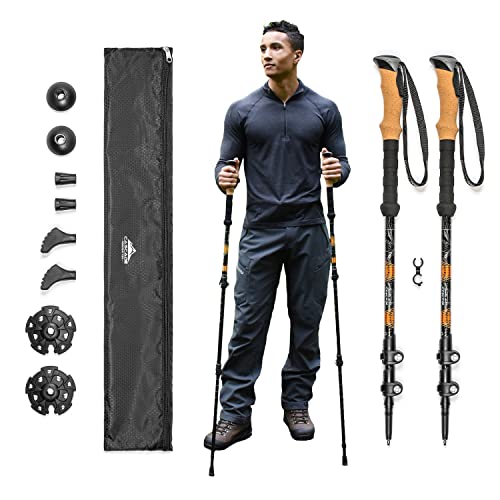
- Sturdy 6061 aluminum shafts resist bending under load across rocky trails and uneven terrain
- Ergonomic cork handles combined with EVA lower grips provide comfortable, versatile hand positions
- Lever-style quick locks allow fast, tool-free length adjustments between 26 and 54 inches
- Generous accessory bundle includes mud baskets, snow baskets, rubber boots, tip covers, and a carry bag
Cons
- Collapsed length of 26 inches may extend above the top collar of smaller 15L to 20L daypacks
- At 10 ounces per pole, aluminum construction is heavier than ultralight carbon fiber designs
- Quick-lock cam tensioners require occasional thumb-screw checks to maintain firm holding pressure over time
The Cascade Mountain Tech 6061 Aluminum Trekking Poles serve as a dependable, budget-conscious trail accessory designed for day hikers, weekend backpackers, and outdoor walkers seeking upper-body engagement and knee relief. Built to pair with standard hiking daypacks and larger backpacking packs, these two-section adjustable poles provide steady points of contact across varied outdoor surfaces.
On the trail, the quick-lock lever mechanism allows smooth height adjustments spanning from 26 inches up to 54 inches to accommodate various hiker heights and changing slope angles. Weighing approximately 10 ounces per pole, the shafts offer solid balance without excessive swing weight. When you reach a flat trail section or scramble where free hands are required, the poles collapse to a manageable 26-inch profile that fits neatly onto external backpack gear loops, side compression straps, or inside the included travel bag.
Material construction centers on aircraft-grade 6061 aluminum, which provides dependable bend resistance when navigating rocky terrain, boulder fields, or stream crossings. The ergonomic handles combine genuine cork tops with extended EVA down grips. The cork sections help dampen ground vibrations and wick moisture away during warm summer hikes, while the lower foam sections let hikers quickly lower their hand positions during steep switchbacks without pausing to readjust pole length.
Dialing in the poles for specific trails is straightforward thanks to the included accessory bundle. The core shafts feature tungsten carbide tips that bite into hard-packed dirt and slick rock surfaces. For paved greenways or sensitive rock paths, push-on rubber boots and tip covers provide traction and prevent surface scarring. When transitioning to wet spring trails or winter routes, the interchangeable mud and snow baskets screw on easily to prevent the poles from sinking deeply into soft ground.
While these poles provide dependable trail stability, prospective buyers should recognize a few practical design tradeoffs. The three-section telescoping design collapses to 26 inches, which is longer than folding Z-style poles and may extend beyond the top of compact 15-liter to 20-liter daypacks. At roughly 10 ounces per pole, aluminum construction also carries a modest weight penalty compared to premium carbon fiber poles. In addition, the quick-lock cam tensioners may require occasional finger-tightening of the thumbscrews to maintain positive locking force over miles of continuous vibration.
For beginner hikers, weekend backpackers, and budget-conscious outdoor enthusiasts looking for reliable trekking poles with comprehensive multi-season accessories, the Cascade Mountain Tech 6061 Aluminum Trekking Poles offer balanced durability and practical trail support.
When not in use, each pole collapses down to a compact 26 inches, allowing hikers to stow them easily along the exterior of most hiking backpacks. Hikers can thread the tungsten carbide tips through standard lower trekking-pole attachment loops and secure the upper shafts using side compression straps or elastic bungi cords.
For travel or vehicle storage, the set includes a lightweight zippered travel bag that prevents dirt, mud, and trail debris on the baskets and tips from contacting the interior fabric of your backpack or luggage. At 10 ounces per pole, carrying them on your pack adds minimal base weight during trail approaches.
The poles arrive with an extensive accessory package configured for year-round hiking versatility. Hard tungsten carbide tips serve as the baseline contact point for dirt singletrack, loose scree, and rugged mountain paths where maximum purchase is necessary.
For asphalt trails, slick boardwalks, or indoor transit, the included rubber boots and tip covers slip over the metal ends to dampen noise and enhance surface grip. The kit also includes wide rubber snow baskets and medium mud baskets, which prevent the poles from sinking into deep drifts, boggy soil, or loose river gravel.
Pros
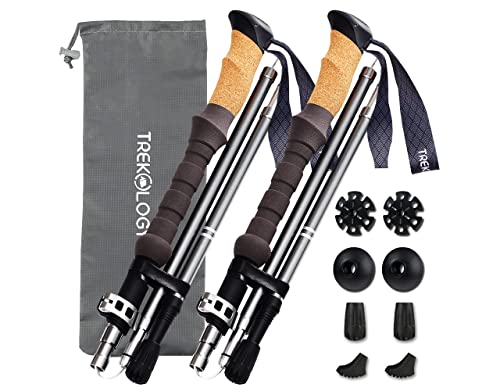
- Collapses down to a compact 15 inches, fitting easily inside backpacks or carry luggage bags
- Natural cork handles absorb hand perspiration effectively during strenuous hikes
- Sturdy aircraft-grade aluminum construction with protective metal caps at the folding joints
- Simple height adjustment between 110 cm and 130 cm via a sturdy metal flip lock lever
Cons
- TSA regulations require trekking poles to be packed in checked luggage rather than carry-on bags
- Users must verify the push-button lock is fully popped out to ensure shaft stability before hiking
- At 11.5 oz per pole, aluminum construction is heavier than ultralight carbon-fiber alternatives
The Trekology Trek-Z Cork Grip Collapsible Trekking Poles are three-section folding hiking sticks designed for day hikers, backpackers, and adventure travelers who require portable stability on uneven trails. Rather than using traditional telescoping designs that remain long when collapsed, these poles utilize a tri-fold folding cable system that stows down to a compact 15 inches. This makes them a strong match for hikers who prefer storing their poles directly inside a daypack or securing them flat against external pack compression straps without poles protruding past the top lid.
On trail, these poles offer an adjustable length range of 110 cm to 130 cm, covering a stated user height range between 5'2" and 6'5". Each pole weighs 11.5 oz (330 g), delivering a solid feel that helps distribute carried weight and stabilize joint impact on steep descents. The main handle is shaped from natural cork, which naturally absorbs hand moisture and sweat during warm trail outings. Trekology notes that the cork grips incorporate a slight rotational flex as an anti-torque ergonomic feature. Below the cork, secondary EVA foam grips allow hikers to quickly choke down on the poles when negotiating short, steep step-ups without adjusting overall pole length.
Build quality centers on aircraft-grade aluminum alloy shafts, chosen to withstand lateral loads and rocky terrain where brittle materials might crack. To reinforce high-stress connection points, Trekology adds metal caps around the folding joints, reducing play once the poles are deployed. Extension and length adjustments are secured using a durable metal flip lock at the upper section, ensuring reliable clamping power once clamped to the hiker's preferred height marker.
Deploying the poles requires extending the folding sections until the internal tension cable pulls tight and an internal metal lock button pops through the shaft hole. Ensuring this button is fully seated is essential for complete structural rigidity before latching the upper flip lock. For transport, collapsing the poles takes seconds, allowing both poles to slip neatly into the included storage bag. When traveling by commercial air to hiking destinations, keep in mind that TSA and airline policies classify trekking poles as checked luggage, meaning they must be stowed inside checked duffels or backpacks rather than overhead carry-on bags.
While the folding mechanism provides impressive packability, the design does present a few practical limitations. The total adjustment range is 20 cm (110 to 130 cm), which may not suit hikers under 5'2" who require a shorter pole setup. Additionally, at 11.5 oz per pole, weight-conscious thru-hikers aiming for sub-pound base weights might find aluminum folding poles heavier than fixed-length carbon options. The locking button also requires careful initial alignment during assembly to ensure the segments seat properly without wobbling.
For hikers, backpackers, and travelers seeking dependable trail support without spending top-tier outdoor brand prices, the Trekology Trek-Z Cork poles offer exceptional value. The combination of sweat-wicking cork handles, reinforced aluminum joints, and an ultra-packable 15-inch folded size makes them a versatile accessory for everything from local forest walks to rugged mountain backpacking trips.
The Trekology Trek-Z poles adjust between 110 cm and 130 cm in length, accommodating hikers measuring roughly 5'2" to 6'5" (159 to 195 cm) in height. Length adjustments are managed via a metal flip lock clamp on the top shaft section, allowing users to fine-tune height based on trail slope or individual arm ergonomics.
Hikers shorter than 5'2" may find the minimum 110 cm setting too tall for standard 90-degree elbow positioning on level terrain. Always confirm that your forearm rests parallel to the ground when holding the cork grip before clamping the metal flip lock.
Thanks to a three-piece folding design, the Trek-Z poles collapse down to just 15 inches (38 cm) in length. This compact size allows them to fit horizontally or vertically inside most standard daypacks, carry duffels, or luggage cases without hanging loosely off external attachment points.
The poles come with a dedicated carry bag to keep trail mud and dust away from clean gear inside your backpack. Hikers traveling by air should remember that TSA guidelines prohibit trekking poles in carry-on baggage, requiring these poles to travel inside checked luggage.
The pole shafts are manufactured from aircraft-grade aluminum alloy, delivering reliable strength-to-weight performance and high resistance to bending stresses on demanding rocky routes. The connection joints are strengthened with metal caps to guard against joint wear and slippage over time.
The handles feature genuine cork, which helps manage perspiration and adapts comfortably to hand pressure over long miles. A secondary EVA foam grip sits directly beneath the cork for quick hand repositioning on steep gradients without stopping to change shaft length.

Pros
- Lightweight 3K carbon fiber construction reduces carried and swinging weight to 7.6 ounces per pole
- Metal flip locks offer secure, slip-resistant tension compared to traditional twist-lock mechanisms
- Ergonomic cork handles paired with secondary EVA foam grips provide versatile hand positioning on varying trail grades
- Wide 24-inch to 55-inch adjustment span suits a diverse range of user heights and terrain angles
Cons
- Carbon fiber shafts can fracture if wedged between rocks and subjected to severe lateral bending forces
- Collapsed length of 24 inches may extend beyond the top or bottom of ultra-compact daypacks when mounted externally
- Metal flip lock levers require occasional thumb-screw tension checks to prevent slippage over extended mileage
The Hiker Hunger 100% Carbon Fiber Trekking Poles are adjustable three-section telescoping trail poles built for day hikers, section hikers, backpackers, and campers seeking to shed weight without giving up stability. Constructed from 3K carbon fiber, each pole weighs approximately 7.6 ounces, making them an excellent choice for hikers looking to reduce joint impact on rugged trails while keeping their base gear manageable.
In terms of trail adjustment, these poles expand from a compact 24 inches up to a full 55 inches, comfortably serving both shorter and taller hikers across diverse terrain grades. Rather than relying on twist locks that can slip or freeze when exposed to dirt and moisture, Hiker Hunger equips these poles with quick-adjust flip locks built with metal hardware. This provides firm, slip-resistant clamping whether you are lengthening the poles for a steep downhill descent or shortening them for an aggressive ridge climb.
Grip comfort is a primary design focus, featuring ergonomic natural cork handles that actively wick moisture away from your palms while molding to your hand shape over time. Directly beneath the cork handles, secondary nonslip EVA foam extensions provide an immediate choke-down point for short, steep switchbacks, eliminating the need to stop and adjust pole length. Soft neoprene-padded wrist straps further enhance comfort, distributing downward pressure across your wrists without causing chafing during long mileage days.
Transporting and maintaining these poles on the trail is straightforward. When not in use, the shafts collapse down to 24 inches, allowing them to nest securely into side water bottle pockets, slide behind backpack compression straps, or strap onto front trekking-pole attachment loops. Maintenance involves basic trail hygiene: simply wipe away grit and moisture after wet outings and periodically check the thumbscrew tension on the metal flip locks to preserve optimal clamping force.
While carbon fiber provides exceptional weight savings and natural vibration damping, it behaves differently than aluminum under severe lateral stress. If a carbon pole becomes trapped between roots or granite boulders and is subjected to heavy sideways leverage, it is susceptible to cracking or snapping rather than bending. Additionally, hikers using compact daypacks under 20 liters should note that the 24-inch collapsed height will protrude somewhat above the pack rim when lashed to external straps.
For day hikers, multi-day backpackers, and travelers seeking an agile pair of poles with natural cork ergonomics and durable metal locking mechanisms, the Hiker Hunger Carbon Fiber Trekking Poles represent strong trail value. Backed by a 1-year warranty and a USA-based company, they provide dependable knee-saving support and steady balance across varied backcountry trails.
The Hiker Hunger trekking poles feature a telescoping three-section shaft that adjusts smoothly between 24 inches and 55 inches. This expansive range accommodates men, women, and younger hikers across flat paths, steep alpine ascents, and knee-jarring descents.
Length adjustments are secured using external flip locks equipped with metal levers. Unlike plastic components that can warp or weaken over time, the metal locking mechanism maintains consistent clamping pressure against the carbon fiber sections to help prevent unexpected slippage while hiking under load.
Constructed entirely from 100% 3K carbon fiber, these poles offer high tensile strength and natural vibration absorption while weighing only 7.6 ounces per pole. This lightweight profile substantially lowers the energy required per arm swing over long trail days.
The upper handle combines natural moisture-wicking cork with dense EVA foam for the lower grip extension, providing comfortable handholds in both warm and cold weather. To maintain the structural integrity of carbon fiber, hikers should avoid using the poles as pry bars and keep the locking collars clean of trail debris.
With a collapsed length of 24 inches, these poles integrate easily with standard hiking daypacks and multi-day backpacking packs. They can be threaded through dedicated lower trekking-pole loops, secured via upper bungee cords, or held fast by side compression straps.
For travel or public transit to the trailhead, the 24-inch collapsed size allows the pair to fit inside standard checked luggage or across larger duffel bags, keeping your trail gear neatly consolidated between outings.

Pros
- Collapses down to a compact 15-inch profile that fits inside most hiking daypacks and travel bags.
- Aircraft-grade aluminum shafts and metal flip locks resist trail impacts better than fragile plastic clamps.
- Natural cork grips offer comfortable, sweat-resistant hand placement with lower EVA foam extensions for switchbacks.
- Listed at 9.95 ounces per pole, keeping carried base weight and trail fatigue low.
Cons
- The 100-120 cm adjustment range is strictly limited to hikers 5 feet 9 inches and under.
- Folding cord design requires manual joint alignment during deployment compared to standard twist or slide poles.
- Aluminum construction is slightly heavier than ultralight carbon fiber alternatives.
The Hiker Hunger Foldable Aluminum Trekking Poles are compact, packable hiking sticks designed for trail balance, stability, and joint relief during day hikes or backpacking excursions. With an adjustable range spanning 100 to 120 centimeters, this specific short variant is built specifically for hikers standing 5 feet 9 inches and under. For hikers who prefer to stow their poles inside or alongside a pack when scrambling rocky sections, boarding planes, or commuting to trailheads, the folding configuration provides a distinct packability advantage over standard full-length telescoping options.
On the trail, the main benefit of this system is the compact 15-inch collapsed length combined with a manageable listed weight of 9.95 ounces. The multi-section folding shafts slide smoothly into side water-bottle pockets, slip behind exterior pack compression straps, or stow entirely within internal gear compartments. This makes them especially useful for technical trail segments where hands-free movement is required, as well as for minimalist backpackers who value clean external pack lines without protruding gear.
Construction quality centers around aircraft-grade aluminum tubing connected by reinforced joints and secured with external metal flip locks. Metal locking levers provide reliable holding strength against vertical slippage on steep descents and resist impact damage better than brittle molded plastic alternatives. Hand comfort is supported by genuine cork main grips that shape to the palms and absorb sweat, while lower EVA foam grip extensions allow hikers to choke down during sudden steep switchbacks without pausing to unlock and shorten the poles.
Deploying and adjusting the poles is straightforward once familiar with folding-shaft mechanics. The lower segments lock into place via an internal tension cable, while the uppermost section provides 20 centimeters of fine height adjustment secured by the metal cam lever. Basic maintenance involves wiping away trail mud, letting the shafts and inner cable dry thoroughly before long-term storage, and checking the flip-lock tension screw occasionally to maintain firm clamping force.
Realistic limitations must be noted before purchase. Because this model reaches a maximum length of 120 centimeters, hikers taller than 5 feet 9 inches will lack sufficient extension for a proper 90-degree arm angle, particularly on steep downhill sections. Furthermore, while aluminum bends rather than snaps abruptly under extreme lateral loads, it carries a small weight penalty over premium carbon fiber alternatives. The folding joints also require routine visual checks to ensure trail grit does not interfere with proper joint seating.
For day hikers, section hikers, and adventure travelers who fit within the recommended height parameters, these Hiker Hunger poles represent a well-constructed, travel-friendly trail tool. Their 15-inch packed profile, durable metal hardware, and ergonomic cork handles make them a dependable asset for any hiker seeking reliable stability without taking up unnecessary pack volume.
This model features an adjustable usable length between 100 and 120 centimeters, designed to fit hikers who are 5 feet 9 inches tall and shorter. Proper ergonomic trekking pole fit requires that your elbow forms approximately a 90-degree bend when holding the grip with the pole tip resting on level ground.
Hikers near the upper limit of 5 feet 9 inches who frequently tackle steep mountain descents may find themselves near the pole maximum extension. Hikers taller than 5 feet 9 inches should look toward the longer 115 to 135 centimeter variant to ensure adequate downhill reach and optimal joint support.
Collapsing down to just 15 inches, these folding poles pack considerably smaller than standard two-section or three-section telescoping poles that typically collapse to 24 inches or more. This compact profile allows them to slide entirely inside daypacks, luggage, or trunk storage compartments without sticking out.
When stowing poles on your backpack exterior, the 15-inch length minimizes snagging hazards when hiking through dense brush or off-trail terrain. To maintain the internal tension cord and prevent corrosion, ensure all sections are completely dry before packing them away for extended off-season storage.
Evaluating Nordic Walking Poles Versus Trekking Poles for Mountain Trails
The short answer to whether you can take Nordic walking sticks into the backcountry is yes, but only under strictly limited trail conditions. If your route consists of smooth canal paths, flat dirt service roads, or gentle park loops, fitness walking equipment can provide a pleasant rhythm and mild balance assistance. The moment a footpath turns steep, rocky, or off-camber, however, the mechanical differences between fitness sticks and mountain trekking poles become impossible to ignore.
Trekking equipment is engineered around safety, structural stability, and joint preservation under heavy loads. Nordic walking equipment is built around fitness cadence, upper-body calorie burn, and forward propulsion across hard, level surfaces. Using the wrong pole on technical terrain can compromise your footing and even increase your risk of injury during a stumble. Examining the mechanics of each component clarifies why dedicated trail equipment remains essential for backcountry safety.
Fundamental Biomechanics: Forward Propulsion Versus Axial Braking Support
The primary distinction between these two styles of poles lies in how they interact with human biomechanics and body weight. Nordic walking originated as an off-season dryland training method for cross-country skiers, designed to turn a standard walk into a full-body cardiovascular workout. In this discipline, you plant the poles behind your center of gravity at roughly a 45-degree angle. You push backward through the strap to propel your torso forward, maintaining a rapid, athletic stride across relatively flat terrain.
Backcountry trekking requires the exact opposite kinetic movement. On steep mountain trails, hikers plant their poles forward or vertically to create solid braking support before stepping downward. This forward placement helps absorb the severe deceleration forces that punish the patellofemoral joints, quadriceps, and hips on rocky descents. Instead of pushing you faster down the trail, a trekking pole acts as an active shock absorber and a third point of contact to prevent uncontrolled acceleration.
Attempting to use backward-angled Nordic propulsion on an irregular, boulder-strewn descent disrupts your natural balance and places your poles in positions where they cannot catch you if your foot slips. When you step down off a tall granite ledge, you need immediate vertical resistance directly beneath your shoulders. Dedicated hiking poles are tuned to receive direct downward compressive loads, whereas Nordic poles are shaped to glide through a fluid, swinging backward push.
Grip Architecture and Strap Safety Mechanics
The hand interface reveals another critical divide between fitness equipment and rugged mountain gear. Nordic walking poles almost always feature specialized glove-like mesh harnesses, often called trigger gauntlets, that wrap tightly around the palm and thumb. These gauntlets clip directly into the grip mechanism, allowing the walker to open their fingers completely at the back of each stride and push purely through the strap without dropping the pole. This continuous release-and-catch cycle is ideal for aerobic cadence on paved pathways.
On technical singletrack, however, having your hands tethered inside rigid glove gauntlets introduces a severe safety hazard. If you trip over an exposed root or lose your footing on loose scree, your instinct is to throw your hands out to break your fall. A glove strap traps your hand against the pole shaft, preventing you from releasing the grip and greatly increasing the danger of sprained thumbs, wrist fractures, or blunt impact injuries. Mountain safety requires that you can slip free from your poles instantly during a sudden fall.
Dedicated hiking models, such as the TrailBuddy Trekking Poles and Cascade Mountain Tech Trekking Poles, utilize open, adjustable webbing loops rather than enclosed gauntlets. When hikers enter the strap from underneath and rest the base of the palm over the webbing, body weight transfers cleanly into the shaft while the hand maintains a relaxed grip. If a fall occurs, the hand can pull straight up and out of the strap without getting trapped against the handle.
Handle shaping and secondary grip zones also differ significantly between these pole styles. Hiking poles frequently incorporate contoured natural cork or dense EVA foam, paired with lower choke-up sleeves beneath the main grip. Models like the Cascade Mountain Tech Trekking Poles feature an extended EVA down grip, allowing you to choke down on the shaft when traversing steep sidehills or ascending short, punchy switchbacks without stopping to alter the locking mechanism. Nordic grips are typically slim, upright, and lack lower grip extensions entirely.
Shaft Metallurgy, Wall Thickness, and Structural Load Limits
The structural demands placed on hiking poles far exceed the modest forces encountered during neighborhood fitness walks. When a hiker carries a loaded pack, such as an iron frame hiking backpack, any sudden misstep can transfer a substantial portion of combined body and pack weight directly down a single pole shaft. Trekking poles must possess exceptional axial load-bearing capacity to prevent sudden structural buckling during an emergency catch.
Shaft materials in trail poles are chosen specifically to handle rugged backcountry abuse. Options like the TrailBuddy Trekking Poles utilize aircraft-grade 7075 aluminum, an alloy recognized for its high tensile strength and resilience against permanent bending. Other models, including the Cascade Mountain Tech Trekking Poles, rely on 6061 aluminum, which provides dependable durability across rough environments. Aluminum exhibits ductility, meaning that under severe stress it tends to bend gradually rather than snapping instantly, giving hikers a chance to recover their balance.
For backpackers prioritizing minimal swing weight, carbon fiber designs offer impressive strength-to-weight ratios alongside natural vibration dampening. The 100% Carbon Fiber Trekking Poles by USA Brand from Hiker Hunger Outfitters utilize multi-layered 3k carbon fiber shafts that weigh only 7.6 ounces per pole. This lightweight build drastically cuts down on arm and shoulder fatigue over high-mileage trail days. However, carbon shafts require caution in talus fields, as sharp rock impacts can cause localized fractures under lateral shear forces.
Pure Nordic walking sticks, by contrast, are often optimized solely for ultra-low swing weight and longitudinal springiness across level terrain. Many fitness models feature thin shaft walls or high-flex composite tubing designed to cushion light arm strikes on tarmac. If you accidentally wedge a lightweight fitness pole between two granite boulders on a mountain trail and lever your body weight against it, the shaft is prone to bending or splintering under lateral shear stress it was never engineered to withstand.
Locking Mechanisms and Terrain-Specific Height Calibration
Elevation changes in the mountains require frequent adjustments to your pole length to maintain sound ergonomic posture. The standard rule of thumb on flat ground is setting the pole height so your elbow forms a clean 90-degree angle when holding the grip. When tackling an extended, steep climb, shortening each pole by 5 to 10 centimeters keeps your hands below chest level and prevents shoulder strain. Conversely, lengthening your poles by 5 to 10 centimeters for steep descents lets you reach down the slope without bending forward at the waist.
Many traditional Nordic walking poles are built as single-piece fixed shafts or simple two-section poles. While fixed poles offer exceptional stiffness and eliminate joint rattle on level pavement, they cannot adapt to mountain topography. Forcing a fixed-length pole to navigate a steep 20 percent descent forces you to lean forward dangerously, throwing your center of mass over the front of your boots and compromising your stability on loose gravel.
Adjustable mountain poles rely on robust locking systems to handle constant vertical impact. Models like the Premium Foldable Hiking Poles by USA Brand and the TrailBuddy Trekking Poles use external metal flip locks that clamp securely around the shaft sections. These external cam levers feature adjustable thumb screws, allowing hikers to fine-tune clamping tension in the field if cold mountain air causes metal hardware to contract. External levers provide a clear visual indicator that the clamp is fully engaged before you lean your weight onto the pole.
Packability is another major consideration when transitioning between varied trail conditions. Folding Z-poles, such as the Trekology Trek-Z Hiking Trekking Poles and Trekology Trek-Z Cork Grip Collapsible Lightweight poles, utilize an internal tension cord and reinforced joint connections to collapse down to a portable 15 inches. This compact folded profile lets hikers stow their poles inside or against a daypack during steep rock scrambles where two free hands are required. Long, two-piece fitness poles cannot collapse down small enough to fit inside standard daypacks or checked travel luggage.
Ground Contact Systems: Angled Rubber Paws Versus Carbide Flex Tips
The bottom tip of your pole determines whether you find reliable traction or skitter dangerously across slick terrain. Nordic walking poles are universally recognized by their angled rubber feet, often called asphalt booties or fitness paws. These rubber pads are shaped like miniature boots with tread angled backward, designed specifically to grip hard pavement and packed limestone paths as you push off behind your body. On dry asphalt, these rubber booties grip reliably and dampen harsh vibration through the arms.
Bringing angled rubber booties onto technical backcountry singletrack is an invitation to slip. When you attempt to plant a rounded rubber boot onto a wet river stone, muddy root, or mossy granite slab, the rubber cannot bite into the surface. Instead, the rubber skids across the rock face, causing the pole to kick out from under you just when you need it to bear weight. Rubber tips can also pop off easily when dragged through thick mud or wedged between roots, leaving you with unprotected plastic stems.
Backcountry poles rely on durable tungsten carbide flex tips to establish aggressive mechanical purchase. A sharp carbide tip penetrates decomposing granite, bites into slick timber, and catches micro-edges on smooth bedrock, providing rock-solid hold regardless of the angle of contact. Cascade Mountain Tech Trekking Poles and Hiker Hunger models come equipped with durable carbide tips designed for year-round wilderness conditions, accompanied by removable rubber tip covers for road transitions.
Basket design represents another fundamental difference that impacts ground penetration. Mountain poles feature modular basket fittings near the tip, allowing you to swap between low-profile mud baskets and broad snow baskets. A mud basket prevents your pole from plunging deep into boggy loam, soft peat, or scree fissures, preserving your momentum and protecting the lower shaft from bending. Nordic poles either lack baskets entirely or use tiny plastic discs that instantly submerge into soft backcountry terrain.
Trail Safety Scenarios: When Fitness Equipment Creates Backcountry Hazards
Evaluating gear safety becomes crucial when trail conditions shift from predictable paths to challenging terrain. River crossings, for instance, demand maximum stability where rushing water exerts lateral pressure against both your legs and your equipment. Planting a broad-basketted mountain pole with a biting carbide tip provides a firm anchor on slimy riverbed cobbles, establishing a secure tripod stance with each step. A Nordic pole with an angled rubber foot lacks purchase in swift currents, creating an unstable foundation that can wash away under pressure.
Scrambling across Class 2 and Class 3 terrain highlights the danger of non-releasable hand straps. When moving across steep scree slopes in lightweight hiking pants, you must be able to ditch your poles or collapse them onto pack loops the second you need your hands for balance or handholds. If you lose your footing while tethered inside a Nordic gauntlet, the trapped pole can catch between rocks, yanking your wrist violently backward and preventing you from using your hands to protect your head and torso.
Internal twist locks found on many entry-level walking sticks present another common point of trail failure. When hiking in wet weather or dusty conditions, fine trail silt and moisture work their way inside telescoping seams, coating the internal nylon expansion plugs. Once coated in grit, twist locks can slip unexpectedly when loaded with full downward body weight on a descent, leading to sudden pole collapse. External lever locks, like those on Hiker Hunger and Trekology models, keep clamping hardware outside the shaft where grit cannot compromise friction.
Shelter pitching compatibility is an additional advantage unique to rugged trekking poles. Many ultralight backpackers rely on their hiking poles as the primary vertical structural supports for non-freestanding tarps and tents. Trekking poles with flat grip caps and dependable flip locks hold rigid under high wind gusts and tensioned guyline loads. Nordic walking poles, with their rounded angled grips and lightweight gauntlet clips, cannot support the apex of an ultralight shelter securely.
Actionable Advice: How to Choose the Right Gear for Your Route
If you already own a pair of Nordic walking poles and wish to walk on natural surfaces, assess your terrain carefully before leaving home. Flat crushed-limestone rail trails, dry urban dirt loops, and manicured park paths are perfectly suitable for fitness poles. When walking on dry dirt, remove the angled rubber booties to expose the small metal point underneath, and loosen your gauntlet straps slightly so you can slide your hands free quickly if you lose your footing.
For any adventure that involves steep elevation changes, loose scree, wet river crossings, or rugged rock gardens, invest in dedicated trekking poles designed for mountain conditions. Models built from 7075 aluminum or 3k carbon fiber offer the necessary downward load-bearing capacity, grip versatility, and tip security needed to safeguard your joints and maintain balance across unpredictable terrain. Features like natural cork handles, extended EVA choke sleeves, and external metal flip locks ensure dependable comfort and reliability across long backcountry miles.
Before heading out, inspect your pole hardware by checking thumb-screw clamp tension, verifying that sections do not slide under full downward body weight, and confirming that mud baskets are screwed tight onto their threads. Pack your poles inside checked luggage when traveling by air, as security regulations prohibit sharp carbide hiking tips in carry-on bags. Matching your pole design to the reality of the trail ensures you protect your knees, maintain dependable footing, and enjoy every mile in the backcountry.


Write Your Review
No reviews yet. Be the first to share your experience!