


Navigating steep descents and uneven forest paths puts significant repetitive impact on knees, ankles, and the lower back. Stepping down onto rocky terrain requires deliberate balance, and carrying a properly sized staff distributes that downward force into the upper body while preventing sudden stumbles. Determining what size walking stick for height makes the difference between fluid, upright posture and awkward shoulder strain that leaves you fatigued after only a couple of miles. Hikers who pair proper stick mechanics with hiking apparel for knee comfort often notice substantially less joint soreness when negotiating rough elevation changes.
A stick that stands too tall forces the arm upward, cramping the trapezius and wrist over long outings. Conversely, an undersized shaft causes the torso to pitch forward, throwing off your natural center of gravity and worsening lumbar tension on steep trails. Finding the ideal fit depends on whether you prefer a standard balance stick measured to your elbow or an extended hiking staff that offers versatile hand placement. The goal is dependable stability that feels completely natural under load without resembling a clinical medical cane.
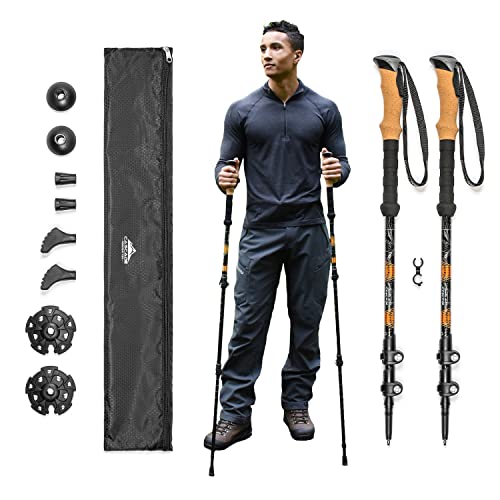
Pros
- Sturdy 6061 aluminum shafts resist bending under load across rocky trails and uneven terrain
- Ergonomic cork handles combined with EVA lower grips provide comfortable, versatile hand positions
- Lever-style quick locks allow fast, tool-free length adjustments between 26 and 54 inches
- Generous accessory bundle includes mud baskets, snow baskets, rubber boots, tip covers, and a carry bag
Cons
- Collapsed length of 26 inches may extend above the top collar of smaller 15L to 20L daypacks
- At 10 ounces per pole, aluminum construction is heavier than ultralight carbon fiber designs
- Quick-lock cam tensioners require occasional thumb-screw checks to maintain firm holding pressure over time
The Cascade Mountain Tech 6061 Aluminum Trekking Poles serve as a dependable, budget-conscious trail accessory designed for day hikers, weekend backpackers, and outdoor walkers seeking upper-body engagement and knee relief. Built to pair with standard hiking daypacks and larger backpacking packs, these two-section adjustable poles provide steady points of contact across varied outdoor surfaces.
On the trail, the quick-lock lever mechanism allows smooth height adjustments spanning from 26 inches up to 54 inches to accommodate various hiker heights and changing slope angles. Weighing approximately 10 ounces per pole, the shafts offer solid balance without excessive swing weight. When you reach a flat trail section or scramble where free hands are required, the poles collapse to a manageable 26-inch profile that fits neatly onto external backpack gear loops, side compression straps, or inside the included travel bag.
Material construction centers on aircraft-grade 6061 aluminum, which provides dependable bend resistance when navigating rocky terrain, boulder fields, or stream crossings. The ergonomic handles combine genuine cork tops with extended EVA down grips. The cork sections help dampen ground vibrations and wick moisture away during warm summer hikes, while the lower foam sections let hikers quickly lower their hand positions during steep switchbacks without pausing to readjust pole length.
Dialing in the poles for specific trails is straightforward thanks to the included accessory bundle. The core shafts feature tungsten carbide tips that bite into hard-packed dirt and slick rock surfaces. For paved greenways or sensitive rock paths, push-on rubber boots and tip covers provide traction and prevent surface scarring. When transitioning to wet spring trails or winter routes, the interchangeable mud and snow baskets screw on easily to prevent the poles from sinking deeply into soft ground.
While these poles provide dependable trail stability, prospective buyers should recognize a few practical design tradeoffs. The three-section telescoping design collapses to 26 inches, which is longer than folding Z-style poles and may extend beyond the top of compact 15-liter to 20-liter daypacks. At roughly 10 ounces per pole, aluminum construction also carries a modest weight penalty compared to premium carbon fiber poles. In addition, the quick-lock cam tensioners may require occasional finger-tightening of the thumbscrews to maintain positive locking force over miles of continuous vibration.
For beginner hikers, weekend backpackers, and budget-conscious outdoor enthusiasts looking for reliable trekking poles with comprehensive multi-season accessories, the Cascade Mountain Tech 6061 Aluminum Trekking Poles offer balanced durability and practical trail support.
When not in use, each pole collapses down to a compact 26 inches, allowing hikers to stow them easily along the exterior of most hiking backpacks. Hikers can thread the tungsten carbide tips through standard lower trekking-pole attachment loops and secure the upper shafts using side compression straps or elastic bungi cords.
For travel or vehicle storage, the set includes a lightweight zippered travel bag that prevents dirt, mud, and trail debris on the baskets and tips from contacting the interior fabric of your backpack or luggage. At 10 ounces per pole, carrying them on your pack adds minimal base weight during trail approaches.
The poles arrive with an extensive accessory package configured for year-round hiking versatility. Hard tungsten carbide tips serve as the baseline contact point for dirt singletrack, loose scree, and rugged mountain paths where maximum purchase is necessary.
For asphalt trails, slick boardwalks, or indoor transit, the included rubber boots and tip covers slip over the metal ends to dampen noise and enhance surface grip. The kit also includes wide rubber snow baskets and medium mud baskets, which prevent the poles from sinking into deep drifts, boggy soil, or loose river gravel.
The Complete Guide to Walking Stick Sizing, Posture, and Trail Mechanics
Sizing a walking stick requires matching shaft length to your body geometry and the terrain you intend to explore. When your stick fits correctly, your arm forms a relaxed right angle, keeping your shoulders level and your spinal alignment neutral. Choosing the wrong length forces awkward body mechanics, creating muscle tightness in the neck or overloading the knees during steep descents. Understanding the key measurement rules ensures you get dependable trail support across any environment.
The Fundamental 90-Degree Elbow Rule for Level Ground
The standard baseline for any walking stick used on sidewalks, level nature paths, or packed gravel is the 90-degree elbow rule. Stand upright with your shoulders relaxed, letting your upper arm hang naturally alongside your torso. Bend your elbow until your forearm rests completely parallel to the ground, creating a clean right angle at the elbow joint. The vertical measurement from your palm down to the floor represents your ideal walking stick height for flat-ground balance assistance. This specific position allows your biceps and triceps to absorb subtle shocks without hiking your shoulder toward your ear.
When a stick exceeds this natural 90-degree alignment, your elbow remains bent too sharply, forcing the upper trapezius muscles to stay constantly engaged. Over a walk of several miles, this chronic elevation leads to tension headaches, shoulder fatigue, and aching wrists. Conversely, if the shaft falls below this baseline, you must lean forward and stoop to plant the tip firmly on the ground. Stooping rounds the spine, reduces lung capacity during brisk walking, and places unnecessary mechanical strain on the lower back. Maintaining forearm parallelism ensures comfortable posture and efficient energy transfer.
Hiking Staff Sizing: Why Trail Staffs Reach the Chest or Shoulder
Traditional hiking staffs follow a completely different sizing standard than neighborhood balance canes. Outdoor trekking staffs typically measure between 50 and 55 inches, reaching somewhere between mid-chest and the collarbone of an average adult. This added length allows hikers to shift their hand position fluidly up and down the timber shaft as trail gradients change. Rather than maintaining a rigid 90-degree bend, a tall staff gives you dynamic leverage across undulating mountain terrain. The extra height proves invaluable when stepping across deep ruts or descending steep drop-offs.
A chest-high hiking staff acts as an anchor point across rocky creek crossings and steep terrain where you must probe ahead before committing weight. Placing a tall staff ahead of your leading foot establishes an effective third leg that prevents slips on loose shale and wet mud. The extended upper shaft also provides leverage when stepping upward onto high rock ledges or pushing back overhanging brush. For woodland trails with constant elevation changes, this classic staff profile offers versatile utility compared to shorter, single-height walking canes.
Step-by-Step Measurement Technique with Trail Footwear
Accurate measurement starts from the ground up, which means putting on your actual hiking boots or walking shoes before taking dimensions. Trail boots frequently add between one and two inches of stack height due to thick lugs, cushioned midsoles, and rock plates. Measuring while barefoot or in flat house slippers results in a stick that arrives noticeably short once you lace up your trail footwear. Stand comfortably on a hard, flat floor with your standard walking posture and feet shoulder-width apart.
If you are sizing for a standard balance walking stick, hold a tape measure or a long dowel in your dominant hand. Let your arm hang naturally at your side, bend your elbow to create a 90-degree angle, and have a partner measure from the crease of your wrist to the floor. The distance from the wrist crease to the ground represents the exact height of the handle surface. If measuring alone, rest a broom handle vertically, mark the spot where your hand rests with a horizontal forearm, and measure that length with a tape measure.
Sizing for a traditional tall hiking staff requires measuring straight from the ground to the center of your sternum or the hollow of your neck. For most adults between 5 feet 4 inches and 5 feet 8 inches, a 50-inch staff provides excellent balance, while hikers over 5 feet 10 inches generally prefer a 54-inch or 55-inch shaft. If you purchase a handcrafted wooden stick that arrives slightly tall, you can trim the excess length from the bottom ferrule end using a fine-tooth handsaw. Always measure twice and cut gradually, leaving room for the slip-on rubber ferrule to seat fully over the tenon.
Adapting Stick Height for Ascents and Downhill Descents
Terrain angles completely alter the effective distance between your hand and the ground. When climbing a steep mountain incline, the slope rises toward your body, effectively shortening the trail surface in front of you. Attempting to grip the top of a full-length walking stick on an ascent pushes your elbow past your shoulder, reducing your leverage and burning unnecessary energy. On climbs, you should either shorten an adjustable pole or choke down your grip several inches below the handle on a solid wooden staff. This adjustment maintains your arm at an efficient working angle without forcing your chest backward.
Downhill descents present the opposite mechanical challenge and place enormous decelerating forces on the quadriceps and patellar tendons. When descending steep switchbacks, the ground falls away below your feet, requiring a longer stick reach to plant the tip securely. Hikers who also focus on managing trail impact through carrying an iron frame hiking backpack appreciate how a long pole transfers braking force through the triceps and core rather than jarring the knees. Palming the rounded top knob of a walking stick allows you to brace downward with your body weight centered securely over your heels.
Shifting your hand placement rather than altering your posture keeps your center of mass inside your base of support. Leaning outward or overreaching down a slope increases the chance of slipping on loose gravel or slick pine needles. Keep the stick planted slightly ahead and outward from your downhill foot, allowing the shaft to act as a dependable braking strut. This controlled technique minimizes joint shock, stabilizes momentum, and preserves muscular endurance across long mountain descents.
Adjustable Shafts versus Fixed-Length Wooden Staffs
Choosing between an adjustable trekking stick and a solid wooden staff involves balancing mechanical adaptability against heirloom aesthetic appeal. Modern aluminum walking sticks, such as the Cascade Mountain Tech Trekking Poles, feature telescoping shafts made of aircraft-grade 6061 aluminum that adjust smoothly between 26 inches and 54 inches. This broad adjustment range lets hikers fine-tune shaft height instantly when transitioning from flat meadow walks to steep switchbacks. Fast-acting Quick Lock mechanisms allow you to loosen, slide, and clamp the telescoping sections without needing hand tools on the trail.
In contrast, handcrafted wooden sticks carved from hardwoods like hickory, white oak, sweet chestnut, or hazel provide rigid structural stability and organic beauty. Solid timber dampens trail vibrations naturally through the cellular grain of the wood without the mechanical chatter that can sometimes travel up metal tubes. However, a wooden staff remains a single fixed length, requiring the hiker to rely on multi-hand positioning along the shaft rather than mechanical resizing. For travelers considering packing collapsible walking sticks in carry-on luggage, multi-section aluminum poles collapse into a compact package that easily stows in daypacks or airline baggage.
When using adjustable poles, always inspect the tension of the cam-lock mechanisms before bearing weight. If the locking collar is loose, the pole can suddenly collapse under heavy downward pressure during a descent, leading to a loss of balance. Tighten the adjustment screw with your fingers until closing the lever requires firm thumb resistance. Testing the stick by placing your body weight downward against the grip on a level surface ensures the telescoping joints hold firmly before you encounter steep terrain.
Handle Ergonomics, Palm Pressure, and Grip Materials
The handle design dictates how comfortably downward force transfers into your palm and wrist throughout a long trek. Traditional wooden staffs often feature simple rounded knob tops, tourist crooks, or contoured derby grips that support the palm across a broad, flattened surface. A wide derby handle spreads downward pressure evenly, reducing localized nerve compression that causes tingling or numbness in the fingers. For hikers managing mild joint stiffness, a palm-contoured grip provides a stable resting platform that requires minimal hand squeezing.
Material choice plays an equally critical role in preventing blisters, sweat buildup, and grip fatigue over extended outings. Natural cork grips conform to the unique shape of your hand over time and absorb trail moisture, keeping your grip secure during humid summer hikes. The Cascade Mountain Tech Trekking Poles pair an ergonomic cork main handle with an extended EVA foam down-grip positioned directly below the top grip. This extended foam sleeve allows you to slide your hand lower on steep uphill sections without stopping to adjust pole length.
Proper wrist strap usage also improves endurance by transferring downward load directly into your wrist bones rather than forcing your fingers into a continuous grip. Slip your hand upward through the bottom opening of the strap loop and rest your palm downward over the handle, sandwiching the webbing against the grip. This configuration lets you push downward against the tension of the strap with an open, relaxed hand on level terrain. During steep descents, however, remove your hands from the straps so you can drop the stick instantly if you stumble.
Tip Selection and Ferrule Traction Across Changing Surfaces
The tip of the walking stick dictates ground traction, safety, and durability across wildly varying surfaces. Bare metal or tungsten carbide spikes provide aggressive bite on packed dirt, soft forest mulch, gravel, and trail ice. The sharp point penetrates soft soil to prevent the base of the staff from skittering out from under your stride. However, placing a bare carbide spike on polished granite slabs, wet cobblestones, or paved asphalt can cause the metal to skate unpredictably, creating an immediate slip hazard.
Fitting a dense rubber ferrule or rubber walking boot over the metal spike solves traction problems on hard, unyielding surfaces. High-traction vulcanized rubber cushions each ground strike, quieting mechanical clicking and providing dependable friction on smooth rock and concrete paths. Quality replacement ferrules include an embedded internal steel washer at the base of the rubber socket. This metal reinforcement prevents the sharp metal spike or narrow wooden tenon from puncturing straight through the rubber pad under heavy downward force.
For variable seasonal conditions, trail accessories like mud baskets and snow baskets expand the utility of the stick. Small circular mud baskets screw onto the lower shaft above the tip, preventing the pole from sinking deeply into boggy meadows or loose sand. In winter conditions, wider snow baskets provide surface floatation across powder and crusted snowdrifts. Regularly inspect your rubber tips for tread wear, replacing them promptly once the rubber thins or the internal metal washer becomes visible.
Safety Boundaries: Recreational Balance Support versus Clinical Aids
Understanding the distinction between recreational walking sticks and certified clinical mobility devices is essential for safe trail use. Standard hiking staffs and trekking poles are designed specifically as balance-assist tools that stabilize your gait, probe trail depth, and offload joint strain on steep slopes. They are not manufactured, tested, or rated as medical crutches or full weight-bearing orthopedic mobility aids. Recreational hikers must not rely on single trail sticks for non-weight-bearing injury rehabilitation or severe balance disorders without medical guidance.
Solid hardwood staffs and aircraft-grade aluminum poles offer impressive strength when downward pressure is applied straight along the vertical axis of the shaft. However, applying severe lateral torque, such as wedging the stick between two boulders and levering your full body weight sideways, can snap wood or bend aluminum. Before every outing, inspect your wooden sticks for deep longitudinal checking, hairline grain cracks, or moisture rot near the ferrule. For aluminum poles, check for dents or bent shaft sections that could cause the tube to buckle under sudden load.
Maintaining your gear ensures reliable performance season after season. Treat unfinished or oil-finished hardwood staffs with a light coat of boiled linseed oil or pure tung oil once or twice a year to preserve grain flexibility and repel water. Store all walking sticks clean and dry in a temperature-stable room away from damp basements or direct sunlight. Taking a few moments to verify your stick height, lock tension, and ferrule integrity guarantees confident footing and upright comfort wherever your trail leads.





Write Your Review
No reviews yet. Be the first to share your experience!